



Michael Skidmore explores how folk stories can help sailors navigate the Hebrides.
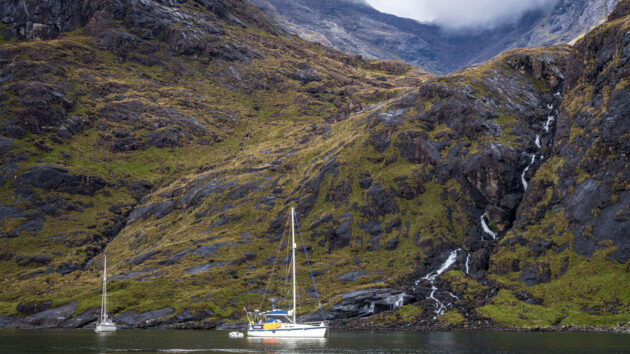
Spotting bloodstains in a hotel would usually make me run for the door.
But at Raasay House, I was trying to find them –as my partner and I had set out on our Westerly Storm last summer in search of Hebridean witches.
Skye used to be full of them.
Tales of storms, spells and sieves were used to warn of something in the water or rival clans tarnishing the reputation of their enemies.
We wanted to learn what historic Gaelic communities believed and how it might help sailors to interact with the sea.
Witches were usually old women on the fringe of the village, but they were often young wives, or even children.
They could transform into animals, sometimes going to sea in strange objects (like eggshells, or sieves).
They could poison or cure farm animals, and guide fish into new fishing grounds.
They were adept at controlling the wind, and could punish or reward sailors by fighting to sink or save a ship.
The historic hotel is on the island of Raasay, east of Skye.
The bloodstains belonged to a young witch, a MacLeod that lived there.
After she summoned a gale to sink a ship in the sound, her brother let her blood until she died.
Hotel staff told me the stains are off-limits to the public, but they will not wash out.
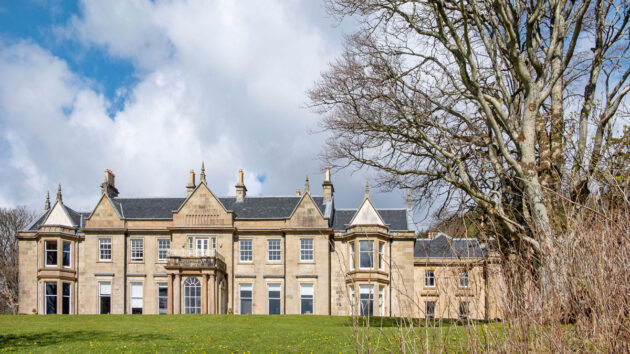
Raasay House, now a renovated historic clan mansion turned into luxurious hotel with modern facilities and numerous outdoor activities. Credit: Ana Iacob/Alamy
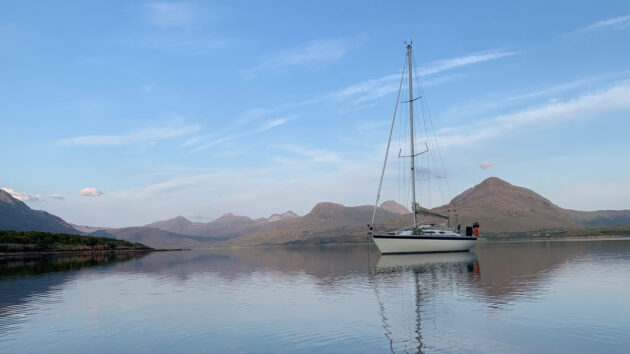
The Highlands are always beautiful, even more so on a peaceful evening. Credit: Michael Skidmore
We had begun this leg of our journey from the Small Isles to the south.
We drifted up the Sound of Sleat under jib.
The soft green of this corner of Skye is a stark contrast to the rockier Loch Hourn and Loch Nevis opposite.
Kyle Rhea, with its fearsome tides, was windless as we shot through under engine, touching 9 knots.
After a restock at Kyle of Lochalsh, we took the last of the breeze to Broadford, anchoring easily in the wide bay.
The weather soon changed.
A gale was approaching, and Broadford Bay was soon riddled with white caps as the wind built.
This part of the island is famed for the downdraughts that rush down the mountain slopes.
The Red Cuillin climb from the shore and the wind accelerates through the high cols and valleys.
Searching for shelter we squeezed through the narrow tidal channel between Scalpay and Skye.
We headed into Loch Ainort hoping to make the head, but a huge squall hit the port bow. The wind blew 35 knots, gusting to 40, and I was blinded by driving rain.
With no other option I threw the helm over and furled the remaining jib, scudding under bare poles.
We retreated to Caolas Scalpay and pulled close to the southern shore to drop our anchor with 60m of chain.
The tempest was short lived.
After only two uncomfortable nights the skies lightened and we could finally head north.
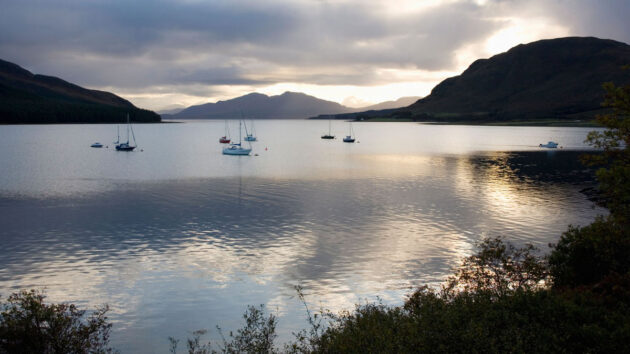
Michael and his partner retreated to Caolas Scalpay in their Westerly Storm in rough conditions and had two uncomfortable nights at anchor. Credit: Ruth Tomlinson/robertharding/Alamy
Something to blame
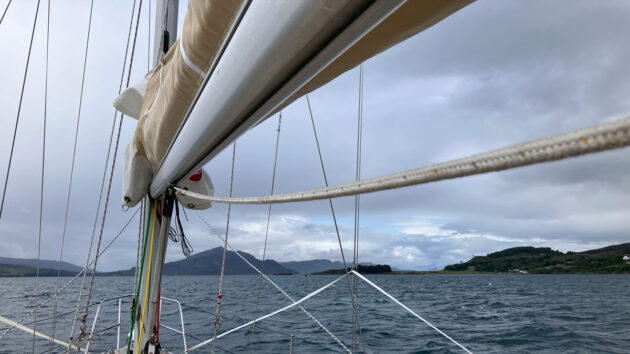
Motoring through the Narrows of Raasay with Raasay House to starboard. Credit: Michael Skidmore
The last gasps of the gale gave us a thrilling reach up the Sound of Raasay.
The pointed hat of Dùn Caan rose ahead and we considered the MacLeod witch who had stood there, conjuring a different storm.
To visit her Raasay House, the new pontoons in Churchton Bay are very smart, but often exposed to huge gusts from the west.
It is often better to anchor directly opposite in Camas a’ Mhòr-bheòil.
The belief that witches could control the weather was only a part of their powers.
It mirrors a modern sailor’s understanding of natural forces.
A foul wind might keep us in a harbour for days or weeks, or a squall might appear from nowhere.
Fish might be scarce where they are usually found, or nets might keep getting torn.
Witches or superstition provided something to blame.
After Raasay we swept up past Portree to the popular Acairseid Mhòr on Rona.
There are a handful of moorings inside the tricky entrance, but still plenty of room to anchor.
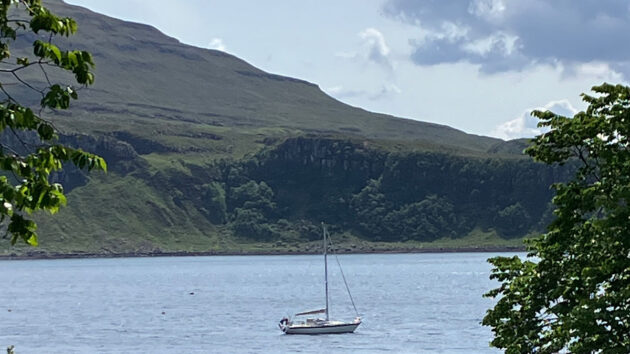
Westerly Storm at anchor in Portree – there is room outside the moorings! Credit: Michael Skidmore
In the morning, we set off in a flat calm to round Skye’s northern tip, past Flodigarry to the low, angular rocks of Fladda-chùain and Sgeir nam Maol.
Here we encountered our next tale. It is said that Iain Garbh, a notorious MacLeod chief of Raasay, was killed by witches raised by his enemies.
When sailing between Fladda-chùain and Sgeir nam Maol, his mother created huge seas by reciting incantations over a bowl set in a milk pail.
Witches appeared as birds in the sky and as frogs dropping on deck.
Disguised as a raven, one settled on the gunwale. Iain slashed it with his sword.
Now holed, his birlinn (galley) sank and he drowned.
Not wanting the same fate, we turned south-west, along with the wind, which strengthened into a Force 5.
We reefed and beat for several hours across the wide mouth of Loch Snizort.
Westerly Storms are notorious for their weather helm.
To compensate, we usually put the second reef in the main early and fly the full genoa for as long as possible.
The helm lightens, the wind vane is happy and the speed is unaffected. There is plenty for a cruiser to explore in Loch Snizort, including interesting anchorages among the tiny Ascrib Islands.
In one of the villages an old woman was often teased by three young lads.
When they were old enough to buy a boat and go fishing, they found their nets torn again and again by a mischievous whale.
One day they stuck it with a pitchfork, only to return home and find the old woman bleeding from her side.
The whale did not bother them again.
This part of Skye is close to the Outer Isles.
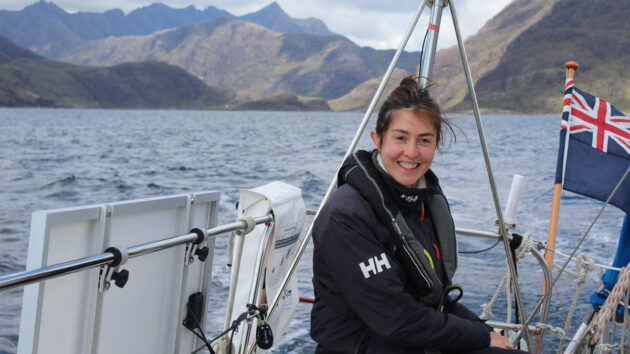
The crew enjoying a reach as the Black Cuillin is left behind. Credit: Michael Skidmore
Harris is only 15 miles away, well within reach for a detour.
Or some might use Skye as a staging post on a longer cruise.
This narrowness also means a bottleneck for shipping travelling up the Minch.
We made long tacks and slow progress to windward.
The ferry from Uig to Tarbert passed us twice while we dodged a fish farm vessel.
To the west, a cruise ship steamed rapidly north, bound for windswept Shetland.
But we were the only yacht.
We found the same in most places north of the Small Isles.
Positive traits
Witches could also be kind and helpful.
If the wind blew against you for weeks, a crone might be conspiring to keep you in harbour.
If your fishing grounds were empty, perhaps an enchantress could lure the herring in with a silver charm.
A witch might act on personal grounds if you had caused upset or shown kindness but often they stood out of sight, blamed for natural happenings.
In the distance, North Uist sat grey on the horizon.
The ragged teeth of the Outer Hebrides faded into the south down to Barra, where another tale was waiting.
Donald, a fisherman, would often sail from Barra to Glasgow to sell his catch.
While away, he would let his neighbour, Mary, graze her cows on his land.
Once, on his way home, Donald reached Coll before a gale rose against him.
After weeks, he visited an old witch, a Mistress MacLean, who told him that Mary was another witch, keeping him away so her cows could graze.
She gave Donald a string with three knots and strict instructions.
Donald set off in a flat calm, untying the first knot for a fine following breeze, then the second when it started to get late.
When he reached Castlebay, he waited until past Kisimul Castle before undoing the last.
A hurricane blew up, and it took all the might of the crew to row to safety.
We finally rounded Waternish Point and launched into a flying fetch, surging over the swell.
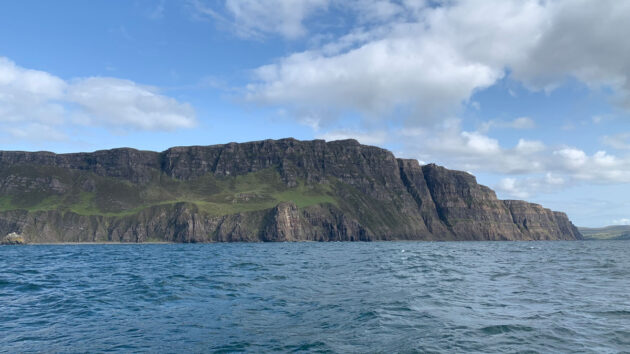
The west of Skye is all dramatic headlands, including Dunvegan Head. Credit: Michael Skidmore
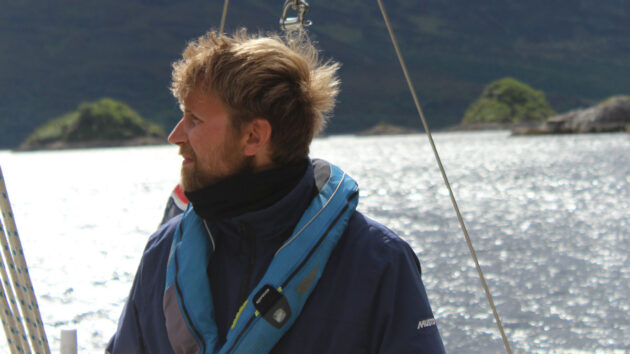
Michael winding his Westerly Storm between small islands around the Isle of Skye. Credit: Michael Skidmore
The blackening sea was studded with copper sheets and the horn of Dunvegan Head thrust darkly in the harsh glare.
Dolphins surrounded us, careering through the swell and under the bow.
After only an hour, we turned downwind around Neist Point and past Camas nan Sìdhean (Bay of the Fairies).
They decided we’d had our fun: the light softened, the sea grew a more familiar blue, and we rolled into Loch Bracadale as the sun set behind MacLeod’s Maidens.
This large, enclosed area has offered good shelter and safety for centuries of sailors.
The drying Pool Roag is a traditional winter berth for fishing boats, but only a brave yacht with local knowledge would attempt it now.
A pretty, less-visited spot is in Loch Bharcasaig to the west.
Tired, we chose the easy anchorage to the east of the doirlinn (isthmus) behind Oronsay.
Taking care to avoid the rocky patches, we dropped the anchor on the 5m contour, before dropping into sleep.
We delved deeper in the morning, short tacking into Loch Harport with the Black Cuillin rising in the distance.
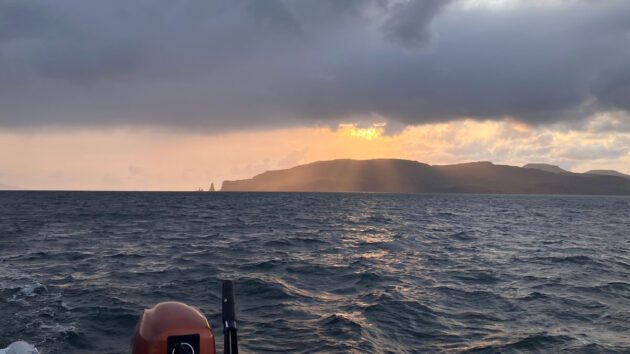
The sun sets behind MacLeod’s Maidens as Mike’s Westerly Storm enters Loch Bracadale. Credit: Michael Skidmore
Beira, the great winter hag, once roamed a moor between Loch Bracadale and the Red Cuillin. Spring, in his eternal war with winter, asked the Sun to help banish her.
The Sun threw a spear, missing Beira but hitting the moor.
The rocks bulged in a huge molten blister, driving winter away.
They eventually cooled into the Cuillin, but snow still struggles to settle on the peaks.
In driving drizzle the next day, we passed inside Soay to anchor in Loch na Cuilce, the bowl of the Black Cuillin.
The mist lifted to reveal the towering black mountains around us, veined with silver rivulets.
Yachts often anchor by the heavily used landing stage at the river.
But a quieter spot can be found by tucking in behind Eilean Reamhar.
Dig in carefully and watch out for the prodigious weed.
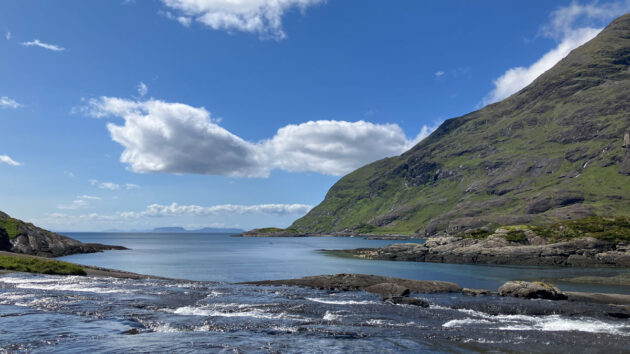
A quieter spot than Scavaig can be found behind Eilean Reamhar. Credit: Michael Skidmore
Keeping stories alive
Around the corner at Loch Slapin it is said that a witch would often go fishing with two other witches.
Her husband begged to come along.
Relinquishing, she told him to tell no one about their fishing, and to avoid saying anything holy.
At the lochside, the three witches turned into rats and used a sieve to herd herring into the husband’s waiting nets.
His job was to shout when enough fish had been driven ashore.
The third time they asked, as he replied ‘Yes, thank God!’ the witches were dragged underwater and drowned.
After 10 days, we said goodbye to Skye in glorious sunshine.
Flying on a broad reach, we watched the Cuillin recede and give way to the green of the Point of Sleat.
Here, a child once stood with her father and watched a ship founder off Eigg.
When the father realised his child had caused the disaster, and his mother had taught her the spells, he killed both of them.
Yet, hundreds of years on, their stories are still very much alive.
How to cruise the Isle of Skye
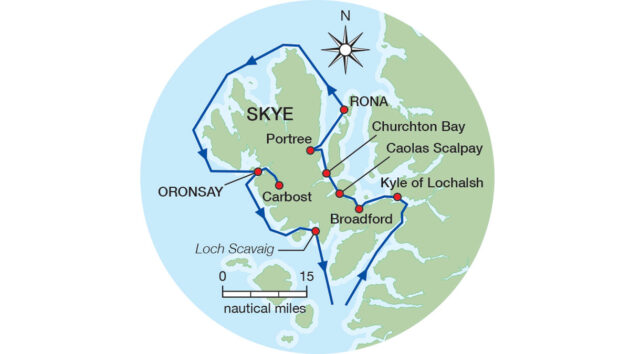
Michael Skidmore’s route around the Isle of Skye in a Westerly Storm yacht. Credit: Sudden Impact Media
Clockwise or widdershins?
Superstition would have us turning to starboard when leaving port.
Visitors to Skye have more choice, depending on their starting point.
The full circumnavigation can be as short as 130 miles.
Shorter hops make an ideal week’s cruise.
For yachts arriving from the south and needing to replenish supplies, it makes sense to start up the Sound of Sleat, pass through Kyle Rhea and stop at the supermarket in Kyle of Lochalsh.
Then set off anticlockwise.
Strong tides around the island take some thought when passage planning, especially through the tidal gate at Kyle Rhea.
Monstrous overfalls can form at Rubha Hunish, Waternish and Neist Point, with confused seas in even a moderate chop.
But a well-prepared boat and crew should encounter nothing worse than they might off Portland Bill or Land’s End and the rewards are huge.
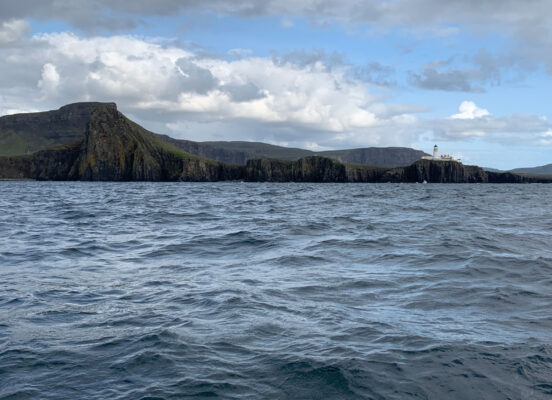
The sea can be very confused around Neist Point. Credit: Michael Skidmore
Where to stop
There are pontoons in Kyle of Lochalsh, Portree and Churchton Bay on Raasay, and moorings at Rona, Dunvegan and Loch Harport.
Plus beautiful, remote options at anchor.
For spectacular mountains, Lochs Scavaig, Slapin and Sligachan are among the most impressive anchorages in the world.
For magic, you might visit Dunvegan Castle to see the fairy flag, or the Cave of Gold at Harlosh in Loch Bracadale.
Those seeking adventurous pilotage could enter the pool at Soay, or meander among the islands off Colbost.
Many anchorages are heavily covered in weed.
Take time to dig in properly and be prepared for a couple of attempts.
The anchor will need to be cleared by boathook when weighing.
Short-handed crews should be wary of drifting while partly immobilised.
Mountain downdraughts
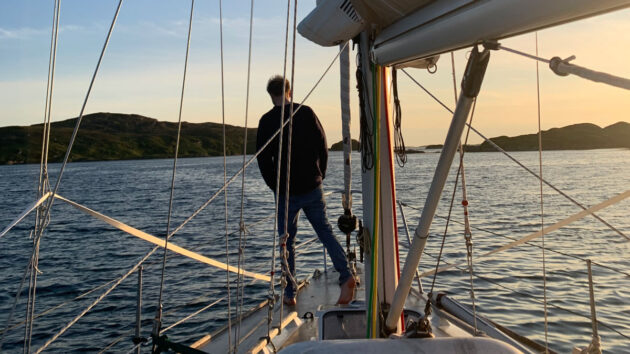
It’s important to make sure the anchor is dug in. Credit: Michael Skidmore
Prevailing southwesterlies leave a lot of options for shelter in a gale.
The Inner Sound, east of Skye, is usually better protected.
Beware huge downdraughts off the high mountains.
Perfect-seeming spots will experience gusts at least 10-15 knots more than further offshore.
Depending on wind direction, the worst offenders are Lochs Ainort and Sligachan in the east, and Loch Scavaig and Loch Slapin in the south.
It pays to consult an Ordnance Survey map if a real blow is coming in, and many boats would prefer to run for the Sound of Sleat, Plockton or Isleornsay.
Fuel, food and water
Skye is still a remote place for yachts to visit and opportunities to restock are few.
Water by hose can only be found on the pontoons at Kyle of Lochalsh, Raasay or Portree (where cruise ship tenders often mean the pier is the only option).
Fuel can be found by hose at Kyle or Portree.
But jerry cans can easily be filled at roadside pumps at Broadford, Uig and Armadale.
Food is easiest to find at Kyle, with the supermarket a short walk from the pontoon.
But smaller shops are dotted around the island.
Whisky is liberally supplied at Talisker in Loch Harport, and the Isle of Raasay distillery of Churchton Bay.
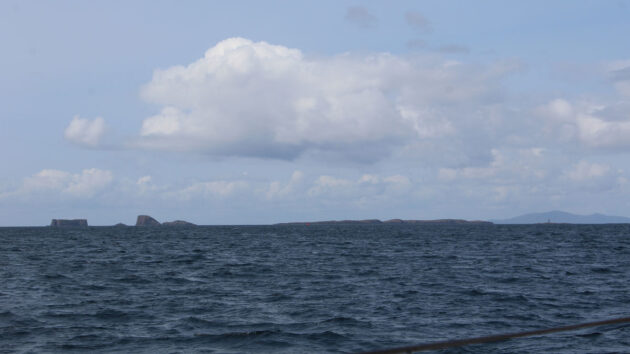
Iain Garbh is said to have drowned between Fladda-chùain and Sgeir nam Maol. Credit: Michael Skidmore
Find more stories
Skye: The Island and its Legends by Otta Swire (Birlinn, £8.99) is the best-known guide to Skye folklore.
The Gaelic Otherworld by John Gregorson Campbell (Birlinn, £30). A heftier introduction to traditional Highland beliefs.
Visit the knowledgeable owners of Carmina Gadelica bookshop in Portree. Charts and pilot guides
The standard paper and electronic charts cover the area adequately, but every sailor in the Hebrides should use Bob Bradfi eld’s ultra large-scale Antares Charts.
They cover almost every potential anchorage and encourage well-prepared cruisers to be more intrepid.
The Clyde Cruising Club’s (CCC) Sailing Directions for Ardnamurchan to Cape Wrath offers great advice.
Extra clues on traditional anchorages and dangers can be found in Gaelic place names.
Ordnance Survey (OS) maps are a good source, with a basic guide to the language provided by OS, or in the back of the CCC guide.
About the author
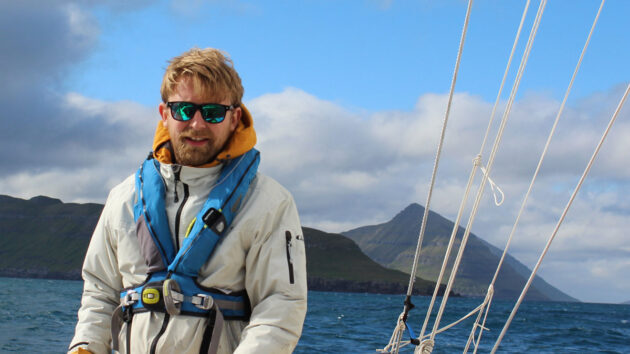
Michael Skidmore has cruised from Greece to Iceland and is a member of the Royal Cruising Club.
He is exploring folklore under sail on his Westerly Storm.
Best boats for crossing the North Sea: the Moody Eclipse 33 + 5 other models
Sailing north from Scotland takes you into a different world. Towering cliffs, remote islands, and empty, white-sand beaches await sailors…

Cruising from Orkney to Kinlochbervie
Nick and Alison Boxall sail their 35ft 6in Southerly 110 from Mainland to mainland, from Orkney to Kinlochbervie, Scotland
Sharks in the UK: A guide for sailors
Genevieve Leaper looks at some of the shark species around the British and Irish coasts and how to spot these…
What to read more cruising articles like this?
A subscription to Practical Boat Owner magazine costs around 40% less than the cover price.
Print and digital editions are available through Magazines Direct – where you can also find the latest deals.
PBO is packed with information to help you get the most from boat ownership – whether sail or power.
-
-
-
- Take your DIY skills to the next level with trusted advice on boat maintenance and repairs
- Impartial, in-depth gear reviews
- Practical cruising tips for making the most of your time afloat
-
-
Follow us on Facebook, Instagram, TikTok and X