


Phil Clandillon looks at the best second-hand yachts for sailing northern Scotland and across to Norway. Fisher 25 | Sadler 29 | Rival 36 | Moody Eclipse 33 | Maxi 1100 | Dehler 41 DS
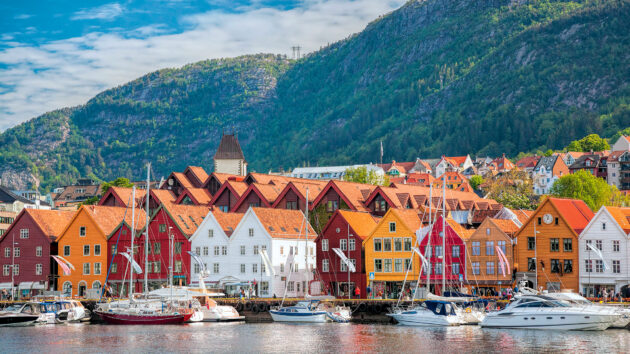
Sailing north from Scotland takes you into a different world.
Towering cliffs, remote islands, and empty, white-sand beaches await sailors willing to suffer cooler temperatures, rain, and strong currents that demand careful planning.
Boats leaving the Clyde can transit the Crinan Canal as a shortcut to the Sound of Jura, home to some of the most diverse marine life in Scotland.
Yachts heading for Norway can hop to Fort William from Oban, and transit the Caledonian Canal to Inverness. From there, it’s around a three-day passage to Stavanger, or approximately two days to Bergen if you visit Shetland first.
Those with more time can head north-west through the Sound of Mull, taking in the wild beauty of Skye before picking their weather to round the aptly-named Cape Wrath and make landfall at Stromness, entry point to the Orkneys.
Highlights of this remote archipelago include four Neolithic UNESCO World Heritage Sites, the fascinating World War II block ships at Scapa Flow, and the towering sea stack, the Old Man of Hoy.
Fair Isle, equidistant between the Orkneys and Shetland, offers the chance to spot some of the world’s rarest land and sea birds.
Shetland itself consists of 100 islands, and 48 natural harbours, anchorages and marinas. Visit the Viking longship sites at Unst and send a postcard from Britain’s northernmost post office.
Anchor at Mousa and explore the 2,000-year-old Broch, a remarkably complete Iron Age tower. Or spot dolphins, minke whales, and orcas from windswept Sunburgh Lighthouse on the southern tip of the Mainland.
From cosmopolitan capital Lerwick, it’s a 220-mile passage to the picturesque Norwegian city of Bergen, gateway to some of the country’s most beautiful fjords.
Stop at Rosendal, a charming village on the Hardangerfjord, and anchor at the spectacular Langfoss waterfall in the Åkrafjord.
Ghost down the jaw-dropping Lysefjorden under sail, and see the iconic Preikestolen cliff formation from the comfort of your boat.
Then, explore the narrow streets and wooden buildings of Stavanger’s old town before crossing back to the UK.
Suitability
Tougher conditions are likely, with the chance of tidal overfalls in the Northern Isles and the often confused seas of the open North Sea.
Any well-prepared yacht and crew should be able to cope, but the models I’ve picked out prioritise comfort and seakeeping.
Three of the boats I’ve chosen can be steered from inside, either via a second wheel or internal autopilot controls.
Fisher 25
British duo David Freeman and Gordon Wyatt created the Fisher 30 motorsailer in 1971, with a ketch rig, trawler-style hull design, and forward-raked wheelhouse.
The concept proved so popular that more models were quickly added, and production moved to UK builder Northshore, which eventually bought the brand. It survived the UK yard’s closure in 2014, and you can still buy a new Fisher today, built by Neil Marine in Sri Lanka.
The Fisher 25 was introduced in 1974. To maximise space in her short hull, her designers swapped the canoe stern of her sisterships for a flat stern and transom-hung rudder.
Otherwise, she’s a mini version of the 30, with the same distinctive wheelhouse, high bulwarks, ketch rig and famous seakeeping qualities. Around 270 were built before Northshore stopped production in 2008.
With sails up and engine running she can make 5-6 knots, and she’ll tramp along at similar speeds with sails alone in heavier airs. She’s also capable of making comfortable and steady progress into a head sea under power, without slamming.
There are limits, however. She won’t sail closer than 50° to windward without significant leeway, and tacking in heavier conditions may well need assistance from the engine.
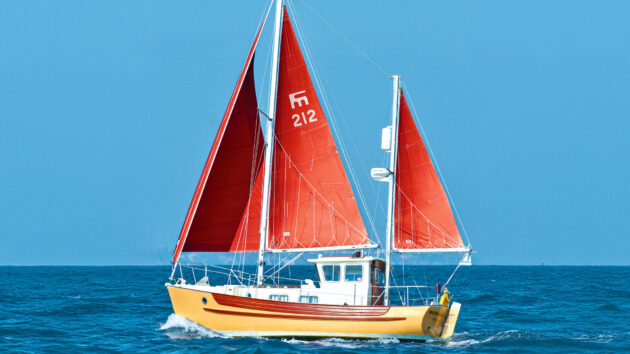
The Fisher 25’s side decks are well protected by high bulwarks. Photo by David Harding
Her 50% ballast ratio and modest sail area mean that reefing is rare, but sailing under jib and mizzen is a good option in heavy weather.
Her long keel means directional stability under sail is good, yet she’s reported to be surprisingly manoeuvrable under power, although not fantastic in reverse.
High bulwarks protect the side decks, but her foredeck is raised, necessitating a climb up to deal with anchoring.
The cockpit seats three comfortably, or four at a squeeze, with a removable tiller for sailing. The wheelhouse is small, and headroom is restricted to 1.75m/5ft 9in. There’s a folding seat behind the helm on the port side, and a small bench to starboard.
Original boats have a cosy, teak-trimmed saloon, with a dinette on the port side, converting to a double berth.
There is a small galley to starboard, with a quarter berth behind. The heads is to port between the saloon and the forecabin, with a wardrobe opposite.
The forecabin is a good size for a 25-footer, helped by the raised foredeck and bluff bow. Today’s 25 has a redesigned interior with a more contemporary layout.
Engines included the 18hp Volvo 2002 and the 28hp 2003, but most earlier boats have been re-engined. New 25s are powered by a 29hp Yanmar 3YM30.
Lifting the wheelhouse floor gives good access to the engine from above, but it’s difficult to get at the fuel tank or prop shaft.
Otherwise, there are no major issues aside from peeling non-slip on the decks and leaky windows in the wheelhouse.
Fisher 25 specifications
- LOA: 7.69m/25ft 3in
- LWL: 6.40m/ 21ft
- Beam: 2.85m/9ft 4in
- Draught: 1.14m/3ft 9in
- Displacement: 4,600kg/10,079lb
- Working sail area: 22m2/234ft2
- Built: 1974-today
- Typical asking prices: £18,000-£45,000. Asking prices start at around £12,000 for a project boat, and rise to £45,000, with solid examples available between £20,000-£30,000. A brand new, ketch rigged 25 Mk2 will set you back around £166,000 before options.
Sadler 29
After designing the legendary Contessa 32, David Sadler began boatbuilding with his father, Martin.
By the early 1980s, their range had expanded, and the Sadler 29 became a bestseller, with around 400 built from 1981 to 1988.
She was marketed as unsinkable, with the cavities between her inner liner and hull filled with closed-cell foam. Thankfully, sinking yachts are rare, but the additional insulation is welcome in our colder cruising area.
Her looks are traditional, with a raised bow and pronounced sheer. She has a wider stern than other Sadlers, with a transom-hung rudder to maximise internal space.
The standard fin drew 1.5m/4ft 9in, while the popular twin keel variant drew 1.1m/3ft 6in.
She has a short masthead rig and headsail-biased sail plan, typical of the era. The 150% genoa needs reefing at the top end of Force 4, so some owners have switched to a 110% jib.
Appropriately canvassed, she delivers a good performance in a typical North Sea chop.
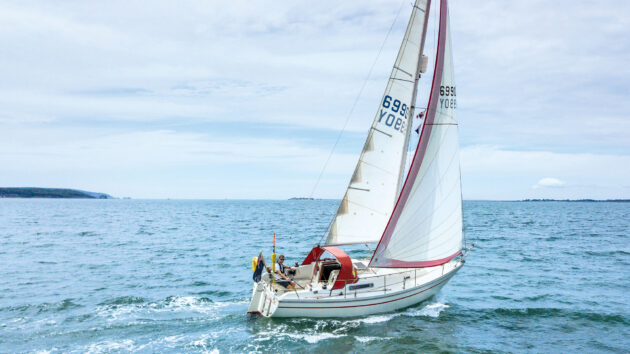
The Sadler 29 is well balanced and came with a choice of keels. Photo by Richard Langdon
A long coachroof creates space below, but results in a small cockpit, further restricted by the tiller.
There’s a deep locker to port, and stowage under the sole for a small inflatable. The traveller is on the bridge deck, halyards are led to the coachroof, and jib sheet winches are forward on the coaming.
Her sloping side decks are wide, and her babystay is well aft, creating a spacious foredeck.
Below, a glassfibre liner means no saggy headlining. There’s comfortable seating in the saloon, with a settee to starboard and a shallow dinette to port.
The compromise is a small galley, to port by the companionway, with a sloping floor betraying the hull’s fine run aft. Opposite, there’s a forward-facing navigation station at the head of a generous quarter berth.
The heads is aft of the forecabin, with hanging space opposite. The forecabin itself has a decent V-berth with an infill to make a double.
Earlier boats had vertical bulkheads on either side of the companionway, restricting access to the galley and quarter berth, modified around 1985 to a sloping design. Boats from 1988-89 gained a third window in the coachroof.
Twin keel owners report the root of the windward keel can slam when hard pressed, solved by reefing early.
Leaking windows should be resealed to avoid water between the dual skins.
Early boats had a 2-cylinder Bukh DV20 engine. Later, Sadler fitted the 18hp Volvo 2002 and finally the Volvo MD-2020.
Sadler 29 Specifications
- LOA: 8.66m/28ft 5in
- LWL: 6.96m/22ft 10in
- Beam: 2.90m/9ft 6in
- Draught: standard: 1.50m/4ft 11in; shallow fin:1.20m/3ft 11in; twin keel: 1.10m/3ft7in
- Displacement: 3,720kg/8,200lb
- Working sail area: 34.5m2/372ft2
- Built from: 1981-1988
- Typical asking prices: Asking prices start at around £10,000 for boats that need some attention, rising to £18,000.
Rival 36
In 1967, English sailor turned designer Peter Brett drew the Rival 31, hoping to find buyers for 50 boats. The series went on to sell over 600 yachts across five models, far exceeding his modest expectations.
The 36 was the last Rival off the board, and owners generally agree it’s the best, retaining the legendary seakeeping of earlier designs, but being faster, and beautifully balanced, with a fingertip-light helm.
She is a heavy cruiser with traditional lines, a long fin keel drawing 1.83m/6ft, and a rudder on a full skeg, and will take tough North Sea conditions in her stride.
A masthead rig with overlapping genoa was standard, and a cutter rig and teak deck were options. Tiller or wheel steering was offered. A shallower Scheel keel (an early bulb keel) drew 1.5m/4ft 11in, and the rarer centreboard version had a shorter rig.
Her cockpit is small, but well protected with very high coamings. The traveller is forward of the companionway, with lines led either side of the main hatch, entering through openings in a moulded spray rail.
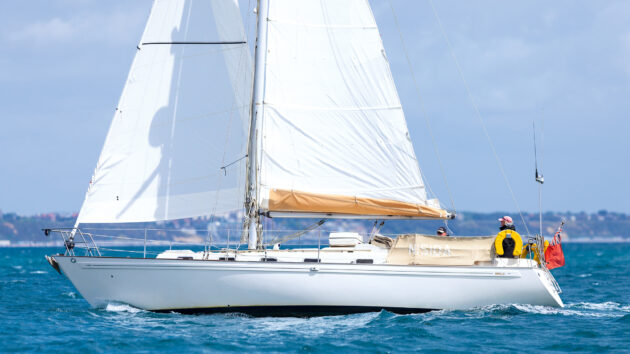
The Rival 36’s wide side decks provide a secure, stable platform for crew. Photo by David Harding
Her side decks are wide, but the foredeck is narrow owing to her fine bow.
A high bridge deck and small hatch are great for keeping green water out, but require a bit of clambering over.
Below, there’s a U-shaped galley to port, ideal for cooking underway. Opposite, there is a forward-facing navigation station, with a comfortable seat, stowage, space for instruments, and a slim quarter berth behind.
Her saloon has a stylish keyhole cut-out in the main bulkhead, with maximum headroom of 1.9m/6ft 3in. An L-shaped dinette converts to a double berth, and a settee to starboard doubles as a sea berth.
The head is en suite to the ample forecabin, but can also be accessed from the saloon. The water tank is in the top part of the keel, accessed via inspection hatches in the sole.
Performance downwind in light airs can be sluggish, and a gennaker would be a good addition. Her high directional stability is an asset under sail, but challenging under power in tight spaces.
Engines included the Perkins Perama M30 and Bukh DV36; however, many older boats have been repowered by now. Access is excellent, as the companionway steps come away to expose the entire top and left side of the engine.
Around 78 boats were built from 1980 to 1993. Build quality is excellent, and the main watch-outs are leaky windows and saggy headlining.
Jane Ashe, daughter of Peter Brett, runs the owners’ association at rivalowners.org.uk.
Rival 36 specifications
- LOA: 10.92m/35ft 10in
- LWL: 8.28m/27ft 2in
- Beam: 3.35m/11ft 0in
- Draught: standard 1.83m/6ft 0in; Scheel keel 1.50m/4ft 11in; keel/centreboard 1.10m/3ft7in (board up) 2.00m/6ft 7in (board down)
- Displacement: 6,500kg/14,250lb
- Working sail area: 53.2m2/573ft2
- Built from: 1980-1993
- Typical asking prices: Prices start at £30,000 for boats needing TLC, and run to around £68,000 for exceptional examples.
Moody Eclipse 33
Anyone who has sailed in northern waters for long enough will know the pang of jealousy when a yacht with inside steering cruises past as the rain stings your face.
Moody pioneered the deck saloon in the late 1960s with their Carbineer 44, and by the 1980s, the idea had reached smaller yachts.
Bill Dixon designed the Moody Eclipse 33 with an in-mast furling main and roller genoa as standard, meaning crew wouldn’t have to go forward for sail handling. This allowed him to sacrifice width in the side decks for a bigger deckhouse, creating more interior space.
Introduced in 1987, the Mk1 version had a second wheel, helm seat and engine controls inside.
With the Mk2 in 1991, Moody removed these in favour of a larger navigation area, with remote controls for the autopilot, freeing up space and allowing more light into the galley below.
The Moody Eclipse 33’s standard fin keel has 1.45m/4ft 9in draught, and the twin keel 1.10m/3ft 7in. Her masthead rig isn’t huge, and the boom is high, so light weather performance isn’t stellar.
Most controls are led aft, but halyards are clutched at the mast, not a concern as both sails are furling.
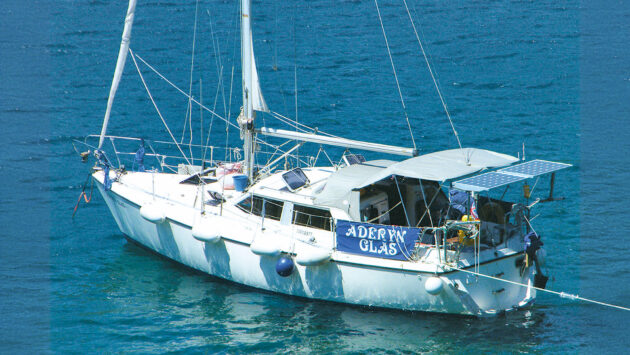
The Moody Eclipse 33’s deck saloon enables you to extend your sailing season. Photo by Richard Langdon
The cockpit is well protected behind the deckhouse, with wheel steering and a deep locker on the port side.
In the raised saloon, a dinette to port seats four comfortably, or six at a squeeze, and converts to a double berth.
A step down at the rear leads to the starboard side aft cabin, where the bunk is too narrow for a true double, and only 1.80m/5ft 9in long.
Forward, another step down leads to a linear galley, with ample storage and work surfaces.
A very large heads to port includes a separate shower, and an additional door to the spacious forecabin, which has a double V-berth, dressing area and wardrobe. Headroom is 2.00m/6ft 5in at the galley but drops to 1.80m/5ft 9in in the heads.
Friction in the in-mast furling system may mean that various pulleys need replacing. Some boats have a wood block in the layup under the mast base which can rot and sag.
Window frames and stanchion bases can leak. Original mild steel tanks can suffer from corrosion.
Engines included the Perkins Perama M30, the 28hp Volvo 2003, and the 43hp 2003T. The engine is under the deckhouse floor, and access is tight. Tankage is a useful 151lt of diesel and 246lt of water.
The Moody Eclipse 33 sold well, and Marine Projects built 253 by the time production ended in 1994.
Moody Eclipse 33 specifications
- LOA: 9.91m/32ft 6in
- LWL: 8.53m/28ft
- Beam: 3.40m/11ft 2in
- Draught: fin keel: 1.45m/4ft 9in; twin keel: 1.10m/3ft 7in
- Displacement: 5,650kg/12,465lb
- Working sail area: 42m2/452ft2
- Built from: 1987-1994
- Typical asking prices: Prices for the Moody Eclipse 33 remain strong, at around £30,000 for examples that need updating, to £60,000 for boats in top condition.
Maxi 1100
This stylish cruiser racer was built between 1999 and 2005, when Maxi was owned by Nimbus, builder of quality Swedish powerboats.
The 1100’s powerful rig and relatively heavy displacement deliver impressive speed in winds above 12 knots, and a comfortable motion, ideal for crossing to Norway at a clip.
Standard draught is 2m/6ft 7in, but a 1.50m/4ft 11in shoal keel was also available. Both are cast lead with a substantial bulb.
Her rig is 9/10ths fractional, with a keel-stepped, twin-spreader mast, fully-battened main, and 105% headsail. All boats also came with tracks for a genoa, and one would be useful in light airs.
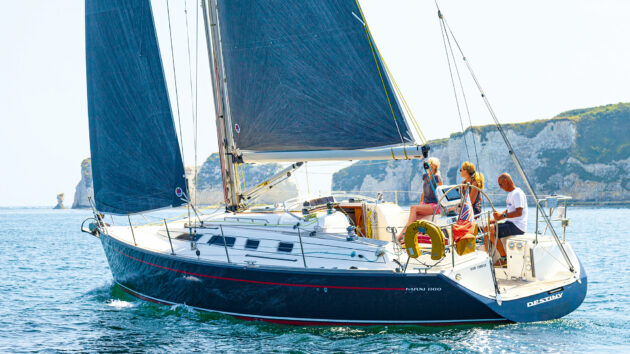
The cockpit, with its high coamings, provides plenty of space for leisurely sailing. Photo by David Harding
Her cockpit has two long benches and a cutout for the single wheel behind. There’s a large locker on the port side, and two shallower ones in the corners.
The open-fronted stowage bins in the coaming are brilliant for preventing small items from going walkabout, and the centre of the helm seat lifts to access a wide bathing platform, handy for dinghy access.
The traveller is just in front of the wheel, sheet winches are on the coaming, and halyards and reefing lines are on either side of the companionway.
Wide decks make it easy to get forward, and her foredeck is big enough to keep a dinghy inflated.
Deck hardware is substantial, with large stainless steel cleats and a chunky double bow roller. Her deep anchor locker has an internal windlass.
Below, she has a quality, mahogany-trimmed interior, with good handholds and plentiful stowage. To starboard, there’s an L-shaped galley with twin sinks and a crash bar.
Access to the aft cabin is behind, with a double berth, a small wardrobe and a dressing seat. To port, there is a forward-facing navigation station with good stowage. A door adjacent leads to the single heads with a sit-down shower arrangement.
Her saloon can seat seven at a pinch, with a settee to port, a central drop-leaf table and a shallow dinette to starboard. The port side makes a good sea berth, and the dinette converts into an occasional double.
There is a sizable V-berth in the forecabin, along with more stowage, and dressing seats on either side. Pressurised hot water was standard, and it’s common to find diesel-fired heating installed.
Power was from a 28hp Volvo Penta MD-2030, mated to a saildrive. The original through-hull fittings suffered from corrosion and should have been replaced by now.
Saloon windows can leak and may need rebedding. Otherwise, the quality from Nimbus was high.
Maxi 1100 specifications
- LOA: 11.17m/36ft 8in
- LWL: 9.85m/32ft 8in
- Beam: 3.65m/12ft 0in
- Draught: 2.00m/6ft 7in; 1.50m/4ft 11in
- Displacement: 6,100kg/13,448lb
- Working sail area: 61m2/656ft2
- Built from: 1999-2005
- Typical asking prices: Asking prices start around £70,000 for boats in need of some updating, and top out at around £95,000 for the best examples.
Dehler 41 DS
This Judel/Vrolijk design is a wolf in sheep’s clothing, with a sail/area displacement ratio of 19 and the ability to tack through 75°.
Her performance and stability, combined with a cosy deck saloon, make her an excellent choice for covering distance in cooler northern climes.
The 42 DS has a slippery hull with moderate beam, a chunky bulb keel and an authoritative rudder.
Standard draught was 2m/ 6ft 7in, but a shoal fin was also available, drawing 1.65m/5ft 5in. Her tall fractional rig has a fully-battened main and a small self-tacking jib.
All lines lead back to clutches on either side of the wheel, with a pair of electric winches making short-handed sailing easy.
Her cockpit is well sheltered behind the deck house. It’s a squeeze to get behind the oversized wheel, but there’s a comfortable helm seat when you do.
The wide helm pedestal provides space for instruments, buttons for the electric winches, and the engine control panel.
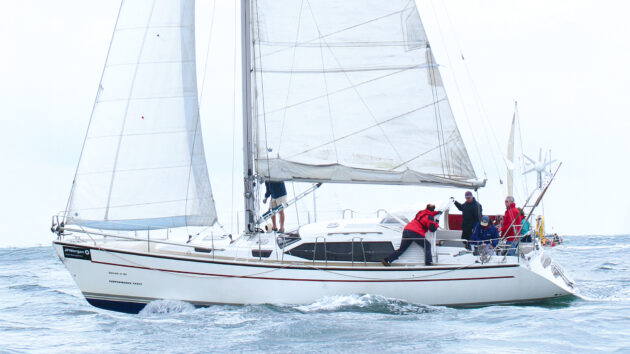
The high performing Dehler 41 DS is something of a wolf in sheep’s clothing. Photo by David Harding
Her side decks aren’t generous and are obstructed by two sets of chainplates. The foredeck is spacious, however, with an electric windlass and a large anchor locker.
Inside the deck saloon, there’s a dinette on the starboard side, high enough to see out of the windows, meaning you can admire the wildlife even if the weather misbehaves.
The navigation station faces forward on the port side, fitted with autopilot controls, making an inside steering position.
Two steps down lead to a linear galley on port, and a very large heads and shower to starboard.
Behind, there’s a door to the aft cabin, with a mid-sized double berth. Forward, there’s an impressive forecabin, containing a large, semi-island double bed, dressing areas, and a wardrobe.
The joinery is very 1990s, with light wood and smooth curves, but the quality is high, and there is a lot of clever storage.
Power was from a 48hp Yanmar 4JH2E, mated to a shaft drive. Engine access is by removing the floor under the saloon table, making getting to the sides of the motor difficult. Swollen bearings causing a stiff rudder were common, but should be replaced by now.
If original, electronics will be dated. Otherwise, the fundamental build quality is excellent.
Dehler 41 DS specifications
- LOA: 12.45m/40ft 10in
- LWL: 11.05m/36ft 3in
- Beam: 3.90m/12ft 10in
- Draught: Standard 2.00m/6ft 7in; shoal:1.65m/5ft 5in
- Displacement: 8,900kg/19,621lb
- Working sail area: 79.6m2/857ft2
- Built from: 1996-2004
- Typical asking prices: The 41 DS remains a popular design, and values are strong. Asking prices range from £75,000 for boats in need of updating to £130,000 for the best-equipped and maintained examples.
Practicalities and reading
This far north in summer it never gets completely dark, meaning longer passages are possible in daylight.
The waters around Cape Wrath, the Orkneys, and Shetland feature some of the strongest and most challenging tidal currents and overfalls in the UK, and require careful planning.
In the North Sea, oil and gas rigs and platforms are a hazard. Static platforms are charted, and rigs broadcast their positions on AIS.
For the Orkneys and Shetland, it’s advisable to carry a heavier anchor, not only for security, but because many anchorages have kelp on the seabed. Bring fender boards if you plan to use the many piers around Shetland.
Anchoring in the Norwegian fjords can be tricky due to the steep sides. The preferred technique is to drop your anchor in the deeper water, then back the boat into the shore before tying off at a couple of points. You’ll need very long lines and a dinghy to bring them ashore.
Clyde Cruising Club has been publishing its Sailing Directions for Scottish Waters since 1909. Today it’s in multiple volumes, covering the Clyde to Cape Wrath, the East Coast to Inverness, the Outer Hebrides and Orkney and Shetland, all available from Imray.
Orkney Marinas provide up-to-date information on pilotage, charts, and tides at orkneymarinas.co.uk
For Norway, the Havneguiden series of harbour guides is available digitally and in print from harbourguide.com
Want to read more articles about the Moody Eclipse 33 and similar models?
A subscription to Practical Boat Owner magazine costs around 40% less than the cover price.
Print and digital editions are available through Magazines Direct – where you can also find the latest deals.
PBO is packed with information to help you get the most from boat ownership – whether sail or power.
-
-
-
- Take your DIY skills to the next level with trusted advice on boat maintenance and repairs
- Impartial, in-depth gear reviews
- Practical cruising tips for making the most of your time afloat
-
-
Follow us on Facebook, Instagram, TikTok and Twitter