




Solidly-built, reliable and a pleasure to sail, boats built by Rival are among the most sought-after cruising yachts. Peter Poland charts their story
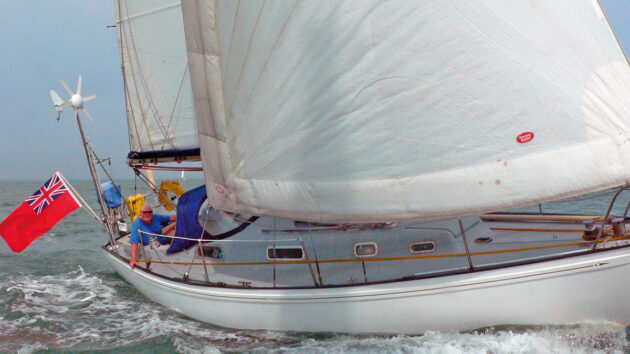
Consider this for a scary scenario: wind strength well over 50 knots; sea state tumultuous; yacht position, just off Bermuda; crew number, two. In my book, this all adds up to a hazardous situation. Would you like to have been there?
Eric Faber was, and in his book The Cruise of Luna Quest he wrote: ‘Luna Quest heeled at an awkward angle, not for long, maybe a couple of seconds, but long enough to freeze us in suspense. The sea was pressing with all its might against the little windows…we could only watch in agony, hoping the windows would hold… As if this punishment was not enough, Luna Quest was picked up by another monster, swept along, then deposited. Luna Quest shuddered, we shuddered, everything on the boat
shuddered. I wondered if the engine was still bolted to its beds and whether the 75m of heavy gauge anchor chain had cracked the hull trying to bomb through it; but all appeared intact. The rig was still up there. My God, this boat must be strong! A sense of pride came over me.’

The first moulding of the Rival 31, from 1967
And of course, the boat was strong. She was a Rival 38. Crewed by Eric and a friend, she was on her way home after competing, very successfully, in the ARC. Like all Rival Yachts, this boat was designed and built to go to sea and look after her crew. There is something special about Rival Yachts – they ooze solidity and reassuring
they ooze solidity and reassuring British quality. The firm behind them may have joined the long list of legendary British boatbuilders to have gone to the wall, but the Rival Yachts tradition survives, as do the boats themselves.
Look at any entry list in any long- distance sailing event and you will find Rivals there. And if you need further proof of this ability to survive the direst of adventures, what about Rachel and Paul Chandler’s Rival 38, Lynn Rival?
Abandoned to her fate after Rachel and Paul had been kidnapped by Somali pirates, she was subsequently found in mid-ocean by a ship, hauled (and banged) alongside, craned aboard, deposited on deck and brought back to the UK. But more on that later.
The start of the Rival Yachts story
So, to return to the beginning of the Rival Yachts saga, designer Peter Brett’s daughter Jane Ashe told me that, even as a schoolboy, her father was always fascinated by yachts. In the mid-1920s, when Brett was at Winchester College, his art teacher taught him how to design freehand, without using splines. And as he delved deeper into the black art of boat design Brett fell under the influence of the great Uffa Fox, for whom he had crewed.
However, having completed his education, the young Brett clearly decided that yacht design was too precarious a first career. He took a safer option and went to work as a chemical engineer with ICI from 1931 to 1966, although he continued to draw boats in his spare time. He designed a 12ft (3.7m) dinghy, which some see as a forerunner of the National 12. Then he went larger with a 42ft (12.8m) cruiser, built in 1936 and called Makrojak – and then smaller with Fair Rover, which went on to become the first of the Dee 25 class.
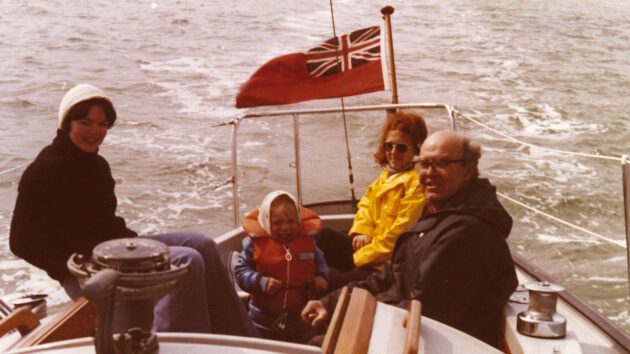
Jane Ashe, left, with her father, Rival Yachts designer Peter Brett, right
In 1967, Brett felt that the time had come to be bold, forsake chemical engineering and take the plunge to turn his hobby into a profession. He’d designed a new 31ft (9.4m) cruiser for glassfibre production, so now he needed to find a moulder and builder. Eric White, whose company Marine Construction (Marcon) was already mass-producing the Trident 24 cruiser in Southampton, was persuaded to mould the boat.
Next, White introduced Brett to three young craftsmen by the names of Charles Maunder, Keith Crossley and John Florance. They had just set up the Southern Boatbuilding Company and built the wooden plugs from which GRP moulds would be lifted. They also undertook the fit-out of the hulls moulded by White, after another company had completed the first Rival to hit the water.
By now Brett had ploughed a substantial amount of his own money into the project and, well aware of the risk he was taking, set about financing, marketing and selling
the boats. The recipe worked out well: Brett, White and Southern Boatbuilding made a good team and pooled their respective skills to build the Rival Yachts brand. It was much later before Brett decided to hand the reins over to Southern Boatbuilding and just concentrate on his design work.
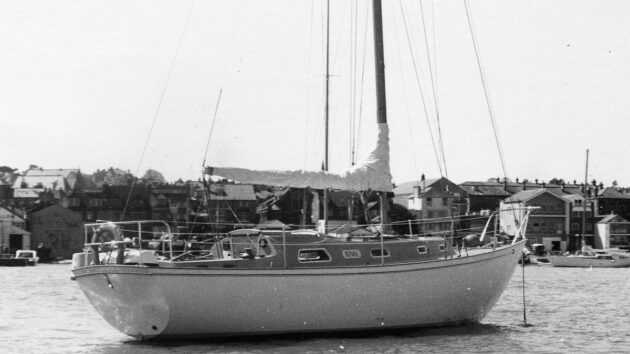
The first boat: the prototype for the Rival 31
And so the first Rival was born, but Brett wanted to evaluate his design before committing it to production. ‘I decided that no work must start until a sailing model had been produced and tested for hull balance,’ he said. ‘After making the model, the sailing trials were carried out on the canoe lake at Sandown over the 1967 Easter
weekend and these showed the balance of the hull was right.’
The production process therefore started, and the prototype was launched in 1968. Initially the new Rival 31’s transom-hung rudder sat on a raked stock, but sailing trials showed this produced more weather helm than Brett deemed ideal – especially on a fast reach in strong winds. So he decided to change the mould tools and fit a vertical internal rudder stock trunk with the blade attached to a skeg tucked under the transom. This transformed the boat.
Sensible Rival
So what are the principal attributes of this first Rival, and how did they set her apart from the run-of-the-mill production boats of her era? It is perhaps her very ‘sensibleness’ that makes her special. Brett did not set off on any flights of fancy. There is nothing about her design or construction that makes you say: ‘my word, that’s different.’
Her draught of 4ft 8in (1.42m) and beam of 9ft 8in (2.95m) are moderate for her era. The maximum beam is situated around amidships and tapers to a stern that is neither too tight nor too broad. The keel itself is long by modern standards but it is still very much a fin, and its 40% ballast ratio is generous without being excessive.
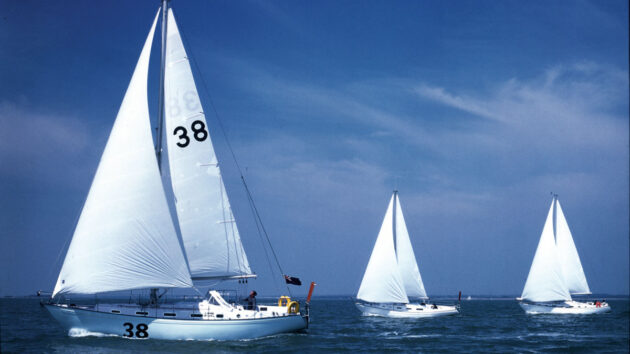
The Rival 38 was popular for bluewater cruising
With an all-up displacement of 11,200lb (5,080kg) she comes in with a DLR of 340, which pushes her up from the moderate displacement camp towards the heavy. The Contessa 32 – by way of comparison – displaces less (at 9,500lb/4,309kg) and comes up with a sportier DLR of 306.
The Rival 31’s interior layout is also unremarkable for her era. A V-berth forepeak, amidships heads, straight-fronted saloon settees, ample stowage, galley and chart table areas aft and a navigator’s quarter berth do their jobs admirably. All of this added up to a modest sales total of 22 boats, but this was enough to cover Brett’s investment – and he was already planning the far more successful Rival 32.
Rival Yachts evolution
Given that the 31 performed so well, the evolution of the Rival 32 was relatively simple. Brett added a graceful little counter to the 31’s somewhat abrupt transom and reworked the interior layout. Job done. The new 32 looked prettier than her predecessor thanks to her more balanced overhangs, and gained a little sailing waterline length.
She sold well, with around 200 built, and set the Rival ‘ethos’ in stone. The brand had well and truly arrived. A few years ago, I had a chance to try out one of these iconic yachts, although given the reputation of Rival Yachts for sea-kindliness and an ability to take heavy weather in its stride it was a shame that I was confronted with a puny breeze and flat seas.
Still, a Rival is a Rival, so off we set in Andrew Gardener’s Rival 32, St Brigid. Andrew bought her at a used-boat show in 1994 and had since worked through her, replacing old or tired gear when he could afford it. To start with, the Volvo MD15A was replaced by a powerful and smooth-running Yanmar 3GM. This large lump just fits under the companionway steps.
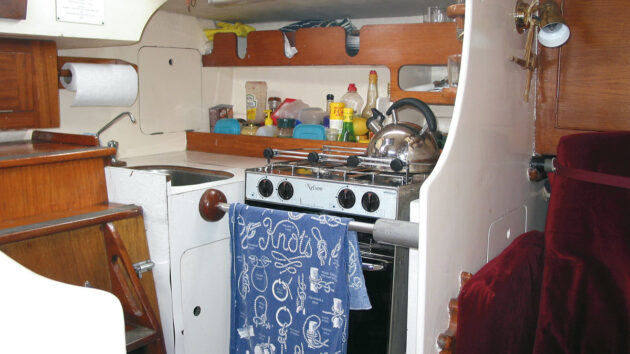
The galley onboard the Rival 32, St Brigid. Credit: Peter Poland
Then Andrew reupholstered the original mattresses, replaced the heads and renewed the saloon headlining. On deck, St Brigid retained her original mast and boom, but Andrew ditched the mainsail roller reefing and fitted a modern slab system. Then a removable inner forestay was added (to take a blade or storm jib) and two powerful
Andersen 40ST stainless steel winches took the place of the more feeble originals.
Finally, after about 27,000 miles with her previous sails, St Brigid was treated to a new Kemp mainsail and roller genoa with a foam luff. As a result of all this TLC, she
certainly didn’t look her age.
Sadly, the wind refused to go above 9.9 knots, but even in such light airs – and despite her undoubted weight – St Brigid made a respectable 4.8 knots to windward,
sailing at about 40° to the apparent wind. Since the sea was flat, it was impossible to experience how her sweeping and high bow kept waves off the decks. Still, like
looking along the bonnet of a stately car, the view along her ample side-decks towards the stem gave a sense of security and potential power. She’s no flighty racer or fat-sterned modern yacht of course, but she performs well and feels right.
Down below, several unusual features – too costly to feature as standard on a modern production boat – show how she had been conceived and built by experienced sailors. The saloon table can fold away, freeing up the saloon for easy movement at sea. There are eminently practical ‘stow-away’ root berths whose inboard support poles slot into notches on the bulkheads: anyone who has slept in one at sea will know how well they work.
The galley, forward-facing chart table and quarter-berth, divided off from the saloon by Rival’s trademark ‘keyhole’ bulkhead, are easy to use and well proportioned – and lockers seem to be everywhere. If you want a palatial aft WC compartment, the Rival 32’s amidships heads and washbasin won’t thrill you – but how much time do you spend using the loo?
A larger Rival
As ever-larger numbers of sailors fell for this Rival’s shapely sheer, sea-kindly bow, non-extreme fin keel and proven stability, Brett decided to up the ante again and
introduced the Rival 34. He unearthed the original model he made for the 31 and changed it by deepening the afterbody.
Then Brett checked it out by tank-testing the reworked model at Southampton University. The change proved a success, producing an average reduction in resistance of 6%. But Brett claimed that the new 34’s longer overhangs did not result from the tank testing. Rather, he added them to improve upwind steadiness in a seaway and to make her look even prettier.
The Rival 34’s potential prowess in offshore sailing was soon put to the test. Four Rivals – a 31, two 32s and the first 34– entered the first AZAB race (Azores and
back, around 2,500 miles). Then Brett entrusted his own Rival 34, Wild Rival, to a young naval officer, Geoff Hales, to have a crack at the 1976 OSTAR (Observer Single-Handed Transatlantic Race).
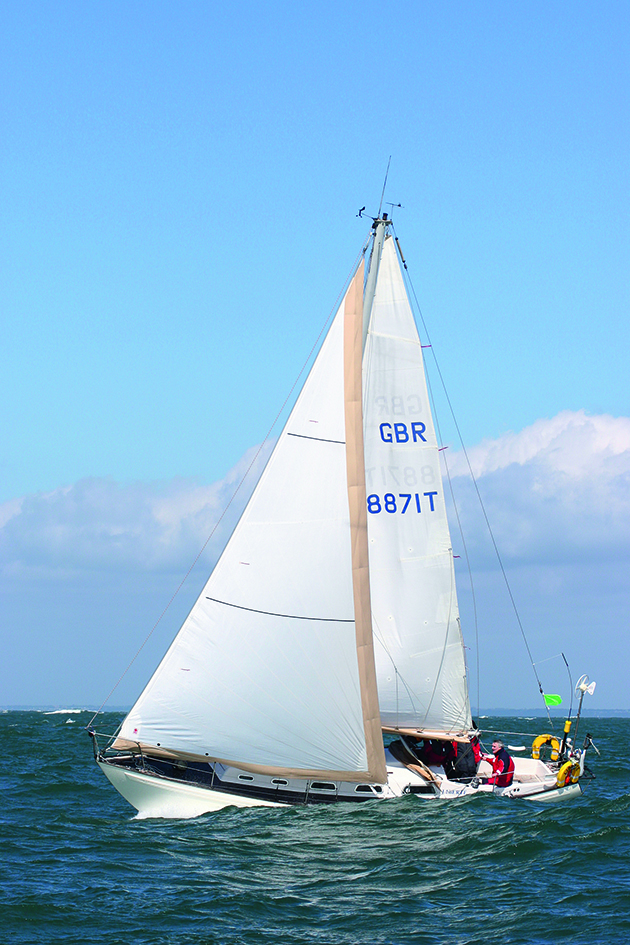
The Rival 34: ‘pretty well sails herself upwind’. Credit: David Harding
Hales told me that it was one of the roughest OSTARs ever, adding that: ‘Out of 126 entries, only 76 finished. Wild Rival, a deep-keel version of the 34, took it all in her stride and we finished 23rd. Only two smaller and racier boats came in ahead of us, and we won overall on handicap.’
He even beat Eric Tabarly, who had finished first on the water in his mighty Pen Duick IV. Hales also told me that the 34 was so well balanced that she often sailed herself with the Aries self-steering gear turned off’, and that the high bow proved its worth in the heavy head seas. The only damage was a split mainsail, caused by a
knockdown when Wild Rival was hit by a rogue wave during a storm with winds touching 60 knots.
‘Needless to say,’ Hales added, ‘Wild Rival was straight back on her feet!’
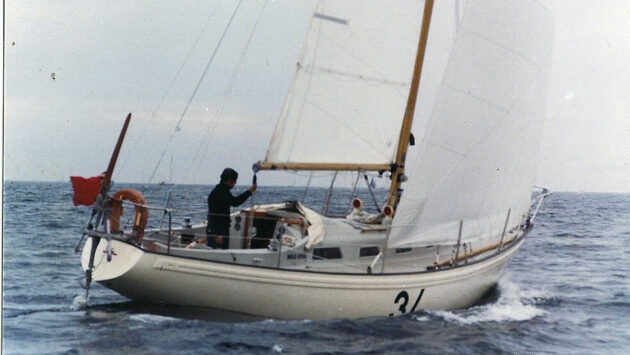
Peter Brett’s own Rival 34, Wild Rival, is an OSTAR veteran and is still sailing today
Wild Rival was also owned by Steve and Cathy Lacey. They told me, ‘Our sailing has been constrained to the South Coast, Normandy, Brittany and the Channel Islands but we have aspirations to explore the Baltic once work ceases to get in the way.
‘Wild Rival looks after us well, and with a new main, feathering prop and a clean bottom, charges along at a reasonably satisfying pace. Reaching at 8 knots or more in a stiff breeze is not uncommon.
‘With a well-balanced helm, and a comforting degree of ruggedness in her design, she copes well with whatever the elements throw at her,’ they said. ‘In terms of maintenance, we have replaced the standing rigging and the main, upgraded the electronics and replaced the 38-year-old engine and propeller.
‘Down below, the replacement of the gas stove with a Taylor’s paraffin one and the installation of oil lamps all maintain the image of the boat. Forty years young this
year, hopefully Wild Rival will keep sailing for several decades to come.’
Test of time
To get a professional opinion on how the Rival 34 (of which over 170 were built) has stood the test of time, I spoke to experienced Scottish yacht surveyor Ian Nicolson. When I heard he had changed his championship-winning Sigma 33 for a Rival 34, I was keen to hear his opinions on his latest and, without being uncharitable to Rivals, somewhat less sporty yacht.
He told me: ‘Restoration of my Rival 34 was a middle-of-the-road job. I worked on her over three-and-a-half winters and now she’s more comfortable – these boats tend
to be basically safe and not a lot was needed structurally.’
What about her handling and performance? ‘When I get our Rival into a tight marina berth with half a gale on the beam, I wish she had the short keel of the Sigma 33 for swift, tight turning.
‘But when I am out alone and have not linked up the autopilot, the Rival’s steady plod in one predetermined direction is an asset. In squally conditions the Sigma
needed firm handling, and we won races by keeping the boat on its feet, while others were broaching. There are none of these problems with the Rival. If I had a
choice for Scotland I would go for the would go for the deep-draught version.’
I’ll leave the last word on the 34 to single-hander extraordinaire Geoff Hales: ‘I think the deep 34 was and still is an excellent cruiser and passage-maker. She is very well balanced and pretty well sails herself upwind with little work for the helmsman or Aries. She’s pretty relaxed about less-than-ideal sail trim or sail area, which for a non-racer could save a lot of work.’
Rival Yachts gets bigger
Following on from the Rival 34, Brett then gambled on going considerably bigger. The Rival 41 came out in 1973 and was offered as either an aft cockpit model, usually with sloop or cutter rig, or centre cockpit – usually with a ketch rig. Some owners like the idea of a smaller forepeak and separate aft cabin with twin berths and its own ensuite heads. Others prefer the traditional looks of the aft cockpit version.
Either way, she is a true Rival and is much sought after as a superb bluewater cruiser. At 22,046lb (10,000kg), her long fin and skeg hull has power aplenty, and Southern Boatbuilding’s craftsmanship and distinctive internal finish put the Rival 41 in a different league to the average production boat of the time.
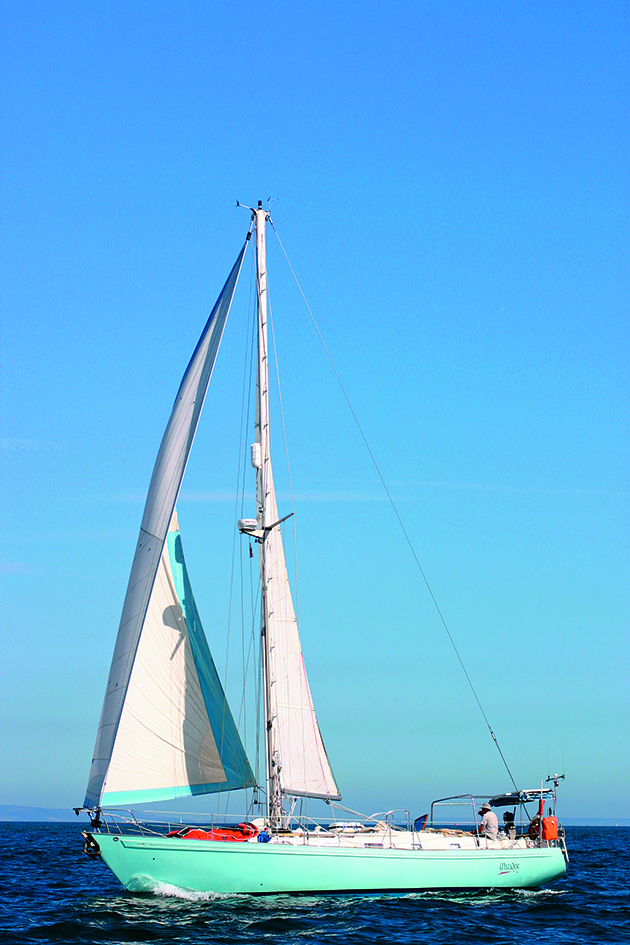
The Rival 41 from 1973 was offered with either an aft or centre cockpit. Credit: David Harding
The new Rival 38 then followed hot on the 41’s heels. Geoff Hales teamed up with Chris Smith, the initiator of the AZAB race, to enter the new 38 Lone Rival in the 1978 Round Britain Race. Then he went solo again for the 1979 AZAB – an event that featured nine Rivals in its entry list: four 32s, four 34s and Geoff’s 38. When it came to overall performance, Hales told me: ‘I don’t think the 38 was as good upwind as the 34, but it flew as soon as you could crack off.’
All the Rivals’ popularity for short- or single-handed sailing can, Hales says, be attributed to their solidity and ability to give the crew an easy, comfortable ride. Their moderate to heavy displacement gives a motion that’s steady rather than erratic. Their hull design’s inherent balance lends itself to self-steering. And all of these desirable qualities appeal as much to less adventurous sailors who just cruise the Channel as they do to the ocean voyagers.
I was once lucky enough to be part of a magazine testing team and took an early Rival 38 sailing into the teeth of a full gale. And it was an experience. Having reefed down a bit – but not a lot– we snuggled into the cockpit, ground in the sheets, pointed as close to the wind as we could and chucked the boat at the onrushing seas. And guess what? Everything they say is true. She settled into an easy groove, surged rather than slammed over the waves and was so balanced that I barely needed to touch the beautifully-varnished new wheel.
Rival survivor
Rachel and Paul Chandler, who were kidnapped and released by Somali pirates, told me that their Rival 38 Lynn Rival “was once owned by a friend’s parents and based in Greece. At first she seemed much bigger than anything we’d aspire to, and we didn’t think we’d ever be committed enough to own a cruising yacht. But by 1995 we’d fallen in love with her so we took her on, gave up our other interests, found someone to share her with us, and haven’t looked back.’
When I asked Rachel why the Chandlers bought a Rival 38 in the first place, she said: ‘Her sea-kindliness is the overriding factor, but the fact that she’s aesthetically pleasing is important too. Perhaps the two are related?
‘Our Aries vane gear is one of the most important pieces of equipment on the boat. We have an electric autopilot and use it when manoeuvring under power, but
would not rely on it in heavy seas.
‘Perhaps the most useful innovations have been LED lights and a gennaker. We’re wary of adding things that increase our power consumption, but as liveaboards we have added plenty (fridge, computer, SSB radio, washdown pump etc) and treasure our solar panels and Rutland wind turbine for the added comforts that they allow.’
Last of the Rival Yachts line
The last Brett-designed Rival – before Southern Boatbuilding amalgamated with Bowman, then Starlight, then hit the buffers – was the Rival 36. She followed the by-now-established Brett formula of generous displacement (14,250lb/6,464kg) and moderate beam (11ft/3.35m). Her DLR comes out at 319. This is a smidge sportier
than the 32 and 34 (350), but less so than the 38 (300).
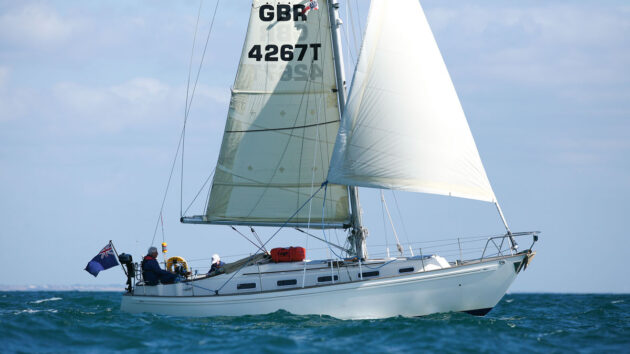
The Rival 36 was the last to be designed by Peter Brett. Credit: David Harding
The 36’s keel choice is centreboard, Scheel or deep-draught fin keel. Visually, she is perhaps the prettiest of the lot and close on 80 were built. They are cruised extensively, and one Dutch 36 owner has sailed around the world – twice!
After Peter Brett died in 1983, later and larger Rivals – called Rival Bowmans – were designed by Chuck Paine, but that’s another story. Meanwhile, the
Rival Owners’ Association remains as active as ever.
Sheer joy
Perhaps I should finish the Rival Yachts story as I started, with words from Eric Faber’s book The Cruise of Luna Quest.
Describing a mid-Atlantic day in his Rival 38’s ARC adventure, he writes: ‘Towards the end of the first week, when the wind picked up to F6 touching F7, and Luna Quest was regularly making nine knots, a speed probably in excess of her theoretical hull speed, we had made up for lost time and overtaken many of our competitors. The strong winds produced some mighty seas that came running up behind us, threatening to engulf our little home, but each time the wave would break just shy of the stern, sending foam either side of the boat. Luna Quest almost surfed down the larger ones. The sky and ocean remained a brilliant blue. The Parasail billowed taut. It was sheer joy to experience the use of these forces of nature…’
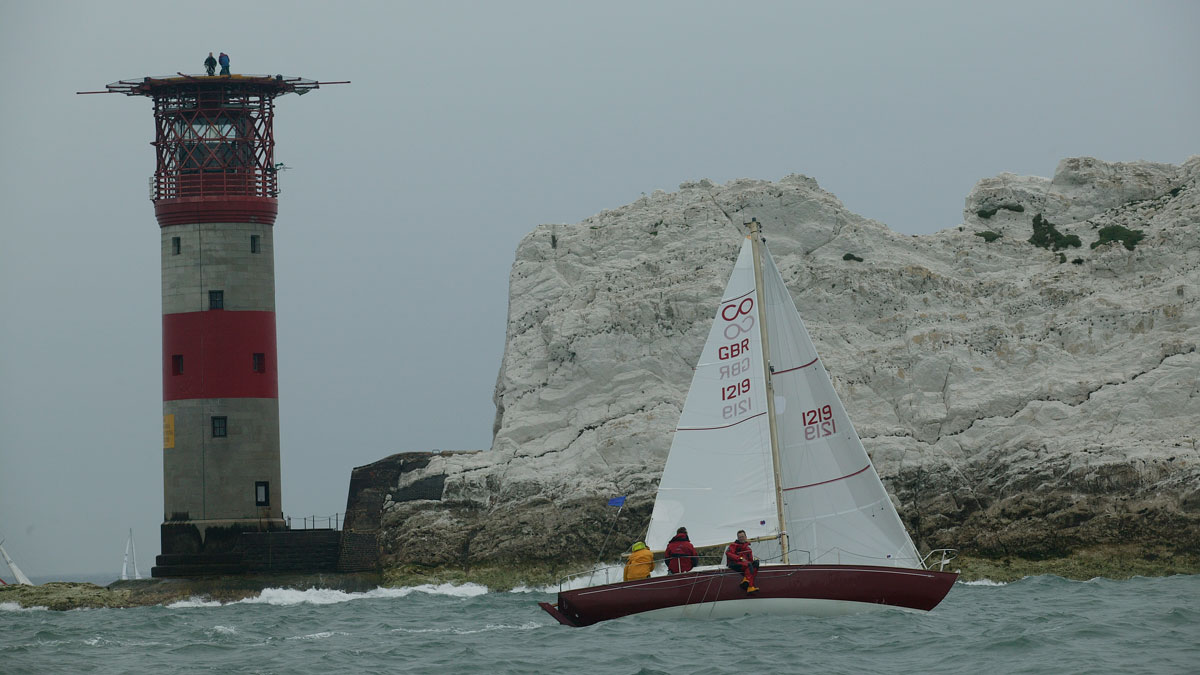
Contessa 26: a true legend
Peter Poland recounts the story of the Contessa 26, one of the most able, famous and popular compact long-keeled cruiser-racers
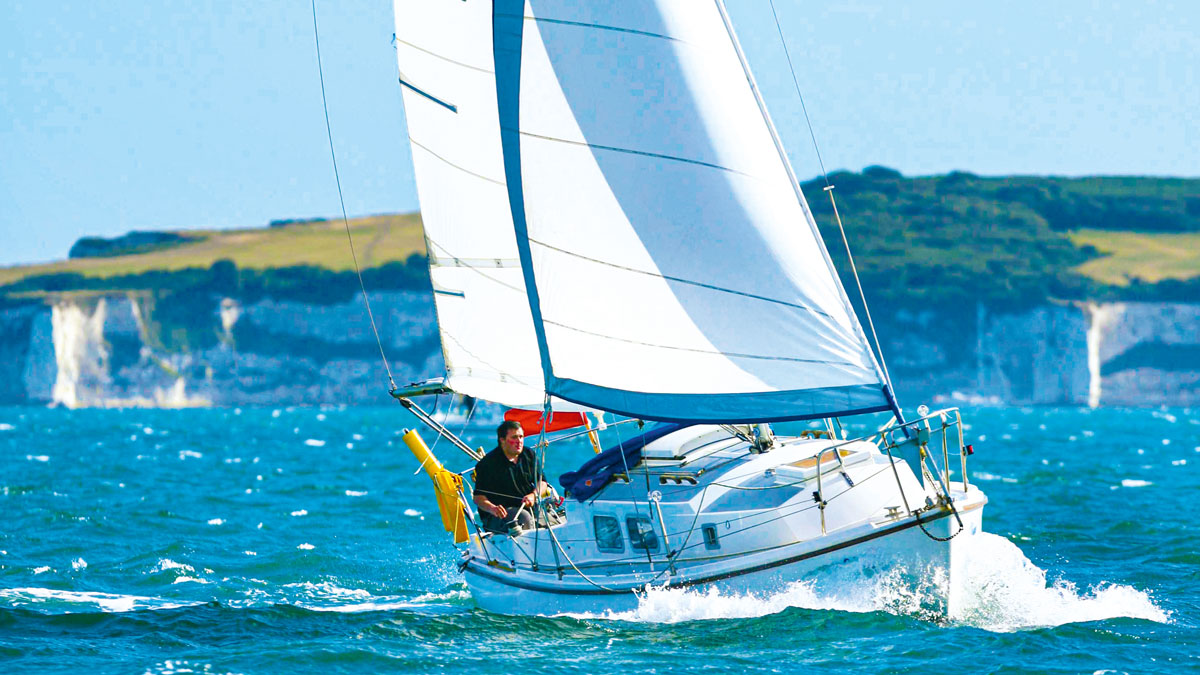
Westerly Centaur: Britain’s most popular yacht
Rupert Holmes analyses the pros and cons for today’s boat owners of the most popular cruising yacht ever built in…

Best Hallberg-Rassy sailboats: The evolution of a Swedish sailing icon
Hallberg-Rassy has been in the same family ownership since Christoph Rassy bought Harry Hallberg’s boatbuilding business in 1972 and formed…
Your ultimate checklist to prepare your yacht’s systems for an ocean crossing
Completing an ocean crossing, such as the traditional transatlantic passage from the Canaries to the Caribbean, is a bucket list…
Want to read more articles like Rival Yachts: the cruising boats built for anything?
A subscription to Practical Boat Owner magazine costs around 40% less than the cover price.
Print and digital editions are available through Magazines Direct – where you can also find the latest deals.
PBO is packed with information to help you get the most from boat ownership – whether sail or power.
-
-
-
- Take your DIY skills to the next level with trusted advice on boat maintenance and repairs
- Impartial, in-depth gear reviews
- Practical cruising tips for making the most of your time afloat
-
-
Follow us on Facebook, Instagram, TikTok and Twitter
PBO web categories