




Topping up the batteries with solar power has never been easier, says Ali Wood, but how do you decide which type to buy?
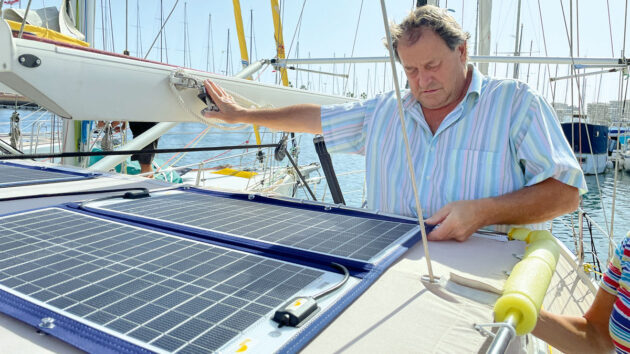
Solar technology has improved vastly over the past decade, so much so that yachts today can handle much of their power requirements through renewable energy. It’s rare to see a cruising yacht without some kind of arrangement of boat solar panels, whether that’s a single panel fixed to the guardrails, or a dedicated arch and flexible panels on the foredeck and coachroof.
By converting sunlight into battery power, boat solar panels reduce the amount of money you need to spend on fuel, as well as giving you the freedom to moor outside of marinas. And, of course, in addition to reducing your expenditure, you’re lowering your carbon footprint.
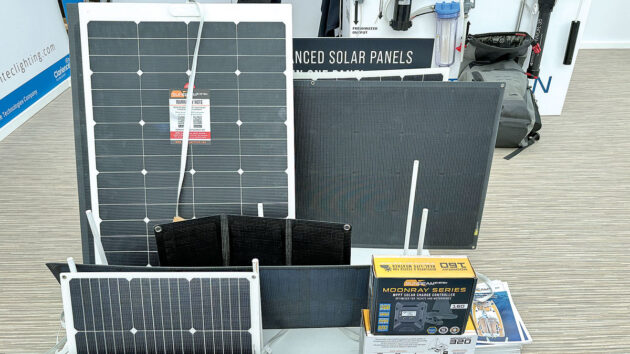
The Sunbeam solar panel system. The box in the bottom right is the controller, which is essential for moderating the battery charge. This comes in different capacities. Credit Ali Wood
You might just want a solar panel to trickle-charge your battery when your boat’s unattended, but on the other hand, a generous arrangement (provided you have enough space) could cover autopilot, radio, lights and even the fridge.
On most boats, though, a hybrid solution, including wind generation, and to a lesser extent hydro power, will be the answer to going completely off-grid, and if you invest wisely and ask the right questions, your solar panels will soon pay you back.
Trade tips on boat solar panels
Marlec Engineering equipped record-breaking sailor Jazz Turner with wind and solar power, allowing her to sail her 27ft Albin Vega FEAR solo, non-stop round the UK and Ireland, becoming the first disabled person to do so. “Jazz is incredible, really inspirational,” says managing director Adrian Dennis. “She wasn’t allowed to touch land or start the engine, so she had to do the whole journey on renewable power. We had to come up with a system that worked for long distances over day and night hours.”
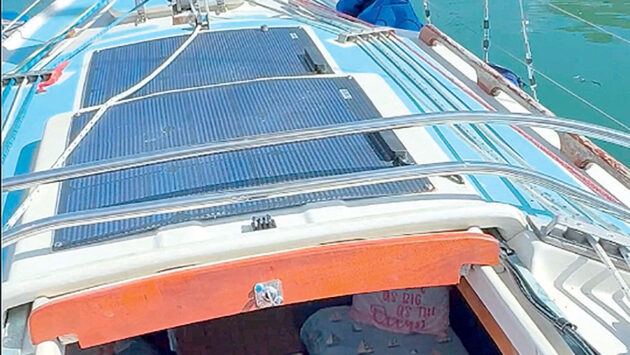
Jazz Turner’s boat FEAR is fitted with Spectra semi-flexible solar panels and a Rutland 914 Windcharger. Credit: Laura Hodgetts
Dennis explains that for anyone doing a long passage, solar alone is not sufficient. “People like to have redundancy with dual charging methods rather than one. In northern Europe or even the Med in winter, you might get 60% to 70% of energy from wind, and the rest solar, but in the Caribbean it could be the complete opposite. It depends on your size of boat too. On a smaller boat, like Jazz’s, you have very little space – enough for 100W if that, while a wind turbine could produce up to 300W in the right conditions.”
Adrian Gray is commodore of the Royal Western Yacht Club and director of Global Distribution Solutions (GDS). He supplies solar panels to the trade and advises boat owners. “The buzz-word right now is ‘power draw’,” he says. “You want to keep it as low as possible. Watermakers, for example, can take up a huge amount of power, so it’s about getting the most efficient watermaker with the most efficient electronics and renewables. Marinas are becoming expensive and our customers want to be off grid.”
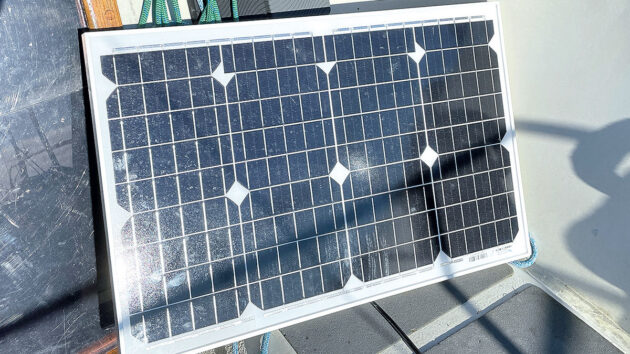
This Victron solar panel kept the batteries charged on the PBO Project Boat
Gray explains that a lot of customers these days are looking for non-slip flexible panels so they can be mounted on the deck. “With rigid panels, you’re always trying to prop them up and if you don’t, they crack. Our SUNBEAM panels, on the other hand, are slightly flexible; enough to bend to the shape of the boat, and they come with sticky tape so you can stick them straight down.
“Some people use an electrician to install them, some don’t. It’s quite straightforward. The key thing is to have the right size controller, otherwise you’re in danger of damaging the batteries through overcharging.”
Marlec also does a range of semi-flexible solar panels, which have a Dupont anti-slip coating.
Calculating energy for boat solar panels
How much solar do you need? The first thing to do is work out your energy requirements. Energy is power accrued over time, so if power is measured in watts, energy is watt-hours (Wh). Add up all the watt-hours used by each device on your boat, such as the fridge, lights, autopilot, chartplotter and so on. Note, if you don’t know the watts, you can find this by multiplying amps by volts.
Once you know your energy requirements, the next step is to decide how much of this will be covered by other means, whether renewables such as hydro- and wind power or simply by running the engine or connecting to shorepower. Weekend sailors may be content with a small panel to recharge the batteries over the course of the week. Or, if you’re laid up, you may just need a trickle-charge from winter sun to ensure batteries don’t go flat while you’re away.
Liveaboard sailors, on the other hand, will be aiming for renewable energy to supply most, if not all, of the boat’s power needs, allowing for peace at anchorage without the need to run the engine. In last year’s ARC (Atlantic Rally for Cruisers), just two boats carried less than 50W of solar, and most carried an average of around 800W, with one boat, a Catana 65, carrying 6,000W.
In addition to solar chargers, many sailors had wind, hydro and fuel-powered generators. We asked three transatlantic sailors to tell us about their offshore power setup.
Carol Wu, sailing on Aria Legra, had to switch off all electronics except the tricolour when her alternator failed. With no means of charging the battery, she had to rely on a 48W rigid solar panel and two removable 120W flexible ones. She wished she’d had more, but deck space was limited on the 34ft Hallberg-Rassy.
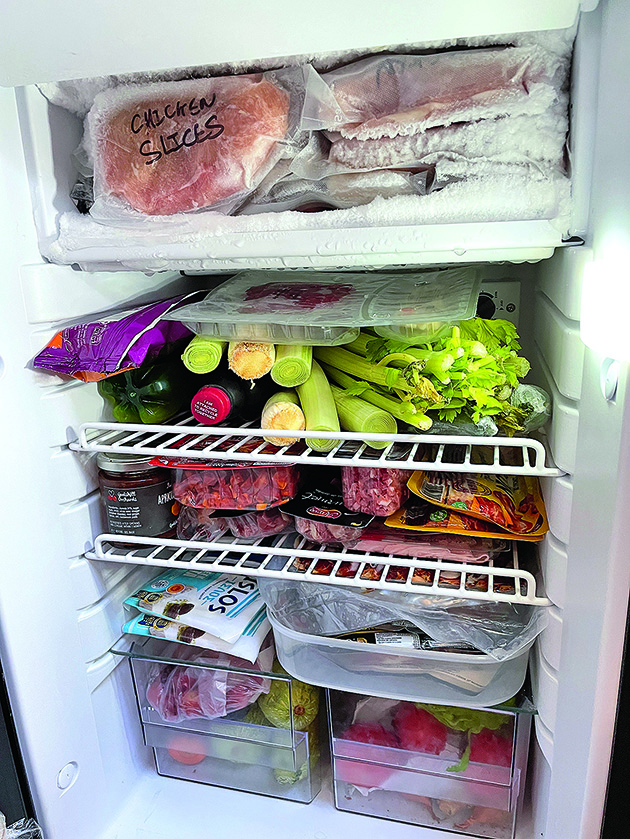
A fridge-freezer pulls a huge draw. Solar power will help keep it powered up during the day, but a secondary renewable source, such as a wind generator, is a good idea. Credit: Ali Wood
James Kenning had 300W of solar power on his Regina 43 Arkyla but said in future he’d aim to at least double this. “Siting panels is crucial to avoid likely shade during a passage. After about 1400, when the sun was mostly off the bow, the solar panels on the arch and bimini were shielded by the twin headsails,” he explained.
Even Rasmus Haurum Christensen, with 1,000W of boat solar panels on his Beneteau Oceanis 423, found that his power-hungry equipment – such as radar, chartplotter, autopilot, freezer, Starlink and watermaker – left the batteries a little on the low side each morning.
Sunlight hours
Once you know your energy requirements, the next step is to determine how much sunlight your boat will receive in a day. You can then use the following formula to work out what capacity of boat solar panels you need.
Energy required (Wh) ÷ Sunlight hours
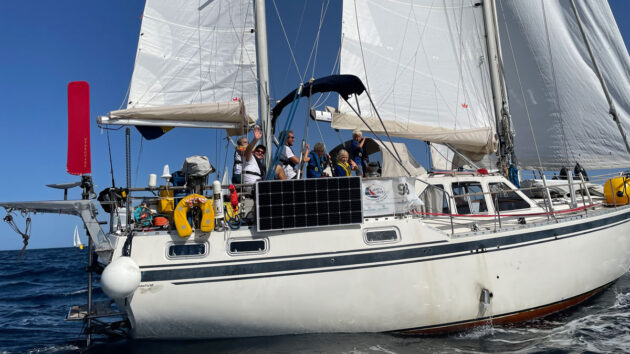
Solar power will reduce reliance on the engine for charging batteries. Credit: Ali Wood
Buying considerations
Many solar panel companies also sell to homes and RVs, so it’s important to check that the ones you’re buying are saltwater resistant. Even those advertised as ‘boat solar panels’ may only be suitable for inland waterways. We’ve all cursed the cost of ‘marine’ products when there appear to be perfectly serviceable ones in hardware stores at a fraction of the cost, but when it comes to boat solar panels, you really do need to go for marine ones so they can withstand the harsh conditions at sea, including salt, spray and impact.
A better option, to maximise space and get the best solar setup for your money, is to contact a marine supplier such as Marlec, which advises the British Marine Federation, or an expert such as Adrian Gray of GDS, who PBO spoke to recently at the Southampton International Boat Show.
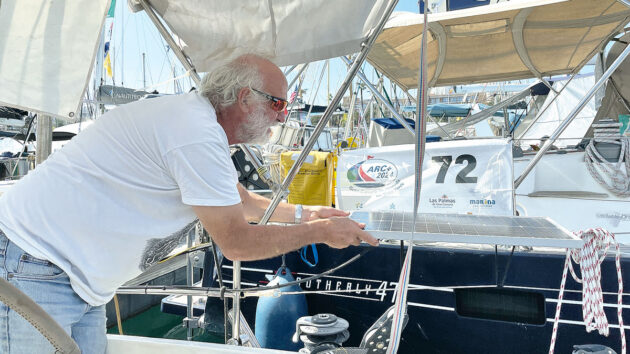
Simon Ridley adjusts the solar panel on his Swan 46 solar arch to maximise efficiency. Credit: Ali Wood
By taking your energy calculations to a specialist, he or she can advise on the ideal combination of panels to reach this amount. Or, alternatively, the specialist might ask what size area you have and work backwards, advising the maximum wattage for that space.
“The other important factor is whether you want your boat solar panels to be permanent or a temporary installation,” adds Gray. “That affects where you put them, for example on the bimini or deck.”
You might find, when you’ve consulted with a specialist, there’s a better solar and/or wind arrangement suited to your needs. For example, Marlec has software which can calculate the amount of power the solar will generate in any GPS location according to the size of boat and where the panels are mounted.
“We do off-grid installations for highways, telecoms and rail,” says sales director Stuart James. “It’s all the same principle, whether to power a boat, a recreational vehicle or a telecoms mast in the Andes.”
Shadow optimisation
You might think that if a shadow was cast over half a solar panel, you’d lose only half the output. Surprisingly, though, even just a single cell in shade can reduce the total output by up to 80%.
On a crystalline panel, even the stripe of a rope’s shadow can wipe out a huge amount of the potential output power. Remember the old Christmas tree lights; how if one bulb blew, the entire lot went out? This was because they were wired in series – where the positive terminal of each panel is wired to the negative terminal of another.
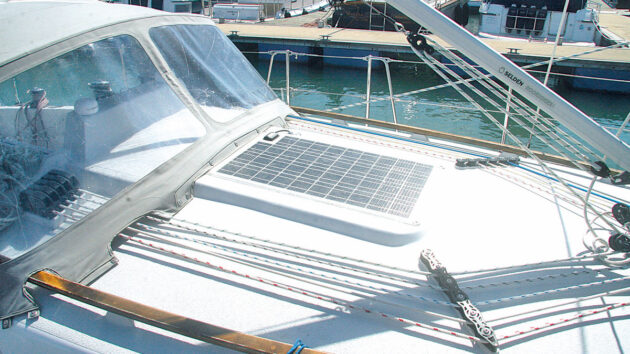
Choose your site carefully – this Sunware semi-flexible panel will be shaded by the boom, reducing its output. Credit: Sarah Norbury
Well, it’s a similar story with boat solar panels. A solar panel is made up of a number of modules, each containing cells connected in series, and those cells must operate with the same current. When a cell is shadowed its output current is reduced, meaning all other cells in the module operate at a lower current.
Excess energy is dissipated in the shadowed cell as heat. The loss is further compounded if the modules in a solar panel, like the cells, are also connected in series. While not generally an issue for solar panels on roofs, on a boat, where you have sails and a boom to contend with, this can be a real problem.
The good news, however, is that some boat solar panels today can be wired in parallel (where all the positive terminals are connected together, as are the negative terminals). This means they’ll continue to work independently of each other, no matter what happens to the rest of the system.
So rather than shade shutting down the whole module, it takes out just the one cell. The upshot is you get much more power from a solar panel today than you would have done a few years ago.
Other ways to improve shadow optimisation include the use of MPPT (maximum power point tracking) devices which adjust the shaded panel’s voltage and current to optimise its output, and bypass diodes which provide alternative pathways allowing current to flow around the shaded cells.
Quoted wattage
It’s important to note that a solar panel produces its maximum output when the sun is directly overhead. Solar cell efficacy is quoted as a percentage, explains Gray, and actually, normal cells are around 20% to 22% efficient.
At the higher end of the solar panel range, you might be looking at 26% efficiency. Note that solar cell efficiency is different to rated power, which we’ll come to later in the article.
Passivated Emitter and Rear Contact (PERC) technology allows the cell to absorb more light than conventional cells, improving efficiency in low light conditions by 15%. You may also come across the term ‘shingled cell module’, which refers to the way that sliced solar cells are overlapped so there are no inactive spaces.
Solar panels typically range from 40W to 850W but will you get the quoted wattage? The short answer is no. A solar panel’s rated output is specified at an irradiance of 1000W/m² (the average irradiance at solar noon in direct sunlight at the earth’s surface).
This is called ‘solar panel efficiency’. It is essentially the amount of natural light a solar panel can convert into electricity in lab conditions. However, there are losses in both the charging and discharging processes of the battery, among other factors.
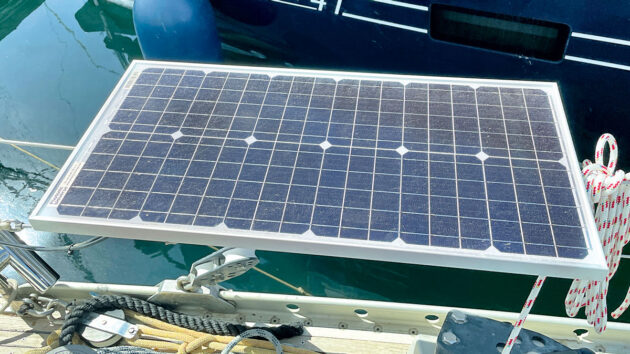
Rigid solar panels offer the most power for the least money. Credit: Ali Wood
If a high-end solar panel quotes a solar panel efficiency of 26%, this means that for every 100W of sunlight that hits the panel, you get 26W of power, or in other words, 26% of the sunlight is turned into usable energy.
A more efficient panel converts a greater percentage of this sunlight, producing more power for its size, but the total wattage is also affected by panel size and the number of solar cells it contains.
When a solar panel has a rated power of 100W, this is quoting the peak STC power, not ‘real world’ conditions, but it is still a good starting point. Once you know this and how many hours of peak sunlight you expect to see (probably around 3-5 hours), you can estimate the watts of electricity each panel will produce as follows:
P (rated power in watts) x H (peak sunlight hours) = Total energy output in Wh
So, a 100W panel x 3 peak sunlight hours will give around 300Wh total energy over the course of a day. But bear in mind factors such as shade, temperature, panel angle and cloud cover prevent a solar panel from generating its full rated power, so you could get as little as 25W per hour from a 100W panel on a cloudy day, up to 90W in bright sunny conditions. Gray warns, “It’s best not to bank on achieving a particular number, though. It really depends on the angle of the sun and where you are.”
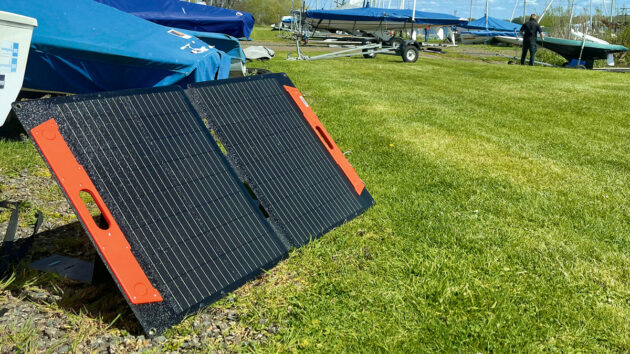
A foldable solar panel, such as this Spectra one, is a good way to top up batteries when your boat’s laid up. Credit: Spectra/Marlec
The declination of the sun over the course of the day can be partly remedied by tilting boat solar panels, but as the sun declines, the light has to pass at a more oblique angle through the atmosphere, hence losing power. Atmospheric conditions such as dust, haze or cloud will affect the efficiency, as will heat.
A panel’s output is reduced by 5% for every 10°C rise in temperature greater than 25°C, so it is actually possible to get a higher output from a boat solar panel in cooler northern latitudes than on the Equator!
Rigid, flexible and portable
Rigid, or ‘glass fronted’ solar panels fit onto a non-flexible frame. If you have plenty of flat space on a solar arch, coachroof or deck, these can be the most cost-effective and durable option. While they offer a higher energy output than flexible panels, they have a glass front so you can’t walk on them.
They come in both monocrystalline and polycrystalline options. As rigid panels are used in mass applications on land, and share some of the same components, they’re much cheaper to produce and offer the most power for the lowest cost.
For curved and irregular edges, flexible boat solar panels may be a better option. These are lighter too – ideal if weight is a factor, such as in a racing boat. They also have a non-slip surface, so you can walk on them.
However, they are restricted to only using amorphous technology, so are the least efficient option. They’re comparatively expensive, as there’s low demand for them outside of the marine industry.
Note that when we use the term ‘flexible’, we really mean semi-flexible. No solar panel is truly bendable, as the connections will be broken, but it should be flexible enough to fit the slightly curved surface of a deck.
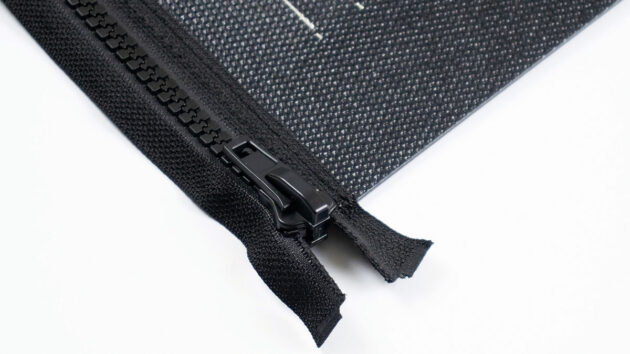
The Spectra Semi Flexible Zipper can be zipped to a bimini or removed when not in use. Credit: Spectra/Marlec
Some flexible panels are fully portable, so can be folded and put away at the end of the day, a good option for prolonging their life on smaller boats where space is at a premium.
Marlec produces the Spectra SemiFlex Zipper panel, which attaches to a panel sewn onto the bimini, and has two robust zippers so you can remove it when not in use. It might be that a combination of flexible panels on deck and solid-framed glass panels mounted on a solar arch gives the right setup for your boat.
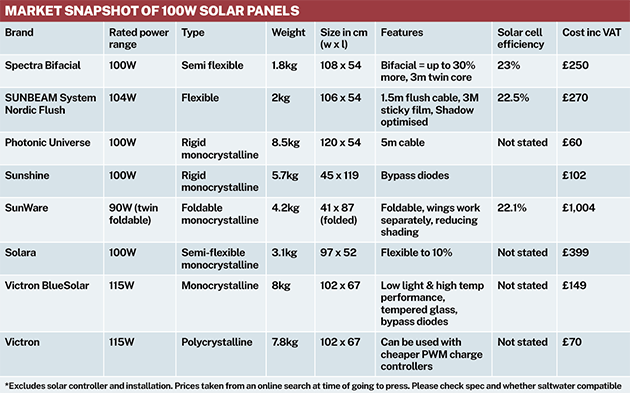
To maximise available space, there are even some solar products, such as SUNBEAM System’s ‘Gap Filler’, which comes in 106cm x 54cm sheets, that can be cut to custom shapes.
Mono or poly
Rigid crystalline panels have photovoltaic cells made of silicon (the same type as in electronic gadgets), but the difference between mono- and polycrystalline is the configuration. Monocrystalline panels are more widely available and have black cells made of single crystals.
These offer a higher efficiency at a higher price, whereas the cells in polycrystalline panels are made of multiple silicon crystal fragments that are melded together during manufacturing.
“Poly is a bit of an outgoing material now,” says Stuart James of Marlec. “It tends to be more common to make rigid panels out of mono PERC cells these days.”
Amorphous
Unlike crystalline panels, flexible amorphous technology uses a thin slice of active silicon on a solid or flexible backing sandwiched between rubber and polymer covers, allowing them to withstand the pressure of being walked on.
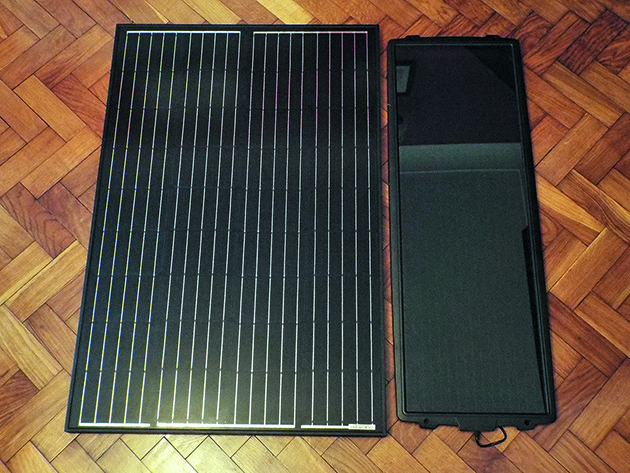
The smaller amorphous panel is 15W and the larger crystalline panel is 100W. So the larger panel is approximately twice the area but seven times the power. Credit: David Berry
Although not considered very efficient, these flexible panels have ‘bypass diodes’ that turn off shaded cells and create new pathways around them so you don’t lose as much energy in the shade.
The layered construction of newer amorphous solar panels allows them to absorb different colours of the solar spectrum, so they work harder in lower light conditions; ideal for shady moorings and northern climes, but they are on the large side for the given wattage.
Cables
The longer the cable, the more energy will be lost as it travels towards your battery, so it’s best to position your solar panels with the wires as short as possible. Some solar panel ranges, such as those by Sunbeam, offer flat cables. To minimise cable losses and prevent potential cable overheating, large-core cables are needed.
Resistance is also proportional to the length of the cable, so long cables need to be even fatter than short ones.
Gantry or surface-mounted
Surface-mounted solar panels are, as the name suggests, fixed to the deck with various fastening options such as adhesives, 3M double-sided tape or mounting hardware.
Lightweight and flexible, they can be trodden on with deck shoes or bare feet, and when used temporarily can be moved into the sun and away from shade.
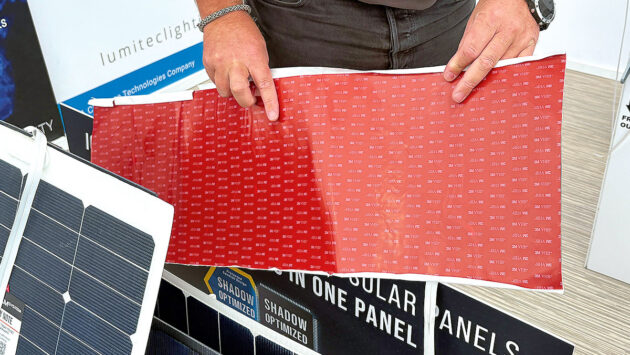
This 3M sticky tape is used to fix a solar panel. Credit: Ali Wood
Gantry-mounted solar panels, on the other hand, are fixed to a solid frame with a mounting kit, or by other means, allowing for larger arrays and therefore greater power consumption.
Bifacial
Bifacial panels are an exciting development. A bifacial solar panel can harness power on both the front and back sides of the panel to capture some of the diffused sunlight reflected off the deck. Interestingly, a factor to consider here is ‘albedo’, which is the amount of sunlight a surface can reflect, measured between 0 (none) and 1 (all).
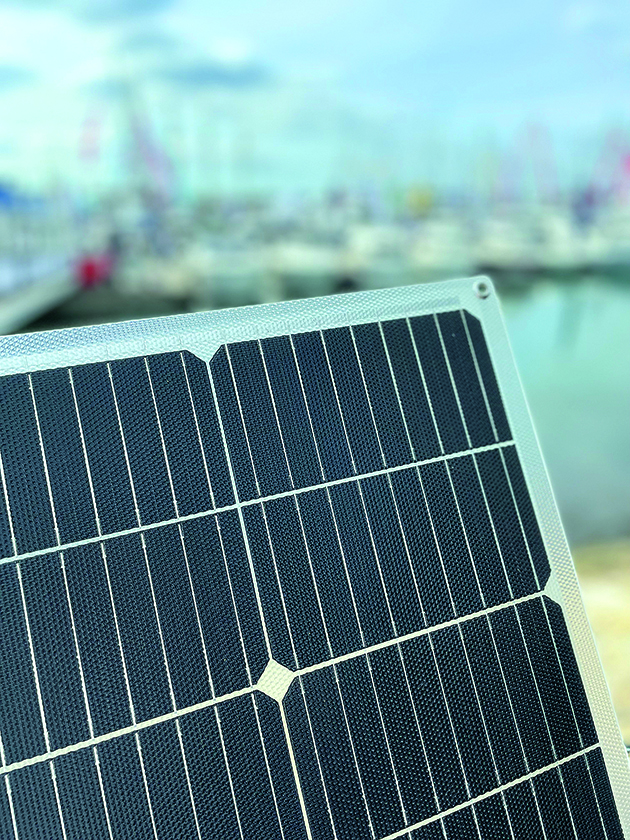
The Spectra bifacial semi-flexible panel catches sunlight on both sides
Black surfaces are close to 0 and white ones to 1, so bifacial panels will work a lot better on a white deck than hanging off the stern of a boat over the dark ocean.
As with standard (or ‘monofacial’) panels, these only state the rated wattage as the front side solar cells, with the reverse side listed in the spec as ‘yield’ or ‘reverse’ gain, and usually written as a percentage.
For example, Spectra’s 100W flexible bifacial panel is rated 100W for its front side, but quotes ‘30% more energy’ from the reverse.
Solar regulator
Whichever solar panels you choose, you also need to factor in the cost of a solar regulator or ‘controller’. This essential piece of kit holds the output voltage at a predetermined value, such as the battery float charge voltage of 13.4V. The value will change depending on the current required by the load.
Older regulators tend to be PWM (pulse width modulation) which is essentially a switch that connects a solar array to the battery. The result is that the voltage of the array will be pulled down to near that of the battery.
An MPPT charger (maximum power point tracking) is more expensive but sophisticated. This adjusts its input voltage to harvest the maximum power from the solar array and transforms it to supply the varying voltage requirement of the battery plus load.
An MPPT will outperform PWM in a cold to temperate climate by around 10-30% while both controllers will perform similarly in a subtropical to tropical climate.
However if you really need every scrap of power then you need to find a way to keep the panel cool and you’ll need to invest in an MPPT regulator. As the panel gets older, its performance will drop off even more.
The future of boat solar panels
Solar technology is improving all the time. Stuart James explains that a new generation of solar cell is on its way, which Marlec is looking to integrate into next year’s panels.
HPBC cells, made by Chinese energy company LONGi, stand for Hybrid Passivated Back Contact. In this type of cell, as opposed to PERC, all the electrical contacts are shifted to the back, reducing shading and allowing sunlight to be captured more efficiently.
“It’s about squeezing more energy from a given space,” he says. “These Longi cells are starting to be used in the domestic housing market and will work their way down.”
With increasing demand for renewables, the cost of solar panels has come down over the past decade. Will the arrival of HPBC solar technology mean current PERC solar panels will become cheaper still?
“Unfortunately, not,” says James. “The Chinese government is taking away tax incentives, so the costs will get passed on to manufacturers. Right now you’re seeing rock bottom prices for solar panels.”
Conclusion
If you’re just fitting a small panel to top-up batteries on a mooring, a cheap 20W rigid panel is absolutely fine. Find places on your boat where you can tilt it to catch the sun’s rays for the majority of the day.
If you spend more time on board and need to get the best from your panels, mono- or polycrystalline panels will give more power from the same space, with monocrystalline being the more efficient option.
But with the higher efficiency comes higher sensitivity to poor mounting conditions, so ensure they’re not shaded, and also that they are tilted as close to a right-angle to the sun as possible. Liveaboards often mount theirs on adjustable gantries at the stern or on the pushpit.
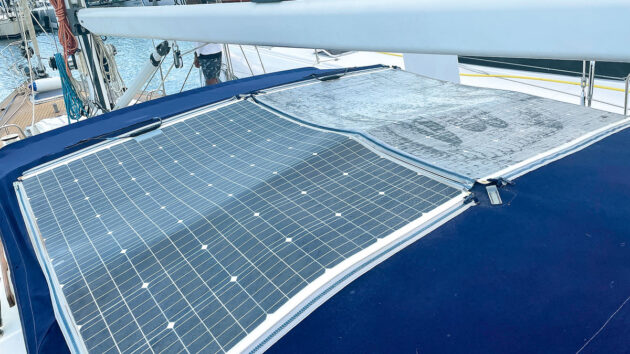
This semi-flexible solar panel is zipped into the bimini. Credit: Ali Wood
For example, sailor Rasmus Haurum Christensen told us that on an east-to-west passage, the sun was always on the port side, so he kept the port panel at 45°, and the starboard one at 0°.
Sarah and Will Curry sail a Leopard 46 catamaran, Kaia II of Vancouver, with young twins. They not only live aboard but run their Hydrovane windvane self-steering gear business from the boat. They have 2,600W of solar power, and though they have a 5,000W inverter, they find they rarely need it as the solar is so great.
“We have an induction stove top, an electric oven, freezer, washing machine and three air conditioning units,” says Sarah. “Really, it’s not that different to what you’d have at home.”
So whatever you’re looking for – a battery top-up or a complete energy solution – there will be a solar configuration for you.
Speak to your marine electrician about the best battery and charger setup, and discuss your space and energy requirements with a solar panel specialist, and hopefully it won’t be long before you’re sailing on sunshine and costly hook-ups are a thing of the past.
How to manage solar, hydro and wind power on your boat
Three transatlantic cruisers share valuable lessons about their onboard power setups, their marine battery choices, and where they went wrong.
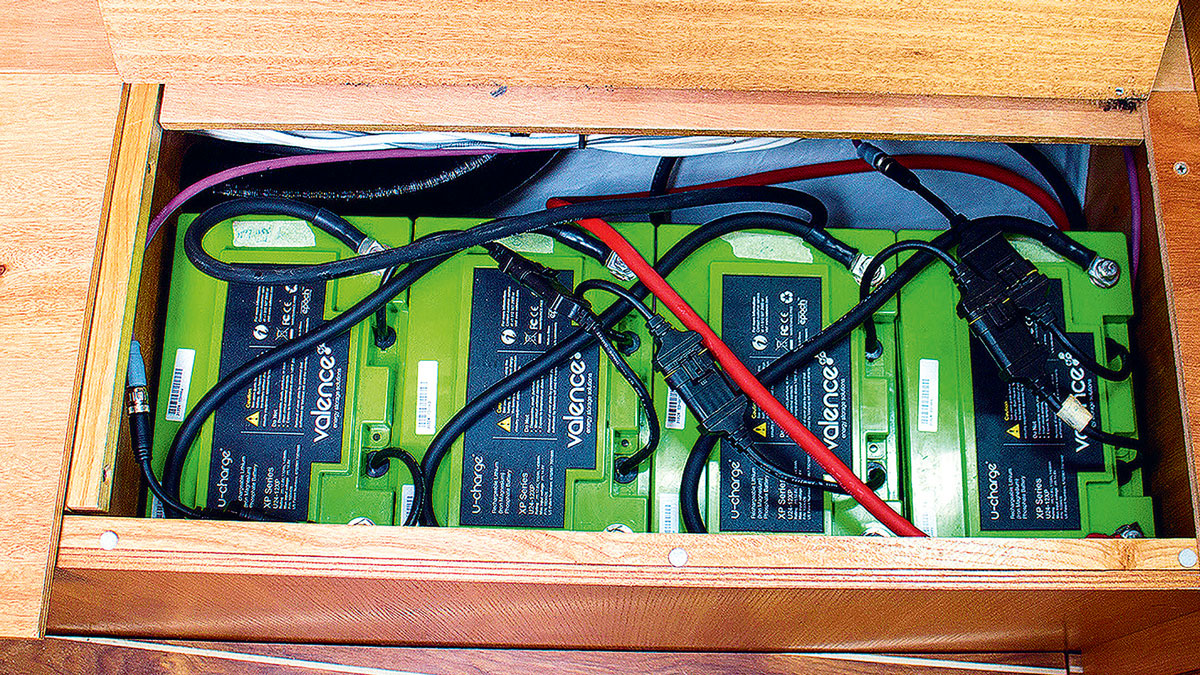
Latest lithium-ion battery installation advice that every boat owner needs to know
Marine engineer and surveyor Marcus Jones unpicks the confusion surrounding the use of lithium batteries and what you should consider…

How a boat solar hot water system works
Jon Walmsley explains how to heat water without a diesel engine
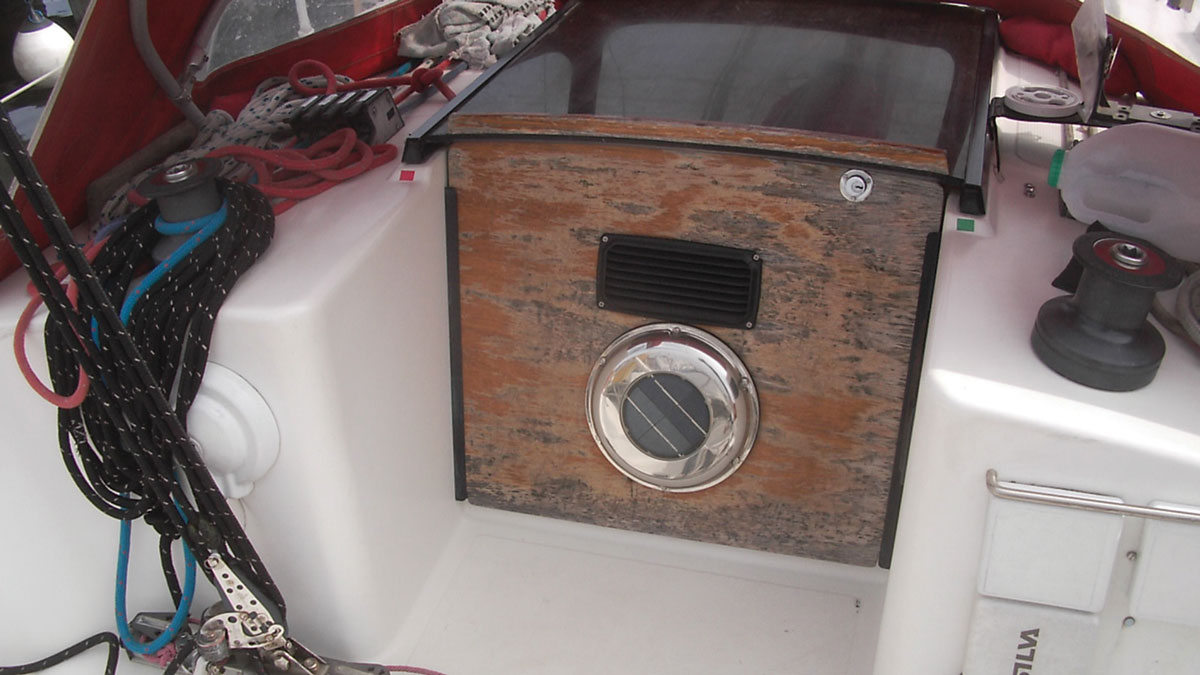
Banish winter damp: install a solar-powered vent
Ten years ago, Colin Haines installed a solar-powered vent on his boat. He shares the results and if it still…
What to read more gear articles like Boat solar panels: Everything you need to know to get started?
A subscription to Practical Boat Owner magazine costs around 40% less than the cover price.
Print and digital editions are available through Magazines Direct – where you can also find the latest deals.
PBO is packed with information to help you get the most from boat ownership – whether sail or power.
-
-
-
- Take your DIY skills to the next level with trusted advice on boat maintenance and repairs
- Impartial, in-depth gear reviews
- Practical cruising tips for making the most of your time afloat
-
-
Follow us on Facebook, Instagram, TikTok and X