


Are two headsails better than one or just twice the bother? David Rainsbury explains why he finds a cutter rig ideal for cruising

Cutter, a name derived from the rig’s ability to cut to windward at speed. In the days of sail the customs and excise boats had a cutter rig, with twin headsails, their speed and windward ability the scourge of smugglers laden with illicit brandy from the Continent. The title ‘customs cutter’ is still applied to HM Revenue and Customs vessels today, even though the sails have long since been replaced with high-powered engines.
Yacht rigs and sail plans have developed through the years, of course, and the cutter is no longer considered the racehorse of the seas – but there are still sound reasons for choosing a cutter rig for cruising.
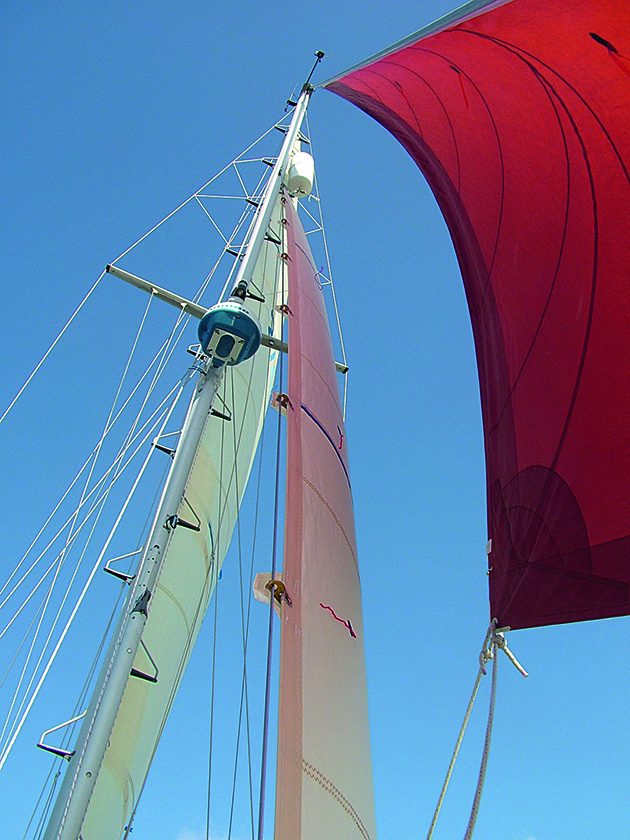
Trimming sails: Three sails, two slots working in harmony. Even with a large effective sail area up front the sheet loads are modest and the yacht is easy to balance up to sail herself
Kate, my Vancouver 27, has a cutter rig and in the short time I’ve been sailing her I have grown to appreciate this flexible, tough and workmanlike rig. I am still learning to get the best out of having two headsails to play with, but she never ceases to impress.
Divide and rule with a cutter rig
The Yankee and the staysail together amount to the area of a good-sized genoa, but instead of tacks involving all that genoa canvas dragging itself around the inner forestay, the Yankee slips easily across and there is nothing to hamper the staysail’s progress onto the other tack. On many cutters the stays’l is self tacking.
The two sails require two sheets each side, and if the staysail is not self tacking (Kate’s isn’t) that means two winches to wind. The loads on each winch are smaller, however, so the winch handle is only called for in fresher winds on the Yankee, and rarely if ever on the staysail. Most of the time you can simply reel the sheets in by hand
A cutter rig needs organisation
The penalty for this ease of sail handling is the need to be very well organised in the tacks, especially when beating in a narrow channel. My routine is as follows:
- Dress the weather winches
- Put the helm down
- Free the Yankee sheet
Then, as she comes through the wind:
- Position the main traveller for the new tack
- Sheet the Yankee on to the new tack
- Free the stays’l and then sheet on to the new tack
- Steer for the new tack
It’s a lot to do and in fresh conditions can be very hard work, especially single-handed. In the name of efficiency some compromises need to be made when short tacking. With the main traveller centred some windward ability may be sacrificed but at least it can then be ignored for the time being.
If searoom is really tight, among moorings for example, I occasionally furl the Yankee, working with the stays’l and main only. This slows things down yet maintains manoeuvrability until there is space to get her moving. To really show its paces the cutter rig needs open water and a clear horizon.
Don’t get caught in the stays
In light airs Kate’s long keel can make her a bit slow to come about. I release the Yankee sheet as I put the helm down but leave the stays’l aback until it has pushed her head through the eye of the wind, dealing with the sheets once she is round onto the new tack.
Downwind with a cutter rig
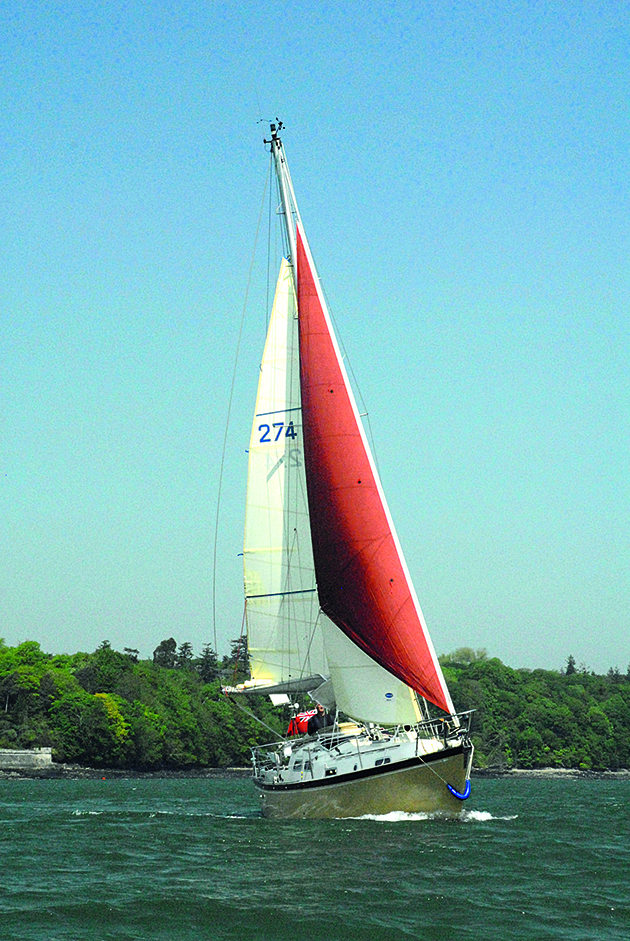
Downwind: Off the wind she is moving very well, but she won’t do a dead run
One of the cutter’s weaknesses is her downwind performance. The stays’l is too small to be of use and is usually blanketed by the main. Also, it can spoil the airflow to the Yankee. One solution is to pull the staysail flat amidships where it will act as a roll damper. Once the genoa or cruising chute is up it is better out of the way and I lower it, flaking it on deck and securing it with sail ties to the foredeck rail.
Some cutters go one further, attaching the inner forestay with a Highfield lever so that this too can be cleared, converting her to a sloop. This gives the best of both worlds, making more space to handle a spinnaker pole or to tack a genoa.
Trimming sail
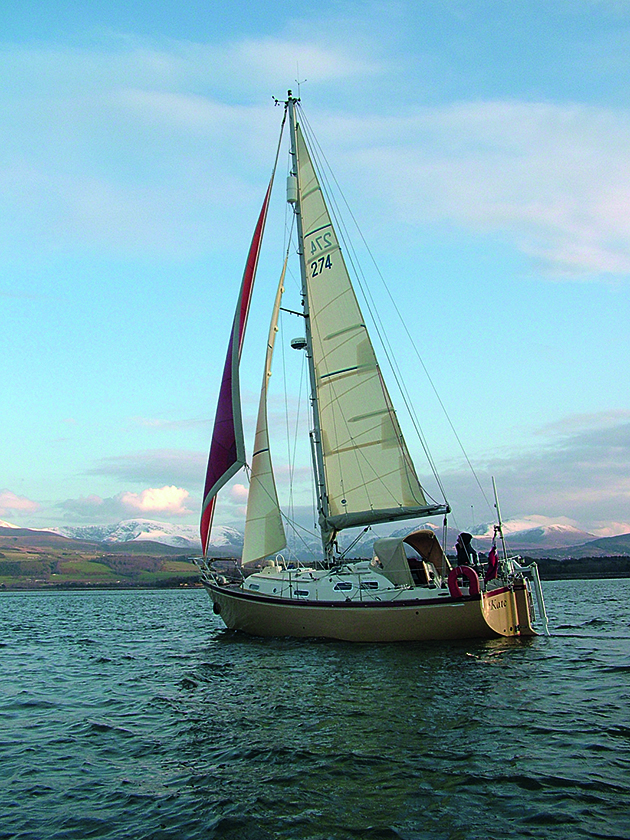
Trimming sails: The Yankee and staysail working together, the camber of each sail creating acceleration in the slot between the sails. Kate’s main is a little over-sheeted and flat here, losing the benefit of that second slot
Two headsails means two slots and for best effect these must work together. As the Yankee directs the airflow to the other sails, I trim this first, though I usually sheet the stays’l hard in first, just to get it out of the way and to be sure it is not disrupting the wind flow over the Yankee. With the Yankee trimmed, I sight up the leech of both headsails and trim the stays’l sheet so that the curves of both leeches appear to be parallel. This gets it somewhere near right and final adjustments are made by looking at the telltales, which should all be streaming aft on the windward side of the Yankee and on both sides of the stays’l.
Finally, the main is trimmed in exactly the same way as for a sloop.
Sailing in stronger winds

SET FOR A GALE With deeply reefed main and stays’l, Kate is still well balanced and moving fast under a sail plan that would fit a Wayfarer dinghy. She does have a storm stays’l – but if you need less sail than pictured here the weather must be very rough indeed
On a sloop rig, reducing the area of the ubiquitous overlapping roller-reefing headsail can lead to inefficient windward performance. As the sail is rolled down, not only does it become baggier, but its raised tack also increases forestay sag and its centre of effort moves further away from that of the mainsail. Balance and pointing ability are compromised at the worst possible time.
On Kate I put one reef in the main first. As wind strength increases I gradually roll up the Yankee, leaving the stays’l set. This keeps the sail plan balanced about the ideal centre of effort and as the sea gets rougher, the working sails are further inboard.
Set for a gale
With about a third of the Yankee rolled up the next step is to put the second reef in the main. The sail plan is then a fraction of normal area but is still balanced and the sail that is set is working efficiently. With the Yankee fully furled and two reefs in the main I estimate that she would carry this sail plan in a gale without difficulty, though I have yet to test the theory for real and I just hope I never feel the need to break out the storm stays’l.
If I know the wind is going to be consistently at or over Force 5 I hoist the jib in place of the Yankee before we put to sea.
Heaving to: the handbrake

Heaving to: With the stays’l aback and the helm down Kate will sit hove-to, slightly head to wind and gently fore-reaching through a nasty blow
Whether for storm survival or for a controlled pause to make lunch, take star sights or compass bearings, or just to make sense of a difficult harbour entrance, the ability of a yacht to heave to and to sit unattended, gently fore-reaching, is essential for a serious cruising yacht.
Kate heaves to perfectly under backed stays’l and eased main. In winds of around Force 5 she will fore-reach at about ¾ of a knot at an attitude about 60° off the wind.
Choosing sails for a cutter rig
It is vital that a cutter’s headsails work together for maximum effect. It is impossible to consider one without reference to the other right from the design stage. Kate’s main and stays’l were made at the Kemp Sails loft, so when buying a new Yankee I sought their advice, and was advised: ‘The clew height and angle are determined firstly by the track position and secondly by trying to get the correct slot between the outer stay and the inner stay. If the slot is wrong then the staysail will be sucked onto the Yankee making it next to useless.’
Pretty as a picture
The cutter is such a pretty rig. With her cream-coloured main and stays’l set off beautifully by her tan Yankee, Kate’s cutter rig is not only practical but very eye- catching, turning heads and receiving compliments wherever she goes.
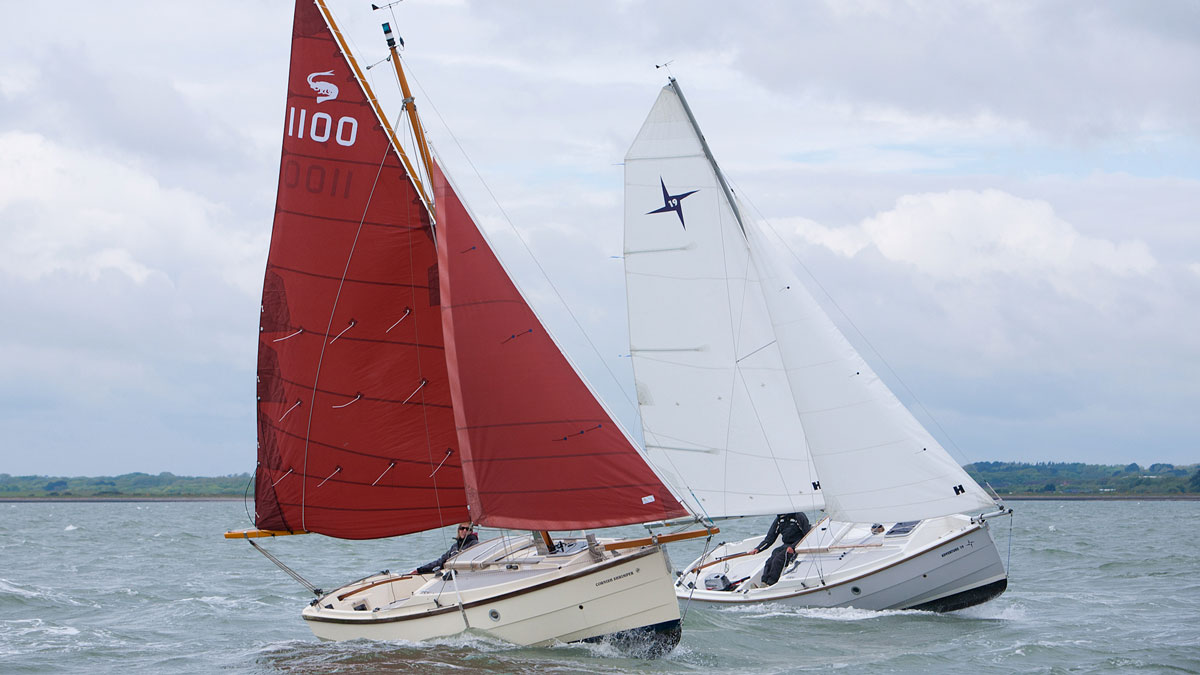
Bermudan vs gaff rigs: Which rig setup wins for coastal cruising?
How better to compare the handling and performance of Bermudan and gaff rigs than on two boats that use the…
Rig tuning for cruising sailors
Point higher and sail faster – every yacht can benefit from an optimal rig setup. Ali Wood finds out from…
Masthead rig modifications for better performance
When a masthead-rigged Hunter couldn’t keep up with the Squibs in the club fleet, the owner realised that something had…
Transatlantic rigging failure: how a professional skipper managed the emergency with a young family onboard
Broken shrouds and two young children onboard during a transatlantic crossing is the ultimate test of seamanship for Vicky Ellis
Want to read more articles like Sailing a cutter rig: How two headsails improve handling and balance for cruising?
A subscription to Practical Boat Owner magazine costs around 40% less than the cover price.
Print and digital editions are available through Magazines Direct – where you can also find the latest deals.
PBO is packed with information to help you get the most from boat ownership – whether sail or power.
-
-
-
- Take your DIY skills to the next level with trusted advice on boat maintenance and repairs
- Impartial, in-depth gear reviews
- Practical cruising tips for making the most of your time afloat
-
-
Follow us on Facebook, Instagram, TikTok and X