




Point higher and sail faster – every yacht can benefit from an optimal rig setup. Ali Wood finds out from the experts how it’s done

Remove the backstay please, requested the yard manager as my Maxi 84 was due to be craned out. My stomach sank. In all the time I’d owned my first yacht I’d not even tweaked the rigging, let alone removed any part of it. I was aware of the importance of rig tuning and tension, but the rig had been declared safe and seaworthy, so I was satisfied.
I had no intention of going racing, so as long as the mast wasn’t going to fall down, I was happy. But now I was embarrassed to admit I didn’t know how to do it. Fortunately, the yard came to my rescue, but it drew to my attention an essential part of my boat I’d mostly ignored. It was time to get to grips with rig tuning; after all, I wouldn’t sail a boat with badly set sails, so why disregard the rig? It turns out I’m not alone in my ignorance.
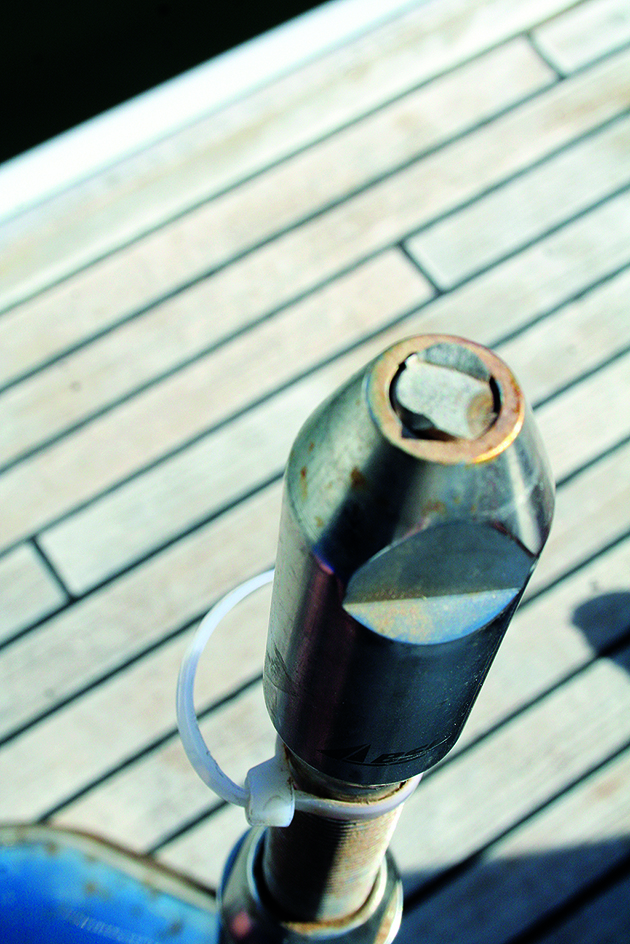
This sheared rod rigging led to an ARC yacht losing its rig. Credit: Ali Wood
PBO’s boat tester David Harding routinely quizzes cruisers about their rig setup. “Oh, it doesn’t matter – I’m not racing,” they reply, but when he shows them the difference a well-tuned rig can make, they agree that cruising faster and more comfortably is definitely better!
Why is rig tuning important?
The number one reason to apply correct rig tension is safety. A well-tuned rig ensures all the strain is taken by the correct elements of the mast, spreaders and wire rigging. A poorly supported mast, on the other hand, is put under all sorts of stresses and in extreme cases dismasting can be the result – something I’ve reported on twice while covering the Atlantic Rally for Cruisers (ARC).
That said, the director of Crusader Sails, Paul Lees, points out that dismasting without warning signs is very rare. “On most boats, the mast is going to stay up. There are very few boats that are so poorly rigged or tuned that the mast is going to fall down as there is such a safety factor in most rigs.”
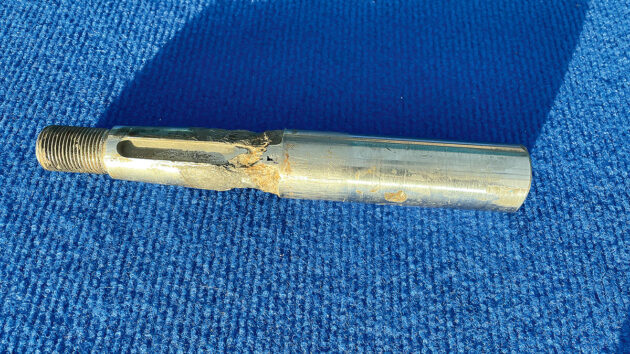
Don’t let your rigging screw reach this state, as found by surveyor Ben Sutcliffe-Davies
Chris Evans of XP Rigging explains that good tuning is also a preventative measure to delay wear and tear. “A rig should be replaced every 30,000 miles or 8-10 years,” he says. “Sooner in the southern hemisphere where it’s subject to higher humidity and salt content. But this is dependent on fittings that are nice and secure under load and working within their design parameters. If they’re flopping around they’re more likely to suffer from cyclic fatigue and surface wear.”
Chris also highlights the importance of replacing fittings. “If you have a wire or termination failure, industry working practice is to replace all of them at the same time, or at the very minimum in pairs. If you have a port lower that fails, for example, you should also replace the starboard one.” Regular rig checks are essential for every boat owner.
Marine surveyor Ben Sutcliffe-Davies points out that rigging or shaft alignment should always be done while the craft is afloat. A proper rig check should consider the age of the wire, chainplate, backstay and forestay security,” he advises. “Make sure you check the mast step for compression issues.”
Over-tuned rigs
Very occasionally, Chris Evans encounters over-tuned rigs, but these are extreme cases. “I might get a call from a boat owner who can’t close the door to the heads, for example,” he says.
“These are relatable and real-world problems – things like lockers not closing! A glassfibre hull has a lot of give in it, and is more flexible than people realise.” This is rarely anything the owner has done, but is down to the boatbuilder or yard. “You can essentially collapse the deck by over-tuning it,” says Chris, “But if you stick to the rule of thumb and tune to 15% of break load, you won’t experience these issues. If you do, you need to speak to a shipwright, surveyor or boatbuilder.”
Under-tuned rigs
Unless you’re sailing a boat that requires a soft rig, such as an X one design (a South Coast day racer), your boat will sail better with a tightly tuned rig. Many boat owners aren’t aware of the difference rig tuning can make. Your sailmaker will have designed your sails to work with the correct rig tension so if the rig’s not right, the sails won’t set properly.
Chris explains: “In simple terms, if the mast is too upright, say 0°, or forward -1°, the boat will struggle to point and sail upwind, but if it’s too raked, ie. +2°, you’re going to struggle with weather helm. It’s what naval architects and sailmakers refer to as ‘balance’; that’s the magic balance point between the sail central loadings and the keel central loadings.”

If you can do just one thing to improve your rig on the water, adjust the backstay. It is a good idea to wear a lifejacket, too
With the right rig setup, you should heel less, point better and have a much lighter helm. Of course, you want your sails performing efficiently too – it’s not just down to your rig. “It’s all related,” adds Chris. “For example, a kicker or a vang will also control the leech profile and how the telltales are dancing.”
There are all sorts of tweaks to be done with the sails and running rigging which are beyond the scope of this article. However, the rig setup is a good place to start and, along with dockside tuning for the conditions, will help you get the most out of your boat.
“It’s unbelievable how many people tell me their boat sails better after I’ve tuned the rig,” says Chris. “For example, on a Westerly Konsort you might get half a knot extra speed but over a day’s passage, that saves a lot of time!”

Correct rig tension improves the efficiency of your sails
If, like me, your preference is to set up your rig and forget about it, the best option is to err towards a strong wind setup, particularly with shroud tension. Rigging that’s under-tensioned puts infinitely more load on the wire, bottlescrews, terminals and hull structure because of the snatch loads every time the boat falls off a wave.
As David Harding points out, “The main reason why undertensioned rigs on cruising boats stay standing as they do is that manufacturers build in enormous margins.”
But even so, proper tension means better performance and greater safety.
Wind strength and direction
While wind direction determines how you trim your sails, it makes little difference when it comes to the rig. Whether you’re on a downwind or upwind passage, the theory is pretty much the same, says Chris Evans. “OK, so if you look at the IMOCA 60s, they’d change their rigs according to the wind direction, but you’re looking at a tiny percent of the world’s top sailors, and even they get it wrong and drop their rigs. For an ARC or long-distance cruiser, wind direction is irrelevant.”
Where rig tension does matter is wind strength – and this is the kind of tuning, or ‘tweaking’ that you do on the dock, or during a passage, as opposed to the initial setup. This is an important distinction. Ideally, each time you go out you should be assessing the weather forecast and wave conditions and tuning the mast appropriately.

In a moderate breeze the leeward shrouds should stay taut
A really rough rule of thumb is that the windier it is the tighter you go. Strong winds require more mast rake and prebend in the rig to help flatten the mainsail, which is usually done by tightening the forestay and backstay. Light airs require softer settings, so you’ll often see racing sailors tweak their rig tensions before a race. If you can do just one thing to improve your boat’s performance, learn to adjust your backstay, advises Chris.
“There are different kinds of backstay; hydraulic or mechanical. Some have ropes with block and tackle on them. In the simplest terms if you want to depower your sails (in strong winds) INCREASE backstay tension. If you want to increase power (in light winds) REDUCE backstay tension. 95% sailors I meet don’t do this, and when I tell them to, it makes such a difference.
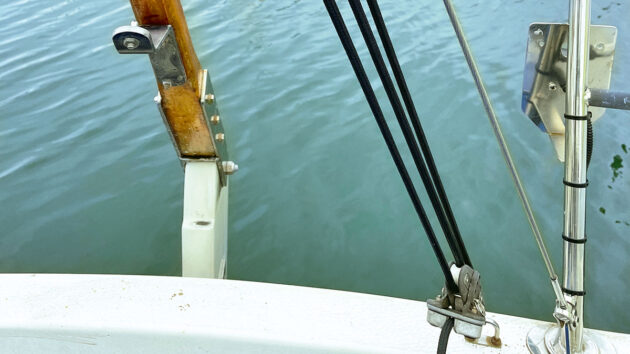
The backstay on this Maxi 84 is easily adjustable. Pull it on in strong winds to help depower the sails
“If you want to know how much tension to apply for different wind strengths, why not ask your sailmaker or rigger to whip some twine and mark the backstay for you? An hour of their time will take away all the guesswork.”
Expert advice on rig tuning
Next time you’re sailing close-hauled in a good breeze take a look up the mast. Are the lee shrouds slack? If the top or middle of the mast is sagging to leeward it’s not properly supported. If the rig is uneven side-to-side, you’ll experience a frustrating difference in power and point of sail on different tacks.
One solution is to have a professional rig-tune, which will take around 1-2 hours. But bear in mind, even if you have an expert tune your rig for you, it will stretch over time, something known in the industry as ‘creep’. This is particularly significant in the first 12 months of new rigging, and riggers such as Chris at XP Rigging will schedule a re-tune after a year to address this.
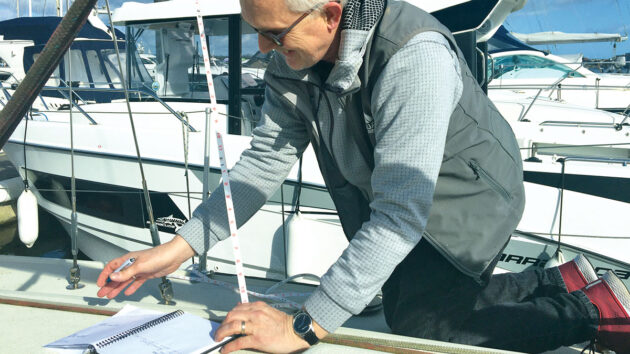
A sailmaker is used to measuring rigs and can tune them too
Also, as sails stretch, rig adjustments are necessary, so it’s worth knowing how to tune your rig, or at least recognise when it needs doing.
Rig tuning will differ from boat to boat, depending on a whole range of factors from the aspect ratio of the rig to the shroud base, roller-reefing system, spreader type and more. You may be able to find instructions from your boatbuilder. If not, consult with a sailmaker or rigger.
“Make sure they know their stuff,” warns Paul Lees of Crusader Sails. “There are those who’ve been sailing for hundreds of years and those who sit behind a laptop. The first thing we ask any boatowner who wants their rig tuned is, ‘what kind of boat?’ A Sadler, for example, will be completely different to a Hunter Legend. It’s a bit like asking a car mechanic to work on a performance motorboat, lorry and lawnmower. What bothers us, and we see it a lot, is someone used to working on a pushbike being asked to maintain a TGV!”
What the sailmaker sees
So what are the typical rig-tuning mistakes the team at Crusader Sails encounters?
“If I had a tenner for every bolt screw not secured, or clevis pin without a split pin…” says Paul. “It’s actually really basic stuff but could cause catastrophic failure.”
Sales manager Andy Cross adds: “Too much or too little mast rake is a common issue. Modern rigs in particular are more sensitive to mast bend, and on fractional rigs with aft-swept spreaders, a lot are set-up with too much prebend. Sails stretch over time and as they get fuller, people, and riggers particularly, tend to add rake to flatten them and make them set better. Then when you stick a new mainsail on, it won’t set right, so you need to go back to the original settings for mast bend. That way you’ll go a lot faster and it won’t do the nasty things of vibrating and unnecessarily stressing fittings.”
Another common issue the team encounters is inexpertly fitted headsail reefing systems; sometimes the anti-wrap fitting is not in place, which can lead to halyard wraps.
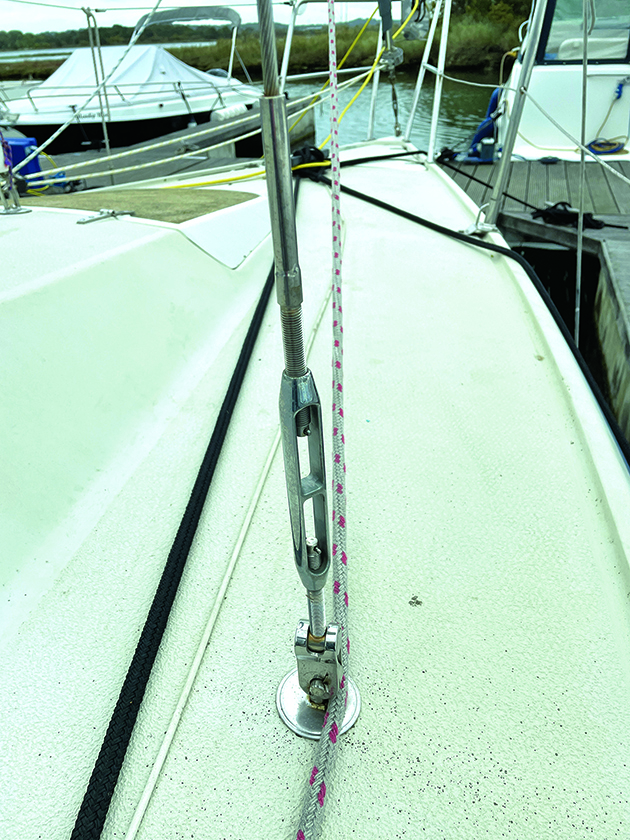
Check the thread length is even on the port and starboard rigging screws. Credit: Ali Wood
The problem, on older boats, is this requires a custom fitting because the ‘off the peg’ version went out of manufacture in 1978!
Andy adds that ‘back in the day,’ most boats were masthead rigged. As a result they had reasonably wide shroud bases.
“You could put the mast in and because it wasn’t particularly tall, you could go around with a spanner and apply a rule of thumb to tune it all. Today’s generation of fractional rig boats have either the same size or a bigger mast further forward so the setup for that is different. You can’t just twiddle a few cap shrouds and hope it will be all right because it won’t be. It requires a whole world of difference.”
Rigging material
Rigging materials have not changed for the everyday cruiser. Steel wire continues to be the most common type of rigging due to its relatively low cost, reliability and tensile strength. The advantage of this is that strand fractures and buckles are easy to spot, warning of potential problems.
Most rigs are set with 1 x 19 wire (a centre strand, 6 twisted around the core, 12 twisted in the opposite direction in outer layers).
Rod rigging, on the other hand, is solid stainless steel shaped into bars. This stretches less and has greater strength (normally 20% stronger than wire of the same diameter), hence its use on racing yachts with high tension rigs. The disadvantages are its shorter lifespan and that it gives no warning of failure, which can be catastrophic. If bent too much, hidden damage can occur, which is only revealed by a non-destructive dye test. Fewer boatbuilders opt for rod rigging these days due to high manufacturing costs.
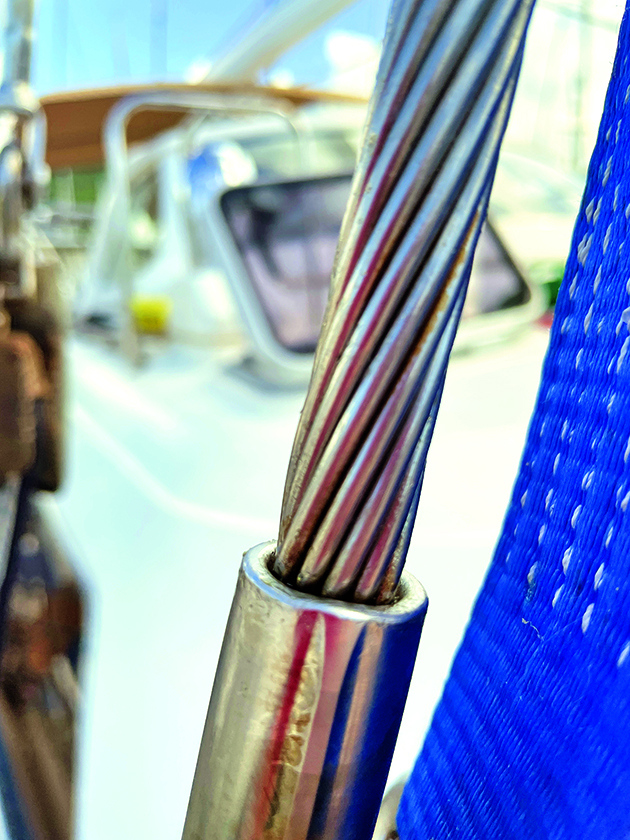
Wire rigging can easily be checked for buckling. Credit: Ali Wood
Fibre rigs have developed greatly in recent years and it’s possible to have both standing and running rigging made of products such as carbon fibre, Spectra, Kevlar and other types.
Extremely stable and lightweight, such rigs are also very expensive and confined to larger performance yachts.
Working with the shrouds and stays, you have toggles, rigging bolts, turnbuckles and terminals, all of which should be stainless steel quality A4 or bronze, and should allow the shrouds or stays to move slightly without developing kinks.
Chainplates and the entire hull, including bulkheads, should be able to absorb the loads from the rig. It’s a good idea to familiarise yourself with how the rig load is supported in your boat so you can keep an eye on it. Moisture or grounding damage, for example, can weaken the structure or corrode hidden parts of chainplates or welds.
Types of rig
The Bermudan rig is the most common, and there are two main types: masthead (backstay and forestay are both attached at the masthead) and fractional (the forestay is attached below the masthead). The fractional rig, which supports a larger main and smaller/fewer headsails, is more ‘tuneable’ but also more demanding to tune and keep well-tuned.
Can you tune a multihull?
Chris Evans of XP Rigging explains that multihull rigs are tuned on the ground before they go up because they use an additional set of shrouds called reverse diagonals (RD1, RD2 and RD3) and jumpers. “These basically support the mast but can induce and reduce prebend, which is matched to luff curvature. “Like with the B&R rig [a Bermudan variant designed by Swedish engineers], the reverse diagonal shrouds are used to pull back the mast while on the ground then the rig is put up almost like a bent banana.”
Once this mast is up, you can’t bend it any further with the backstay like you would a monohull. In other words, multihull rigs are not ‘tuneable’.
Brian Thompson, multihull racer and director at Doyle Sails Solent, points out that you can’t flatten a mainsail with mast bend as you might do in a monohull with a backstay. On a multihull, because the shrouds are further outboard and often further aft than on a monohull, permanent backstays and runners aren’t required.
A multihull won’t roll downwind like traditional monohulls, so there’s much less risk of an accidental gybe. The high righting moment combined with a lack of backstay or runners, means that the mast has to be strong and stiff and is not adjustable in bend under way.
Advanced rig tuning
There are three stages to monohull rig tuning: trimming the rig sideways, trimming it fore and aft then fine-tuning under sail.
While many cruising boat rigs have not been tuned since the day they were launched, racing boat rigs are regularly removed for transport and then re-rigged. These owners are adept at rig tuning to get that last half a knot out of their boat. Some owners even keep a tuning guide in order to keep track of the optimal positions of the stays, shrouds and rake.
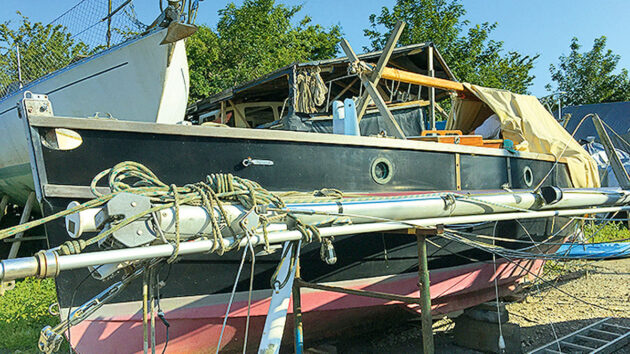
If you’re taking your mast down, record the settings on your rigging screws with PVC tape
If you sail a dinghy or small keelboat, why not experiment with how tuning affects your sail plan? On boats this size, smaller masts and shroud diameters show more dramatic tuning adjustments that aren’t as obvious on a large cruising boat. Measure the turnbuckle turns, shroud tension and adjustment and mast rake, and take notes. Then, once you have a baseline, sail methodically, adjusting one setting at a time. If you move it, write it down. If the new setting is worse, move it back, if it’s better, keep going.
When the boat is fast and performing how you want it to, mark everything and write it down so you can repeat your settings with ease.
You can find more about this on the Quantum Sails website, including a downloadable chart.
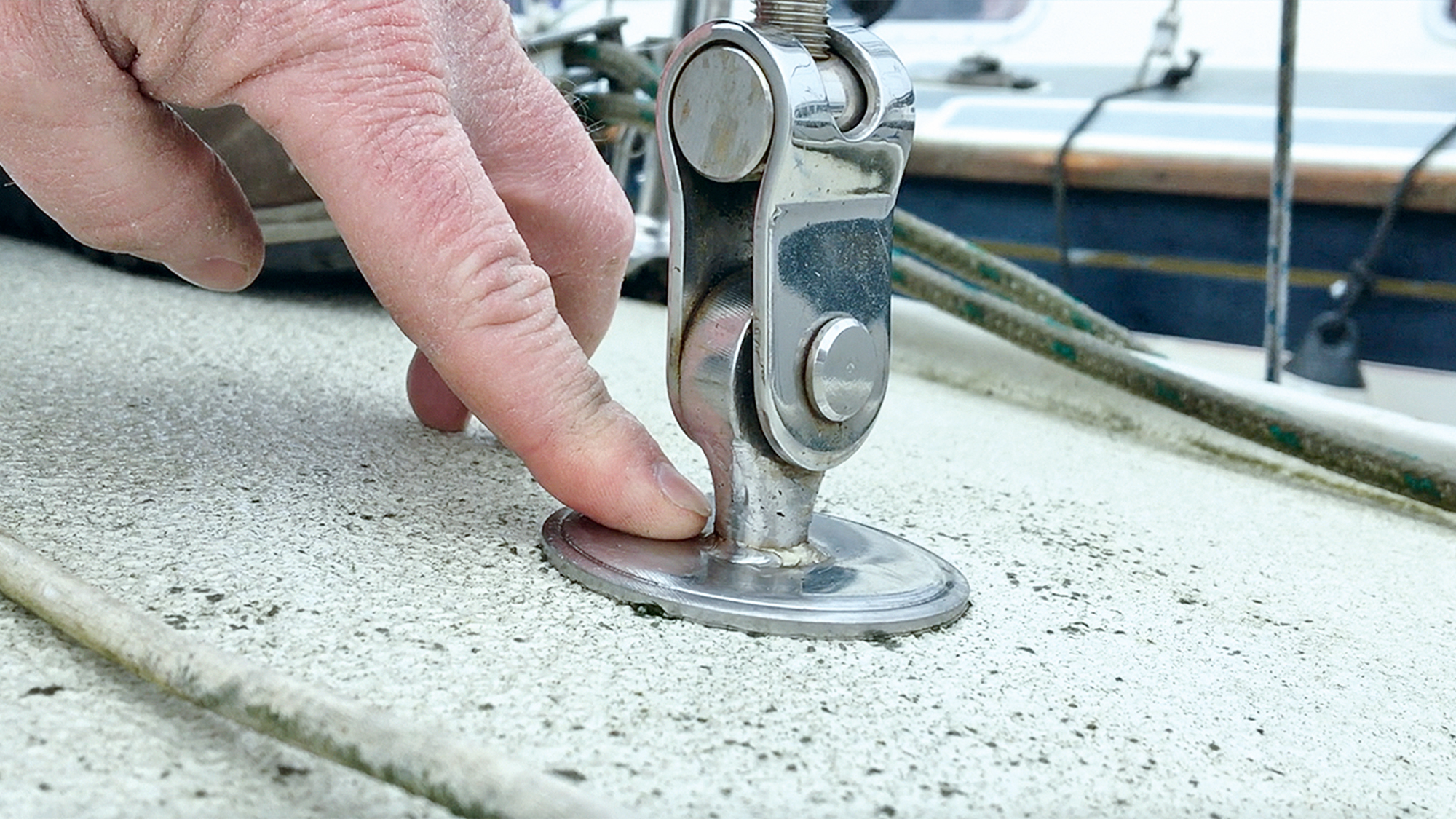
Rigger Chris Evans has a simple tip for any boat owner removing the rig, whether for over-winter storage or to get work done. He suggests you mark the bottle-screws with PVC tape before undoing them. “If you know your boat sailed really nicely, and you want it to do the same next time, tape both ends of the thread where it meets the clevis pin. You can then wind it back to these fixed parameters to replicate the perfect mast setting.”
Fend off rigging failure: the most common problems and how to prevent them
Most sailors will probably have seen or experienced a stranded wire, or a failed swage, or the catastrophic resulting from…
How to replace your running rigging: The essential DIY guide for older cruising yachts
Replacing old, tired lines is a critical job for any sailboat owner. Follow this step-by-step process for a full running…

Understanding and mastering boat rigging
Your yacht’s rig remains upright thanks to the right balance of compression and deflection, as Owen Brown explains

How to check your rigging – video guide
There are plenty of ways that a mast or its rigging can fail, but there are often key telltale signs…
What to read more practical articles?
A subscription to Practical Boat Owner magazine costs around 40% less than the cover price.
Print and digital editions are available through Magazines Direct – where you can also find the latest deals.
PBO is packed with information to help you get the most from boat ownership – whether sail or power.
-
-
-
- Take your DIY skills to the next level with trusted advice on boat maintenance and repairs
- Impartial, in-depth gear reviews
- Practical cruising tips for making the most of your time afloat
-
-
Follow us on Facebook, Instagram, TikTok and Twitter