




How better to compare the handling and performance of Bermudan and gaff rigs than on two boats that use the same hull? PBO’s David Harding did exactly that
When it comes to Bermudan and gaff rigs, it sometimes seems like a case of never the twain shall meet. Some lovers of gaff won’t hear a word against it. At the same time, performance-conscious and family sailors have been known to question the virtues of what they see as an antiquated rig that’s more complicated and less efficient than the simple, functional and now near-universal Bermudan.
Time was when gaff was the norm: it made sense on working boats for all sorts of reasons. With shorter spars and a greater fore-and-aft spread, it kept the centre of effort low while still presenting a generous sail area. Short spars reduced the loads on the rigging and simplified the engineering. It was easy to depower: raising the boom and lowering the yard would take all the drive out of the mainsail. You could pile on the canvas in light airs with a topsail, or by flying extra headsails from the end of the bowsprit. And so it went on. It was practical, versatile and still used for working boats long after Bermudan had taken over elsewhere.
More recently, gaff rigs have established a following on modern designs inspired by traditional working craft. Many of these trad lookalikes do little more than nod in the direction of their working forebears, using simplified, high-peak gaff rigs that are easier for modern sailors to accept and get to grips with. They give people a way to buy a little bit of nostalgia, often on a newly designed plastic boat, without all the traditional complications.
Bermudan vs Gaff Rigs: Contrast and compare
Gaff rigs don’t have to mean wooden spars and tan sails, but it often does – even on today’s modern gaffers like the Cornish Crabbers. The big question is what – if anything – owners of boats such as the Cornish Shrimper are sacrificing in terms of efficiency and simplicity in order to enjoy their slice of tradition. Some might say that it doesn’t matter if the boat is a bit slower or harder to sail than an alternative with a Bermudan rig. They don’t buy it for speed and ultimate simplicity. If you’re racing, what matters is that all the boats are the same. Some very good sailors race Shrimpers and the competition is extremely close at the top. There’s scope for tweaking gaff rigs if you know how. If you want ultimate performance you wouldn’t buy something like a Shrimper anyway.
As for simplicity, or lack of it, there’s nothing inherently difficult about gaff. You have two halyards for the mainsail instead of one, a chunky piece of wood that descends from aloft when you release them, and a boom that’s probably a bit longer than you’re used to. That’s about it. On a sizeable yacht you will notice more difference than on a 5.8m (19ft) Shrimper.
What’s the Adventure?
For a builder of modern gaffers, it’s only to be expected that most enquiries will come from people who like gaff rigs. Nonetheless, over the years Cornish Crabbers have spoken to a significant number of people who like the boats but who, for whatever reason, wouldn’t choose gaff. This prompted the development of a parallel range based on the same hulls but with Bermudan rigs and alloy spars. The new Adventure range runs from the 12 to the 26 by way of the 17, 19 and 22. The first Adventure sailing in the wild was a 19, the Bermudan equivalent of the ubiquitous Shrimper, so it seemed fitting to use this and a Shrimper for our comparisons.
Shrimpers that race have to leave their outboards down and suffer the drag of the leg and propeller unless they clear the water when the boat heels on starboard tack, so in the spirit of fair play we left the Adventure’s outboard down in its well. The Shrimper was a newish boat with an inboard engine and the prop lined up behind the keel. It was, however, more heavily laden with owners’ kit and a few whiskers were growing on the antifouling.
How do the rigs differ?
It was never Crabbers’ intention that the Adventures should sail in exactly the same way as their gaff equivalents. The Adventure 19 has a relatively low aspect-ratio mainsail with a heavily roached head, maintaining the Shrimper’s low centre of effort but shifting it a little further forward and slightly increasing the total area.
One obvious performance benefit is the reduction in the rig’s weight: the Shrimper’s wooden mast and yard together weigh 30kg (66lb), whereas the alloy mast of the Adventure tips the scales at just 10kg (22lb). Weight aloft makes a significant difference, so the Adventure could be expected to benefit from reduced heel and pitching.
As the mast and chainplates are in the same position on both boats, there’s not quite as much sweep-back on the Adventure as would be the case had it been designed from scratch, so plenty of cap-shroud tension is needed to achieve the necessary pre-bend and forestay tension. Long spreaders help.
Although some people lack confidence in their ability to set up and handle a gaff rig, Crabbers point out that there’s actually more scope for tweaking and fine-tuning with Bermudan: it’s easier to get the fundamentals right than with gaff, but after that there are greater opportunities for changing the shape of the sails. Once you’ve mastered the slightly greater initial challenge of gaff, there’s less scope for trimming.
Bermudan or gaff rigs – the comparisons
Sailing performance
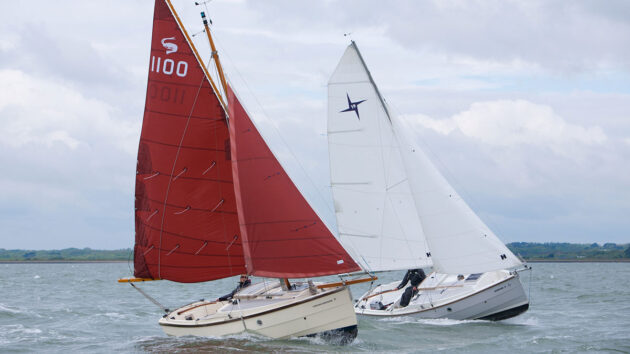
The Adventure sailed faster and pointed higher upwind…. Credit: David Harding
Let’s start with the question that most people will ask first: which is faster? In our trials with these two boats, the Adventure was streets ahead. On the wind she sailed both higher and faster, even demonstrating the ability to start astern and to leeward of the Shrimper, sail straight through her lee and quickly work her way ahead and to windward.
She was significantly faster on every point of sail, including dead downwind. Greater sweep-back on the cap shrouds would normally impose more of a limit to the boom’s angle with a fractional Bermudan rig, reducing the mainsail’s projected area and possibly tipping the balance in favour of the gaffer.
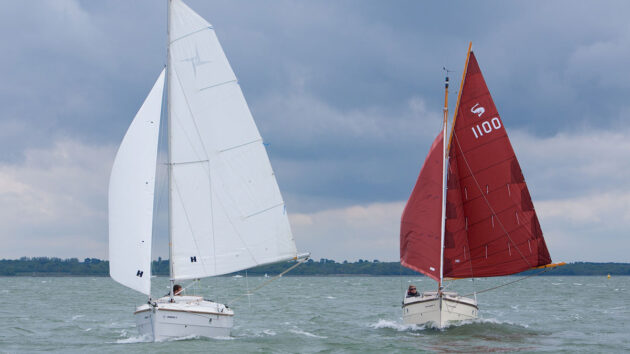
…and ran away downwind, when gaffers are often considered quicker. Credit: David Harding
Feel and handling
In keeping with her superior performance, the Adventure felt a good deal livelier: lighter, more powerful and more responsive, like a car with firmer suspension and a bigger engine.
To what extent this was due to the rig, and how much could be attributed to the Shrimper’s more heavily-laden state, it’s hard to say
Sailing under mainsail
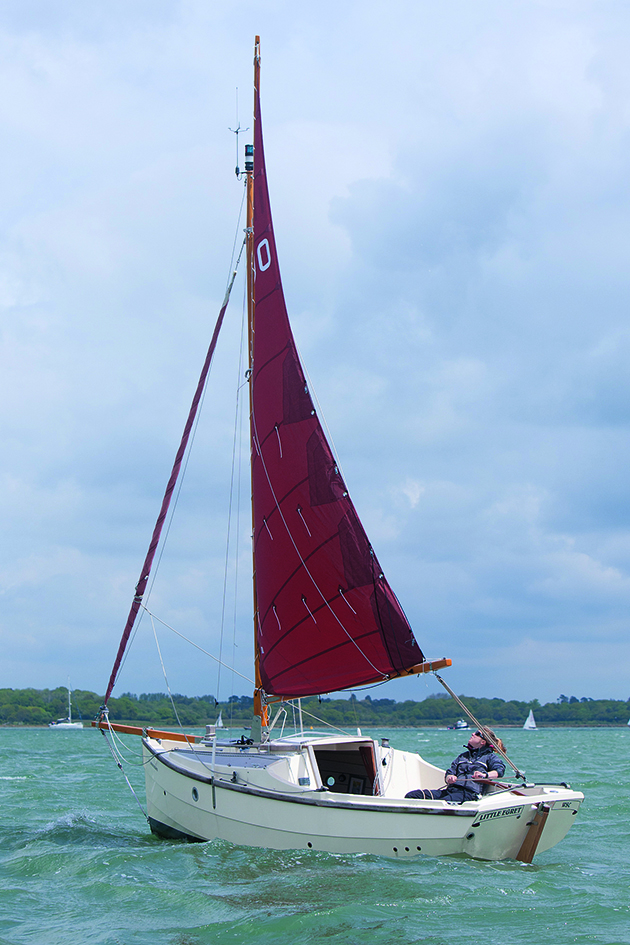
Sailing without the jib was manageable with the Shrimper as long as the boom was kept well eased. Credit: David Harding
Boats with big mainsails are normally able to make progress to windward without the headsail’s help, if rather more slowly.
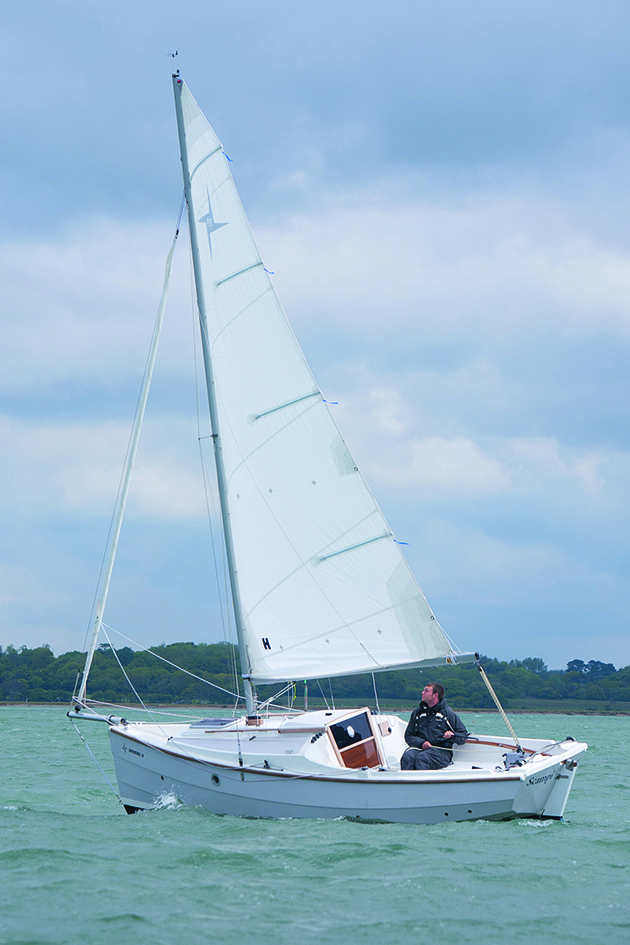
Less weather helm made the Adventure easier to sail under just the mainsail, but she still needed to be sailed free. Credit: David Harding
Both the Shrimper and Adventure were happy to do so, but, with her shorter boom and the centre of effort further forward, the Adventure carried less weather helm and was easier to sail.
Lowering the main under way
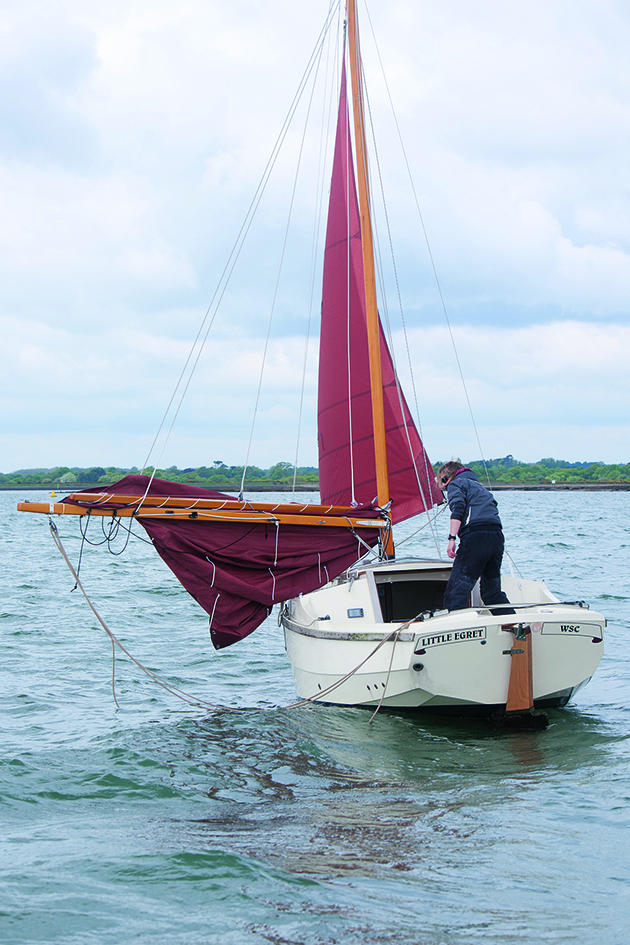
The weight of the yard makes sure the Shrimper’s mainsail comes down positively…Credit: David Harding
Here the gaff has the advantage that gravity will always make sure the sail comes down without hesitation. With the sail held by the yard at the top and the boom at the bottom, it can’t escape very far and you don’t have to rush to do any tidying up after lowering the halyards.
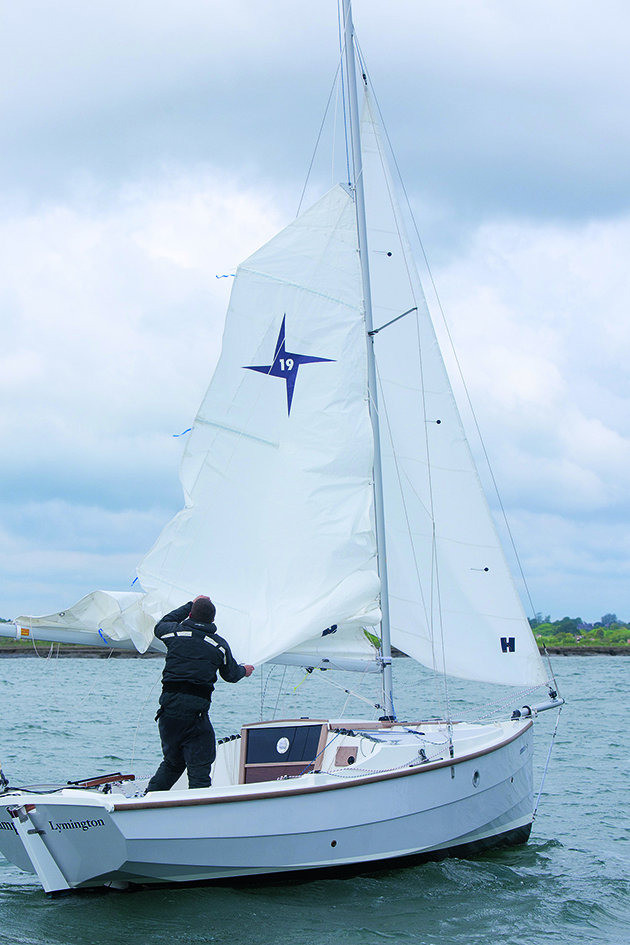
…while there’s less help from gravity with a Bermudan sail, so a little pulling is normally needed. Credit: David Harding
In a seaway, of course, you would need to be aware of the yard swinging around on the way down. Like most Bermudan sails, the Adventure’s took a little pulling to come down all the way. Lazyjacks will keep it under control reasonably well but a sail tie or two always helps.
Hoisting the main under way
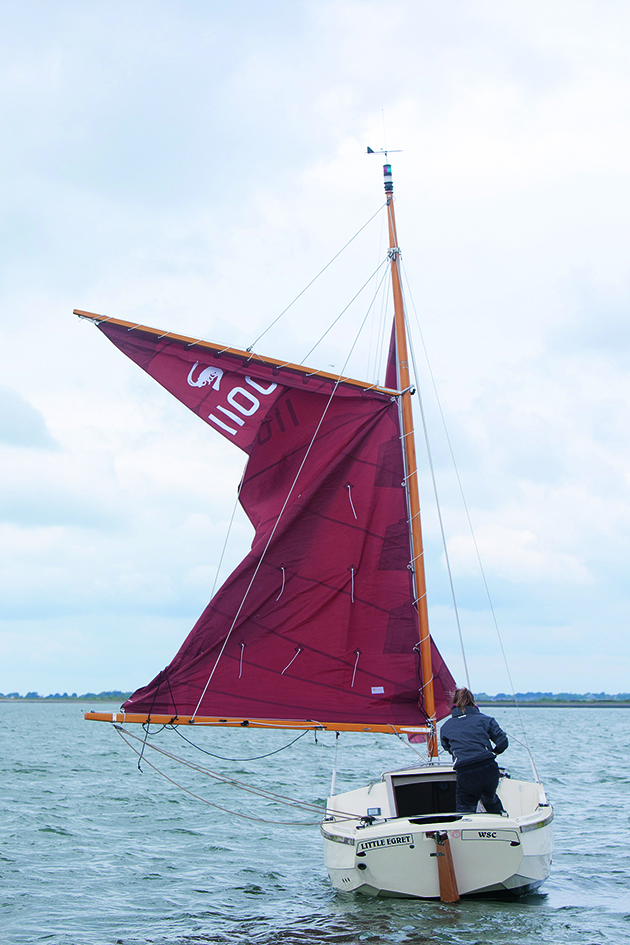
Even with the jib backed and the wind on the beam, hoisting sail on the Shrimper presents no problems. Credit: David Harding
Here again it’s easier with the gaff because the length of the yard keeps the peak of the sail (the top corner) between the two strands of the topping lift, so the leech tends to follow. The sail can be hoisted even with the wind on the beam.
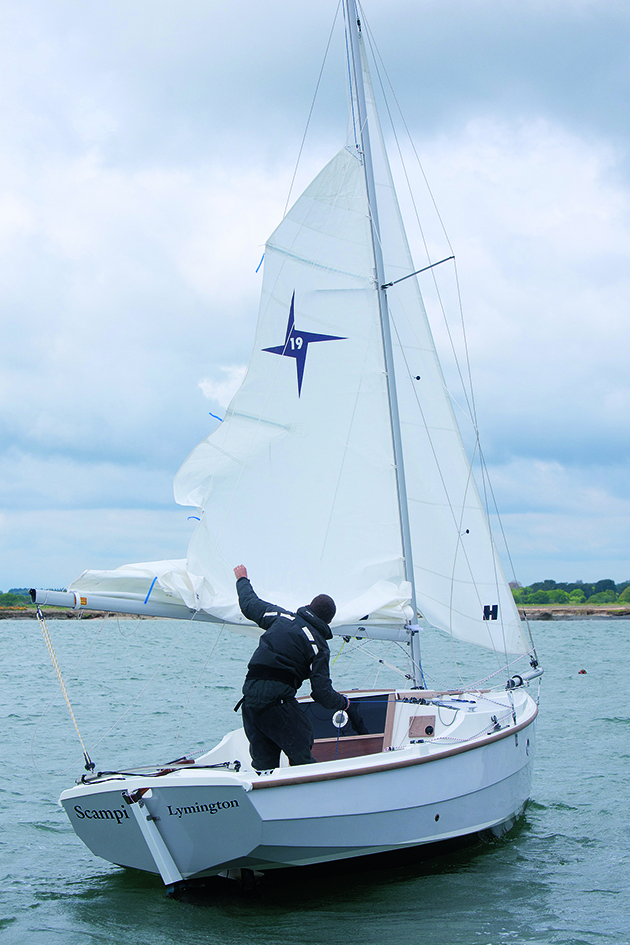
It’s not quite as simple on the Adventure, but would be easier if the forward strands of the lazyjacks were rigged. Credit: David Harding
Incorrectly-roven lazyjacks made life harder than it should have been on the Adventure. As long as the long top batten stays between the lazyjacks it’s straightforward enough.
Reefing
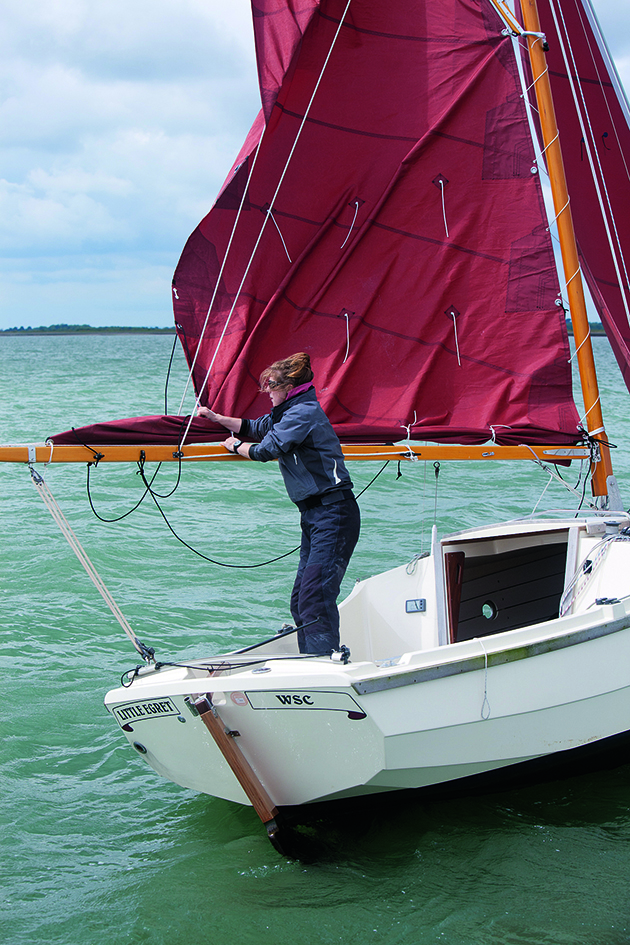
Reefing the Shrimper isn’t complicated, but involves a number of steps that take time..Credit: David Harding
This took a good deal longer on the Shrimper because of the need to lower both throat and peak halyards, tie down the tack cringle, tension the leech pennant on the boom and re-hoist the sail – not forgetting the kicking strap adjustments as well.

…while on the Adventure it’s a simple 60-second job. Credit: David Harding
The Adventure was fitted with single-line reefing, so it was simply a matter of slacking the kicker, lowering the halyard, tensioning the reef line, taking the halyard back up and putting some weight back in the kicker – in total, about a minute’s work
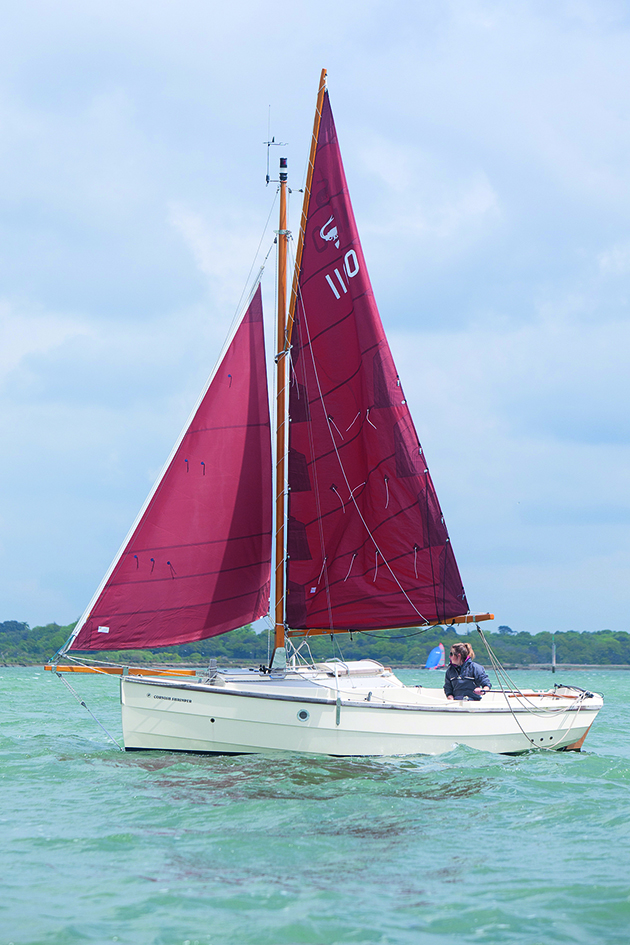
Heaving to presented no problems to the Shrimper…Credit: David Harding
Heaving to is becoming something of a lost art among cruising sailors. Nonetheless, in most situations it’s still the best way to bring a boat to as close to a standstill as possible under sail, and the motion is infinitely more comfortable than if the sails are lowered.
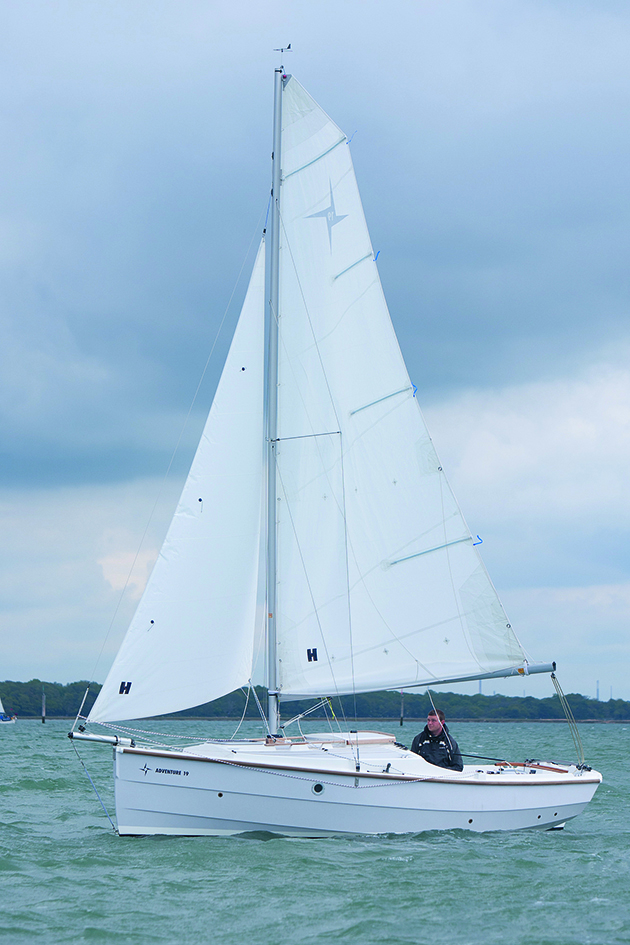
…and it was similarly simple with the Adventure. Credit: David Harding
Both the Shrimper and the Adventure hove to happily and their attitude to the wind could be adjusted by sheet tension. The difference is that the Adventure’s shorter boom makes her easier to gybe around and carry on sailing afterwards.
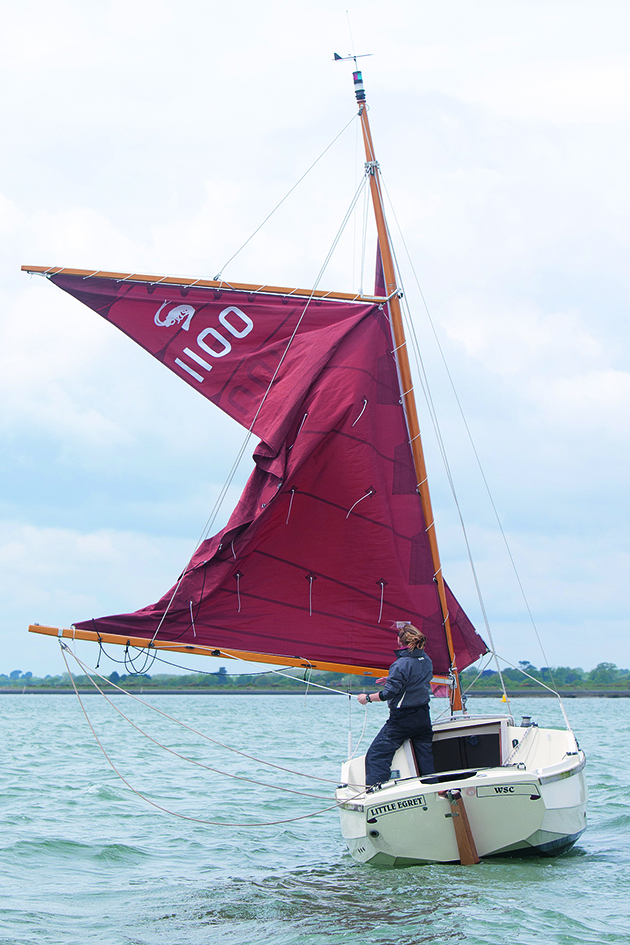
Scandalising the mainsail is something you can only do with a gaff rig. Here there’s no drive at all left in the mainsail, even with the wind almost on the beam. Credit: David Harding
Here the Bermudan rig can’t compete. If you want to take all power out of the mainsail with a gaff rig, lower the peak halyard to drop the yard and tension the topping lift to raise the boom. With a Bermudan rig, you can release the kicking strap and tension the topping lift, but the leech is still likely to retain some power
Conclusion
How the Adventure would compare in terms of performance with a race-tuned Shrimper is impossible to say. What we do know is that she was appreciably faster all round than the Shrimper she was sailing with.
As for the handling qualities, which are probably more important to most people, our comparisons showed that it’s swings and roundabouts to a large extent. The Bermudan rig of the Adventure is undoubtedly simpler in many respects (and involves no varnishing), but the benefits of the gaff still hold true. As with most aspects of boat design, you pay your money and take your choice.

Bermudan rig vs Junk rig: which is best?
David Harding sets up a direct comparison between Junk- and Bermudan-rigged Splinters to find out how they handle

Sail boat rigs: the pros and cons of each popular design
Peter Poland looks at the history of popular rig designs and how the different types affect boat performance
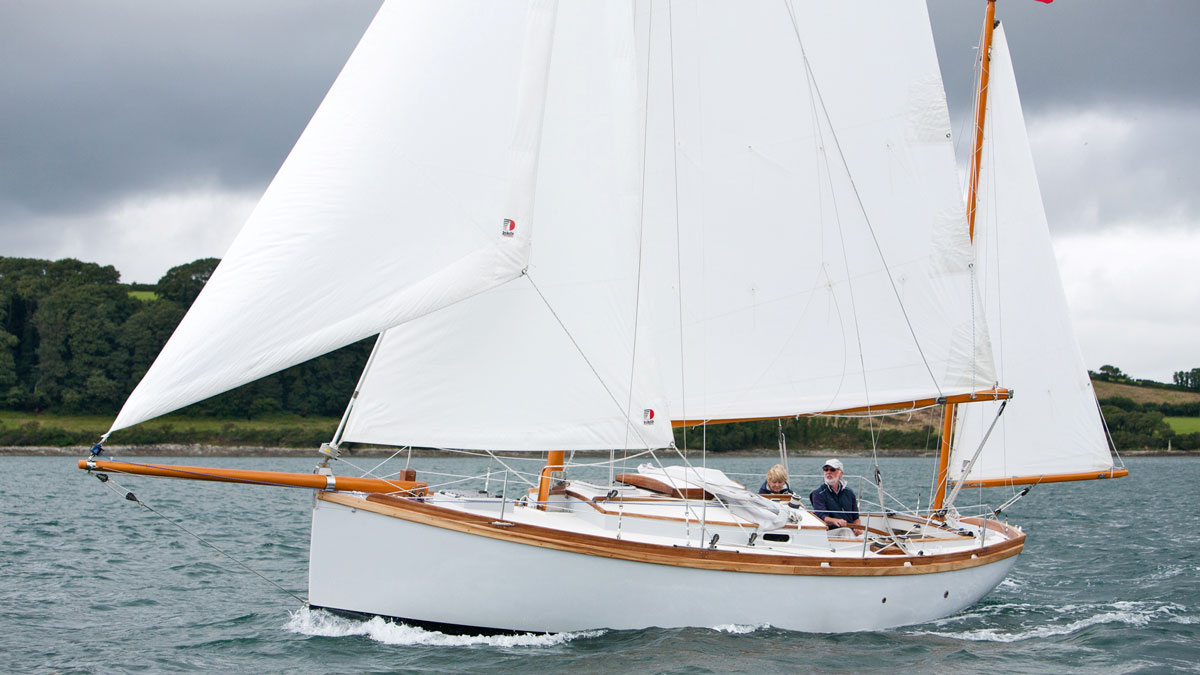
Golant Yawl: a practical modern gaffer
As the man responsible for the ubiquitous Cornish Shrimper and a host of other small gaffers, Roger Dongray is a…

Becoming an Old Gaffer – How I found my ideal boat
I don’t own Wendy May, she owns me. I’m just the custodian. She was built for an army officer in…
What to read more features like Bermudan vs gaff rigs: Which rig setup wins for coastal cruising?
A subscription to Practical Boat Owner magazine costs around 40% less than the cover price.
Print and digital editions are available through Magazines Direct – where you can also find the latest deals.
PBO is packed with information to help you get the most from boat ownership – whether sail or power.
-
-
-
- Take your DIY skills to the next level with trusted advice on boat maintenance and repairs
- Impartial, in-depth gear reviews
- Practical cruising tips for making the most of your time afloat
-
-
Follow us on Facebook, Instagram, TikTok and X