


As the man responsible for the ubiquitous Cornish Shrimper and a host of other small gaffers, Roger Dongray is a well-known name in British boating – but what does he sail himself? David Harding has the chance to sail the Golant Yawl
Golant Yawl: a practical modern gaffer

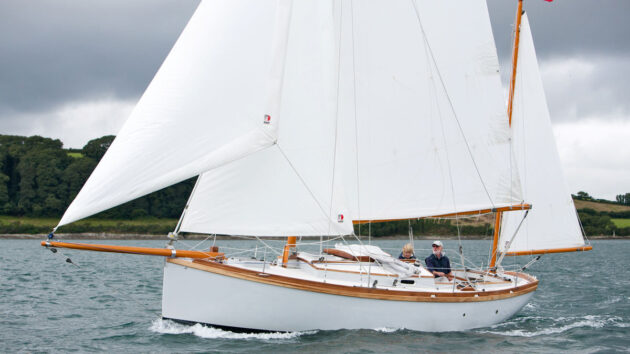
Most cruising yachts are conceived as commercial projects. Designers and builders discuss what they think their target market would like, then they work through all the
compromises to maximise the appeal. After checking that the pennies should add up – all too often a leap of faith – they go into production.
Many wonderful boats have been built as a result; boats upon which their owners would find it hard to improve had they commissioned them specifically for their own use. Nonetheless, sometimes you can’t help but wonder what the designer might draw were he or she free from any constraints imposed by series production and had no one to please but themselves.
I had a chance to see what Roger Dongray has not only drawn but also built with his own hands when I joined him for a sail in Falmouth. As the designer of most of the Cornish Crabber range, Roger will need no introduction to PBO readers: he has probably done more than anyone else to introduce a new audience to the delights of small, shoal-draught modern gaffers.
It’s no surprise that he has owned several of his own designs, including a couple of plywood Shrimpers. Conceived in the 1970s as his own personal project, the Shrimper is a prime example of a boat that suits one person then being seen and liked by others. That’s how she became part of Cornish Crabbers’ range.
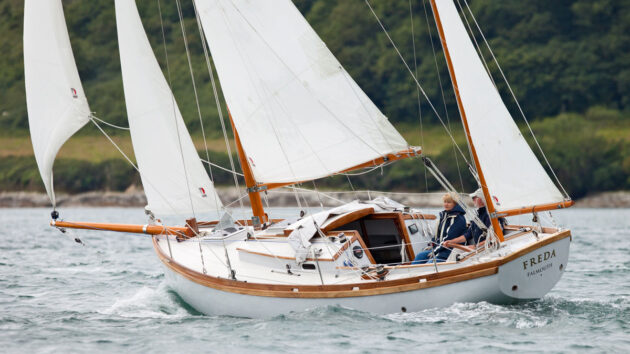
At 4.2 tons the Golant Yawl is no lightweight, but the generous sail plan, ample ballast and balanced hull lines give her a good performance. Credit: David Harding
Roger later had a Cornish Yawl, which, like Crabbers’ co-founder, the late Peter Keeling, he raced with some success. This, and experience with one of his earlier designs, the ketch-rigged Cornish Trader, made him realise that he much preferred the yawl rig.
‘The Trader effectively had two cockpits,’ he said, ’one behind the mizzen and one in front of it. You could never get it right. If you were in one, you wanted to be
in the other. You couldn’t singlehand it very well.’ By no means is the Trader unique in that respect: many ketches are similarly afflicted.
I’m with Roger all the way in the ketch-versus-yawl debate, though it’s only fair to acknowledge that a ketch works perfectly well on some boats. After all, as Roger points out, the word ketch comes from fishing boats when they were known as catch boats.
With the Golant Yawl, however, I was delighted to see a small mizzen stepped well aft. While boats such as the Devon Yawl, for example, are yawls in practice but ketches in theory because the mizzen is forward of the rudder head – hard to avoid with a transom-hung rudder – the 25ft (7.6m) Golant Yawl is a yawl in every sense.
Naming the Golant Yawl
Roger has given her a name because that’s what professional designers do. His previous boat was a Golant Gaffer, a 19-footer he designed for construction in cedar strip and of which over 130 have now been built. Roger and his wife, Irene, used to spend up to a week at a time aboard theirs cruising the Cornish coast. It was only logical that the yawl should be named after the same village on the banks of the Fowey estuary.
Nonetheless, incorporating his experience from over 40 years of designing, building and sailing, the Golant Yawl was what he wanted for himself.
He built her in cedar strip with Robert Rainsford of Seashell Boats, the two of them working full-time for 13 months. Roger accepts that a boat like this is at the upper limit of what home-builders might want to tackle, principally because of her size and the need for a shed 30ft (9m) long.
That’s where professional yards come in: you buy the plans, commission a builder and become the proud owner of a semi-custom boat. Alternatively, to keep labour costs under control, you might do some of the work yourself and employ a shipwright for the trickier bits.
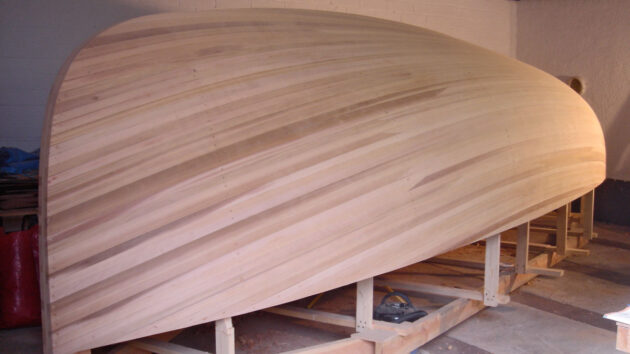
The hull planked and sanded. From start to launch, the building took two people 13 months
Whereas many of Roger’s designs have lapstrake hulls to allow building in plywood, the Golant Yawl has a round-bilge hull form. Like the modern gaffer she is, she also has a canoe-body hull with a bolt-on keel – a spacer of Douglas Fir, then 1,936kg (4,236lb) of lead to give her a ballast ratio of 45%.
The keel runs all the way aft for directional stability, the prop aperture being cut out from both the keel and the large rudder. Displacement is generous at 4,300kg (just under 9,500lb) to ensure a comfortable motion, the ability to punch through the sea and an inclination to maintain her way.
In fact, Roger started with his chosen weight and the rest of the design followed. ‘I knew the shape I wanted, and the rig. It came together from there.’ He did add an extra headsail, though, having started with just one before deciding to go the jib-and-staysail route instead.
‘I spent a long while on the hull’, he says. ‘It was on the wall of the office, and I’d take it down and fiddle with it.’ He likes to draw the hull shape by eye and put it on the computer afterwards. He will print out the drawings, study them back-to-front and upside down, and tweak them to correct features that jump out when the lines are viewed from different angles.
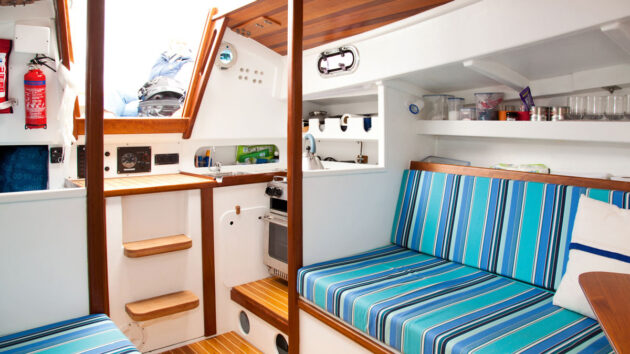
Pillars, rarely seen these days, make the most useful handholds. Trim is solid iroko and the coachroof, like the hull, is cedar strip. Credit: David Harding
It might sound odd to some, but is by no means uncommon among artists and photographers: it’s amazing how you pick up imbalances or misalignments when you rotate a familiar object to reverse it or turn it on its head.
However it was achieved, there’s no doubt that the hull shape of the Golant Yawl is pleasing to the eye. The stem is just off vertical, balanced by a counter that’s well above the waterline at rest but just immersed as hullspeed is approached. The sheer-line, essential for a gaffer, is lowest by the cockpit and is such that a continuation of the line of the coachroof meets the stemhead.
The angle of the bowsprit is another crucial element both aesthetically and mechanically: it doesn’t want to be pointing towards the heavens.
Although the plan view shows the full shoulders one expects on a boat of this nature, combined with a narrower stern than on a typical modern yacht, that’s principally a function of the fare in the bow and the drawn-out counter stern. The waterline is, in fact, finer at the bow and appreciably fuller aft than on traditional designs.
Sailing for pleasure
The Golant Yawl was conceived as a practical modern gaffer: a boat that looks good, looks after her crew, sails well and is easy to manage shorthanded. Roger has always been happy to combine the old and the new – classically pleasing lines with shallow, higher-volume hulls and sharper underwater sections; wooden spars with high-peak
gaffs and modern hardware.
It’s a formula that might not hit the spot for everyone, but the success of Roger’s designs proves that it works for many. Whatever your taste in yacht design and your thoughts on whether white sails belong on a gaffer – a subject of great controversy in some circles – it’s hard to imagine anyone not looking on with a measure of approval as a Golant Yawl sails past.
And if you’re the one sailing her, it’s an agreeable experience too.
Even to those of us far more accustomed to the efficient simplicity of the modern Bermudan sloop, it’s undeniable that gaffs and yawls both offer some very real benefts – especially when combined on the same boat.
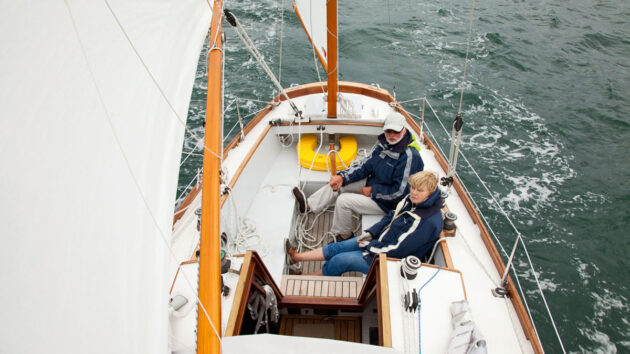
A deep, well-protected cockpit, with sheets and runners close at hand. Modern hardware is used throughout. Credit: David Harding
For example, you don’t need to hoist the mainsail before dropping the mooring or lifting the hook: you can set the mizzen to keep you head-to-wind, unroll a headsail or two and sail gently away without the power of the main or the worry of an accidental gybe as you negotiate the shallows, a narrow entrance, moored boats or other traffic. Then, in clear water, you simply harden up and hoist.
On most boats this is when the bow blows off and you end up with the battens getting caught in the rigging. With a yawl, the mizzen keeps the head up and it’s all so much simpler.
While a Bermudan mainsail is easy enough to hoist if it doesn’t have lazyjacks – which it often does these days – the gaff is the clear winner when it comes to the drop. As Roger says, ‘I just ease the mainsheet so the sail faps, drop it, haul it in and put a couple of ties around it.’ That applies whether you’re approaching a mooring or carrying on under shortened sail, because lowering the main and carrying on under ‘jib and jigger’ is common practice on a yawl.
On Freda – named after Irene’s mother – the first stage in reducing sail is to roll away the staysail. Then it’s the first of two reefs in the main. Roger specified two, thinking he
might have given it too much area, but has concluded that the second isn’t necessary because, after the first reef, he takes it all down. ‘We were going round the Dodman and it started to blow up horribly’, he says. ‘We had full main, so we dropped it and carried on at 6 knots with the mizzen and headsails. It wouldn’t have been any quicker with the mainsail. It’s so comfortable too, because we’re upright.’
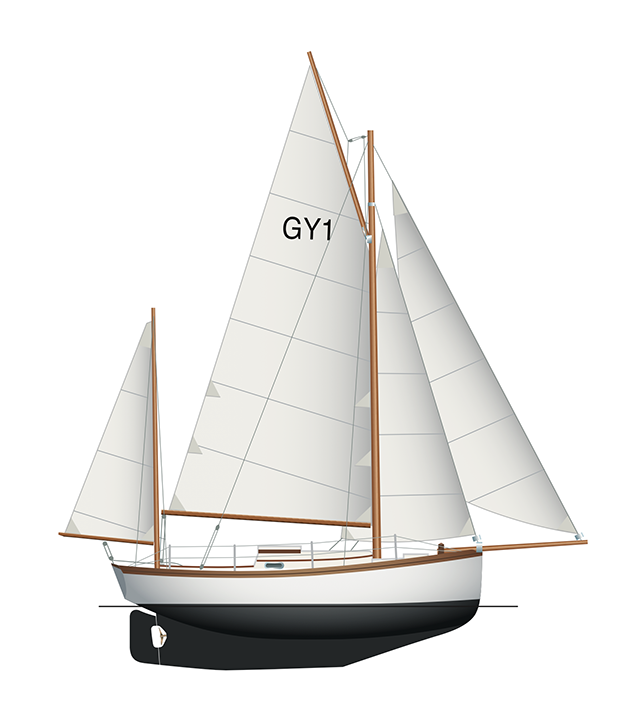
Sail plan of the Golant Yawl
On the day of our sail in the Carrick Roads we had no need to reef. A breeze of 12-13 knots built gradually to 15 or 16, which Freda handled happily under full sail. Once she gets going in 10-12 knots, Roger reckons she can give many a modern boat a run for her money – and it’s easy to see why.
We left the mooring under headsails and mizzen, reaching at an easy 4.5 knots and maintaining a good 4 knots on the wind. Hoisting the main took us up to 5.2 knots and gave a tacking angle of a thoroughly respectable 90°. On a reach the log soon climbed to over 6 knots.
An unbalanced rudder of this size is always going to be felt through the helm, but it never got heavy because of the boat’s natural tendency to run straight – helped by the trim-tab effect of the mizzen. A folding prop meant there was no turbulence over the blade and allowed the boat to slip along cleanly. ‘It makes a big difference’, confirms Roger.
Punching her weight
At the mouth of the Roads, Freda punched her way emphatically through the short chop, demonstrating an easy motion and keeping us dry in the cockpit. She hove to happily and, thanks partly to that large rudder, would gybe round to carry on sailing without asking for the sheets to be eased. It’s no good owning a gaff yawl – especially one with two headsails – unless you’re happy to pull a few strings.
Here we have sheets for main, mizzen and each headsail, plus the running backstays. Main and mizzen sheets don’t need tending during tacks and, with both headsails being of modest area and the boat turning gently, manoeuvres are straightforward and unhurried.
On the wind, the slot between the headsails is maintained by the mounting of the staysail’s tracks inboard while the jib is sheeted to the toerail. Despite being close to the end of the main boom, the mizzen backwinds less than you might expect because it can be sheeted close to the centreline and much of its area is below the foot of the mainsail.
The only slight difficulty upwind is seeing the luff of the jib. It’s never easy from inside a cockpit and with a staysail in the way. On Freda, spars are in spruce by Collar, sails by Jeckells and hardware mainly from Barton. Auxiliary propulsion comes from a 15hp Yanmar 2GM.
Accommodation on the Golant Yawl
There’s nothing like a wooden boat below decks. Freda is finished with white paint on the bulkheads, the hull sides, the front and sides of the coachroof and the underside of the deck (built from two layers of glass-sheathed 9mm ply, which avoids the need for massive beams). Setting off the white is the varnished iroko trim and cedar-strip on the underside of the coachroof.
When it comes to the layout, Roger doesn’t like a heads compartments by the companionway because ‘it spoils the cabin, making it narrow in the wrong spot. I prefer the heads in the head.’
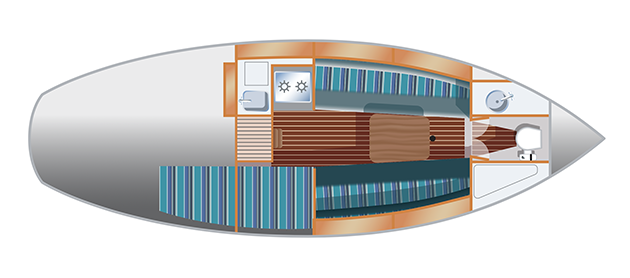
Accommodation plan of a Golant Yawl
As a result, the cabin is open and comfortable. Abaft the partial bulkhead, from which pillars extend to the deckhead to make the most useful handholds/armholds a boat can have, is the galley to port and a quarter berth to starboard. A chart table could be fitted over the head of the quarter berth, which otherwise makes a handy seat for the galley.
A full 2m (6ft 7in) forward of the partial bulkhead is the main bulkhead, allowing room for a spacious saloon and two superlong settee berths. There’s ample sitting headroom beneath the side decks and 1.52m (5ft) for standing (or, rather, for stooping: full standing headroom would involve major compromises in a boat of this length).
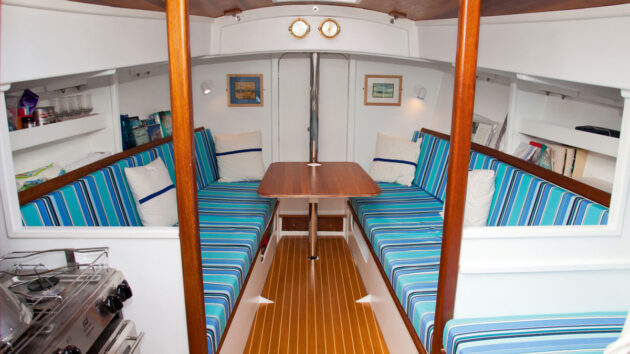
Having the heads in the bow allows space for a roomy, open and welcoming saloon. Infills can be dropped in to create a full-size double berth. Credit: David Harding
Under the hatch it’s 1.77m (5ft 10in). Boards that live in the quarter berth can be slotted in between the settee berths to create a massive wall-to-wall double.
Forward again, the heads is appreciably bigger than it would be had it been squeezed in further aft.
Verdict on the Golant Yawl
Every Golant Yawl will be different, reflecting her owner’s preferences. That’s one of the joys of building a boat like this, whether on your own or with some professional help.
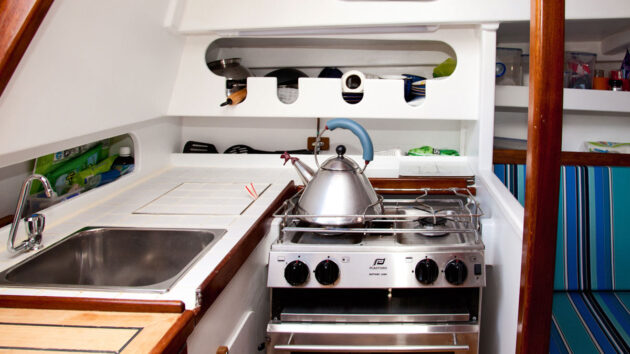
In the traditional fashion, the galley is by the companionway. Credit: David Harding
Either way, you will end up with a well-mannered, comfortable, capable and practical little cruiser that sails very nicely, shows off the versatility of the yawl rig to good effect and will be sure to turn heads wherever she goes.
Details
Length over deck:7.60m (25ft 0in)
LWL:6.85m (22ft 5in)
Beam:2.64m (8ft 8in)
Draught:1.20m (4ft 0in)
Displacement:4,297kg (9,473lb)
Ballast:1,936kg (4,256lb)
Sail Area:43.36sq m (466sq ft)
Displacement/length ratio:371
Sail area/displacement ratio:16.65
RCD Category:A
Engine:Yanmar 15hp diese
Headroom:1.75m (5ft 10i)
Designer:Roger Dongray