


Dinghy design is a complex balancing act, but the Cornish Crabber 12 manages to be roomy, stable, and fun to sail for all ages. David Harding puts it to the test
Cornish Crabber 12: the dinghy that combines gunter rig tradition with surprising stability and space


Designing dinghies isn’t easy. You might think it would be, because they’re so small – but it’s their very lack of size that creates the challenge. In some ways, small dinghies designed to be roomy and stable create the biggest challenge of all, as is the case with the Cornish Crabber 12.
The smaller the boat, the lighter it is, all things being equal, and therefore the greater the relative weight of the crew. That increases your risk of getting wet if you sit on the wrong side.
So, to prevent (or at least to limit) the chances of unwanted dunkings, the designer has to incorporate substantial form stability while not ending up with something shaped like a picnic box, because that wouldn’t be much fun to sail. It’s a complex balancing act.
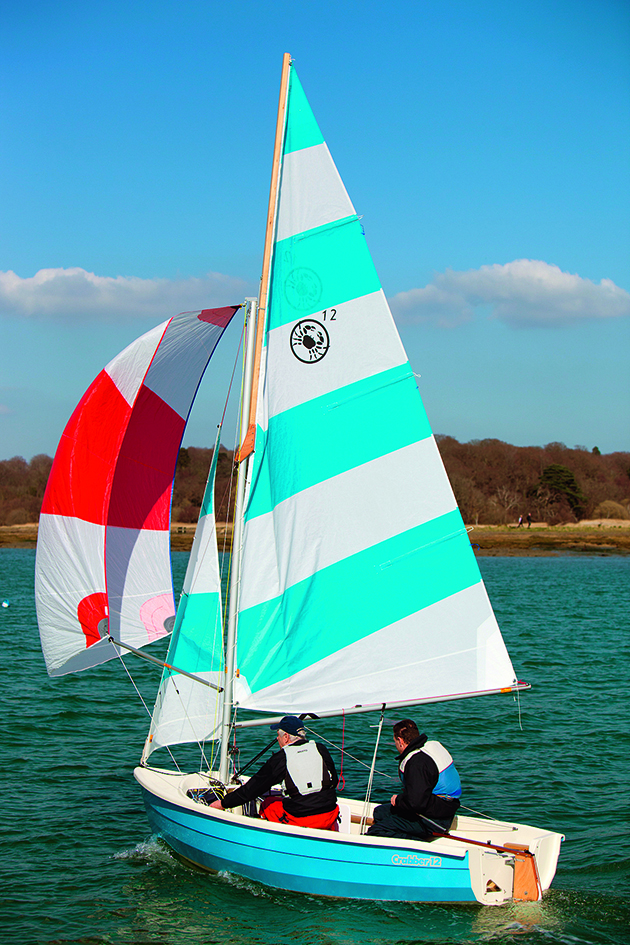
With an LOA of 3.73m (12ft 3in) and a weight of 120kg (264lb), the Cornish Crabber 12 combines handy size and manageable weight. Credit: David Harding
Those of us who were brought up sailing and surrounded by traditional classes of small dinghies such as the Gull, Otter, Heron, Mirror, Vagabond, Eleven Plus and so on understand the problem only too well. I remember maturing sailors of the local sailing club wanting something that was stable enough to be physically undemanding for single-handing, yet fun to sail, big enough to carry a grandchild or two and still light enough to haul up the slipway on their own.
The trad-style dinghy-cum-dayboats with ballasted centreplates were too heavy to handle ashore, and the bigger dinghies like the GP 14, Leader and Wanderer were heavier and more powerful than they wanted.
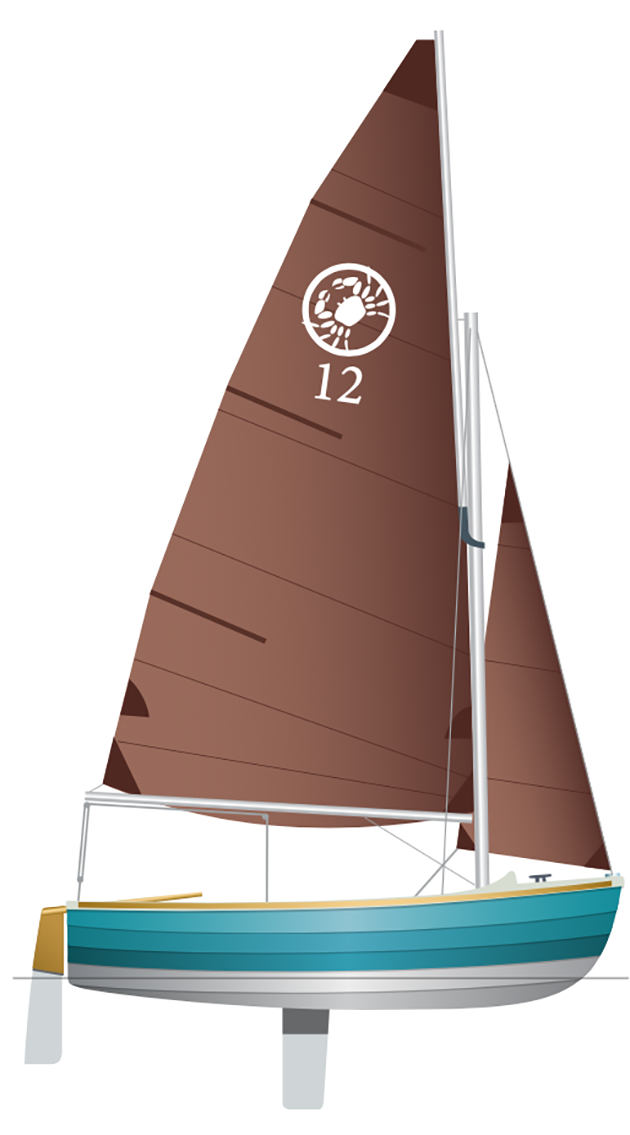
The Cornish Crabber 12 might well have suited them. Here’s a modern dinghy that, like all Crabbers, nods towards tradition with a simulated-lapstrake hull, timber trim and, in this case, a gunter rig with varnished yard and boom in sitka spruce.
The short spars simplify trailing and make it safer to leave the boat on a mooring if you want to. Another mooring-friendly feature is the double bottom that creates a self-draining sole, though the all-up weight of 120kg (245lb) means that hauling her up a slipway shouldn’t be a back-breaking job.
Cornish Crabber 12: space maximisation
One of David Thomas’s priorities in designing the new Cornish Crabber 12 was to maximise space inside a hull that’s just 3.75m (12ft 3in) long. Here, the double bottom helps, as does the roll-over gunwale, both lending substantial strength to the structure and obviating the need for a fixed thwart to brace the daggerboard case. There is a thwart, made of teak, that can be slid forward and aft to balance crew weight when you’re rowing using either of the two rowlock positions, or it can be removed altogether.
Further increasing the internal volume is the way the side buoyancy tanks don’t run the full length of the cockpit, creating extra space forward and aft and making it easier to get into and out of the boat. Even the full-length oars that can be stowed in the bottom aren’t intrusive.
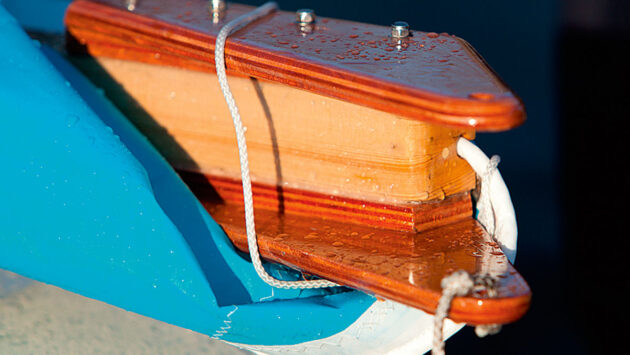
Jaws on the yard. Credit: David Harding
Like the older generation of British general-purpose dinghies, the Cornish Crabber 12 is designed to be sailed, rowed or motored – in this case with an electric outboard, whose batteries can fit into the side buoyancy tanks. She can be sailed single-handed or with up to two crew, under mainsail only or with the tiny jib whose principal purpose is to give the crew something to do.
If you want to pep up the performance downwind, you can even fly the optional spinnaker: a proper symmetrical spinnaker with a pole, so you can go dead downwind.
Sprightly sailing on the Cornish Crabber 12
However clever a dinghy looks, it’s how it performs that really matters. I had two spins in the Cornish Crabber 12, during which time I sailed her single-handed and with a crew, under mainsail only and with the jib, and with the spinnaker.
I sailed her backwards, rowed her, capsized her, sailed her without touching the tiller and launched and recovered her, but didn’t have a chance to try any motoring. The first thing to say about the boat is that she’s surprisingly enjoyable to sail.
She’s stable and forgiving yet nicely responsive and, with 8.5sq m (91.5sq ft) of sail, certainly not under-canvassed. She responds well to roll tacks and gybes, and it’s easy to imagine a fleet indulging in some gentle racing should their owners feel so inclined.
Ergonomically, the layout works well. This is a comfortable boat to sail, whether you choose to sit on the side tanks or the gunwale.
In the absence of toe-straps, which can be fitted, I used the slot in the top of the daggerboard as a substitute for one foot. There’s plenty of space for two adults, and moving around would be easier still if the mainsheet were moved from the centre of the boom to the end.
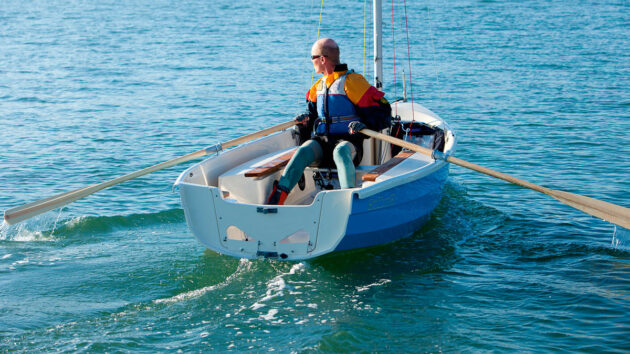
Row your boat: the Crabber 12 has two sets of rowlock positions, an adjustable thwart and full-length oars for efficient rowing. Credit: David Harding
For ease and efficiency, I would be tempted to rig up a bridle on the transom and lead the sheet forward to the central swivel cam, as is common practice on many dinghies. The jib sheets cleat on the windward side, ostensibly for the crew’s convenience, though I didn’t like the arrangement, whether sailing solo or with a crew.
I’d rather cleat the sheets to leeward. Other niggles were few and far between. The inspection hatches in the side tanks were too small for the space to be used for stowage, but were made larger on later builds.
A removable box could also be fitted in the stern. Any multipurpose dinghy needs space to stow a lunchbox at the very least. Hardware is from Allen and generally well specified. Neat touches include the loop on the end of the main halyard that hooks to a 2:1 purchase for easy tensioning.
Cornish Crabber 12
The rudder and tiller assembly were nicely made, and the foils themselves (daggerboard and rudder) smoothly finished in painted plywood, with nice, sharp trailing edges.
As for capsizing – well, any dinghy can be turned over, but it took some effort with the Cornish Crabber 12. I tried both hopping over the gunwale to stay dry and dropping into the water to see what happened; the minimal amount of water drained straight out as soon as she was righted.
The only thing I didn’t try was turning turtle (complete inversion), because of the limited depth in the river. I would also have liked to stand further out on the board for more righting moment: it’s a big sail to pull out of the water.
Part of the reason for not running the buoyancy tanks the full length on each side is to stop the boat from floating too high on her side, reducing the chance of turtling and making it easier to reach the board from the water. She floats pretty high nonetheless.
PBO Verdict
The Crabber 12 combines handy size and manageable weight with a surprising amount of space and stability, and some clever thinking.
Those who enjoy a gentle potter won’t be frightened or tipped in – if they reef down in good time – while their more energetic friends, relatives or offspring will have to concede that their parents’ (or grandparents’) boat is rather more fun than they expected.
Part of Crabbers’ mission was to encourage families who might have lapsed to get back afloat, and to leave them ‘no reasons not to go sailing this weekend.’
Based on what I have seen with this dinghy, I’d say she’s up to the job.
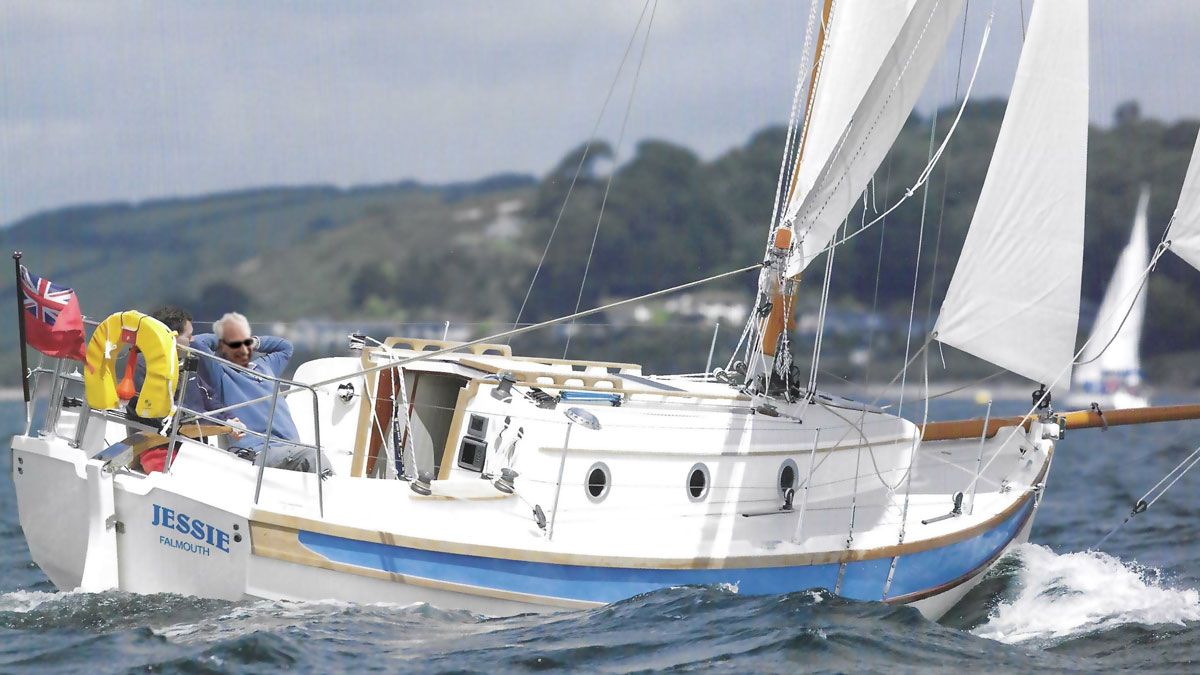
Cornish Crabbers: rebirth of the small boat brand
Cornish Crabbers has now been relaunched having been bought out of voluntary liquidation earlier this year. The new owners share…
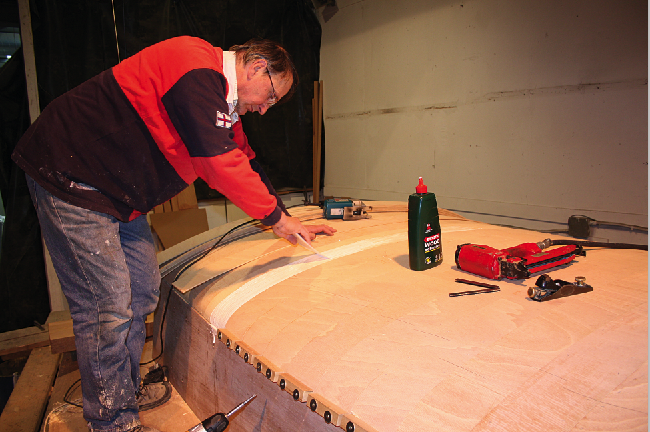
Building a Cornish Crabber 26
Download free multi-part PBO series
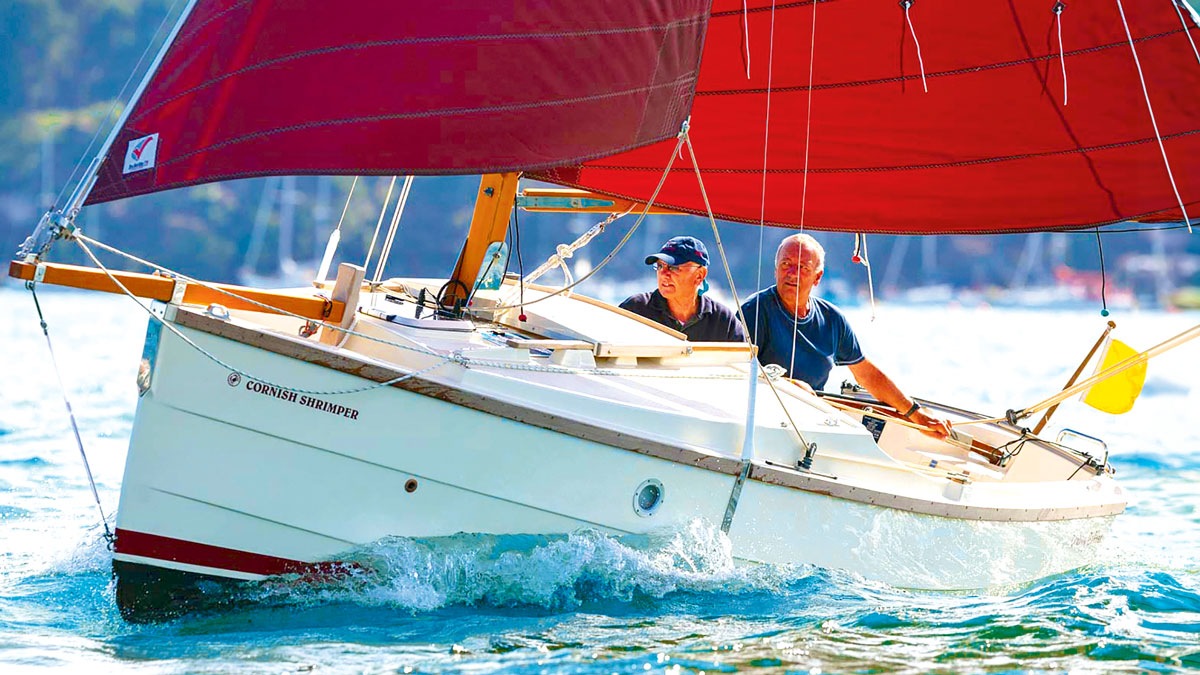
Cornish Shrimper 19: the popular traditionally-styled cruiser + alternative boats to consider
Rupert Holmes looks into why this small, traditionally-styled cruiser remains so universally popular – and suggests some alternative boats that…

Cornish Cormorant used boat report: The day boat that feels much longer than 12ft
The Cornish Cormorant is an attractive cat-rigged dinghy and I was very pleased when Alex at Anglia Yacht Brokerage was…
Want to read more boat tests?
A subscription to Practical Boat Owner magazine costs around 40% less than the cover price.
Print and digital editions are available through Magazines Direct – where you can also find the latest deals.
PBO is packed with information to help you get the most from boat ownership – whether sail or power.
-
-
-
- Take your DIY skills to the next level with trusted advice on boat maintenance and repairs
- Impartial, in-depth gear reviews
- Practical cruising tips for making the most of your time afloat
-
-
Follow us on Facebook, Instagram, TikTok and Twitter
Details
LOA:3.73m (12ft 3in)
LWL:3.43m (11ft 3in)
Beam:1.44m (4ft 9in)
Sail Area:8.5sq m (91.5sq ft)
Draught:0.15m-0.78m (0ft 6in-2ft 7in)
Weight:120kg (264lb)