



David Pugh explains how to keep in shape for all conditions with a comprehensive guide to slab reefing techniques
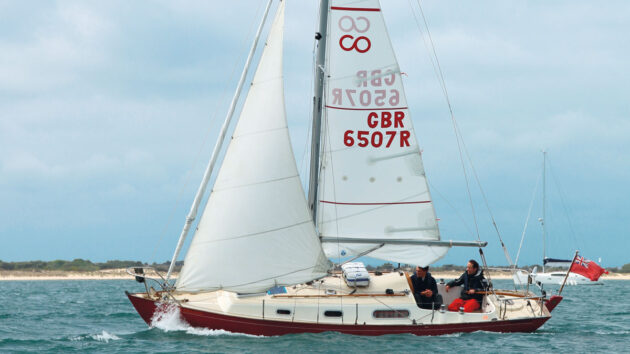
Unless you never hoist sail in more than a Force 3, chances are you’ll have to reef from time to time. But for many, all concept of sail shape goes over the side once the cringles come down – after all, what’s the point in tweaking when you’ve got more wind than you know what to do with anyway? The reality is that shape is just as important in strong winds as it is in the zephyrs – arguably more so, as an overpowered boat is more likely to risk life and limb. And the start of good reefed sail shape is to take control of the situation and reef in your own time and in the right order.
Slab reefing basics
Slab reefing ought to be as basic as it gets – lower the halyard, tie down the corners of the sail and hoist it up again. But get it wrong and you can end up in a worse position than you started – a ripped sail in extreme cases.
When I worked with the gaff-rigged Hunter fleet in Norfolk, a regular task was to show new charterers how to reef. On those boats, the huge mainsails mean that reefing is an essential skill as soon as the wind starts to build – otherwise the boat can easily become too much to handle, especially in confined rivers. But it’s not necessarily simple – with no ramshorns, tack or clew pennants, you have to lower the peak and throat halyards and tie down the tack and clew with sail ties. With a system that complex, your best bet is to judge the wind and reef before you leave.
With the halyards relaxed, the routine was as follows: Lash down the tack to the gooseneck, tie a loop or two of line from the clew around the boom (loosely enough for it to slide), rig a sail tie as a 2:1 purchase (or greater) to haul the clew firmly out to the end of the boom, tie in the reef points around the sail (not the boom), haul up the throat halyard, and set the peak halyard.
There aren’t many seagoing boats with this kind of reefing system any more, but it’s a useful model for what any reefing system must achieve, namely tensioning the foot of the sail and keeping the tack and clew firmly tied down and out.
Ramshorns and reefing at the mast
When we bought our Contessa 26 Red Dragon she was fitted with round-boom reefing, with no splines (battens fixed to the centre section of the boom) or other attempts to improve the reefed sail shape. In addition, it was only possible to fit the kicking strap when the sail was fully unrolled.
A reefing claw would have improved this at the expense of sail chafe, but as the boom was already weakened by fittings that had been added or removed in the past, we opted to change the spar as part of a complete rig upgrade. She now has a standard slab reefing system with ramshorns at the gooseneck and two clew pennants at the mast. The halyard is led aft to allow adjustment under way.
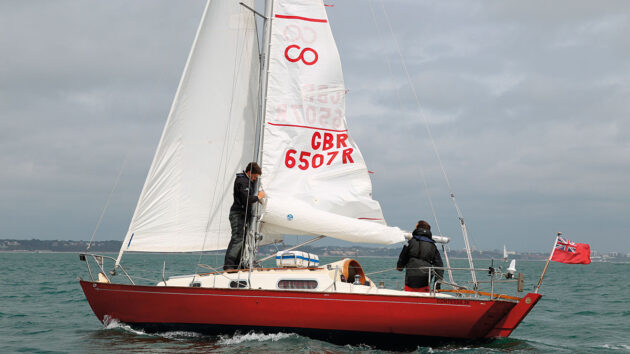
1. Fetching under headsail only with the main eased, I release the kicker and lower the halyard while Ben hooks the tack cringle to the ramshorn.

2. The halyard is then tensioned by hand to avoid the cringle dropping away from the ramshorn, while Ben gets ready to haul in on the clew pennant.

3. The clew pennant is routed so that it pulls the clew both down and out along the boom. It should be good and tight, so Ben uses a mast winch.
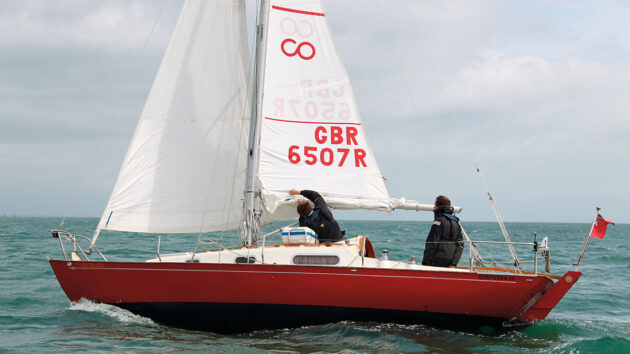
4. Retensioning the halyard and kicker completes the reef, so the main comes in and we start sailing again while Ben tidies up the bunt.
What can go wrong when slab reefing
Whether your reefing system uses a conventional hook-and-clew pennant arrangement or separate pennants led aft for the tack and clew, there are a few things to keep an eye on as your reef comes down.
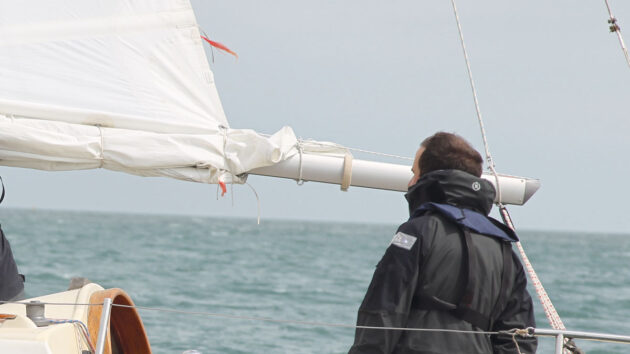
Slab reefing: the clew should be hauled down and out along the boom
- Secure the tack first. Single-line reefs should be biased to do this automatically, but if you’re hooking on a cringle or hauling a dedicated tack pennant, you should make sure it is made fast before the clew and that the cringle doesn’t drop off the ramshorn. If you secure the clew first, you’re unlikely to be able to secure the tack at all, and may tear the sail if too much force is applied.
- Ensure the clew is hauled both out and down along the boom (see image above). Hauling out is essential to tension the foot, and flatten the sail for strong winds, while hauling down gives essential leech tension. Common mistakes are tying the clew pennant directly to the cringle so that there is no means to haul the clew straight down to the boom, or making the clew pennant fast too far forward along the boom, such that it cannot tension the foot.
- Don’t tie reef points too tightly. On loose-footed sails, tie them round the sail only, not the boom. If the foot of the sail is in a track or groove, tie the reef points around the boom but leave plenty of slack. The danger is that the reef points start to take some of the load on the sail and tear it. Some people prefer not to tie them in at all, in case the clew pennant releases and the reefing points tear.
Single-line reefing systems
Many modern boats, especially bigger ones, now have single-line reefing. The systems are many and various, but essentially the idea is that one line comes from the clutch, into the boom and around a block inside the spar before returning to the gooseneck, passing up to the tack and then back down to the boom. The clew pennant is tensioned by the block in the boom, either directly or as part of a purchase.
The secret to a reliable single-line reefing system is keeping friction to a minimum. With so many blocks in the system it’s rare to find one that can be used without a winch, but once a winch is involved you need to be very careful to ensure that you aren’t damaging anything while pulling down the reef. The best systems I have used have blocks sewn to the sail to dramatically reduce the friction of the tack and clew lines from that afforded by simply passing the line through a reefing cringle.
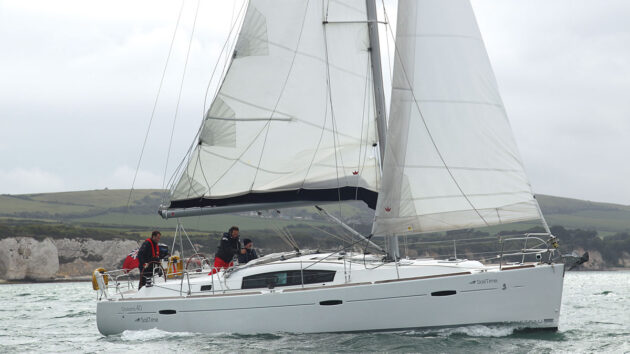
1. Ready to reef – still sailing under headsail, the main is depowered and the kicker eased. An alternative would be to heave to.
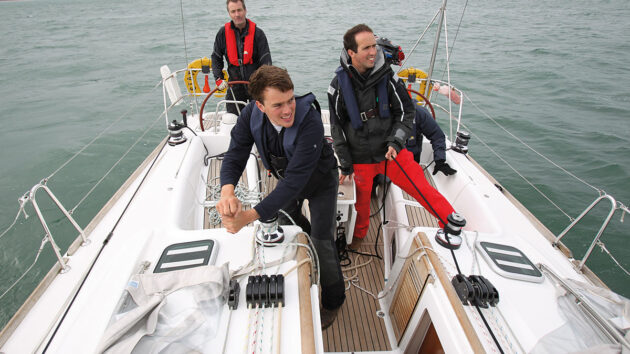
2. As Ben hauls down on the reefing line, I ease the halyard. On a boat this size, reefing is possible with one person but much simpler with two. Keeping both lines synchronised helps to avoid jams.
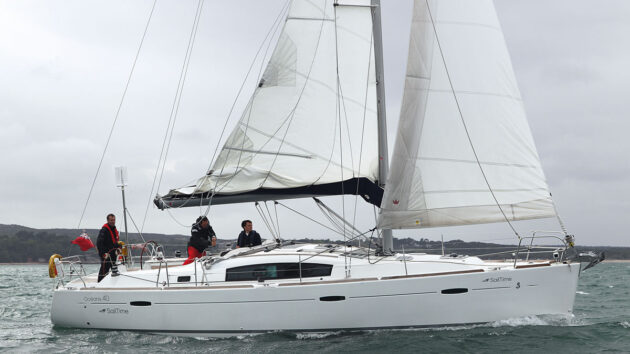
3. The system should haul the tack down slightly faster than the clew – this allows the foot to be tensioned correctly
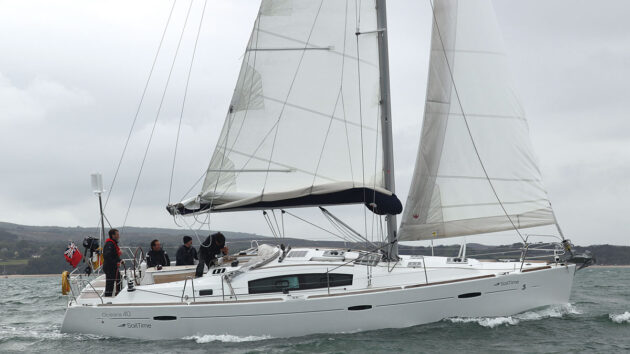
4. All set – the sheet can now be hauled back in, the kicker reset and we carry on sailing. There’s no need to tidy up the sail – the stack-pack takes care of that.
What can go wrong (single-line systems)
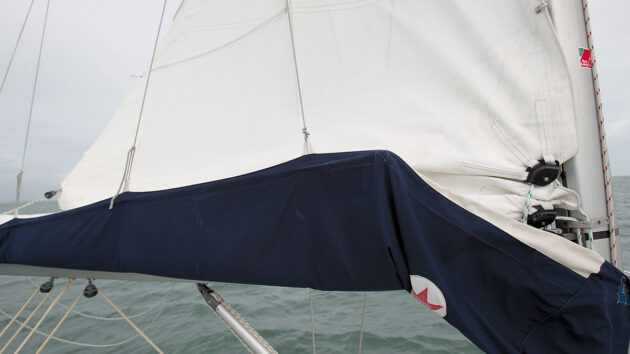
Slab reefing: Tack blocks can stack messily
Tack blocks can stack messily and prevent you from pulling the tack right down to the boom, while clew blocks risk catching the sail itself and damaging the cloth or stitching. Single line reefing systems are known to jam, although modern ones are a great improvement on their early counterparts.
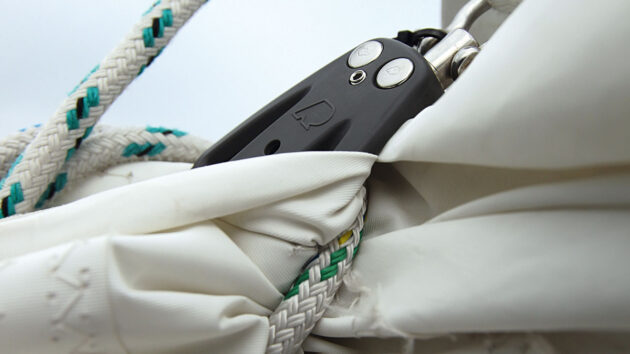
Salb reefing: Clew blocks can risk catching on the sail
Take your time when reefing, and make sure everything is running smoothly. If things do go wrong, a helping hand on deck pulling lines through can often sort things out. When possible, shake the reefs out again before you drop the sail – it’ll make your life much easier next time round!
Single-handed reefing
One option for single-handed reefing is to reef conventionally, with the autopilot holding a steady course. This works well with a constant wind angle, but coastal breezes often shift and on Red Dragon the autopilot spends most of the time in a locker. As a result, my preferred technique for single-handed reefing is to heave to.
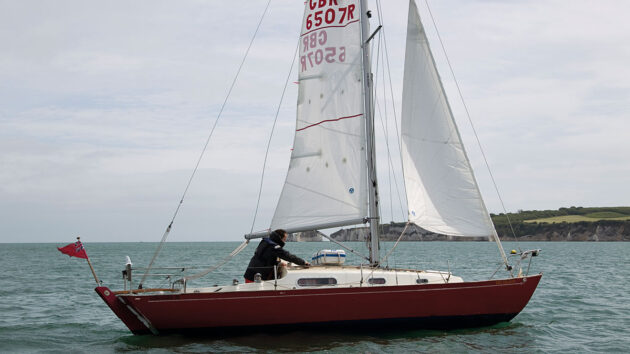
1. Heave to with the headsail to windward and the mainsheet slack. Lash the tiller to leeward and release the halyard and kicker clutches.
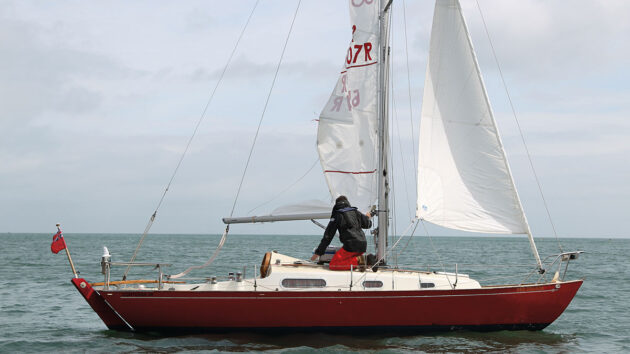
2. With the halyard in hand, move to the mast, lower the halyard and hook the tack cringle. Haul the halyard hand-tight and close the clutch.
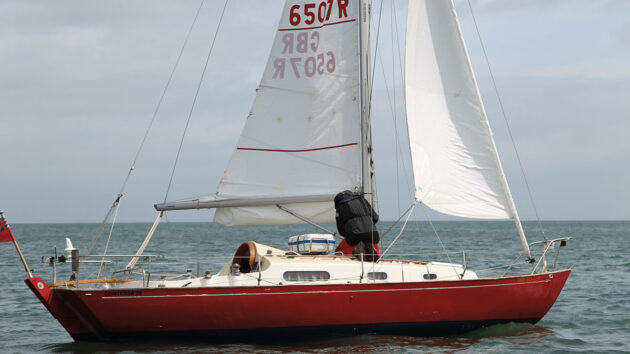
3. Tighten the clew pennant with the winch to ensure the clew is pulled firmly down and out and that the foot of the sail is pulled taut.
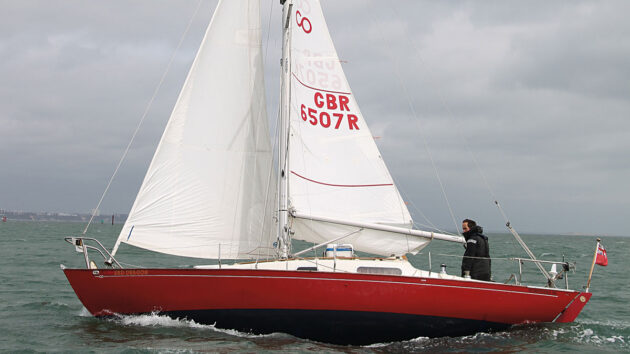
4. If you plan to tie in the reef points, sheet the main in enough to remain hove-to but reach them safely. Return aft, tension the halyard, reset the kicker and start sailing, either by gybing round or tacking the headsail.
Reefing the headsail
So far we’ve concentrated on reefing the main, but with many IOR-influenced boats built in the 1970s and 1980s, the headsail is far more of a powerhouse than the main and should be treated with respect. Many cruisers choose to use roller headsails, and sailmakers have come up with some clever innovations that help them to retain a reasonable shape when reefed – usually a foam or tapered rope lift to take up some of the belly of the sail as it rolls.
However, although the reefing itself is easy, don’t forget the genoa cars – the more you reef the sail, the further forward they’ll need to go. Aim to keep the line of the sheet roughly bisecting the centre of the luff for the best sail shape.
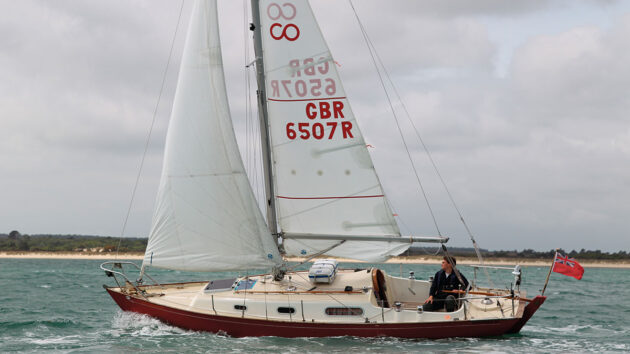
1. The line of the sheet should roughly bisect the lift (image above). A good way to guess this is by matching the angles between the sheet and foot and the sheet and leech. In this picture, the car is too far aft – moving it forward would add shape to the foot and reduce twist in the sail.
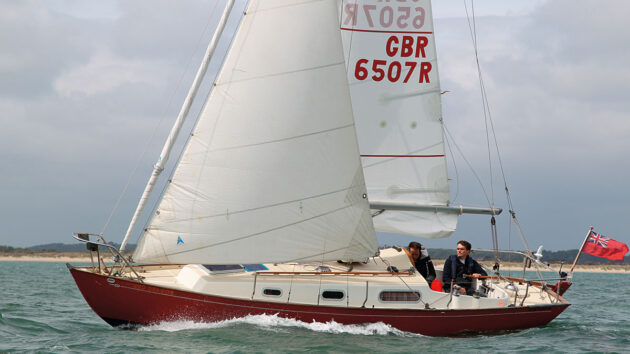
2. If you can bring yourself to dance around on a wet foredeck, the best approach is still to use hank-on headsails (image above). Red Dragon has a removable inner forestay on which we hoist our old No3 headsail if the wind looks set to be regularly above 20 knots. This makes it easier to achieve adequate luff tension and an efficient sail shape in strong winds. It also allowed us to specify a lighter, fuller roller genoa, benefiting us in light airs.
If you have a headsail-biased rig, it’s worth trying to sail under full headsail alone. The headsail overlap helps offset the tendency of the bow to come away from the wind due to pressure in the foretriangle.
Reefing hank-on sails
One oddity of our No3 headsail is that it has extra cringles and reefing points fitted for one reef.
Once commonplace, this is now rarely seen, but can be effective in the right conditions.
The technique is similar to reefing a mainsail:

1. Lower the halyard and shackle the new tack cringle to the deck fitting.
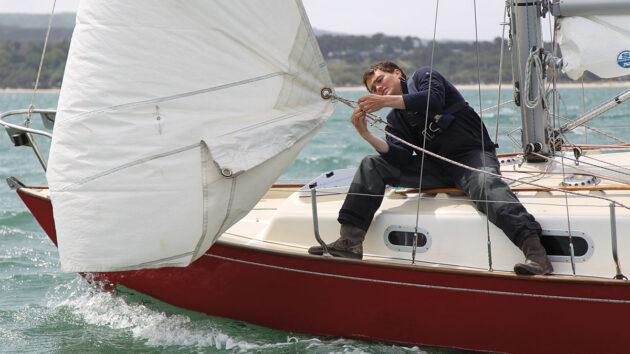
2. Retie the sheets at the new reef cringle
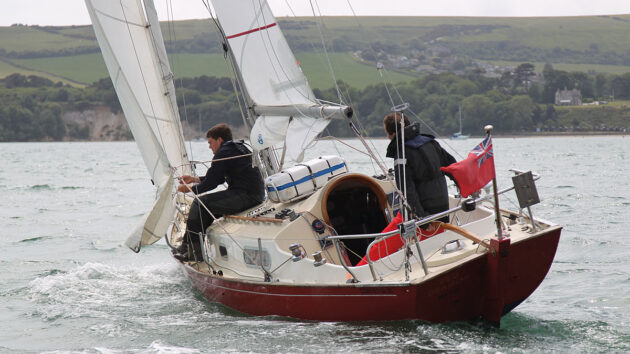
3. Haul up the halyard and tie in the reef points.
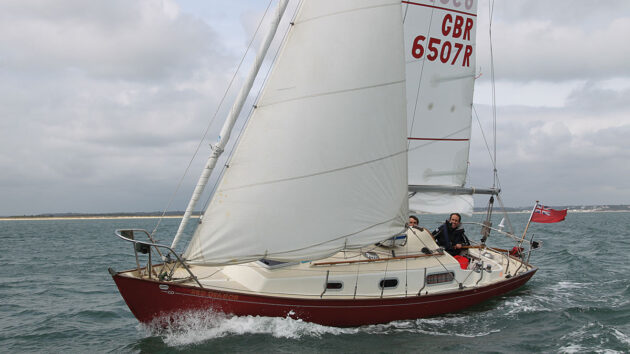
4. The original, dual-purpose sail!
Other reefing systems
I’ve focused on slab reefing for two good reasons: It’s the most common system, and it offers the most control. Users of round-boom reefing will be aware of the problems in retaining a flat sail when reefed and with the methods by which this can be alleviated, such as by adding splines to the centre section of the boom or putting a cushion in the bunt of the sail as it rolls.
Modern in-boom reefing offers little adjustment except by halyard tension, while in-mast reefing has the reverse issue, where halyard tension is virtually impossible to alter once the sail is partially rolled but the foot of the sail can be flattened with outhaul tension. Full batters, whether horizontal for in-boom reefing or vertical for in-mast, help a lot to offset these problems by maintaining a flatter sail shape, but unbuttoned sails tend to be too full and need reefing earlier than slab-reefed ones.
Slab-reefing: conclusion
The key to happy sailing when reefed is always sail shape. When the wind gets up, your first reaction should be to flatten things: tension the main halyard (or Cunningham), genoa halyard, outhaul, backstay and kicker. Flatter sails will help you point in strong winds and avoid griping, while baggy sails will rapidly overpower and cause the boat to round up.
When you reef, the same applies. You’re still setting up the sails for strong winds, they need to be flat. Don’t skimp on the halyard tension, and make sure the mainsail foot is good and light.
You’ll also need to keep an eye on your genoa car positions. Textbook trim has the line of the sheet intersecting the luff at or just above the half-way point, so you’ll need to move the cars forward as you reef or change headsails. If you’re trying to make ground to windward, setting the cars slightly aft from this point will promote twist, depowering the top of the sail while flattening the lower part. It’s also doubly important in this situation that you use the backstay to sharpen the headsail entry.
Most boats are happy to sail reefed, and often actually speed up under reduced sail when things are marginal. As a result, it’s a good idea to reef early, but circumspectly. It’s no fun sailing an over-reefed boat – the likelihood is that you’ll lack power to punch through the waves, which can be a serious problem in lumpy seas – so know your boat and sail her with the sailplane that gives her the most power she needs without stressing her (or the crew) unduly. The result can be some happy, windy sailing.

How to reef – expert advice from PBO Sail Clinic
How do you ensure an efficient reef with a roller-reefing headsail and slab-reefing mainsail? David Harding explains
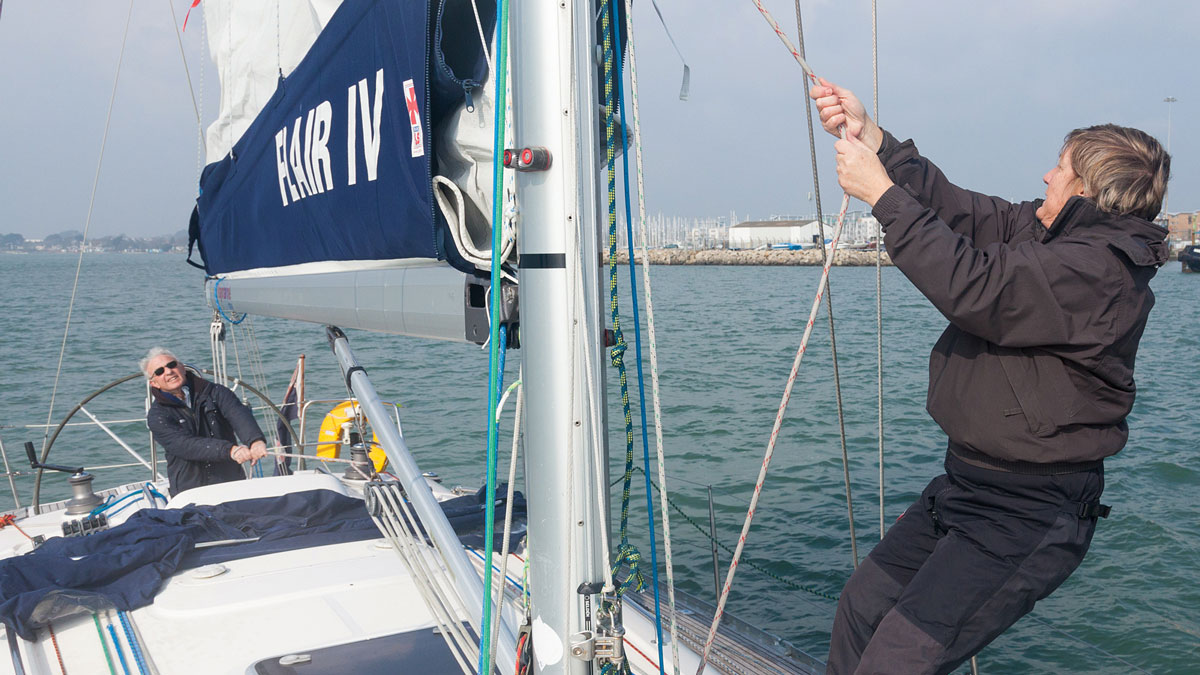
Hoisting and lowering the mainsail: troubleshooting problems
What can you do if your mainsail is hard to hoist or reluctant to drop? David Harding offers some advice

Understanding boat displacement & why it matters
How well do you feel like you understand boat displacement? For most sailors, it’s an overlooked topic. When I returned…
200 miles offshore with no rudder: How four sailors built a jury rudder from cabin doors
Stranded 200 miles offshore in big seas without a rudder is every sailor’s nightmare. The crew of Quokka found a…
Want to read more articles like Slab reefing: Essential guide to sail shape, heaving to, and preventing sail damage?
A subscription to Practical Boat Owner magazine costs around 40% less than the cover price.
Print and digital editions are available through Magazines Direct – where you can also find the latest deals.
PBO is packed with information to help you get the most from boat ownership – whether sail or power.
-
-
-
- Take your DIY skills to the next level with trusted advice on boat maintenance and repairs
- Impartial, in-depth gear reviews
- Practical cruising tips for making the most of your time afloat
-
-
Follow us on Facebook, Instagram, TikTok and Twitter