




Katy Stickland talks to Sailing Uma’s Dan and Kika Deckert about the three year refit of their 1972 Pearson 36 for an all-electric circumnavigation of the globe
Electric engines in boats are nothing new; in fact, they have been around for over 185 years, ever since German-Russian inventor Moritz von Jacobi demonstrated his 24ft/7.3m passenger boat on the Neva River in Russia in 1838.
But in all that time, no one has ever successfully circumnavigated the world via Cape Horn in an electric sailboat, mostly because of the slow progress of battery technology until relatively recently. But that could soon change following the announcement by Sailing Uma’s Dan and Kika Deckert.
At the end of October, the two sailors plan to leave from Europe to sail around the world without using fossil fuels for propulsion, onboard power generation, or cooking. That means no diesel engine, generator or cooking gas. Instead they will use solar power, battery storage, and hydrogeneration to run everything onboard, including Starlink and Iridium Go! for satellite wifi.
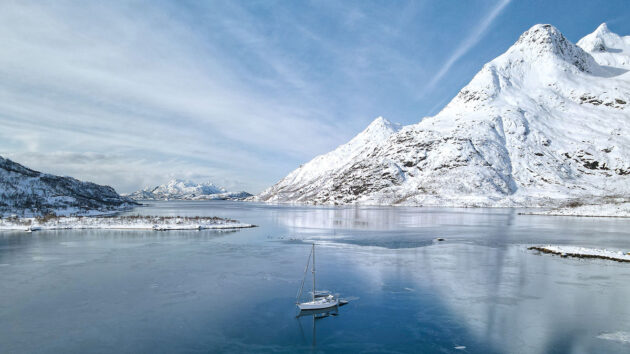
After installing an Oceanvolt ServoProp saildrive 15, Dan and Kika’s power needs were met using just electric power, even in the High Arctic. Credit: Kika and Dan Deckert/Sailing Uma
This might seem like a daunting task for your average sailor but Dan and Kika are anything but average. Since the start of their sailing journey, they have ditched the diesel for electric and, more recently, regeneration, initially powering Uma with a cannibalised second-hand forklift motor with golf cart batteries and solar panels.
“For five years we had our own DIY system which worked but it definitely had limitations with overheating and the batteries were not really set up for what we were doing with them,” explained Kika. “Most importantly we wanted to be able to generate power from our motor which we could not do with our self-built system so we’ve always been in pursuit of regeneration from the prop.”
In 2020, in Norway, they installed an Oceanvolt ServoProp saildrive 15, a software-controlled variable-pitch saildrive that automatically adjusts the pitch of the propeller blades to optimise power generation and output. “We’ve never run out of power offshore since,” said Kika. “And we have taken it further, with Uma carrying us into the High Arctic – the first electric sailboat to reach Svalbard.”
Their 30,000+NM of cruising with an electric engine and the refits of Uma are the foundation for their new challenge.
Building an electric sailboat from the ground up
Most boat owners plan their power needs onboard by calculating daily electrical load, evaluating usable battery capacity, and matching those figures with reliable charging sources. Kika and Dan turned that on its head.
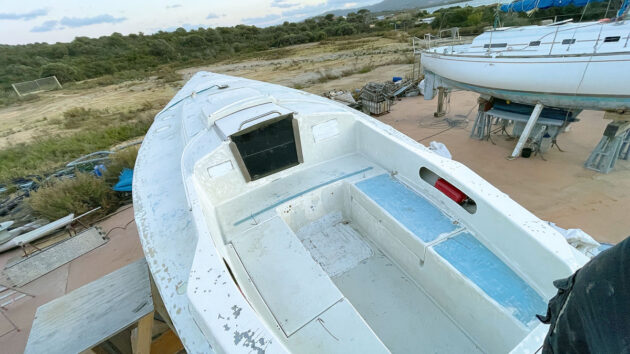
Uma’s deck was stripped back and redesigned. Credit: Dan and Kika Deckert/Sailing Uma
“A lot of people look at it from a top-down perspective: ‘Here’s how much power I need. How do I make it?’ We look at how much power we can generate and ask: ‘What can we do with it?” said Kika. “We barely use the motor to propel the boat because we have sails so our solar and one servo prop were plenty but we wanted to push further and thought, what if we fitted two servo props? What could we do with that power to improve comfort and convenience? You can sail a boat without a motor; that’s the minimum. Everything on top of that’s convenience. We never see a motor as a safety piece of equipment, even a diesel motor. It’s just convenience.”
Installing a second Oceanvolt ServoProp saildrive 15 plus the 3kW of solar onboard means Uma can generate around 40 kilowatt-hours of electricity every day, more than enough for their onboard needs. Each servo prop has its own separate battery bank – five Victron Lithium NG 48-volt batteries and a separate Victron battery management system. One bank is below the waterline, so they stay at ocean temperature. The other is above the waterline to avoid failure if flooded. Each battery bank is capable of running the whole boat at full load. Tinned copper wiring and proper fusing have been used throughout. The whole system has also been load-tested and monitored with a thermal camera to check for potential failure points.
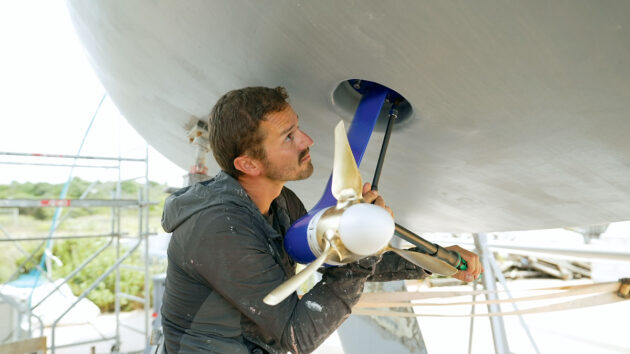
Kika and Dan installed a second Oceanvolt ServoProp saildrive 15; with the extra solar Uma generates 40kWh of electricity daily, plenty of power for an electric sailboat. Credit: Dan and Kika Deckert/Sailing Uma
Further backup is provided by a separate 12-volt house bank and a 12-volt battery management system which powers the essentials like the autopilot, fridge-freezer, radio, and communications.
“Each servo prop is able to run off either or both battery banks or charge either or both battery banks. These are all on a Victron bus bar which is where the solar feeds in, so we can power both battery banks with just solar. Each battery is fused individually and each load fuse has a little sensor on it that alerts us if a fuse blows. When it comes to the wiring, we’ve heat-shrunk, crimped and torqued everything properly. Torque is important because if you don’t have the right torque on a bolt with the right spring washer and it heats up and cools, repeatedly, then you get a loose connection which increases resistance and causes heat to build. This is where fires come from. To avoid possible failures we have layers of redundancy built into the entire system,” said Dan.
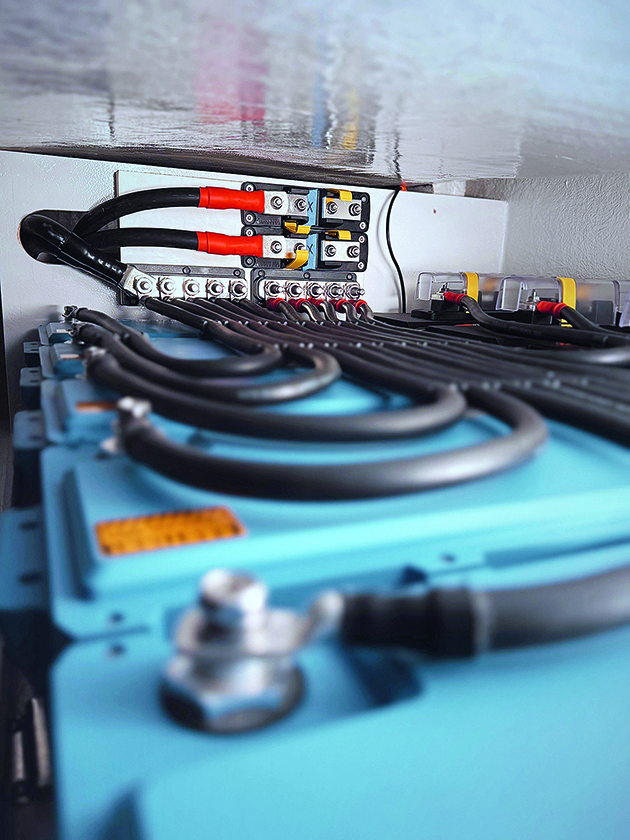
A Victron busbar allows the solar feed to power both battery banks. Credit: Dan and Kika Deckert/Sailing Uma
“We have no galvanic corrosion issues because our whole DC (direct current) system is ‘floating’. This means unlike most other boats our batteries and the rest of the entire electrical system are completely isolated from the ocean. Since we don’t have a diesel engine, there is very little metal below the waterline. There are no metal through-hull fittings; the only metal we have is the keel touching the water and the rudder shaft, but those aren’t connected electronically to anything. This is such a HUGE difference between an electric and diesel boat that is usually overlooked and poorly understood.”
Once each new system is finished, it is brought online for testing and then kept online to iron out any problems, although Dan says there have been “very, very few issues or faults because we’re not waiting til everything’s done to test; we are doing it at every stage.”
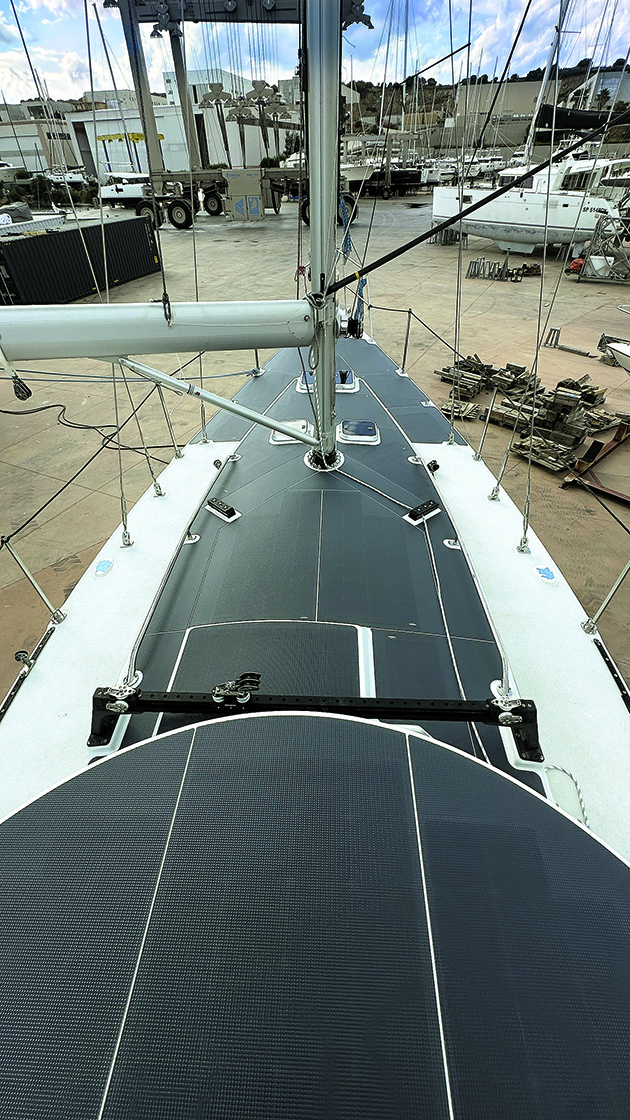
The deck has been covered with 1500W of custom-fit, lightweight Levante solar panels. Credit: Dan and Kika Deckert/Sailing Uma
“Since we’re the ones that did all the wiring on our boat, we know every cable run, every chafe point’s protected, everything’s good. We haven’t just slapped everything in and then waited for everything to be done to system test everything. We test each system when it is finished and then move on to the next one.”
More than a refit
As Uma is being redesigned and rebuilt down below, this gave Dan and Kika the opportunity to design and build a totally new propulsion system; it also meant previous problems could be solved. Initial plans were drawn up three years ago but these changed as the refit progressed.
“It’s been interesting as we’re the ones designing it and building it and speccing the components and installing the components, some of which were not even around three years ago when we started this, so we’re able to find the best position for everything to fit and then wire it up just right,” said Dan. “The only thing that hasn’t changed is the location of the mast.”
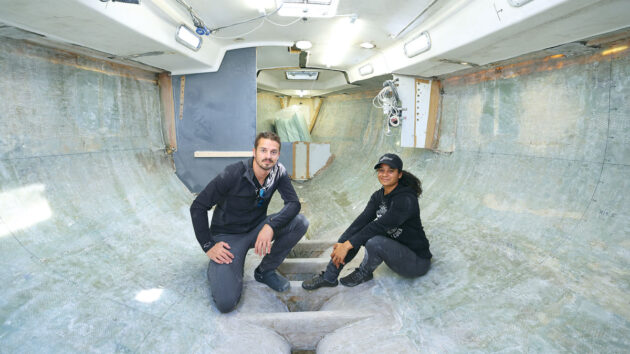
Redesigning the interior means Uma now has 4ft more space down below, although her overall length – 36.52ft/11.13m – remains the same. The galley, which includes an electric oven, has been pushed back 60cm, as the space was no longer needed for a diesel engine; every bulkhead was rebuilt, the location of the heads, dining area and water tanks was changed and new hatches, windows, metal fittings and rig were installed. Even the keel was dropped and new keel bolts fitted.

Redesigning Uma down below has resulted in 4ft of more space. Credit: Dan and Kika Deckert/Sailing Uma
This also allowed them to address a structural problem with Uma – dimpling of the hull where the lower shrouds attach, mainly due to poor glassfibre layup in the original build.
“Because we sailed the boat so much we put tension into the rig and the dimples kept getting bigger and it came to a point where we didn’t feel the boat could take us where we wanted it to take us. It wasn’t safe to keep sailing as we were going to lose the mast. Initially, we thought it was going to be a three-month refit, but when we started to take off things to fix the dimples, we realized that the boat was built terribly. This is why it has taken three years,” said Kika.
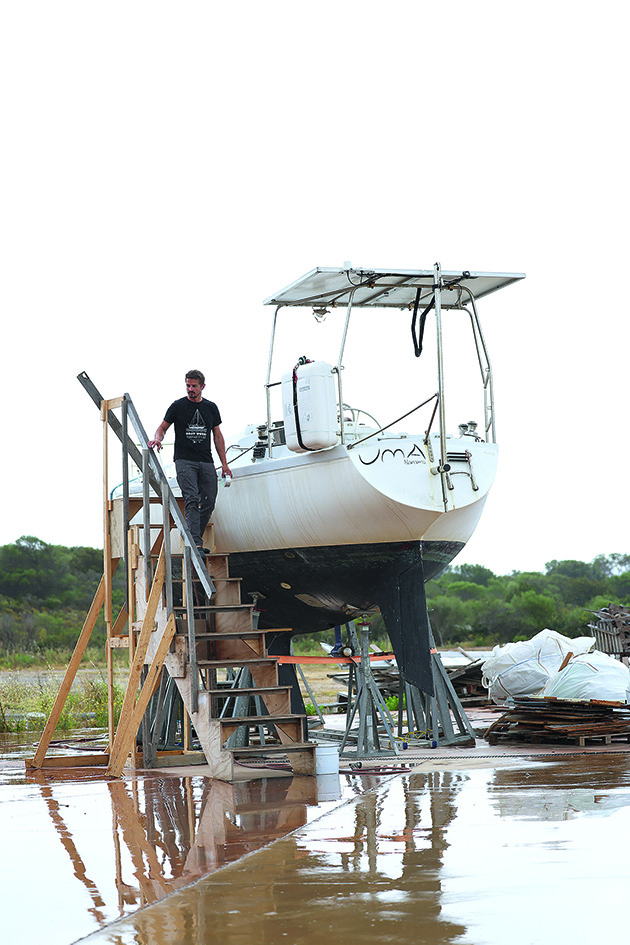
Plans for the refit began three years ago, with changes along the way. Credit: Dan and Kika Deckert/Sailing Uma
“Every single piece of wood and metal” was removed so Uma was just a bare hull before new ribs and stringers were glassed; the entire interior of the hull was also reinforced with another two millimeters of glassfibre added along with insulation.
They ground out 250 kilograms of “aesthetic” glassfibre from the cabin liner head and cabin sole which balanced the extra 250 kilograms of glassfibre added to the structure, so the boat’s weight should be similar, but is now much stronger.

The refit included new windows, hatches and a fully custom hard dodger. Credit: Kika and Dan Deckert/Sailing Uma
On deck, the wheel has been replaced with tiller steering and a new extended hard dodger was designed and built, which can be heated or cooled via the boat’s reverse-cycle air conditioning system, which will provide Dan and Kika with protection when sailing in harsher conditions.
“With the tiller and the centralised twin electric saildrives we should be able to manoeuvre Uma like a catamaran; we will be able to spin the boat around on its keel, so docking is going to be easy. We’re probably not even going to use the rudder coming into the dock; we’re just going to lock the tiller in place and then just drive the boat in like a catamaran,” said Dan. “It’s going to be like learning to sail all over again because she’s a completely different boat now.”
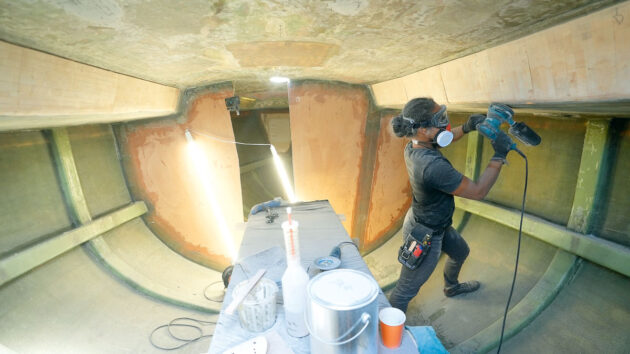
New ribs and stringers were built and the entire hull was reinforced with another 2mm of glassfibre along with insulation. Credit: Dan and Kika Deckert/Sailing Uma
Software updates
Dan and Kika expect to see improvements in the performance of the two Oceanvolt ServoProp saildrive 15s as new software updates are released; over the last four years they have been at the forefront of testing, seeing improvements all the time.
“We always use 1 kilowatt as our slow speed baseline for testing. Before the last update, 1kw of power from the batteries could push the boat to 2.7kts; after the update the same power draw, pushed us to 3.2kts. That’s a 0.5 kt increase in speed, just from one software update. We have been working with OceanVolt a lot over the last five years to help improve the system and are really happy with the new technology. We can motor at 7.5kts, but only for five or six hours, so we don’t plan to do it often. At 3.5kts, we can motor for days. The real reason for dual motors is double the regen while sailing,” explained Dan.
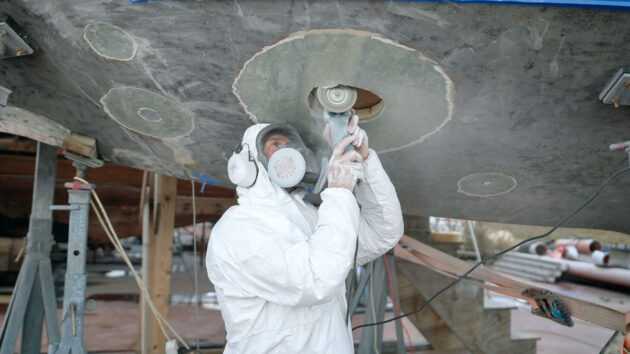
Cutting a hole for installation of the ServoProp saildrive. Credit: Dan and Kika Deckert/Sailing Uma
On board Uma, it has never been about speed, and they notice very little difference between when they are generating power and when they are not.
“I know most people will see the downside of having two props in the water as drag, but unless you are racing, why does it matter? We’re cruising. Our boat has a maximum speed of 7 knots so it doesn’t matter that much. And when we do turn on the regen, sometimes we go a bit slower, but other times it will be a bit faster; the reality is that boat speed changes due to every single wave. If you were racing matched boats, of course, don’t turn the regen on, but if you are cruising, you can’t tell the difference,” said Kika.
New sail plan
The mast of the boat has also increased by 60cm to accommodate a Solent rig (Uma originally had a Bermudan rig), a much larger Code 0, spinnaker and larger lighter genoa to maximise their light wind sail area, and a smaller, heavier jib and dedicated removable stay storm jib. All the sails are being made by Canadian-based Precision Sails.
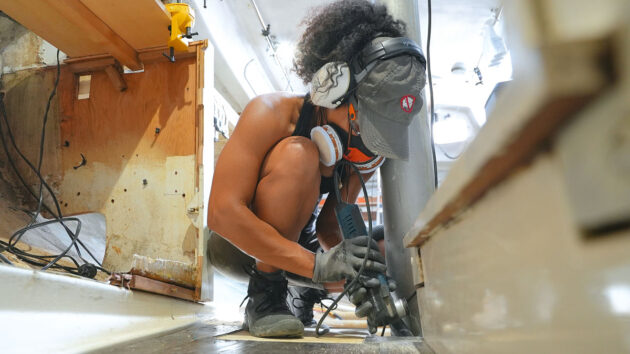
Modifying the sole near the mast base. Credit: Dan and Kika Deckert/Sailing Uma
“On our main we have included the storm jib as part of the sail area,” explained Dan. “Our first three reefs are shallower, knowing that our fourth reef is then the storm sail. The system has been designed so the storm sail is in our stack pack ready to go with a separate track. We can then hoist it on our spare halyard and drop the main from the cockpit. So we can go storm jib up, main down and vice versa from the cockpit. We only need to go forward to set the storm jib, but once we do we can hoist it and lower it easily enough and it is not in the way of the other head sails. So if we know bad weather is coming, we can set the Solent jib and the storm jib and then in the middle of the night, we can roll one up, run the storm jib and when it is light we can unroll any another sail in front of the storm jib until it is time to take it down. We have a 24-speed bike now rather than a 5-speed bike so we can dial into all the settings we need for the wind conditions.”
Shakedown
With Uma being out of the water for three years, Kika and Dan are keen to “shake off the land cobwebs” and test all of the new systems on the water before starting their circumnavigation.
“We want to challenge ourselves and see how viable it is to cruise around the world on an all-electric boat without any fossil fuel or generator on board,” said Kika.
The last person to try an all-electric circumnavigation was Jimmy Cornell, who attempted sailing the same route as the Magellan expedition of 1519 aboard his Outremer 45/4X custom catamaran EL.CA.NO. It was also fitted with twin OceanVolt ServoProps which were capable of generating an estimated 1 kW at 6 to 8 knots. The catamaran also carried 1,500W of solar panels and 56kW of combined battery capacity. But the voyage was abandoned after a 1,500-mile test run from France to Tenerife in late 2020 claiming hydro-generation system could not produce enough reliable electricity while sailing to sustain the zero-emission goal without fossil fuels.
“No one has tried since then but in the meantime we’ve taken our electric boat up to Svalbard and Iceland, and we have proved the systems work,” said Dan. “We have also been testing a single version of this system (Oceanvolt ServoProp saildrive 15) onboard for the last four years and we know how that works and every time a new software update comes out, the boat performs better.”
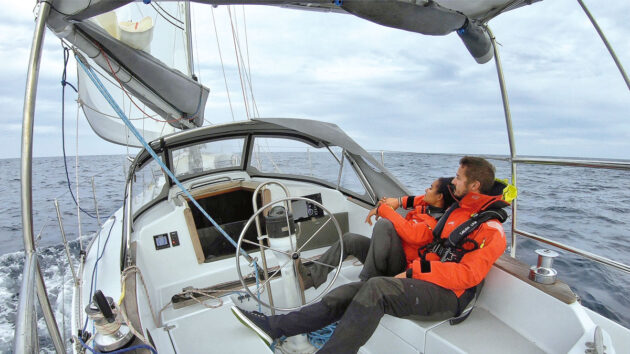
Dan and Kika have cruised over 30,000 miles with an electric engine and now plan to sail the newly refitted Uma around the world via Cape Horn. Credit: Dan and Kika Deckert/Sailing Uma
Like Jimmy Cornell will they also be avoiding shore power for a truly fossil-fuel-free circumnavigation?
“We are going to prioritise anchoring as much as we can or tie to a dock; we have 3Kw of solar so we will be making more from the sun than we would get from a 16amp outlet anyway. We’ve thought about this and if we find ourselves needing to plug in, like a COVID pandemic happening again, our theory would be if we arrive with 80% power, we will be leaving with 80% power. We will leave with what we started with. But we’re not planning on plugging into the shore power at all,” said Dan.
They are clear that their circumnavigation is not a race but also not a 10-year adventure; the timetable will be dictated by each weather window. And if the worst happens, they also know they can continue.
“We know we can sail without electricity. We’ve done it; for the first four years of cruising we couldn’t even plug into shore power,” said Kika. “We know we can sail with a paper chart and a handheld GPS. We’ve done it. We have a sextant; we know we can always go back to that bare minimum and just keep going. So, if our engine dies, we don’t care. We’ll just keep sailing.”
For Dan and Kika, upgrading the boat has been “like a dream”: a chance to test a new frontier in cruising to prove that a sailing boat powered exclusively by renewable sources of energy and with no fossil fuel for propulsion or electricity generation is an option. This could be the start of a new revolution.

Electric engine conversion on a Contessa 32
Norman Rubenis gets ‘Thunderstruck’ when he ditches the diesel and converts his Contessa 32 to run on a 10kW electric

How to choose the right electric boat engine
Electric propulsion is clean, near silent and can even be self-refuelling, but is it worth the investment? Jake Kavanagh considers…

Is it time to switch to an all-electric boat?
Rupert Holmes takes an in-depth look at the practicalities and pitfalls of choosing electric propulsion, or even an all-electric boat

‘Why I want to sail around the world in my 9m electric sailing boat”
Dena Hankins is on a global voyage aboard her 1984 9m Baba 30 converted to run with an electric propulsion…
Want to read more articles like Sailing Uma: ‘How we built an electric sailboat to take around the world’?

A subscription to Practical Boat Owner magazine costs around 40% less than the cover price.
Print and digital editions are available through Magazines Direct – where you can also find the latest deals.
PBO is packed with information to help you get the most from boat ownership – whether sail or power.
-
-
-
- Take your DIY skills to the next level with trusted advice on boat maintenance and repairs
- Impartial, in-depth gear reviews
- Practical cruising tips for making the most of your time afloat
-
-
Follow us on Facebook, Instagram, TikTok and X