



Harbour foreman and boatbuilder Mike Pickles explains that with a little imagination, you can find space on most boats for a waste holding tank
Based at Southwold on the East Coast, we generally have two choices when we leave the harbour. Turn right, or head straight across the North Sea. Us locals try to avoid turning left! Heading straight across means that in 12 to 14 hours we’ll be in Dutch or Belgian waters, and among the myriad of required items we should have on board or fitted is a waste holding tank – especially if we want to visit the inland waterways.
The trouble is, many of the boats produced in the 1980s and ’90s really didn’t take this into account, so it can be quite difficult to work out where to put an additional tank of 100+ litres. Most of the obvious places to fit a tank already have one, so it means we have to get a bit creative.
Lucky for us, Tek-Tanks allows us to do just that, and will build a tank to fit some really weird spaces. I’m sure there are other tank builders that can do this as well, but we tend to stick with what we know works for us.
Designing the waste holding tank
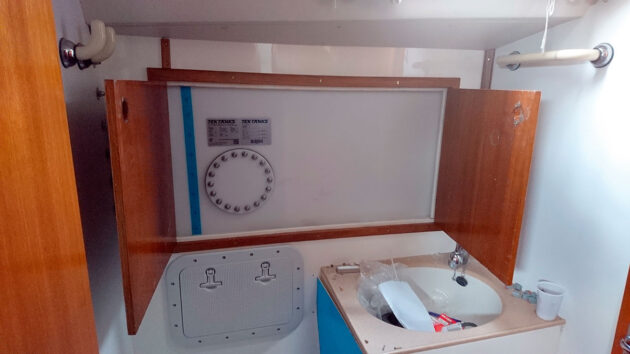
Anyway, it so happened that an Oyster 406 came in for a new Beta engine, a new electric loo and a waste holding tank. While our engineering boys set about tackling the ‘how do we get the old engine out?’ issue, I got on with measuring the total cupboard space above and behind the forward heads. And as long as the owners could find a new location for their toothbrushes and shampoo, I believed I could get a 110lt tank in there.
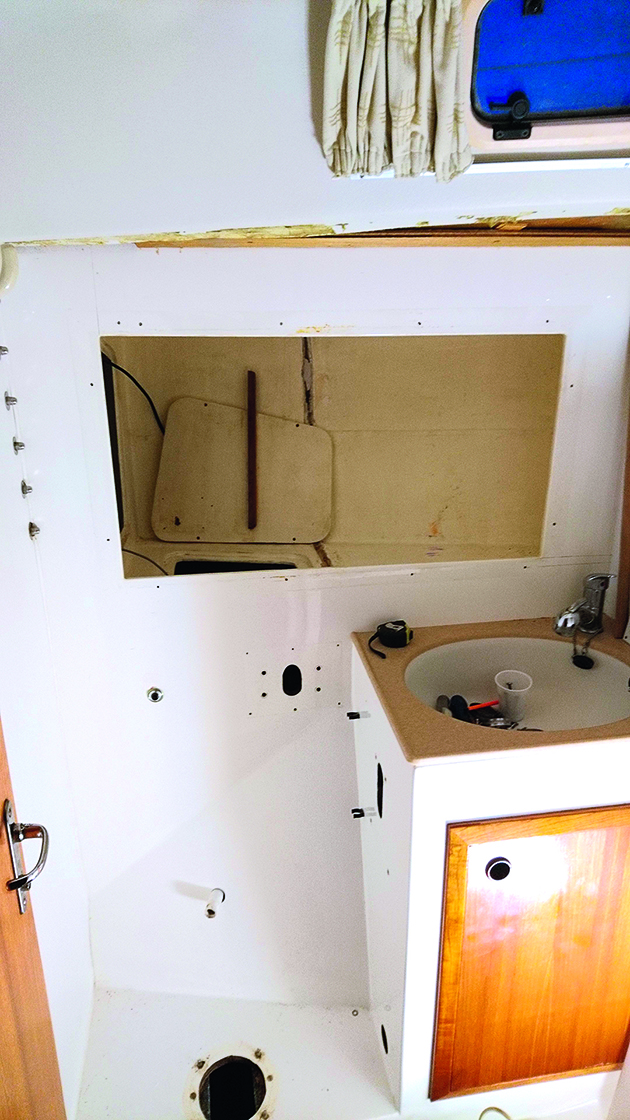
The old cupboard is stripped out to let us take a better look at what lies behind it. Credit: Mike Pickles
Yes, it was a strange shape – a bit like a giant wedge of cheese – but nothing out of the ordinary for Tek-Tanks, who have come up trumps every time I’ve set them a challenge. It would require a little bit of surgery to the boat interior and also some thought to ensure there would be adequate access in the future.
Original builders/designers tend not to lose too much sleep over enabling access to things that could require maintenance work later on, with quite large areas of boat that are virtually impossible to get at.
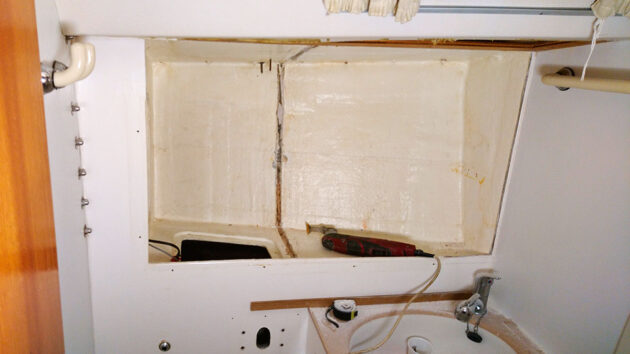
Removing some bulkhead reveals a much bigger space. Credit: Mike Pickles
Being sailors and boat owners ourselves (coupled with the frustration of getting to fittings, bolts, pipes and cables, plus hull areas you need access to in case some numpty T-bones you in a marina), we like to make certain that whatever we put in can also be removed; and we also attempt to provide access to hitherto no-go areas.
We could have totally filled the available space and found another 30lt of tank space, but access would have been made much harder to the top fittings such as the air filter/breather, flush-out and level sender, so practicality won the day. The heads moulding is quite tight to the hull, so the skin fittings are forward of the main bulkhead in the forward cabin.
Changing fittings
Changing fittings, including toilets, will always result in redundant and unsightly holes, so this dictated the location of the access hatch – and that in turn finalised the position of the diverter valve. The electric loo switches were mounted through 5mm white plastic sheet glued to the side of the sink cabinet, again covering a number of redundant holes.
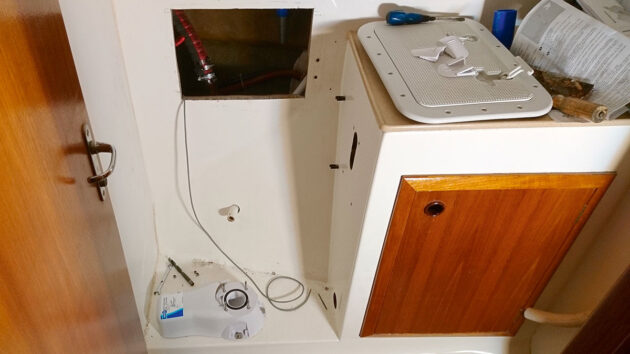
Creating a hole for the connectors and pipework. Credit: Mike Pickles
We could have glassed and re-gelcoated, but the extra expense was viewed as being unnecessary. The one issue I have with electric loos is that they are so incredibly noisy, despite being named ‘quiet flush’. There should be a little flag raised whenever you use one in a marina, saying: ‘Yes, we have a holding tank’.
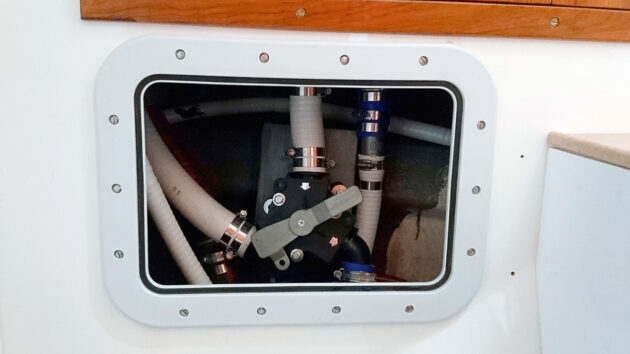
A hole covered by a hatch allows access to connectors and pipework below tank. Credit: Mike Pickles
That said, the Jabsco works well, and based on the lack of complaints from customers they seem very reliable. This is the first time I’ve used the Jabsco diverter valve, and I’m hoping it proves reliable as fitting it was a breeze, especially as the outlets are movable and allow many angles for the 38mm pipework.
More than adequate
During testing the loo and inlet pumps proved more than adequate to discharge into the waste holding tank, and with the diverter valve set to ‘empty’ the tank level dropped like a stone. An initial worry was about having 100kg of extra weight up high and out on one side, but once the boat was on the water it made very little difference visually – and, of course, once offshore the tank could be emptied anyway.
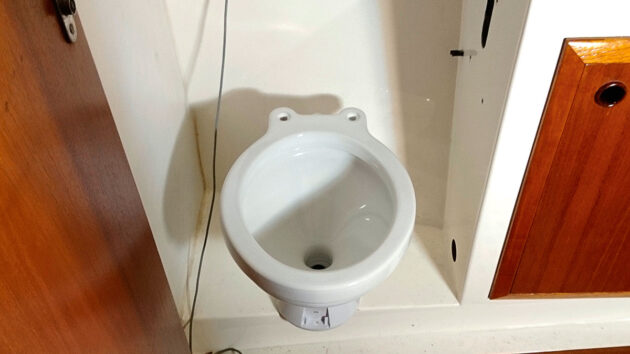
The ‘silent flush’ loo gets a trial fit. Credit: Mike Pickles
The owner’s report back was very positive, and apparently the noisy loo issue is not as bad as I feared as it takes such a short time to flush and pump.
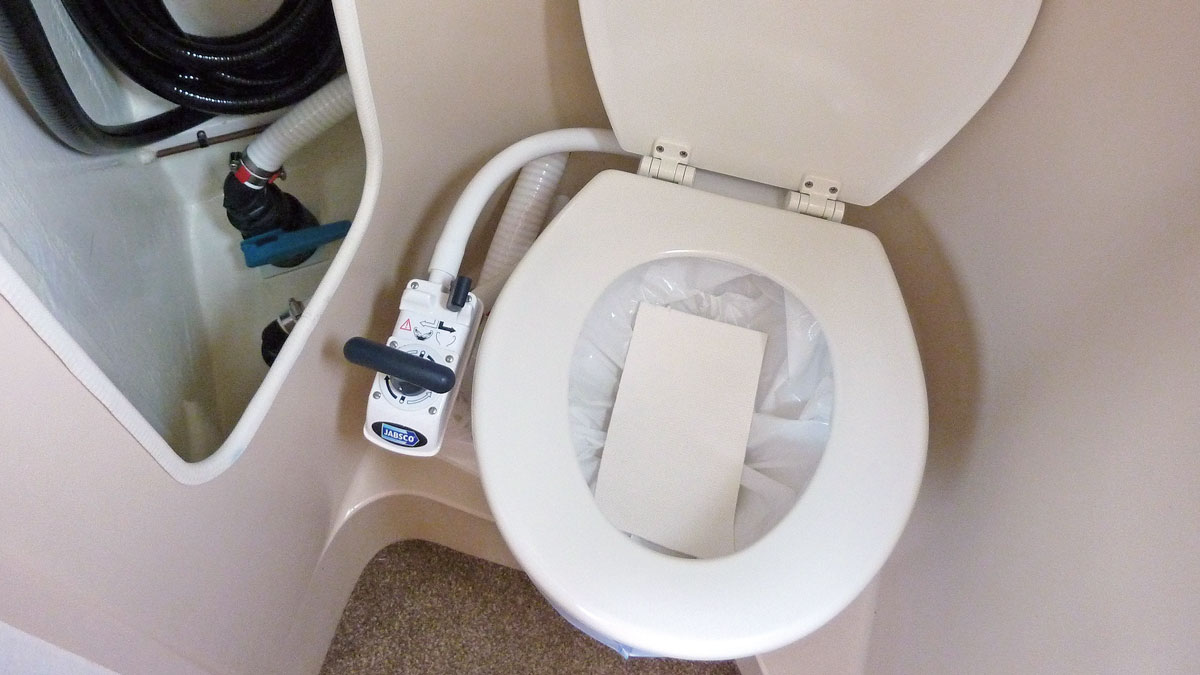
No room for a holding tank? Use a bedpan liner
No-one should be pumping out the heads in a harbour. But what’s the alternative to fitting a holding tank? John…
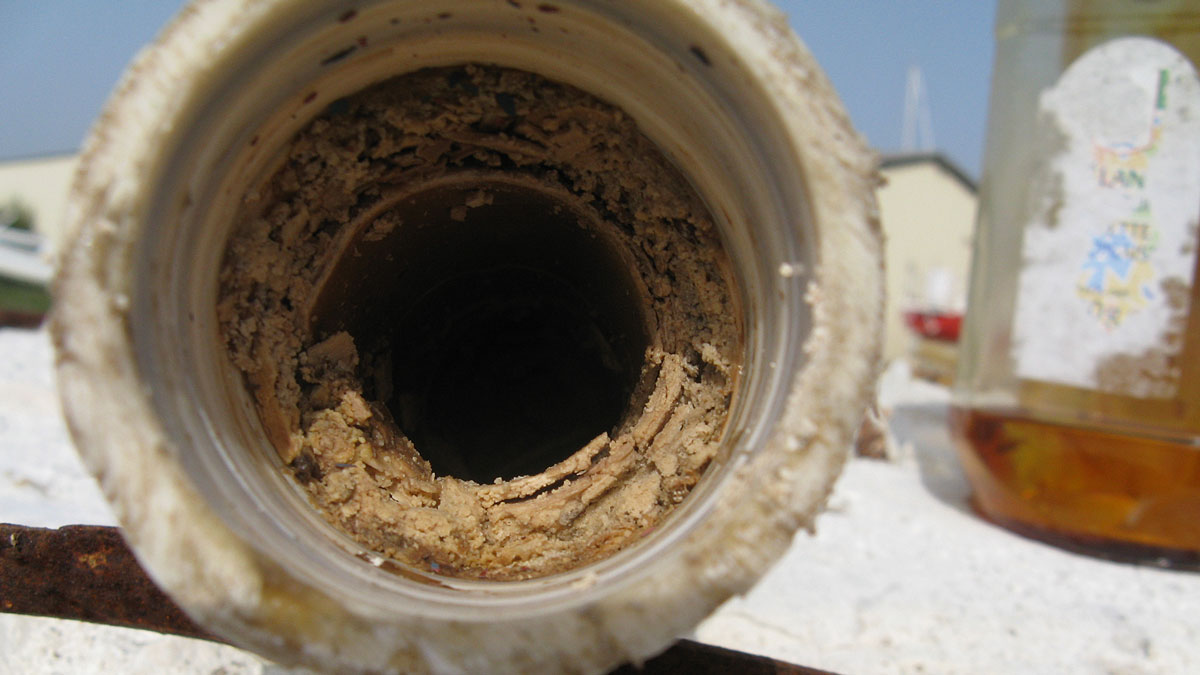
Solutions to descale pipes on your boat
Uric scale can reduce the diameter of sea-toilet hosepipes by half within five years: Richard Hare tests some solutions

Holding tank installation for under £500
Keith Calton fits a compact, economical and user friendly heads system for less than £500

How to design and fit a 50lt holding tank for a Westerly Konsort
My Westerly Konsort Koto was built in 1980 and featured a loo outlet connected direct to the sea via a…

What to read more practical articles like Retrofitting a waste holding tank: Solving the 1980s design dilemma?
A subscription to Practical Boat Owner magazine costs around 40% less than the cover price.
Print and digital editions are available through Magazines Direct – where you can also find the latest deals.
PBO is packed with information to help you get the most from boat ownership – whether sail or power.
-
-
-
- Take your DIY skills to the next level with trusted advice on boat maintenance and repairs
- Impartial, in-depth gear reviews
- Practical cruising tips for making the most of your time afloat
-
-
Follow us on Facebook, Instagram, TikTok and X