


Alan Weavers recalls experiencing a fouled prop, a lifeboat tow, and saildrive failure aboard his Dufour
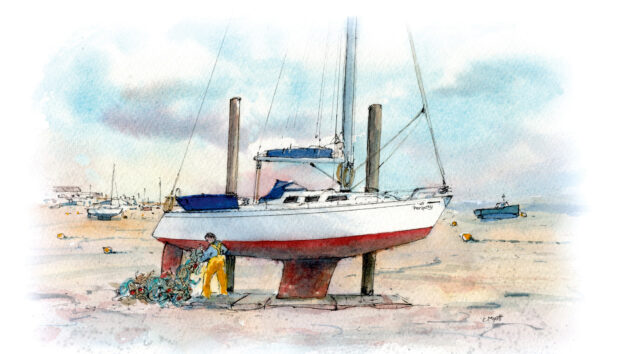
Reading about fouled props and saildrive maintenance in the March 2025 issue of PBO brought back some memories for me.
I once owned the saildrive-propelled Dufour Peripety, and while bound for the Channel Islands from Dartmouth, about three-quarters of the way across – motoring due to lack of wind – the engine stopped.
My reaction was like most skippers, I suppose.
I looked over the stern and there it was, an ugly-looking net, the type that is used for lifting cargo.
Astern power made no improvement. With the boat hook I managed to bring one end of it on board.
I used my homemade viewing tube to see this monster well and truly snarled.
What to do?
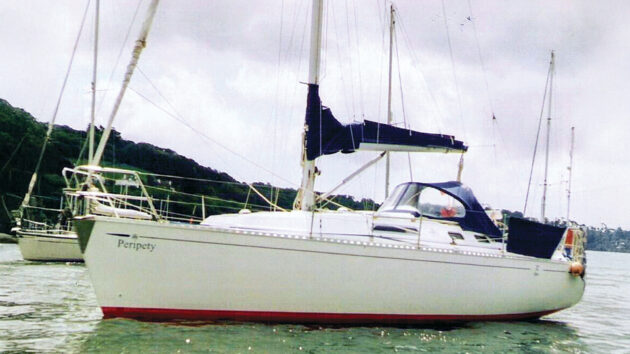
Alan Weavers’ sail-drive propelled Peripety. Photo Alan Weavers
I tried cutting it but none of my tools were up to it. The only way to remove the assailant was to untangle it.
This involved lowering the stern ladder, disrobing, rigging a line under the boat and slowly descending.
When my body temperature in the water reached the critical zone I climbed back up the ladder less slowly. I reasoned that as the propeller was about 5ft down I might drown or succumb to hypothermia and so abandoned that attempt.
Plan B was to dry off, re-clothe, call the coastguard, report the situation, and make a strong cup of tea. The only danger was from passing traffic.
The coastguard called back to say that a lifeboat would be deployed. We kept in contact with position, rate of drift and so on until they arrived.
While we waited my mind went back to my first Channel crossing.
It was text book stuff. Just outside Dartmouth, I set the sails for a beam reach; I didn’t touch them again until we were rounding up to enter St Peter Port. Our track was an almost perfect ‘S’. Anyway, back to the story.
Even with their equipment (a bread knife) there wasn’t much the lifeboat crew could do except rig a tow.
Their towing warp was difficult to pass through the stemhead and round the cleats due to its large diameter, so I decided to use my biggest warp doubled through a loop in their tow.
We kept in contact and all was going well until we reached 10 knots, at which point my warp parted company with theirs.
At the second attempt, I managed to secure their tow. No troubles after that.
They took me to the entrance of St Peter Port and, after remuneration, said goodbye.
A work boat took me to the blocks where I dried out and removed the tangle.
While there I noticed another yacht with the same problem. There must have been a lot of net floating about!
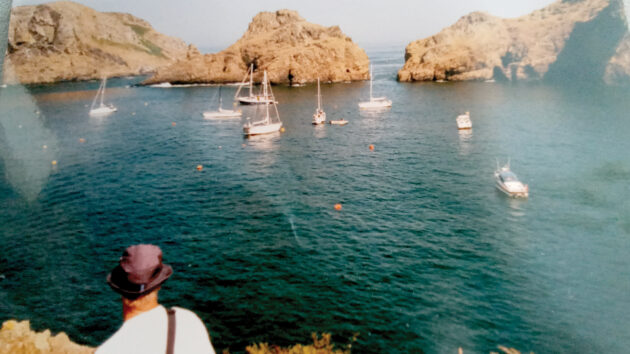
At Sark following a saildrive inspection. Photo by Alan Weaver
An inspection of the saildrive showed nothing untoward so we continued our cruise around the islands, including a climb up to Sark.
I decided to make for home along the French coast, partly because we wanted to see Cap Gris Nez, but unfortunately we were overtaken by a bank of fog and did not get to see it. We did hear it though.
Second challenge
The next trip was to the Netherlands. We had cause for concern rounding Beachy Head, off the coast of East Sussex.
The exhaust note changed and the cooling water flow was reduced. I throttled back as far as I could while still making way.
It took ages to round the headland, but we made our way to Rye and occupied a mud berth. If there was a blockage, it didn’t matter if it got worse.
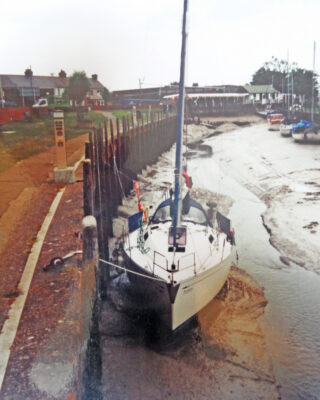
Peripety in a mud berth at Rye. Photo by Alan Weavers
Suitably refreshed and refloated, the next morning I dealt with the blockage and we continued to Dover.
During this leg I had an uneasy feeling about the saildrive. I had the stern lifted but could not find anything wrong.
We cruised through Ostend, Flushing and into the Dutch waterways.
A few weeks passed and found us in Zerikzee where I detected an odour coming from the engine bay. There was emulsified oil under the engine. I guessed that the shaft seal was damaged and water had entered the gearbox.
There followed a clean up session and disposal, helped by the kindly harbourmaster.
More oil was purchased. It was not the recommended type, but it wouldn’t be in there long. We left Zerikzee after waiting for the road bridge to open.
The next day we made steady progress until we arrived at Bruinisse, which had a Volvo dealership.
We berthed in the marina and called at the office, who said: “You need to see Tom the fitter.”
Lift out required
Tom confirmed my diagnosis and organised a lift out. Each boat ashore was on a cradle with castors attached which meant they could be shuffled around with a garden tractor.
The next day we agreed with Tom that we’d disappear during the day, leaving him to do his work and we’d return near the end of the working day so that we could chat with him and then overnight aboard.
This worked well. I even found enough time to borrow a bicycle and play golf at the local club!
The bad news was that the internals at the bottom end of the saildrive had reached the point where they’d need replacement, ie prop shaft, bearings, oil seal and rope cutter (which was useless anyway.) The prop itself was unscathed.
The shaft had to be ordered, but was quite quick to arrive so we had plenty of time for moules.
A costly solution
A couple more days passed until finally the job was done, vessel refloated and checked. All seemed okay.
I went to the office prepared for the worst. One of the women said the bill was quite large but seemed reluctant to reveal it.
I began guessing: “More than a thousand?” Yes. “More than 1,500?” Yes. “More than 2,000?” Yes.
Finally she said it. 2,500. I can’t remember if it was euros or pounds.
She put the credit card in the machine but it would not accept the total. I suggested she enter half the amount twice. The machine was happy with that…
We said goodbye and continued our meanderings back to Flushing. One night was spent in a charming marina arranged like a set of islands among the trees (Goes in the Netherlands).
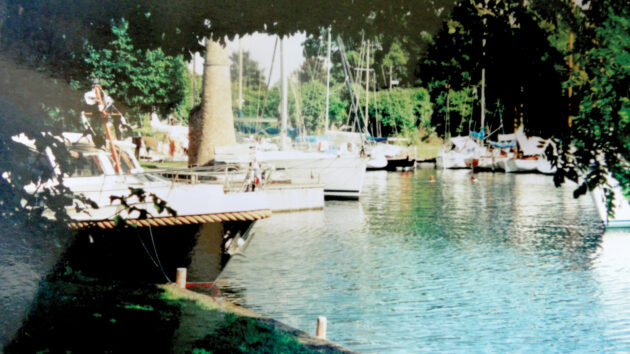
Peripety in the charming tree-lined marina of Goes in the Netherlands. Photo by Alan Weaver
We arrived back in the River Dart with no more trouble.
Some while later I decided to sell Peripety, but I couldn’t let a new owner have it with a 12-year-old diaphragm seal so I took the leg home and fitted a new one which looked the same as the old one.
I refitted the leg, threw in some extra bits and off it went to Falmouth.
Lessons learned
- Devise a method of rigging a tow line capable of towing your vessel at 10 knots.
- Carry a manual oil pump. (I have one but it was in my garage.)
- Have bottles in which to put used oil and rags to clean up.
- Take your golf clubs or something similar.
- Finally… Always have a horseshoe, rabbits foot and four-leafed shamrock!
Expert comment
Simon Hampton-Matthews, chair of the Cruising Association’s Regulatory & Technical Services (RATS) group, summarises RATS’ comments:
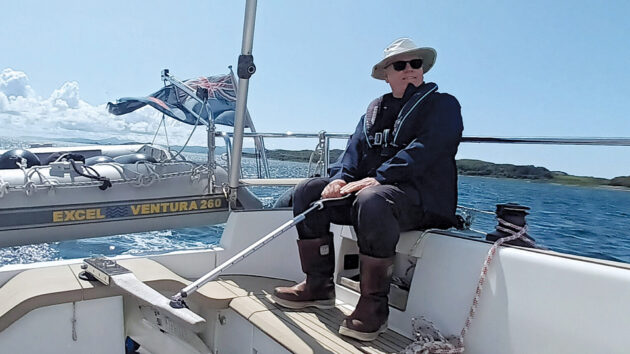
‘Do not enter the water’ if you get into difficulties while sailing says Simon and the CA RATS. Photo by Simon Hampton-Matthews
Dealing with a fouled prop
If your engine stops, don’t immediately re-start and put it in astern until you have assessed the problem – you might make things (much) worse.
An endoscope or, better still, a borescope (generally more rigid), may provide an alternative viewing tube, which could be angled to view the obstruction without leaving the boat. It has other applications on board too.
Do not enter the water, especially offshore. It is exhausting working underwater; you will quickly tire and hypothermia is a real risk to life.
Under no circumstances should you get in the water if you are solo (or effectively so with a weak or inexperienced crew) or if there is any swell.
If you feel you must, don suitable personal protective equipment (e.g. a wet suit, hard hat, fins) and have a line to the boat.
A bread knife securely lashed to a pole and operating from a partly-deflated dinghy might allow you to cut enough of the obstruction away.
Lashing the borescope to the pole may allow you to see what you are cutting. If it’s safe to do so, recover the bits on board for safe and environmentally-friendly disposal ashore.
Calling for help
Remember you are in a sailing boat! You should be able to make some progress towards safety without calling for assistance. You need to carry out a risk assessment – is the tide pushing you onto a hazard, are you drifting into a traffic separation scheme (TSS)?
It’s unclear exactly where the incident occurred, but considering a return to harbour or alternative safe port (e.g. Cherbourg) would be relevant.
No assessment of tides and currents is mentioned, which would determine the plan.
‘Three quarters’ of the way to the Channel Islands would suggest the vessel is near Alderney and the stronger tidal streams around that part of the Channel. Did this affect the decisions?
Time of day (or night) is unclear, but material. Did the netting affect steering and manoeuvrability in a manner that influenced the coastguard call?
Maintenance
If you have a blockage in your raw water-cooling circuit, you might be able to blow the obstruction clear from on board using your dinghy pump. Prepare for the eventuality by obtaining a suitable adapter that will fit into the raw water intake.
Beware the incident pit! You might compound the problem of a blocked raw water-cooling circuit by running the engine, even for a short time. Uncooled exhaust gasses could burn through the exhaust pretty quickly.
It is recommended that saildrive diaphragms are replaced every seven years.
Many people don’t bother for longer and get away with it. Some do the right thing and then still experience leaks.
While we all want to save money, it’s often financially prudent to capitalise on unplanned works. If the saildrive leg was off and in bits, that was the time to replace the seal.
Your insurance may not pay out if recommended service intervals have not been followed and you have some sort of incident.
Towing
Know your hull speed, ask not to be towed faster than it. Spread the load, use spare halyards not mooring lines between strong points and winch up tight (stretchy mooring lines are best for a bridle).
Again, think about how you would set your boat up for towing, so you have an emergency plan. Maintain radio contact with the towing vessel and don’t be shy about asking them to slow down. Have a plan for casting off the load under tension.
There is no mention of pre-departure passage plan in either scenario. This should have included considerations as to emergency situations and potential solutions. A blocked fuel filter would have created a similar scenario, for example.
Alan Weavers got into sailing by building a Signet dinghy. He then modified a Vivacity 24 over 20 years before buying Peripety.
Reader offer
Founded in 1908 to meet the needs of the cruising community, the Cruising Association is acknowledged as a leading organisation for sail and motor cruisers with over 6,400 members worldwide.
It is a trusted source of cruising knowledge, information and advice. Readers of Practical Boat Owner can currently receive 15% off Cruising Association membership with the code PBO-CA-15 at www.theca.org.uk/join.
Send us your boating experience story at pbo@futurenet.com! If it’s published you’ll receive the original Claudia Myatt – signed watercolour which is printed with the article.
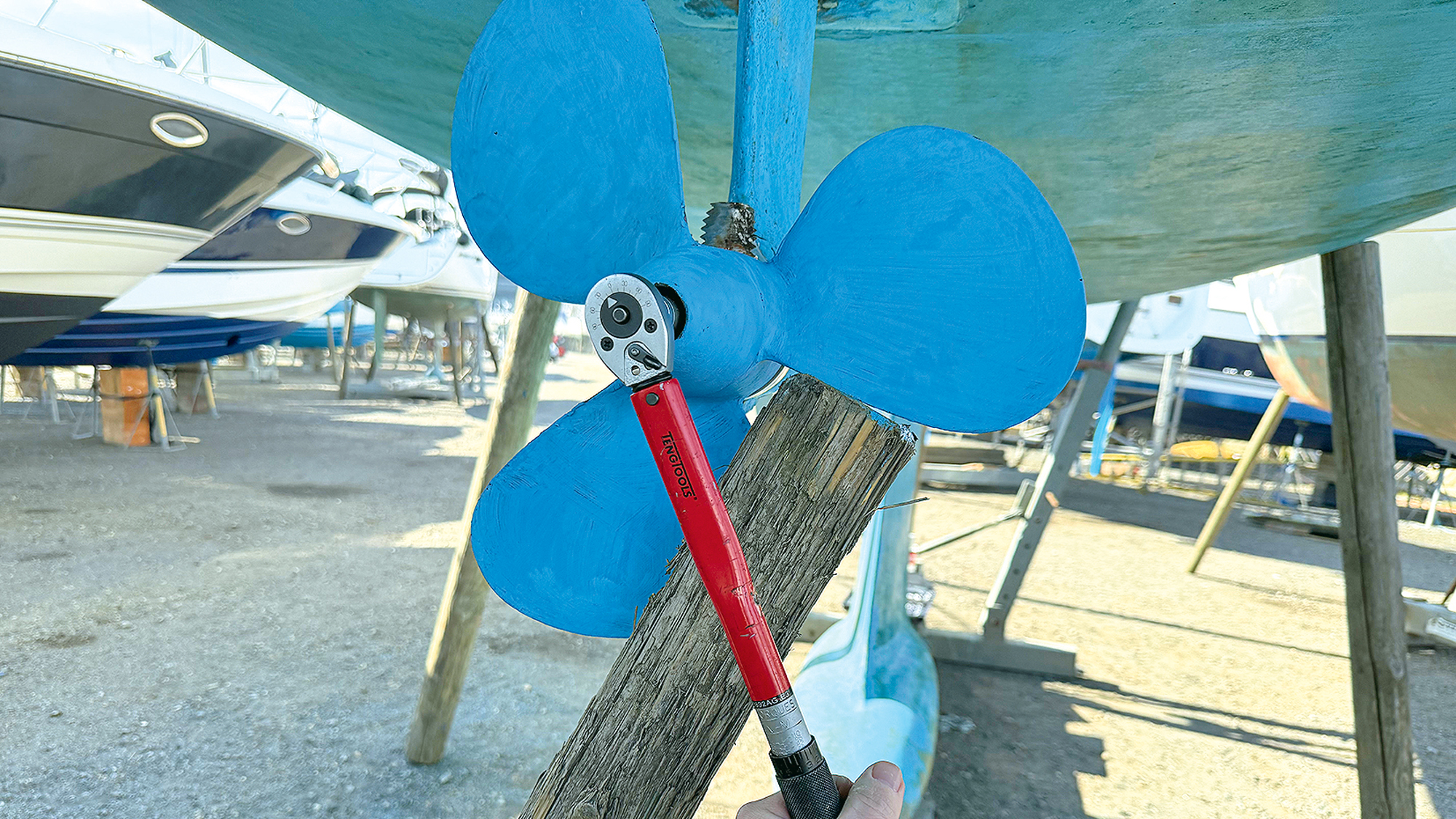
How I refit my own Volvo Saildrive propeller
Prevailing winds in the UK blow from the west, so why is it then, that whenever you want to travel…

Saildrive maintenance: a boat owner’s guide
Stu Davies shares his tips for making sure your boat's saildrive runs smoothly

Milky oil in my saildrive. What do I do?
While changing his engine oil, Chris Mardon noticed milky oil in his saildrive. Will it have caused damage to the…
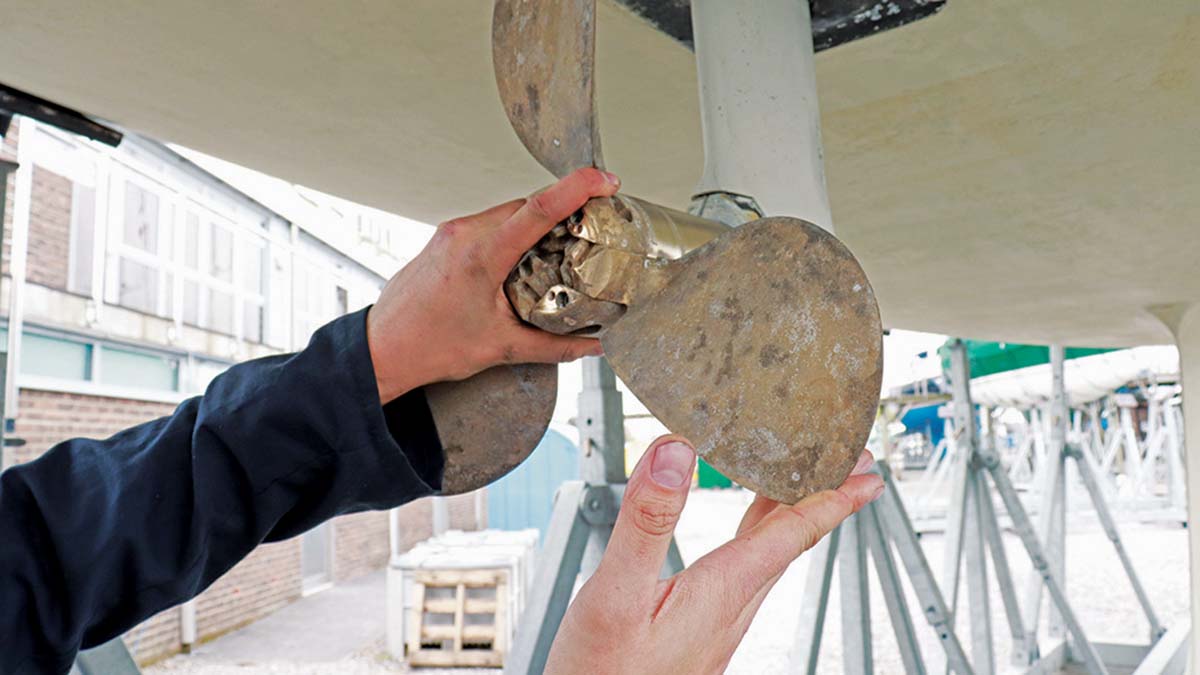
Fitting a saildrive folding propeller? Ask the experts
Peter Dunlop writes: “I have a Volvo Penta MD20-30 with saildrive and three-bladed folding propeller on my 1998 Dawn 39…
What to read more features like Charter to tackle sports clothing impact?
A subscription to Practical Boat Owner magazine costs around 40% less than the cover price.
Print and digital editions are available through Magazines Direct – where you can also find the latest deals.
PBO is packed with information to help you get the most from boat ownership – whether sail or power.
-
-
-
- Take your DIY skills to the next level with trusted advice on boat maintenance and repairs
- Impartial, in-depth gear reviews
- Practical cruising tips for making the most of your time afloat
-
-
Follow us on Facebook, Instagram, TikTok and X