



Cruising instructor Ben Lowings explains how to gybe safely and the techniques used when dealing with different sail types
Assuming you’re reading this as the owner of a boat of some description and a practically-minded one at that, you’re most likely fully aware of what a gybe is. What follows is not a lesson, more a discussion of what a gybe involves, or can involve, and how challenges associated with the manoeuvre can be overcome.
Some sailors tack their boats without saying a word. Crew and skippers are so well-knit that the move can be initiated by the mere nod of someone’s head. In my experience, this has never been the case with a gybe. The body language might well come after the boom comes crashing over, a spinnaker pole gets skied and some choice vocabulary is exchanged.
The foredeck heavy-lifting committee might then collectively glower back to the after guard as if to say, “You gybed before we made on the pole.”
Control is key. Here, the boom is lashed down with icicle hitches to prevent any movement during a gybe. Credit: Ben Lowings
To gybe is to alter the course by turning the stern of a vessel ‘across’ the wind, or ‘through’ the direction the wind is coming from. Gybing has been associated with yacht sailing since the very first days of the ‘sport’ in this country, in the late 17th Century. It is a Dutch word, like ‘yacht’ and so many other terms which sound similar across the North Sea Germanic world. The word can imply a little trepidation.
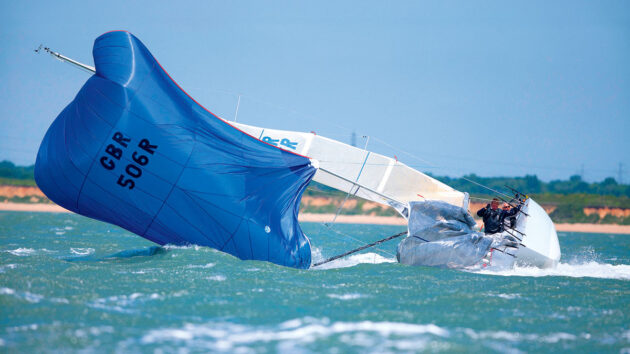
Steering quite deep downwind during a race I was instructed, in a tone I remember very clearly: “DO NOT GYBE”. If the airflow snuck behind the mainsail, if the boat was tipped by a wave, for instance, then the yacht would have gybed. The whisper of a hand on the main leech rapidly becomes a chucking motion, as the mass of canvas is hurled laterally, gathering momentum as it goes (and hopefully not crew members as well). A boom moving through such an arc is a dangerous thing indeed. For a reason, a manoeuvre of this fashion, without precautions to dampen the motion, is a ‘slam gybe’. ‘Slam’ for the sound the gooseneck might make as its castings crack or shear off; for the crack and twang of shocked wire stays; ‘slam’ for the impolite statement the boat seems to make at having seemingly been poorly steered downwind.
A gybe in a sailing dinghy may be an ‘all-standing’ or ‘slam’ every time. But it feels more like the wind flipping from one side to another, with a tug on the boat as harmless as that on the lines from a switchback turn on a stunt-kite.
Gybing an aluminium boom on a 40ft GRP yacht can be a dull heaving-in of the mainsheet and a-butting it out again by leaning on the spar, standing on the coachroof. In heavier air, it’s the aforementioned slam which can leave both a yacht’s rig and her crew trembling.
To a certain extent, gybing a solid timber boom, together with a gaff, can feel a little less exciting; as real timber spars are often many multiples heavier than an aluminium boom, the gybe is slower and softer. In this case, you’d perhaps think the boom has to drag the weight of the gaff across as well, and the slower motion is connected to less momentum with two spars having to travel across.
But its weight gives it plenty of momentum in the turn, and it’s the upper part of the leech that will flip under the wind before the clew. Dampening comes from thicker traditional ropes giving friction through larger mainsheet blocks.
Preparaing to gybe
One of the first things, if not the first thing, I would do as skipper of a cruising yacht to prepare for a gybe is to let everyone know. Standard practice for a tack is to shout below to have books back on their shelves and the cook well-braced. The same applies in a gybe.
Again, as with tacking, the skipper should be making sure there is no likely obstruction. Is it safe to gybe down into the new sector you have in mind?
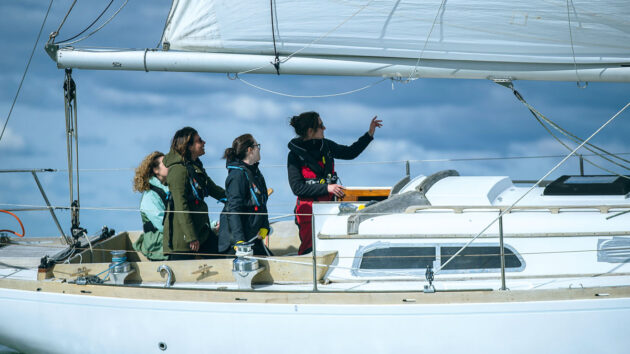
Make sure the crew is fully briefed ahead of gybing. Credit: Richard Langdon
In confined waters do you have space to abort the manoeuvre, or gybe back again? Do you have the staffing on deck to manage the first preference gybe option and the ‘escape’ alternative?
It figures to have experienced people at the helm, and inexperienced ones well out of harm’s way (ie not under the boom or near the traveller). Look, or have someone look, under the sail to check if the zone is clear or about to become congested. This is rather a moot point if you’re in a race and not leading the pack, however.
A vital cockpit preparatory move is to sort out the mainsheet; you want to make sure there are no knots or disconcerting loops which could easily snag and nip themselves into tight knots. Presuming a traveller is fitted, then this apparatus will require a security check before a gybe.
Snatching pressures on the component lines of a traveller can make the whole thing fail. The carriage needs to be centred on the track in most circumstances. Its guiding lines need to be pulled or ground tight to arrest any potential movement in the carriage. There shouldn’t be a need for slack or loops on either side. A clove hitch is adequate security although a constrictor knot will give ultimate peace of mind.
For another gybe preparatory move, hauling the kicker right down will help draw off the punch the boom makes to the mast. Other preparations, involving foredeck spars, are addressed later in this article.
Standby to gybe
The command to initiate the sequence is by common usage: ‘Standby to gybe’.
The logic is that it is phrased to avoid confusion with ‘Ready to tack’ or ‘Ready about’. Supposing it’s windy, though, you might not catch that crucial first bit.
On the foredeck all you might hear are four syllables, shouted, in the rhythm of the Morse Code for ‘V’ [‘Victor’] dot-dot-dot-dash. In practice, a crew is in general usually aware of the boat’s attitude to the wind. If they’re at the mast about to un-jaw the pole they won’t be confusing tacking with gybing.
Associated with standing by to gybe might well be taking in a little on the main. The boom needs to come off the shrouds at any rate – you don’t want it whacking into the shrouds on the other side. A ‘standby’ command is very useful as a warning if you actually don’t intend to gybe. It can be a way of telling the crew that the next wave might wobble the back of the boat and gybe us. The helm intends to come up on the wind as a gybe is not opportune at this time, but nevertheless, standby…
Helm’s-a-weather
This phrase ‘Helm’s-a-weather’ announces the next stage of the gybing sequence. The manoeuvre is initiated by the person at the helm. On a tiller-driven boat, the bar is brought towards the windward side of the boat, and the corresponding call to alert the crew is ‘helm’s a-weather’, that is, the rudder is turning more towards the direction the wind is coming from. You don’t necessarily need the leverage on the rudder you might for a tack. You can afford to have your hand halfway down the bar and do away with any tiller extension.
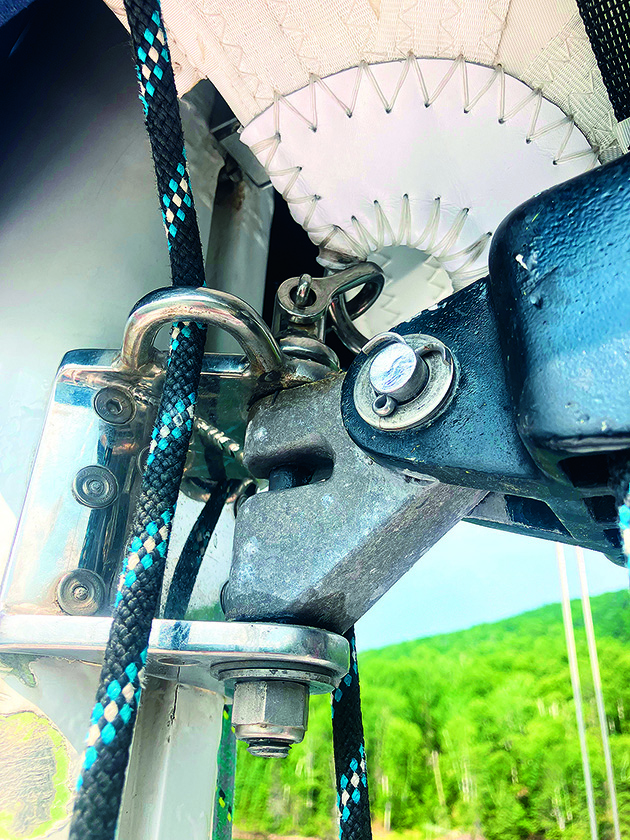
An incorrect gybe will put huge loads on the rig, including the gooseneck. Credit: Mike Reynolds
Guiding round is the idea rather than shoving the boat where you want it to go. With one hand on the tiller, the other can be free to grip the boom to flip it over, or flick the mainsheet across to cushion the gybe. It’s done with care in a dinghy in the same way, but is absolutely not recommended in a yacht other than in very light airs.
On a wheeled yacht, the rim is shuffled between the hands to turn the spokes away from the wind direction. The call – although it makes less immediate visual sense – is still ‘helm’s a weather’. Smoothness is the name of the game. Sensitivity on the helm should be matched by carefully keeping airflow over your sails. Jerkiness leads to stalling and slamming.
Gybe-O
‘Gybe-O’ is announced by the helm when the boom crosses the centre line of the boat. I’ve seen it written as ‘Gybe-oh’, and I’ve also seen it written ‘Gybe-ho’. ‘Gybe-O’ – I’ll happily be corrected on this point – is written to avoid confusion with lee-ho!, land-ho! Westward… and so on.
As with the old ‘Lee-ho’, the timing of your ‘Gybe-O’ is important. As spinnaker trimmers look up to the highest portion of the kite leech for the slightest indication of curl, your guide on a main is the weakness and lifting of the highest piece of mainsail leech. When that piece of the trailing edge goes ‘soft’, it’s ‘Gybe-O’-time.
At the command, the wheel should be brought back to the centre (‘helm ‘midships’). As the boom crosses the stern perpendicular to it, the rudder needs to be centred at the same time. The only exception to this is multihulls; they don’t centre the rudder during the gybe. The centring is necessary to slow the turn, but it is usually necessary to countersteer much further. The boat is essentially being twisted in the wind, the giant aerial rudders flipping it from one direction to another, so countersteer from the rudder is needed to help arrest that turning moment.
Depending on your craft, anything up to full lock the other way on the wheel will apply the right countersteer. It is not, however, universal and depends very much on the characteristics of a boat’s design. You countersteer in a car to stop ‘fishtailing’, and some boats swing their backsides like a loaded supermarket trolley. ‘Steer into the skid’ only works a little in such a situation: it’s usually the unpleasant dragging sensation as you try to wrench the trolley back on course. Yachts don’t have sticky castor-style wheels, but if there’s some groaning from the helm during the gybe it at least indicates the torques involved.
How to gybe: step-by-step
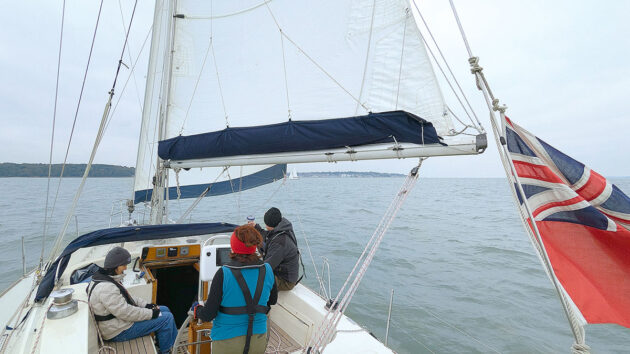
Credit: Ben Lowings
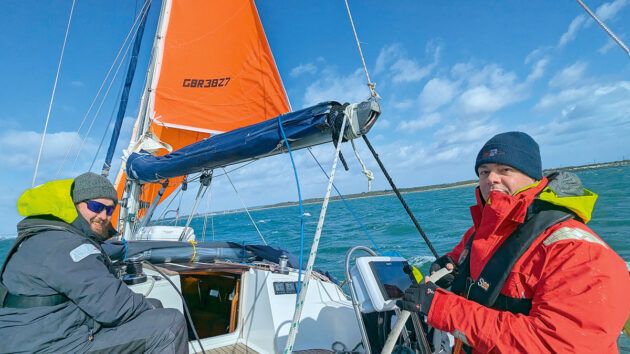
1. Gybing a Westerly Corsair 36 in the central Solent during a light easterly wind. The crew member in the black jacket is asked to trim the mainsheet to prepare for the manoeuvre
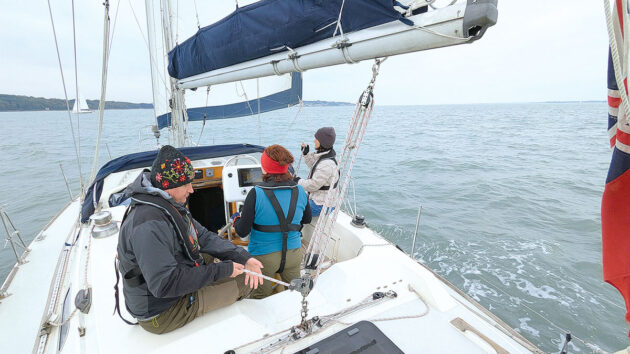
Credit: Ben Lowings
2 The crew member pulls in the mainsheet to centre the boom before going into gybe
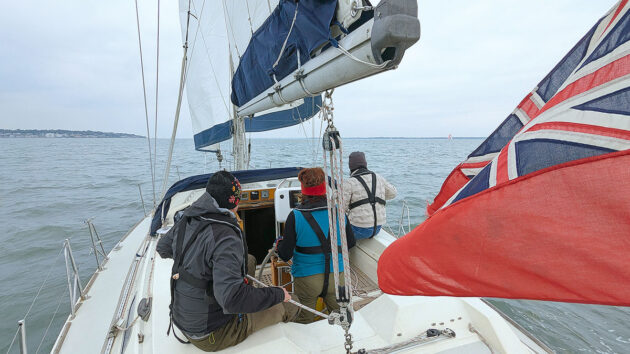
Credit: Ben Lowings
3. Gybe-O. The ensign shows the wind direction. The sails have filled on the new gybe
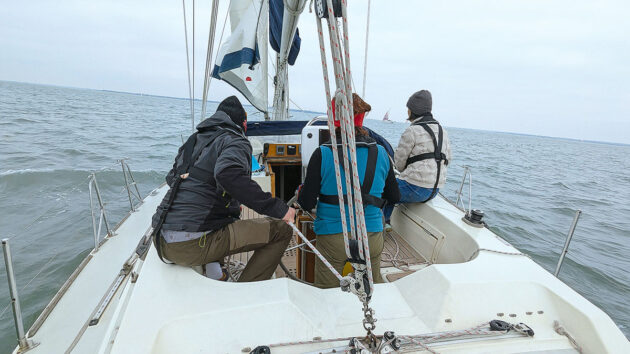
Credit: Ben Lowings
4. The genoa is sheeted over to the new leeward side
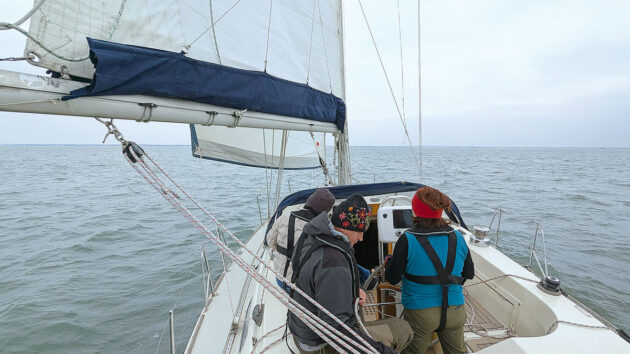
Credit: Ben Lowings
5. The mainsheet eased to start the sails drawing properly, balancing the helm on the new gybe
Unintentional gybe
There is a lot you can tell from the way we sailors use the active and passive forms of the verb ‘to gybe’.
More than other verbs, the transitive or intransitive form of ‘to gybe’ has a big difference. ‘We gybed the main and genny’ is an affirmation. Much like: ‘We tacked each sail.’ The manoeuvre has been crew-initiated.
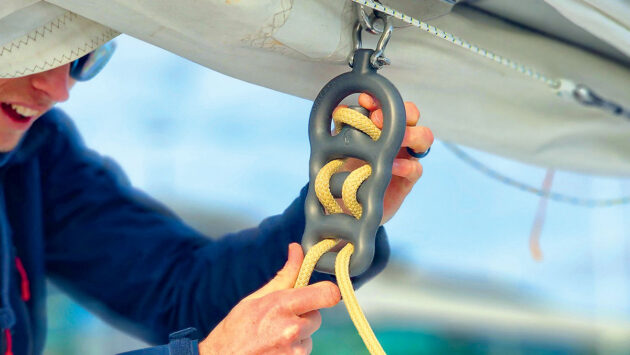
A boom brake or preventer can reduce the risk of some of the most serious head injuries. Credit: Rachael Sprot
A simple ‘we gybed’ (rather than ‘we gybed the main’ or ‘we gybed the headsail’) is much less certain. The boat has wind in its sails throughout the whole manoeuvre. It speeds up going in the move, the boom collects power as you go, and the turn itself is much more of a flick across. It’s a wrenching motion that, done poorly, can induce a feeling of loss of control. ‘We gybed’ has a flavour of ‘we got gybed by the wind.’
Windvane Self-steering
Accounts of solo ocean sailors often show that gybing is the first indication of a problem with the self-steering gear needed for long passage-making on your own. These adventurers often spend much of their time going downwind. Weather systems roll up behind them, with the wind backing, veering and shearing when fronts trundle through.
On his round-the-world voyage aboard Gipsy Moth IV, Sir Francis Chichester feared his self-steering gear, which he called Miranda, might cause trouble by setting off a few gybes. He soon understood that once she was in control, and adjusted for the large sail area of this ‘ocean flyer’, he ought to be more worried about protecting her from getting smashed in any gybe. The Finnish circumnavigator Tapio Lehtinen writes about the inconvenience of having to reset his self-steering after having gone to bed. The gybe came after he’d concluded that the steering was okay.
Injury
The number one worst thing is for the boom to strike a crew member in the head and kill them outright before their body is catapulted overboard. This is equal to a crew member being hit by a mainsheet block which has the same effect. The traveller can inflict harm on a person, slicing through the cockpit on many designs like a meat cleaver.
Boat damage
A crash gybe certainly can harm other things besides people. A snugged-up gooseneck can work itself into a real state after a lot of gybing. The rivets might be loosened, which is always an uncomfortable sight; or they might have popped out altogether. The casting can even get sundered by an ill-judged gybe.
Sailcloth can be torn laterally. Ill-secured travellers can blow through the car-stops at the track-ends. The force needed to bring a decelerating boom to a halt can transfer to this apparatus so effectively that the block itself explodes.
How to prevent an accidental gybe
To prevent an accidental gybe you could simply lash the mainsail down and tie off the boom end on either side. This would remove the anxiety of a potential daisy-cutting boom but perhaps decrease boat stability to some extent.
Gybing is not recommended in huge waves. Rolling about with a trysail in the troughs, I have found an accidental gybe skids a yacht up to windward, requiring all your strength to avoid being pooped or broaching.
Gybing a trysail is a bit academic anyway, since it really has only two settings – eased out in response to an emergency gust, or sheeted in as hard as the bonds of life herself.
DIFFERENT SETUPS
Gybe a headsail in light winds
This one is fairly straightforward. Travelling under genoa alone is a stress-free kind of progress. A Hoyt boom might be a risk in the gybe. But in other circumstances, even with a soggy, weighty sheet dragging the foot of a spray-wettened sail down, the cloth isn’t going to cause much damage by scraping on either crew or boat fitting. A lighter set of sheets might assist with smoother gybes, but the lines might not grab into a jammer as nicely.
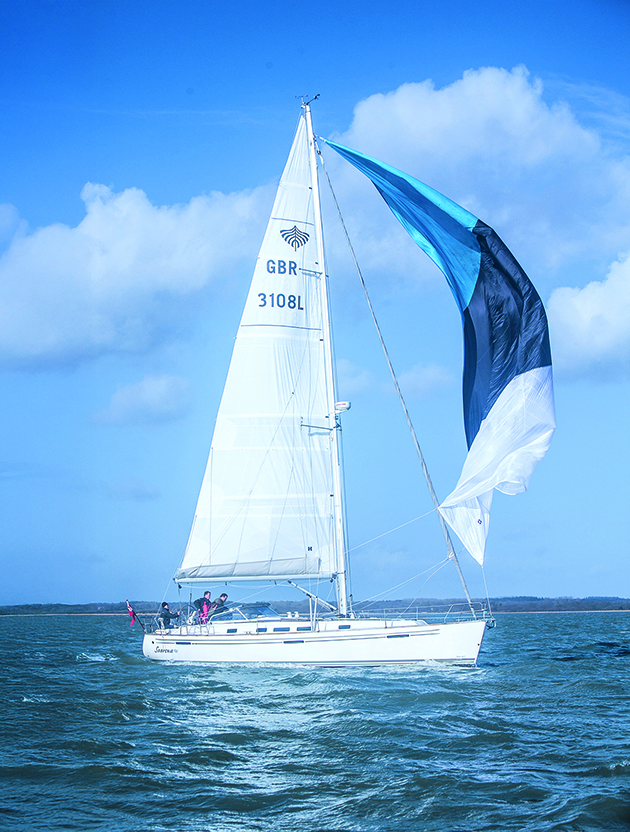
You will never keep a cruising chute filling through a gybe. What matters is that the sail isn’t tangled and it is all still in front of the forestay. The boom can come across now. Credit: David Harding
Gybe a cruising chute
A good cruising chute can supercharge your sailing and is a must for every cruiser’s sail wardrobe. Most of the time people douse the sail and then hoist it on the new gybe. But gybing a chute is a matter of rotating the clew forward and sheeting in on the opposite side, aiming not to let too much slack go into the lines or allow the wind to twist the sail around the forestay (‘wrap’).
You ease the tackline from its little strop or little bowsprit, then take up the slack in the long sheet going right round the outside of everything, outboard of the forestay. You ease out the working sheet, trim the new active sheet at the quarter block, and then wind in the tack line. The key to this move is speed, as you don’t want gusts snatching at the sail before you’ve sheeted it over fully.
Gybing a storm jib
David Lewis, who in Ice Bird made the first solo sail to Antarctica, said: ‘It’s hard to credit the shock of gybing even so minute a sail as a hard-sheeted 30-square-foot storm jib in a hurricane. The sail crashes across like a rifle shot, causing the tormented mast to whip and the whole boat to shudder.’
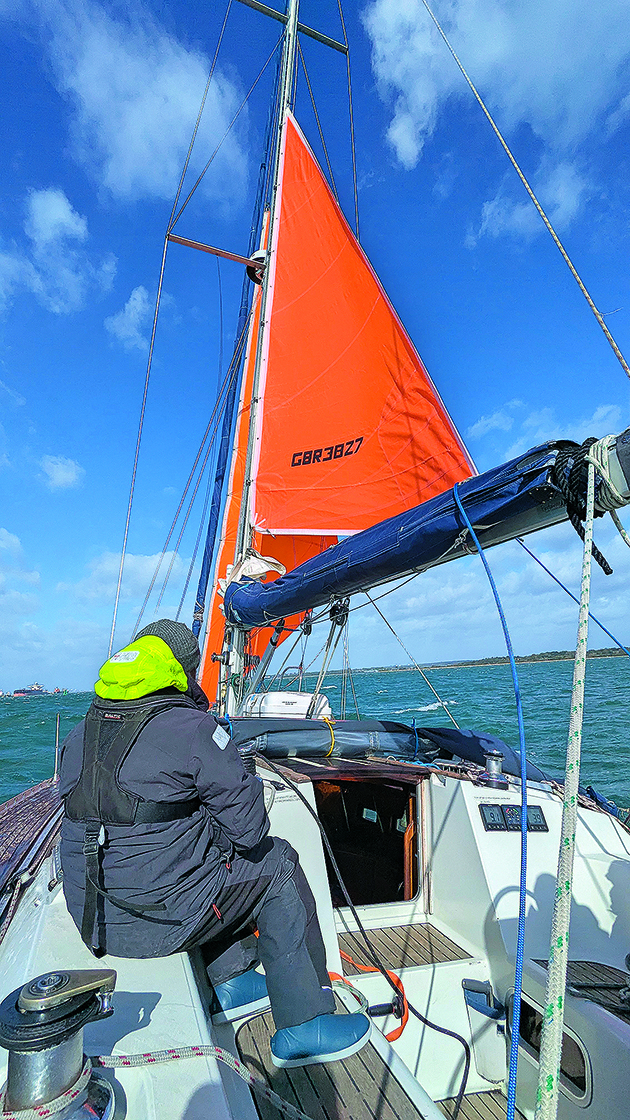
Gybing these storm sails is simply a matter of hauling in the sheets to the new leeward side after the turn has been made. Credit: Ben Lowings
Gybing a trysail
If you only fly a deep-reefed main, and the boom is ‘pinned’ or sheeted in hard down to the traveller, then it will simply slat from one side to the other. No action is required. The same applies to a trysail. These rarely-seen beasts are simply smaller, thicker, more orange deep-reefed mains that fly on their own mast track. The boom is lashed down.
The trysail sheets make a triangle above the boom, leading down to secondary winches or cleats. The sheet is eased according to the downwind sector, brought in (if safe to do so) when close to the gybing point, and then eased out again on the new tack. But trysails won’t typically be gybed at all, their purpose being rather to hold a vessel to windward and ‘wave-ward’. In my personal experience, forgetting to ease a trysail when quartering off waves downwind had such a deleterious effect on ship-handling that I wondered what the point of the sail was. Sliding into Cowes harbour in a full gale would have been a little easier on that occasion had we been under storm jib only.
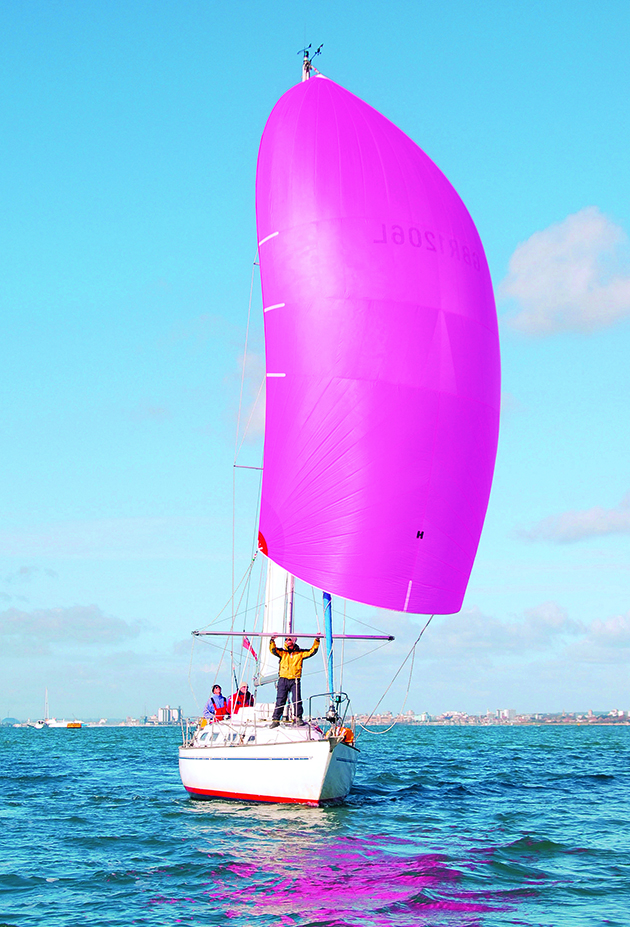
End-for-end gybing is useful on smaller boats with a poled out genoa or spinnaker
End-for-end gybing
When you have a smaller boat the poled out genoa or spinnaker can be gybed by reversing the pole ends. The pole might be girdled by a halyard holding it up in the middle. At ‘Gybe-O’, a crew member disconnects the pole from the mast, while another disconnects the sheet from the jaws. Only when the former outboard end of the pole is into the mast bracket on the new gybe is the shout ‘Made’ uttered.
Dip-pole gybing a symmetric spinnaker
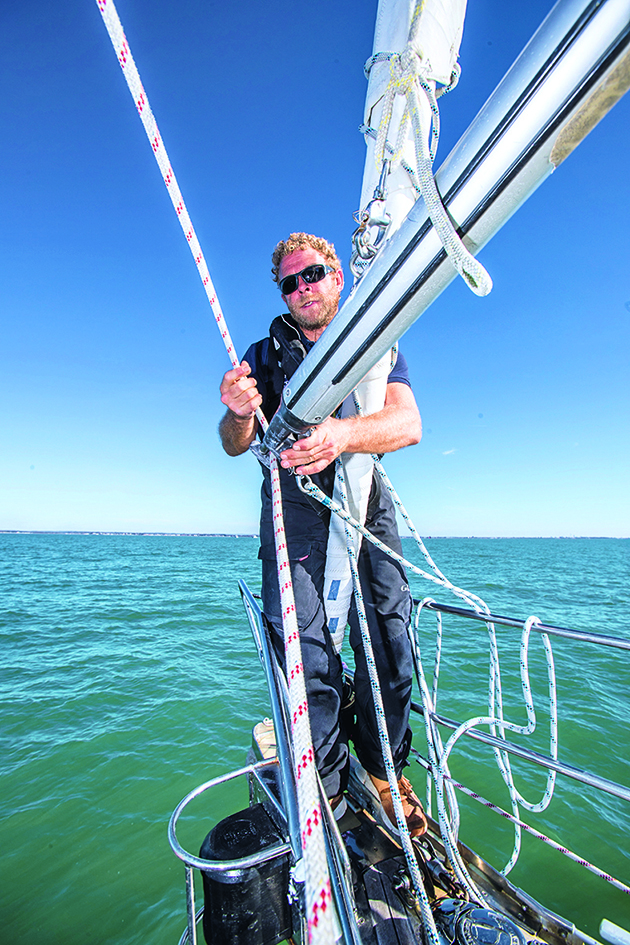
If there is space, a dip-pole gybe canbe easier if the bowman is in front of the forestay. Credit: Richard Langdon
Please credit: Richard Langdon/Ocean Images
This is the heavy-duty pole gybe where one end is locked into the mast. Sheets and guys on their own clew help share the load of a flying kite. The new active guy gets attached (through upward-facing jaws) and the spar’s inboard end is hauled up about a metre on the mast-track. The topping lift is eased down so the outboard end of the pole points diagonally down and inboard of the forestay. This is the ‘dip’. The active guy is tripped, then the lazy guy is taken to the pulpit, chucked into the jaws and the crew member at the bow shouts ‘Made!’ The trimmer goes ‘full-chat’ winding in the new active guy. The trimmer has to keep going until the pole is stretching out to windward, usually past a right angle to the boat, then eased back and trimmed again.
Wearing round
Square-rigs have one great advantage over fore-and-aft sails. This is that gybing is almost effortless, and certainly quieter.
The vessel’s stern passes through the eye of the wind while pressure on each sail in the stack is slowly adjusted. It is known as ‘wearing round’ or ‘wearing’.
A parallel in the fore-and-aft world is if you have a twin staysail set-up which is useful for passage-making in tradewinds. Gybing is more of an alteration in the angle of incidence to this downwind ‘uni-sail’.
Pinning the boom
Pinning the boom is pejoratively known in the United States of America as the ‘Chicken gybe’. I suppose the Americans are particularly disparaging of yachties who don’t wish to contemplate losing their rig in return for undiminished bravado. The boom still flips from one side to the other. When the writer George Millar and his wife, Isabel, gybed their giant yawl Amokura up the Vilaine River in Brittany, they used a powerful force-multiplying mainsheet tackle to pin the boom every time they reached a bend in the waterway. It was measured, even stately.
Preventers
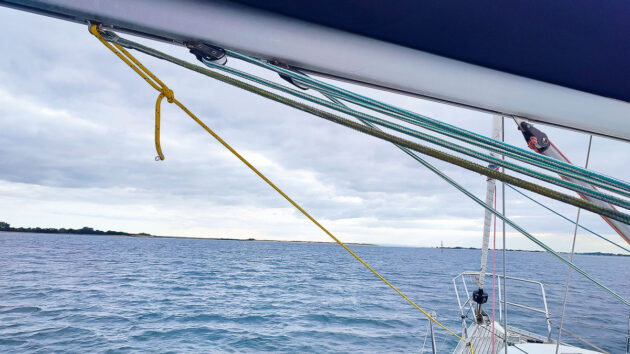
Preventers decelerate the boom during a gybe. Credit: Oliver Perkins
Preventers are misnamed because they don’t prevent you from gybing; rather they decelerate the boom’s travel as it swings over. To rig one is a matter of tying the end of the boom to a point as far forward as possible. This is done most effectively in my personal experience by having a short line which has one end lashed to the end of the boom, and a large-looped handy bowline at the other end, bungeed back to the spar’s side or kicker.
This bowline hangs conveniently inboard to enable you to go to the sidedeck in safety and tie it into another bowline, on the end of a preventer line. This rope goes inboard through the bow fairlead on the same side as the boom, then runs right back down the side deck to be tied off at the stern cleat. A downside of preventers is that the tugging action in wave sets increases the risk of abrading your rope. Chafe during an ocean passage will make short work of a preventer line that’s not tweaked regularly.

Lying ahull or heaving to? Which is best for heavy weather?
Experienced ocean sailor Tim Cassidy advocates lying to the wind with no sail set in heavy weather, but stresses the…

Heaving to: a question of balance
How tricky is heaving to, and how much does it vary from boat to boat? We tried four different hull…
Bermudan vs gaff rigs: Which rig setup wins for coastal cruising?
How better to compare the handling and performance of Bermudan and gaff rigs than on two boats that use the…
Slab reefing: Guide to sail shape & preventing sail damage
David Pugh explains how to keep in shape for all conditions with a comprehensive guide to slab reefing techniques
Want to read more articles like How to gybe safely?
A subscription to Practical Boat Owner magazine costs around 40% less than the cover price.
Print and digital editions are available through Magazines Direct – where you can also find the latest deals.
PBO is packed with information to help you get the most from boat ownership – whether sail or power.
-
-
-
- Take your DIY skills to the next level with trusted advice on boat maintenance and repairs
- Impartial, in-depth gear reviews
- Practical cruising tips for making the most of your time afloat
-
-
Follow us on Facebook, Instagram, TikTok and X