



When a masthead-rigged Hunter couldn’t keep up with the Squibs in the club fleet, the owner realised that something had to be done – but what? David Harding has some answers
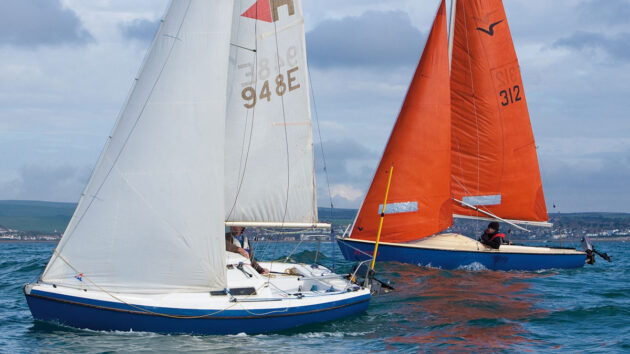
The Hunter 19 Europa, based on the Squib’s hull but with a cabin, a self-draining cockpit and a masthead rig, has a well-earned reputation as a highly competent – and fast – little cruiser.
She enjoyed many successes back in the 1970s in JOG (Junior Offshore Group) events, while David Blagden’s stormy Atlantic crossing in the 1972 OSTAR (Observer Single-handed Transatlantic Race) has gone down in the history of small-boat racing.
Ralf Teubert bought himself a bargain Hunter 19 Europa from eBay; he used to race a Squib in the fleet at Newhaven and Seaford Sailing Club, but decided to change to a Europa so he could do some coastal cruising.
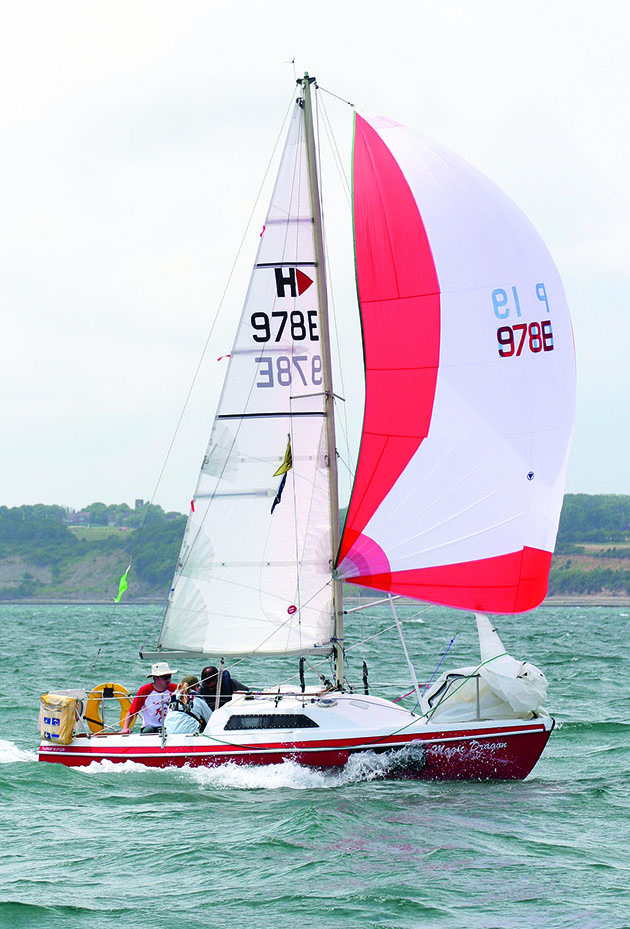
The Europa’s original masthead rig, with in-line caps, aft lowers and a babystay. Here, the spreaders look a bit droopy. Credit: David Harding
Ralf is happy with the Europa’s cruising potential, but he wanted to continue racing against the Squibs on a boat-for-boat basis even though they give time to the Europa under the Portsmouth Yardstick handicap system.
Having been the pacesetter in the Squibs for several years, Ralf was disappointed to find himself consistently at the back of the fleet when he started racing the Europa last season. By the middle of the season he had worked his way up to lower-mid fleet and, towards the end, he was nudging into the top half but still well off the pace of the leading boats.
Ralf’s question initially was whether there was any reason why the Europa, with her shorter masthead rig, should be any slower than the Squib, which has a fractional configuration: was it the boat or the way he was sailing it?
Masthead rig vs fractional rig
There are enough pros and cons when it comes to masthead versus fractional rigs to fill a separate article. The Squib and Europa make a typical comparison, the latter having a shorter mast, a smaller main and larger headsails.
As is often the case with One Design keelboats, much has been written about how to make a Squib go fast: there’s no shortage of advice and rig tuning settings. Notable points about the class include the extremely close-sheeting jib and the debate over rig tension: slack or tight.
In recent years, many of the top sailors have adopted the slack approach, sailing with a lot of luff sag in the jib. On most dinghies and larger yachts, by comparison, tight rigging is essential.
Whichever setting is chosen, the Squib’s close sheeting angle gives it excellent pointing ability. The large main can also be de-powered when the wind picks up, so as on most keelboats the same sail plan is carried throughout the wind range, whereas the Europa needs to change down from the No1 genoa to the No2 and then the working jib. That means three sails to carry and trips to the foredeck to change them.
Where the heavier Europa might have an edge is downwind in light and moderate conditions, thanks to the bigger spinnaker.
Supporting the masthead rig
When I met Ralf’s boat I noticed that the rigging was very slack. Ralf had used typical Squib tensions as a starting point, but it was too slack for a masthead rig and that made it impossible to achieve sufficient forestay tension. I suspected this was largely responsible for the lack of performance.
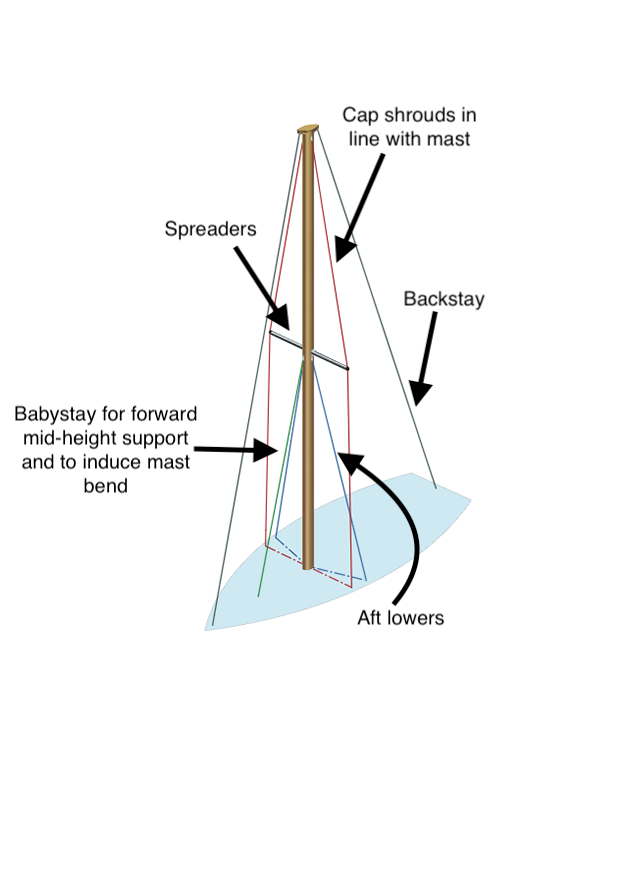
Diagram 1: Original Europa Masthead Rig
The Europa was originally designed with in-line cap shrouds, aft lowers and a babystay (see diagram 1 above). Apart from the lack of tension on Ralf’s boat, my concern was the design of the spreaders, which – as was often the case in the 1970s – were free to swing fore and aft. Riggers and spar-makers came to realise that swinging spreaders weren’t a good idea for reasons of rig stability and performance and they were later phased out in favour of spreaders in fixed brackets, but our challenge was to set up Ralf’s mast in the safest and most efficient way with what we had.
Ralf mentioned that he had also sailed the boat for a while without the babystay, because it interfered with the headsail during tacks. He replaced it after being told that the mast was in danger of inverting. Inversion is when a mast bends aft in the middle to the point where it collapses.
Most rigs, apart from old-style masthead configurations with seriously heavy mast sections, are designed to bend forward in the middle. This makes them stronger and helps control the shape of the mainsail. Excessive bend is normally prevented by the combination of aft lower shrouds and the support of the mainsail.
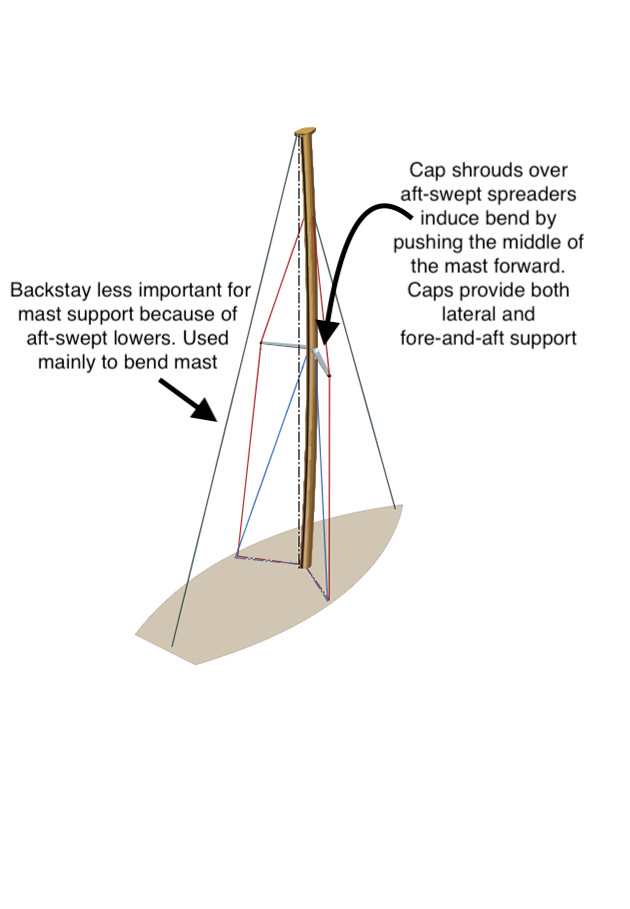
Diagram 2: Typical fractional rig
Bending aft in the middle (inverted bend) should be prevented by forward lowers or a babystay or, in the case of a rig with aft-swept spreaders, the angle of the rigging combined with forward bend induced by the rig tension (see diagrams 2 above and 3 below).
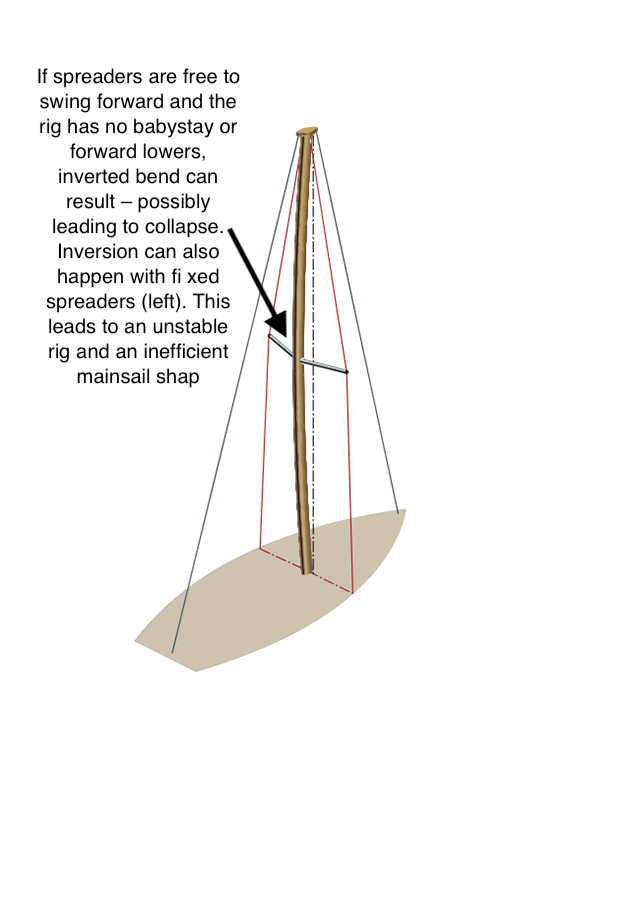
Diagram 3: Inverted Bend
Some masthead rigs have in-line spreaders and no babystay or forward lowers, such as the Sadler 26, for example. Rigs like this rely largely on the stiffness of the mast itself to prevent inversion, though some inverted bend is a common problem.
Another variation is demonstrated by the Europa’s smaller sister, the Hunter 490, which has a masthead rig and no babystay but aft-swept caps over swinging spreaders (see diagram 4 below).
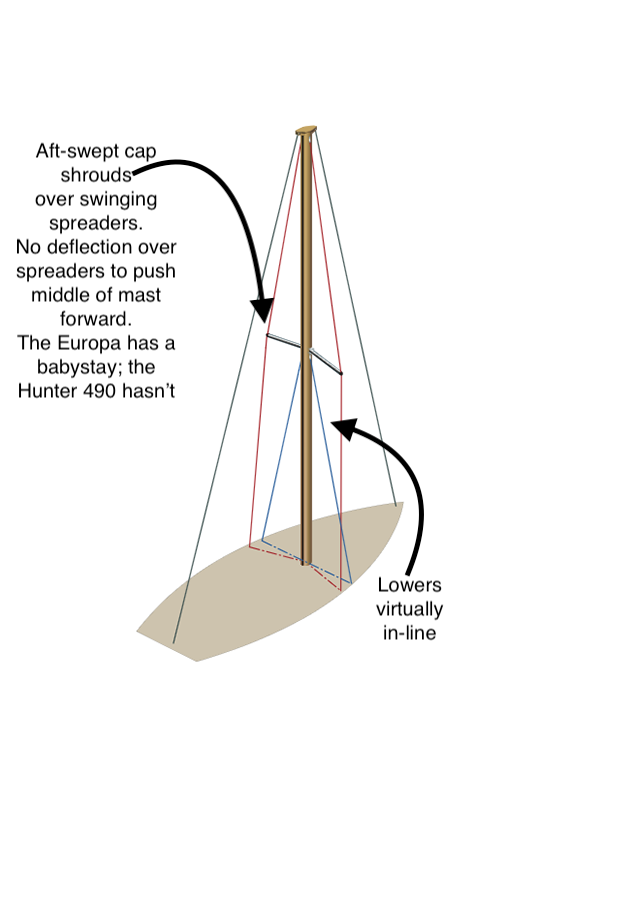
Diagram 4: What we did to the caps and lowers of the Europa
The 490’s lowers are in-line. The caps are swept aft to make sure the spreaders can’t swing forward and induce inversion, because there’s no babystay to prevent it.
If I had a Europa, I would be very tempted to do what at least a couple of owners have done and give it Squib’s rig, or a custom-built fractional rig with aft-swept caps and lowers. Benefits would include a much more controllable mainsail and no more trips to the foredeck to change headsails.
Ralf has entertained similar thoughts, but has looked upon the Europa’s rig as a challenge that he would like to get to grips with.
A swept-back solution
Because of the babystay it should be safe to sail with in-line swinging spreaders – but there would still be a danger of inversion if the babystay were loose and the lowers too tight, especially downwind or if the boat were sailed under just the headsail (ie. without the mast-stabilising effect of the mainsail). I felt inclined to take the caps to the aft set of chainplates – a move I ran past a professional rigger and spar-maker, who agreed that it should improve the rig.
One problem with swinging spreaders is that they only deflect the cap shrouds laterally, not fore and aft, so they don’t push the middle of the mast forward and therefore provide less support than fixed swept spreaders.
Ideally, the lowers would be taken aft as well. With the cap shrouds and backstay both pulling the top of the mast aft, plus the babystay pulling the middle forward, aft-swept lowers might be needed to control the forward bend. The difficulty was how to attach them to the same chainplate as the caps, so we started with them on the in-line chainplates to see how the rig looked.
What we did:
- Attached the cap shrouds to the aft chainplates
- Attached the lowers to the in-line chainplates
- Increased rig tension all-round
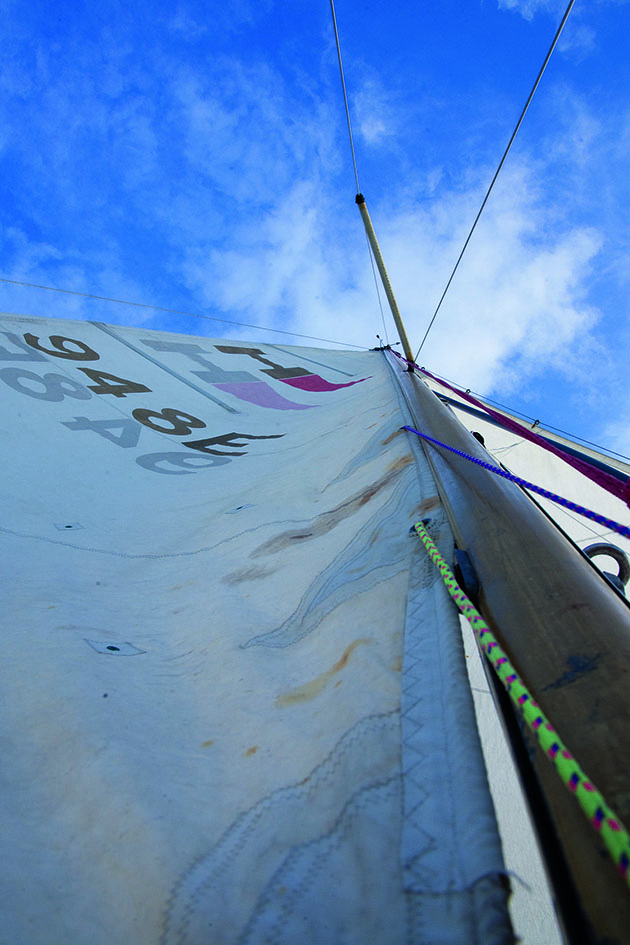
1. Initially, the mast was too straight…Photo credit: David Harding
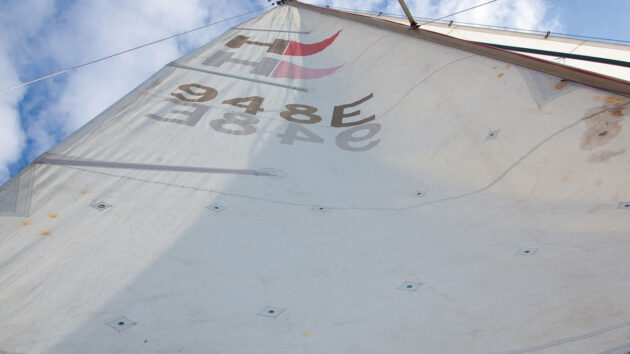
2…leading to a mainsail that was too full and with the draught (point of maximum fullness) too far forward. Credit: David Harding
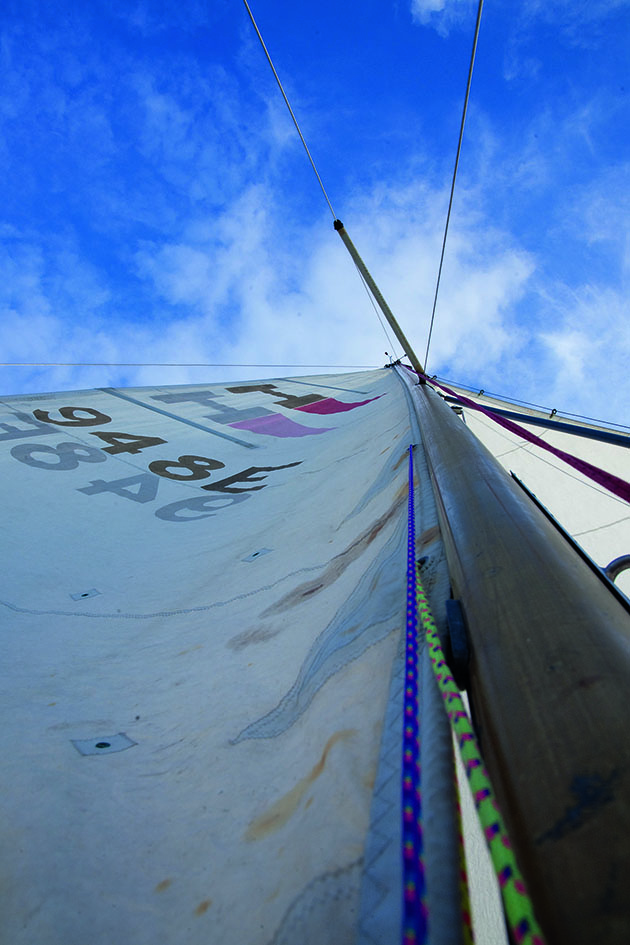
3. Inducing some forward bend in the middle by tensioning the babystay…Credit: David Harding
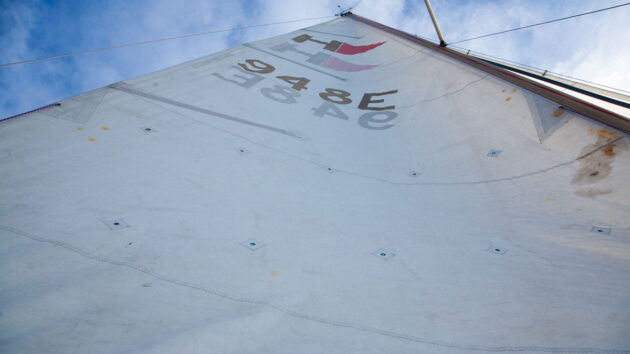
4…flattened the sail and moved the draught aft. It’s far from perfect, but
better than it was. Credit: David Harding
Trying it on the water
After these tweaks to the rig we headed out from Newhaven to find about 7-8 knots of offshore breeze and a sea that was still lumpy from a gale the previous day. Accompanying us to act as a yardstick was a Squib sailed by Ricky Smith, one of Ralf’s fellow club members.
Downwind, as we expected, the Europa had the edge with her larger spinnaker. When racing single-handed, however, Ralf normally uses a spinnaker from a Squib because, being shorter in the hoist, it can be flown with the headsail up – and that means no need to go to the foredeck.
Inducing mast bend
Upwind is when the Squibs tend to get away, so before pacing ourselves against Ricky we had a further play with the rig. Ralf’s sails are getting on a bit and the shape of both the mainsail and the No2 genoa, which we flew initially, left something to be desired.
The mainsail was too full in the forward section and its leech was too closed, so we tensioned the babystay to induce more bend in the mast. This had the effect of moving the draught aft, flattening the sail and opening the leech.
Level-pegging
With these adjustments made, we positioned the Europa on the Squib’s leeward bow, hardened up on the wind and both sailed our best course. For a while we were level-pegging, before the Europa eventually gained a little height and ended up almost directly ahead of the Squib.
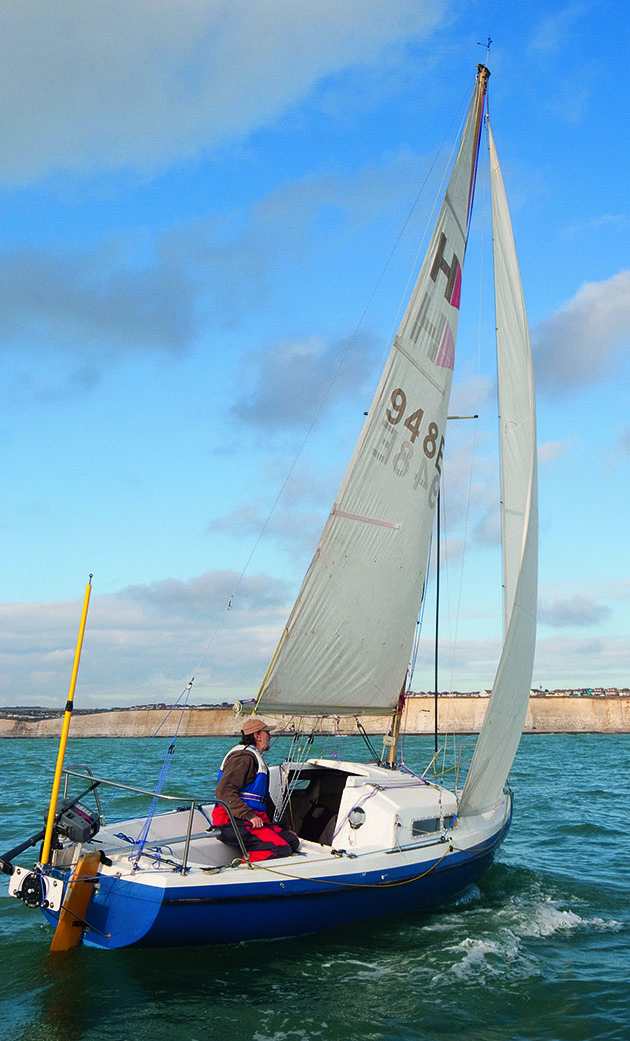
Too much twist: here, the No2 genoa is losing a lot of its drive because it’s too open in the upper leech, even with the car right at the forward end of the track. Credit: David Harding
Given that the Europa is a heavier boat, with old sails and ‘half a workshop down below’ as Ralf put it, and that the deck and cockpit layouts don’t allow the crew weight to be centred over the keel to minimise pitching, it was an encouraging performance.
An apparent asymmetry in the positioning of the hardware meant that we had more twist in the headsail on port tack than on starboard and we found ourselves struggling to point with the Squib.
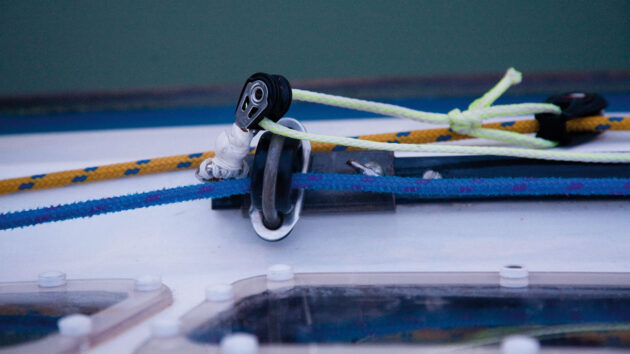
Turning the car around on the track moved the fairlead slightly further forward. Credit: David Harding
Turning the car around on the track moved the sheeting point forward by an inch or so because of the fairlead’s offset position on the car. It made an appreciable difference but not enough for us to keep pace with the Squib. If I acted as a human barber-hauler and held the clew of the sail down further still, we gradually pulled ahead once again. It showed just how critical headsail twist can be to a boat’s pointing ability: inches matter.
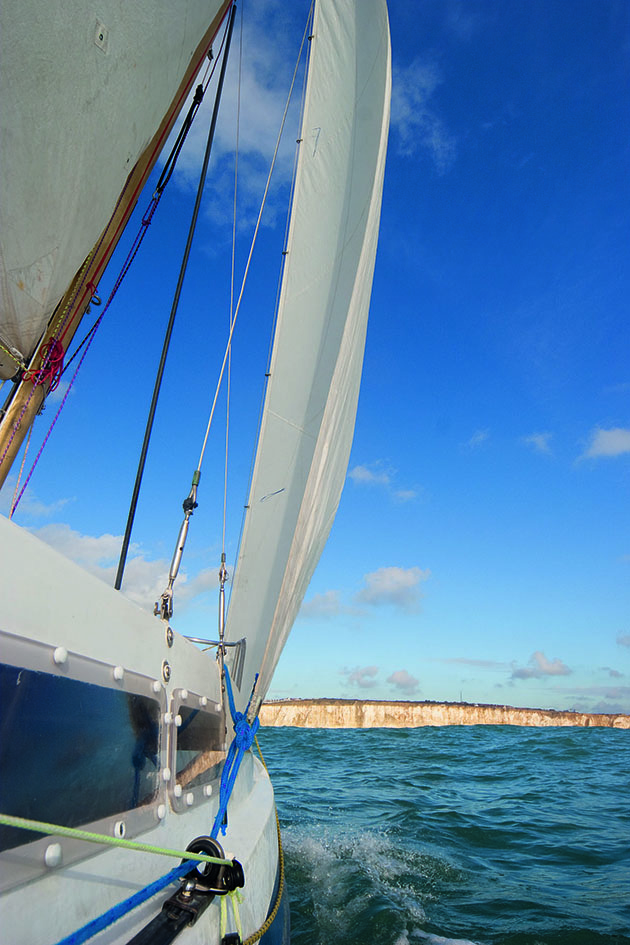
Turning the car around also reduced the twist, though it was still excessive and the sail is well past its prime. Credit: David Harding
Despite the extra size of the No1 genoa, Ralf said he had normally performed less well against the Squibs with it than with the No2. We tried it and also managed to keep the Squib at bay.
Time for further experimentation
Our tweaks to the rig and sails appeared to have some effect, because Ralf closed the gap on the leading Squibs over the remainder of the season. In one race, in a shifty offshore breeze, he and his crew kept up on the windward legs with the top Squib, which was powered by nearly-new sails. Only losing out on a reach due to their smaller mainsail, they finished just 50 seconds behind after 75 minutes’ racing.
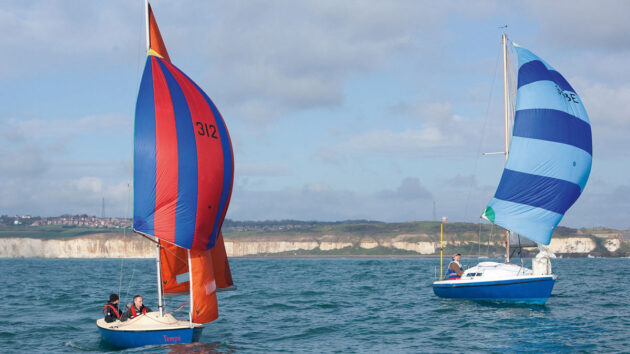
Downwind the Europa’s bigger spinnaker gave her the edge. Credit: David Harding
So, job done – or time for more experiments?
Moving the lowers to the aft chainplates would limit the forward bend in the middle of the mast when the backstay is tensioned, stabilising the rig in a seaway and allowing more of the backstay tension to be transmitted to the forestay.
Ralf is reluctant to move them aft, having now raised the chainplates so the pivot point of the lowers is at the same height as the foot of the mast. This way they make the mast easy to lower by preventing any lateral movement as it comes down.
Ultimately it would be worth trying the Europa’s original configuration but with appreciably more rig tension, especially on the caps, backstay and babystay to ensure lateral mast stiffness and sufficient forestay tension combined with the right amount of forward bend for the mainsail shape.
A new mainsail would help, too – something else Ralf is considering.
Once the best configuration has been established, the biggest change I would like to make for the security of the rig would be to fix those spreaders. It’s time to move on from the swinging ’70s.

How to set up your rig: tension your shrouds on masthead or fractional
How to set up your rig: tension your shrouds on masthead or fractional If boats were cars, many of those…
Rig tuning for cruising sailors
Point higher and sail faster – every yacht can benefit from an optimal rig setup. Ali Wood finds out from…
How I gave my Albin Ballad’s mast and standing rigging a major upgrade
When I bought my 1973 Albin Ballad Moments of Clarity many years ago, the first job I did was to…
How to replace your running rigging: The essential DIY guide for older cruising yachts
Replacing old, tired lines is a critical job for any sailboat owner. Follow this step-by-step process for a full running…
What to read more articles like Masthead rig modifications for better performance?
A subscription to Practical Boat Owner magazine costs around 40% less than the cover price.
Print and digital editions are available through Magazines Direct – where you can also find the latest deals.
PBO is packed with information to help you get the most from boat ownership – whether sail or power.
-
-
-
- Take your DIY skills to the next level with trusted advice on boat maintenance and repairs
- Impartial, in-depth gear reviews
- Practical cruising tips for making the most of your time afloat
-
-
Follow us on Facebook, Instagram, TikTok and X