


Friso Hylkema puts theories to the test when careening his 1978 Standfast 40s while cruising in Africa
The phrase ‘drying out’ usually conjures up images of a leisurely recovery after a heavy night at the yacht club bar, writes Friso Hylkema. However, in the cruising lexicon, it takes on a far more visceral meaning. For the skipper of a deep-fin-keel yacht, intentionally running your pride and joy aground (careening) goes against every ingrained seafaring instinct. It is the nautical equivalent of a voluntary root canal – highly beneficial in theory, but entirely nerve-wracking in practice.
Yet, there we were, deep in the winding waterways of West Africa, preparing to do exactly that with Mojo, our fully modernised 1978 Standfast 40s. Designed by Frans Maas and built in Breskens in the Netherlands, Mojo is a sturdy GRP sloop with an IOR racing pedigree, beautiful classic lines, and a thoroughly deep 2.15-metre fin keel. She is a dream to sail on the open ocean, but a draft of over two metres is hardly the ideal specification for playing chicken with riverbeds.
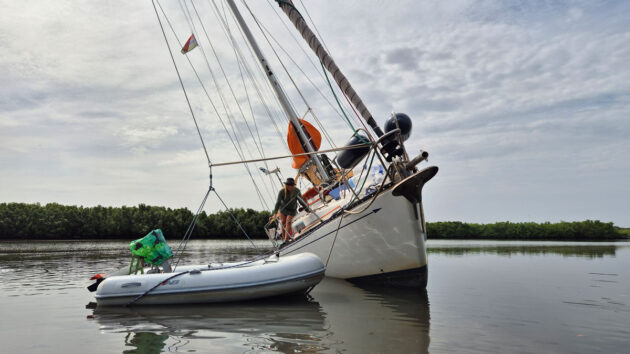
Careening Mojo was the only way to clean the hull ahead of the Atlantic crossing. Credit: Friso Hylkema
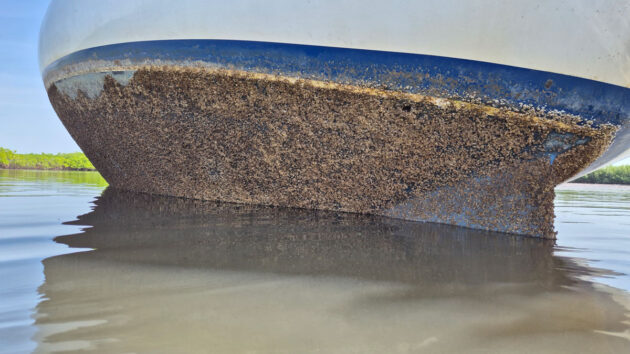
My girlfriend Nadine and I had sailed her down from my home port of Lemmer in the Netherlands, tracing a southern route along the European Atlantic coast before turning her bow towards the more adventurous cruising grounds of West Africa. After weeks of exploring the magnificent, meandering Gambia River, our hull had collected a thriving ecosystem of local marine growth.
Ahead lay a 450-mile Atlantic passage to Cape Verde. To ensure a swift crossing, the local flora and fauna residing on our hull had to go.
Careening preparation
Normally, hull maintenance for me involves a mask, a snorkel, and a spirited session of freediving with a scraper. However, the Gambia River, for all its magic, is a soup of thick, opaque, sediment-laden water. Diving blindly into the murky depths to scrape barnacles alongside anonymous river creatures lacked a certain appeal. The only logical alternative was careening—leaning the boat against a suitable bank and letting the moon do the heavy lifting.
Seeking practical guidance on how to safely dry out a 12-tonne, deep-keeled yacht on a tidal riverbed yielded remarkably little useful information. Most textbooks assume you possess a long, flat encapsulation keel, a twin-keel bilge arrangement, or a handy set of wooden beaching legs. Mojo had none of these. She was all high-aspect fin and deep-profile rudder.
We had been swinging on the hook for a while near Lamin Lodge, a charming, ramshackle restaurant built on stilts among the mangroves a few miles from the capital, Banjul. It is a wonderful oasis for the international cruiser, offering cold beers, excellent meals, local provisioning, and official customs clearance. More importantly, its surrounding waters provided the perfect natural laboratory for our experiment.
By spending time observing the local weather patterns, river rhythms, and tidal ranges, we began to formulate a plan.
Step one was scouting. We took the dinghy out at low water to probe the topography. Just around the corner from the lodge, we located the ideal spot: a steep sandbank flanking a deeper channel near the mangroves. The current ran gently, the area was entirely protected from ocean swell, and because the only traffic consisted of local wooden pirogues and fishing canoes, there was absolutely no risk of a passing vessel’s wake knocking us off balance.
The careening balancing trick
The next morning, our strategy was put into action. Low tide was calculated for approximately 13:00. We weighed anchor at around 09:00, just a couple of hours after high water. This timing was critical: it gave us maximum control while the water receded, ensuring that if everything went horribly wrong early on, we would have plenty of time and water to back off. Conversely, it guaranteed we would have a rising tide later in the afternoon to float us off cleanly.
Navigating the short, 15-minute passage from the anchorage, we used local markers—simple wooden sticks protruding from the water to indicate the edge of the banks. Occasionally, we felt the soft, reassuring ‘give’ of the bottom against our keel. In this part of the world, the riverbed is entirely forgiving, liquid mud; there wasn’t a rock in sight.
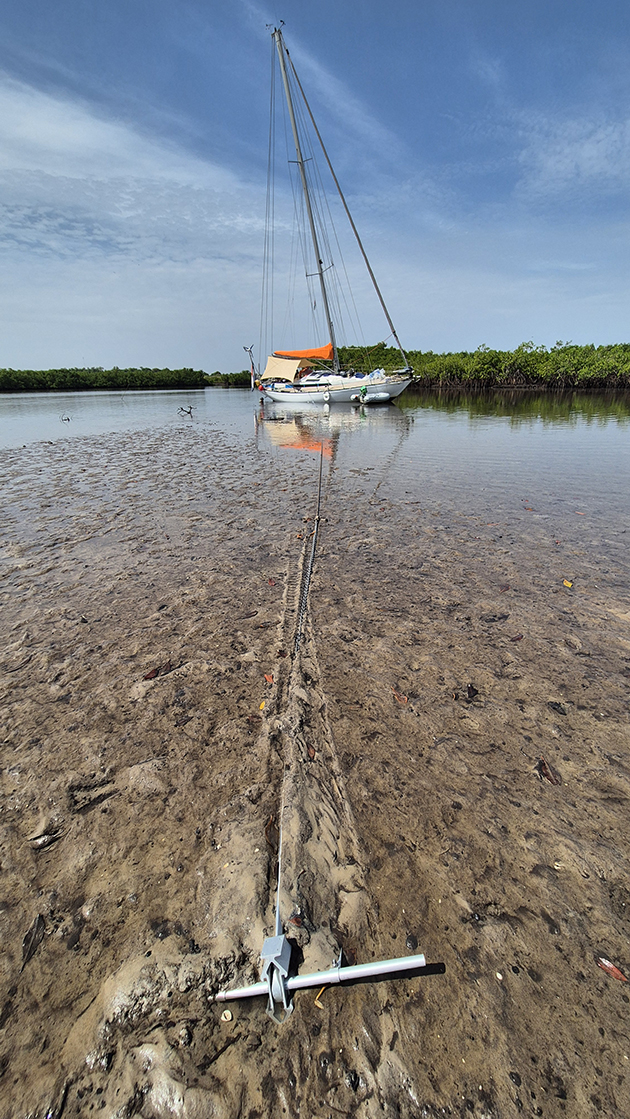
A kedge anchor helped get the balance right. Credit: Friso Hylkema
We manoeuvred Mojo into position, placing her bow directly into the gentle current, with her starboard beam facing perpendicular to the steeply sloping bank. As we edged closer, the depth sounder slowly ticked down to zero. We gently drove the keel into the soft mud until the boat ground to a halt. The riverbed embraced us firmly enough to hold Mojo against the ebbing tide, meaning we didn’t even need to drop our primary bower anchor.
Now came the real seamanship. To dry out a deep fin keel safely on a slope, you must ensure the boat heels towards the bank, resting her bilge against the incline rather than falling away down the slope into deep water. To manage this geometry, I deployed our secondary kedge anchor—an aluminium Fortress FX-23—using the dinghy. I dropped it on the submerged sandbank about 30 metres away, perpendicular to our beam.
At the 15-metre mark on the kedge rode, I rigged a heavy shackle. From this shackle, two lines were run back to the boat: one to the bow cleat and one to a primary cockpit winch. This bridle arrangement allowed us to precisely control Mojo’s bearing relative to the bank. We pulled the bow in slightly closer than the stern, a deliberate tactic designed to keep the deep spade rudder entirely free from any excessive load or pressure from the bank.
We tensioned both lines hard to prevent the hull from sliding down the steep muddy incline as the water dropped. But I still wanted an insurance policy to ensure she heeled to starboard. Leaving nothing to chance, we devised a classic cruising balancing trick:
- We secured the dinghy to the spinnaker halyard.
- We pulled its drain plug and let it completely flood with river water.
- We hoisted the heavy, water-logged tender a few feet out of the water on the starboard side.
This improvised water-ballast bag provided an irresistible, controlled list to starboard. To offer further protection to the rudder, we pulled the suspended dinghy slightly forward towards the bow. The trap was set. All we had to do was wait, keeping a watchful eye on the lines and taking in the slack as Mojo settled.
‘Chocolate Cream’ and the Flexible Scraper
As the river drained away, the hull took the ground and the starboard tilt became permanent. Standing inside a yacht that is leaning heavily on a hard slant gives you a genuinely bizarre sensation. It is a strange, uncomfortable vertigo that sits somewhere right between seasickness and landsickness. Fortunately, we had far too much work to do outside to suffer from it for long.
When the water level dropped to knee-height, we swung over the guardrails and dropped into the river. We instantly sank into 30 centimetres of warm, liquid river mud and shallow water. The squelching feeling of primordial ooze oozing between your toes is certainly an acquired taste. Sensing my initial hesitation, a surfing friend’s voice echoed in my head with some brilliant advice he had given us before we left: “When you’re walking in mud, just close your eyes and imagine it’s all chocolate cream.” It worked wonders for our morale, even if the smell didn’t quite match the dairy-fresh fantasy.
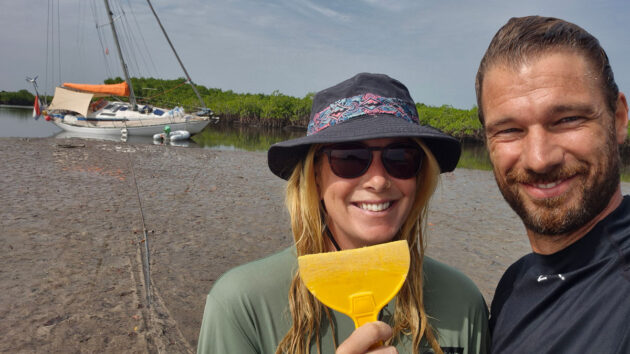
Getting ready to scrape! Creidt: Friso Hylkema
Cruising Tip: Don’t wait for the tide to go all the way out before you start cleaning. Barnacles, weed, and slime are infinitely easier to scrape off when they are still thoroughly wet. Once the tropical sun bakes them dry, they turn into marine-grade cement.
Our secret weapon for the day was not an expensive marine scraper, but an old, flexible plastic kitchen cutting board. Its beauty lay in its flexibility; it could bend easily to follow the beautiful, curved IOR contours of Mojo‘s hull. Because of its substantial width, we could clear a 30-centimetre swathe of growth with every single pass, making incredibly fast progress. The plastic composition was the perfect hardness: tough enough to shear off stubborn barnacles, but soft enough that it wouldn’t gouge our expensive layers of underwater paint.
Naturally, careening against a bank means you can only thoroughly clean one side of the boat at a time. However, by wading into the deeper water, ducking our heads under, and reaching blindly around the keel and the rudder, we managed to clean large portions of the starboard side as well.
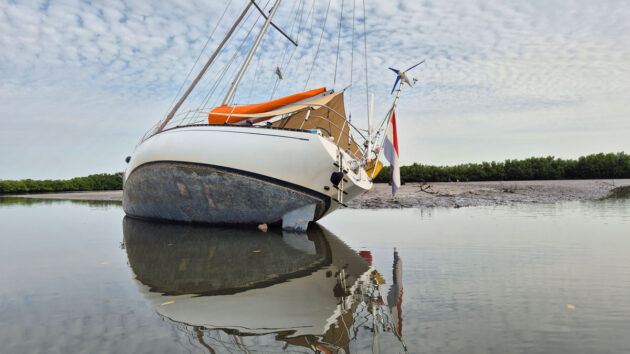
The hull was soon clean. Credit: Friso Hylkema
While Mojo was safely high and dry, we capitalized on this rare opportunity to perform a comprehensive underwater health check. We inspected the propeller anode, verified the smooth, free operation of our feathering prop mechanism, checked the shaft play, and examined the rudder hinges. A general look-and-feel inspection revealed everything to be in perfect working order. Finally, to clear out the local residents who had taken up occupancy inside our through-hull fittings, we used the wooden handle of a kitchen spatula to poke them clean.
Back up again
The cleaning itself took surprisingly little time compared to the long, slow cycle of the tide. With the dirty work completed and Mojo looking pristine, we found ourselves with a few hours to kill while waiting for the flood tide.
Fortunately, the welcoming sanctuary of the Lamin Lodge bar was merely a short dinghy ride away. Covered in mud but highly satisfied, we decided we had fully earned a couple of ice-cold beers and a generous portion of chips.
Sitting on the wooden deck of the restaurant, we could peer over the tops of the thick mangrove bushes and see Mojo’s masthead silhouetted against the African sky. It served as our own giant, nautical grandfather clock. As long as the mast remained raked at a dramatic, diagonal angle, we knew the boat was still firmly aground, which provided the perfect excuse to order another round.
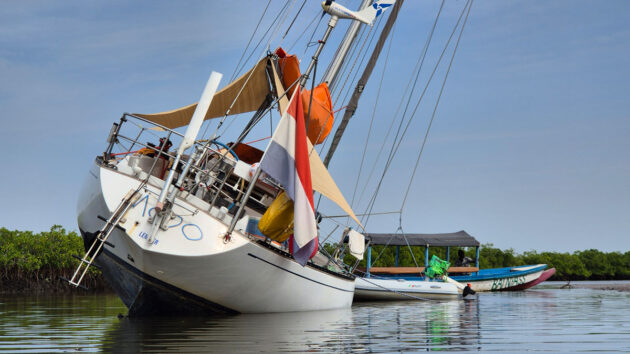
Once the tide had risen, Mojo could be refloated again. Credit: Friso Hylkema
As the afternoon sun began to dip, the hands of our mangrove clock began to move. The masthead slowly but surely crept back toward the vertical. We paid our bill, hopped into the dinghy, and headed back to the bank. By the time we arrived, the sandbank had completely vanished beneath the rising river water. Mojo looked like she was floating normally again, though her 2.15-metre keel was still acting as a spade, buried deep in the bottom.
We fired up the diesel engine to have our propulsion on standby, then used the dinghy to manually haul and retrieve our Fortress kedge anchor from the mud. We waited a few more minutes for the tide to give us those last few crucial inches of lift, popped the engine into reverse, and gently backed Mojo out into the deep channel.
Even though this grounding had been completely voluntary, calculated, and controlled, the moment the hull broke free felt incredibly liberating. Boats are fundamentally designed to float, and seeing the horizon level out again felt right. We motored back to our original spot in the anchorage, dropped the hook, and collapsed into the cockpit, utterly exhausted but deeply satisfied.
The entire operation had consumed a full day, and we had only managed to thoroughly clean one side of the hull. Yet, we had removed the worst of the drag. Mojo was clean enough to easily tackle the 450-mile ocean passage to Cape Verde. Once we arrived in those clear, blue Atlantic waters, we could easily tackle the other side with a basic snorkel set.
We had successfully careened a deep-fin keel yacht in the heart of Africa, proved our theories correct, and didn’t lose a single flake of paint in the process. For any cruiser exploring remote, tidal destinations, drying out shouldn’t be feared. With a clear strategy, a flexible cutting board, and the right mental attitude towards mud, it can transform from a daunting chore into one of the most rewarding adventures on the river.
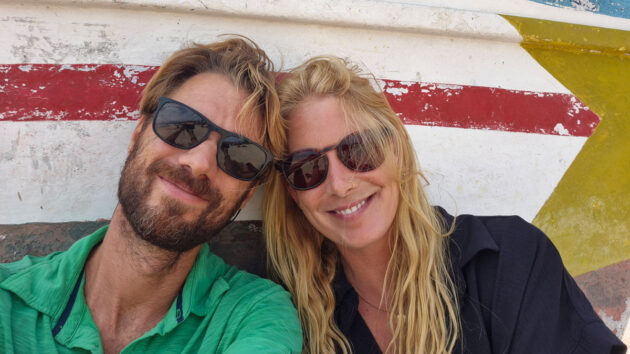
Friso Hylkema and his girlfriend, Nadine, Credit: Friso Hylkema
Friso Hylkema began sailing on Dutch lakes before swapping fresh water for blue water as crew aboard an Ovni 42, sailing to the Philippines and west Pacific islands. He then crewed on a Trident Warrior 40, exploring Indonesia, Madagascar and the Mozambique Channel and then worked as a delivery crew, sailing the Atlantic and Mediterranean. He now owns a 1978 Standfast 40s, sailing from Europe to West Africa with his girlfriend, Nadine before crossing the Atlantic. They are currently in Brazil.
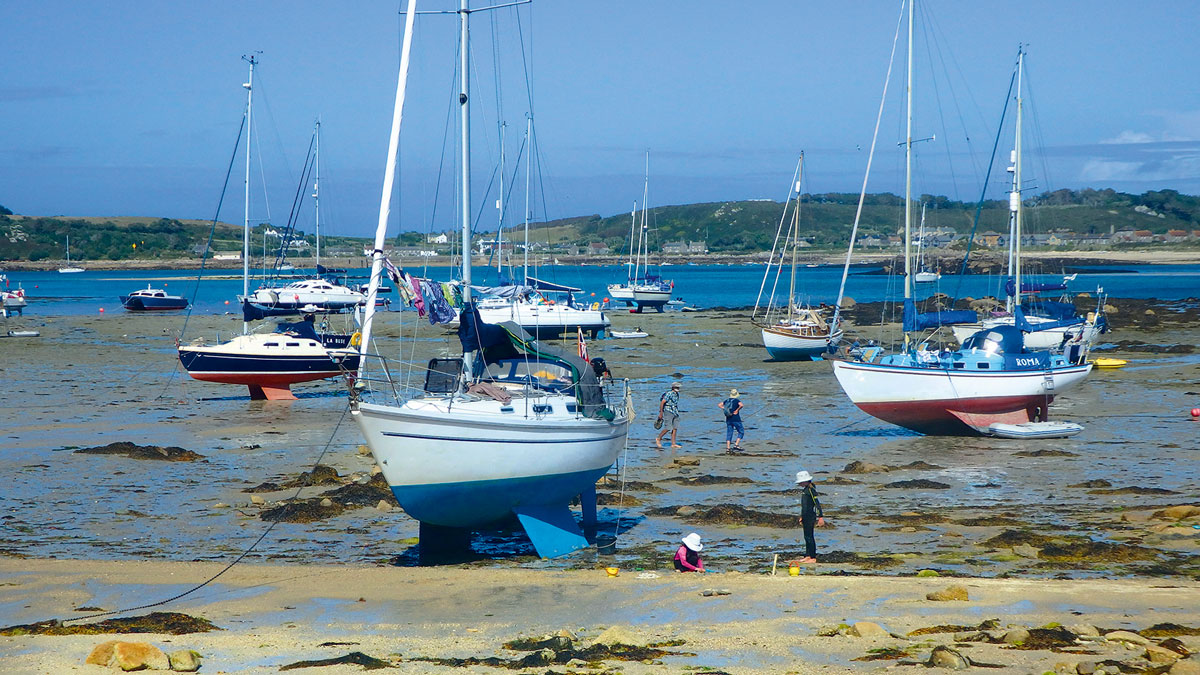
Drying out: how to safely take the ground
Having your boat prepared to take the ground can open up new cruising opportunities - and save you cash! Ben…
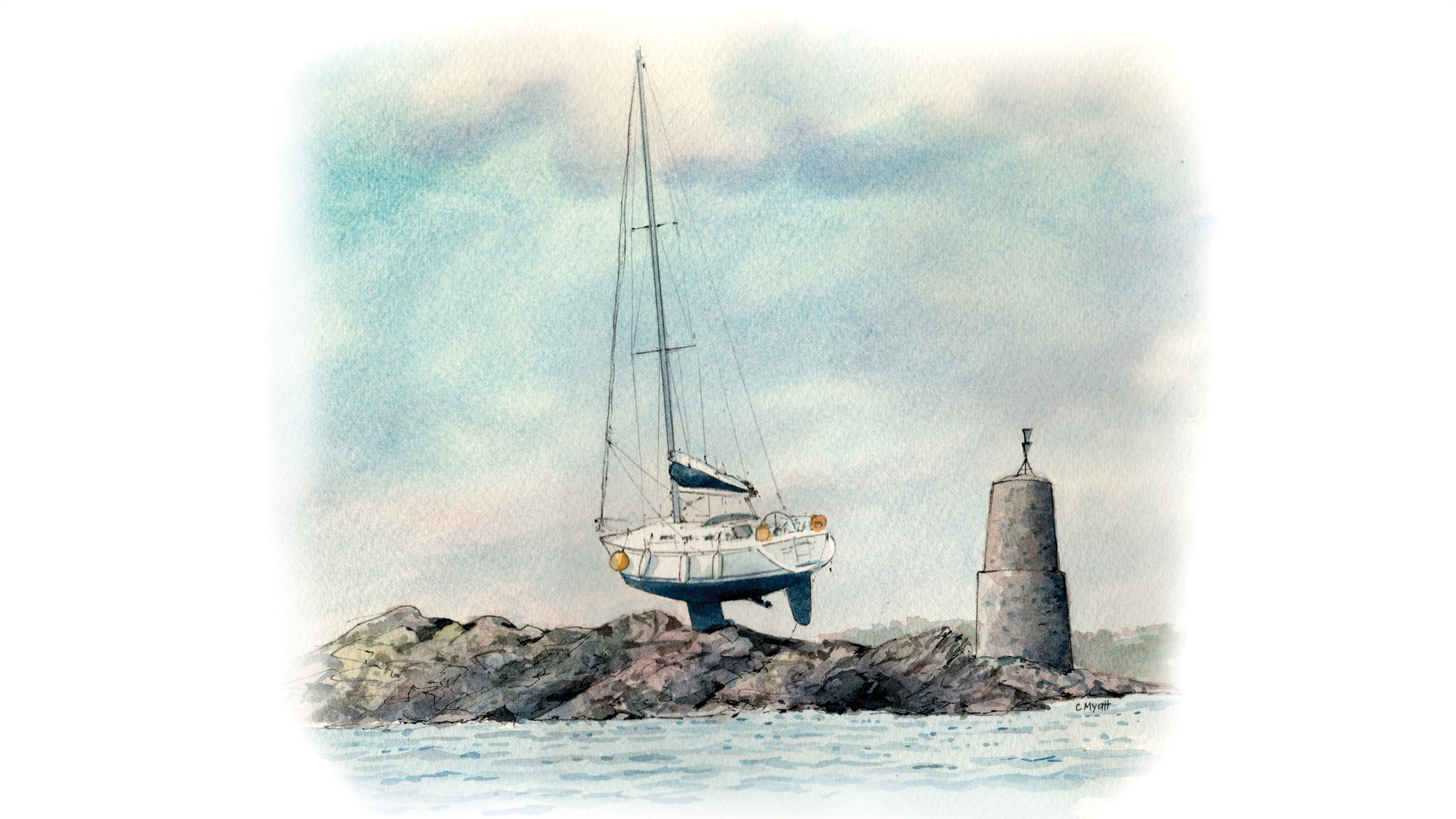
I made international news by running aground off the coast of Brittany
Heading for the start of the annual Waller–Harris two-handed race, an event in which Knight Star had proudly taken the…

Mud team to the rescue! Lessons learned from running aground on a sandbank
Paul Simon used to sing to me that ‘the nearer your destination, the more you’re slip-slidin’ away’. I never knew…

Techniques for boating in shallow water
Sailing in shallows means it’s likely that sooner or later you’ll go aground – but if you’ve planned for the…
Want to read more articles like Careening a Deep-Fin Keel Yacht in The Gambia?
A subscription to Practical Boat Owner magazine costs around 40% less than the cover price.
Print and digital editions are available through Magazines Direct – where you can also find the latest deals.
PBO is packed with information to help you get the most from boat ownership – whether sail or power.
-
-
-
- Take your DIY skills to the next level with trusted advice on boat maintenance and repairs
- Impartial, in-depth gear reviews
- Practical cruising tips for making the most of your time afloat
-
-
Follow us on Facebook, Instagram, TikTok and X