



Ben Lowings looks at the history of the 17ft salmon seiner Shambler, and how it has become a true community boat
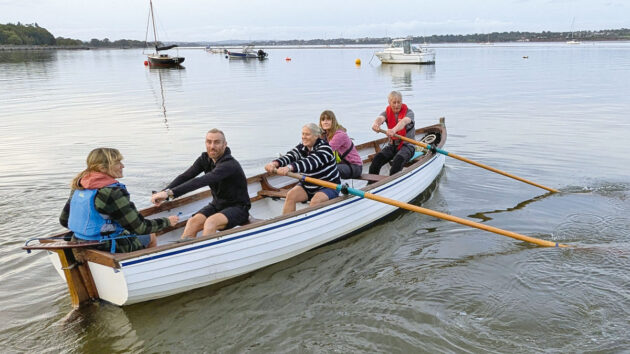
Every boater will be able to recognise this feeling – your craft, gliding along the water as the sun sets, inducing a wholesome sensation of peace, bubbles washing with satisfaction by the hull in line with how the boat’s designers foresaw. It’s a sense of coming home.
That feels especially true this evening on Devon’s Exe estuary, where I’m one of four rowers being coxed by Richard Bentley. Carrying us downstream with panache is Shambler, a 17ft GRP recreation of a salmon seiner -fishing boats which, until fairly recently, cast seine nets in these very waters.
She’s proudly owned by Starcross Fishing and Cruising Club (SFCC), itself established in the village in 1959. Most, if not all, the rowers live within a mile of the boat’s TetraDock pontoon berth.
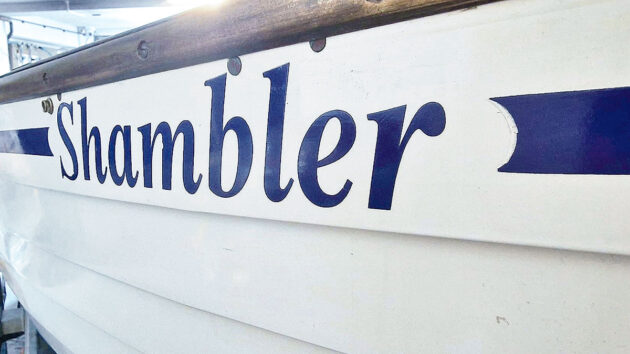
Shambler is a GRP version of the clinker-built elm and larch seiners of the past. Credit: Starcross Fishing and Cruising Club
Shambler is emblematic of community boat use and ownership. She’s out nearly every other day in the season. Many empty GRP yachts clinking their halyards in British marinas cannot boast anything like that level of usage.
This craft – and this community rowing project – stems from one well-travelled creature: the Atlantic Salmon.
Individuals who have swum up to Iceland have been known to journey back to this corner of south-western England, through the sluicing tidal entryway at Exmouth and battle the approximately 50 miles up to their spawning grounds in the freshwater streams of Exmoor.
The seiner
Salmon fishing on the Exe has been recorded for a thousand years (thanks, Domesday Book). In the latter half of the 20th century, the business declined. In the 2010s only several dozen would typically be caught over the course of a year’s season and it was generally agreed that the fishery was unsustainable. The government ushered in the end of the Exe salmon fishery when the Environment Agency discontinued licensing in 2019.
Seiner lore remains in the blood of the old fishers’ families, however. Without doubt, assuming the moratorium ends, the practice of the craft will still be in living memory. The last fish dispatched in 2019 was done so with the traditional wooden club (or ‘priest’) being brought down on its head, as it floundered in the net’s filaments.
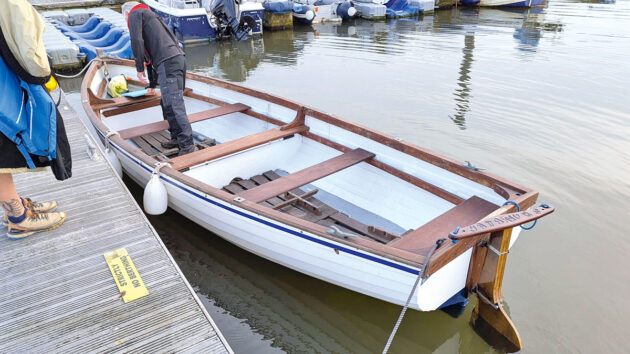
Shambler is based on the original salmon seines, which for centuries were used to fish on the River Exe. Credit: Ben Lowings
Evidence of the seiner can be found in the museum at Topsham village, the old port of Exeter, on the east side of the river. Among the boats which have been exhibited there is Ruby, one of the Exe’s last working salmon fishing craft. You can imagine it sat low in the water with four crew and half a ton of net. That’s not counting the weight of the catch. When you consider the Exe has large mounds of shifting red sand, this craft often has to glide over a mirror-like film of water less than a foot deep.
Construction
Shambler was part of an existing race fleet in the River Teign when she was sold to SFCC. Its estuary flows into the sea only seven miles south of the Exe ‘Delta’.
Shambler in particular has an affinity for the Exe since her provenance is the clinker-built elm and larch 17ft seiners that harvested salmon specifically in the Teign. Boatbuilders based there, such as Alan Chaney, have transitioned from wood to fibreglass. It’s said he created a mould for the GRP seiners after effecting a repair in wood to a Hook Brothers’ boat. Traditions continue with Graham Belton’s River Teign Rowing Boats.
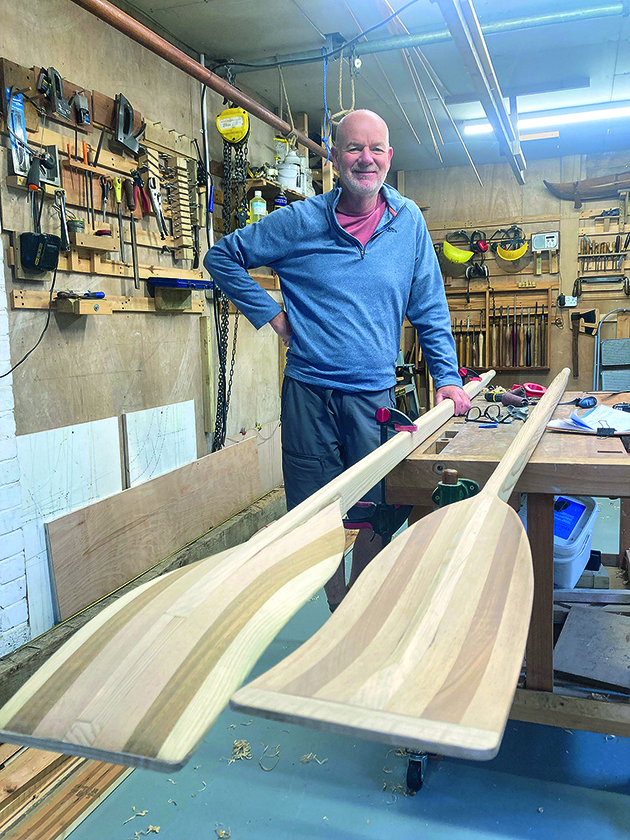
Jon Seal is restoring a wooden clinker-built seiner using traditional tools and methods. Credit: Adam Coupe
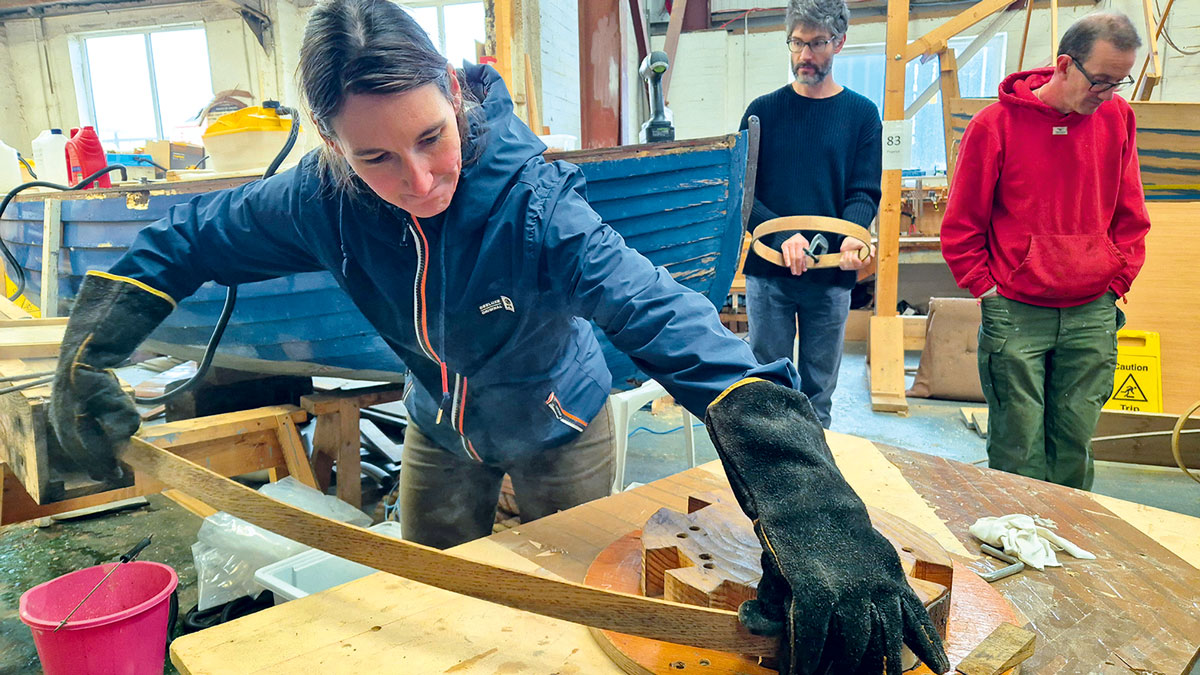
Moving over to the Exe, there’s an effort to keep the woodworking skills alive. SFCC has had the good fortune to count among its members the boatbuilding YouTuber, Jon Seal. He’s restoring, using traditional methods and traditional tools, an old wooden clinker-built salmon seiner called Elsie. “It’s going to be quite an exciting journey,” he declares, as he paces towards the Exe’s Cockwood Harbour at the start of one nicely-spliced new video. ‘Not a beautiful piece [or] elegant… but a functioning solid piece of woodwork.’
The Shamblers are taking an especially keen interest in his workshop activities.
Salmon seiner fleet
As Elsie attests, salmon seiners were commonly named in honour of the owner’s mother or wife: there’s no suggestion Shambler has anything to do with that tradition. The name calls to mind a Westcountry seadog with mutton chops ambling down a local street. And that figure would be in contrast to the sharp and nimble one of Shambler’s former owner: Bill Folley, a 73-year-old former Merchant Navy seaman and stalwart of the rowing scene in Shaldon and neighbouring Teignmouth.
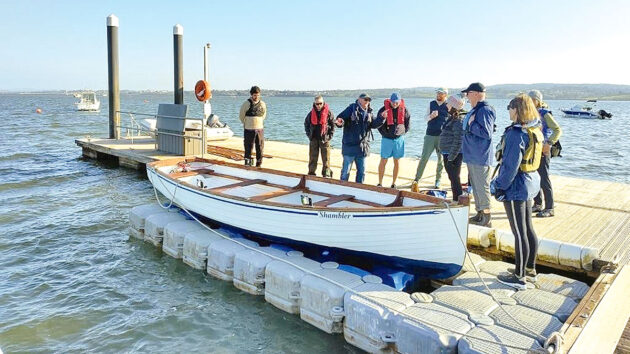
Bill Folley (black jacket, centre) briefs the Starcross crew on Shambler. The outboard TetraDock means the seiner can be hauled out completely. Credit: Starcross Fishing and Cruising Club
Each summer, these crews of four, plus coxswain, engage in serious racing. SFCC was lucky in that Bill vowed to be present not only to introduce Shambler to the members, but also to come out on the water to advise on management, crewing and rowing techniques. His encouraging voice has been key.
Crewing on a seine boat is possible even if you might think you’re not fit for the task. Information supplied on medical conditions or disabilities is only shared with club officials; you should be able to swim two lengths of a pool and dress accordingly for varying weather conditions.
Casual cruise-rowers have no need really for fancy wet-boots. What will be more than sufficient is a pair of used trainers that you don’t mind getting wet.
Into workshop
Work to get Shambler ready for action took place in the club premises underneath Brunel Tower, a Grade 1-listed Italianate sandstone structure built to house a pump for a Victorian experimental railway – one of Isambard’s less well-remembered schemes. As with the building, time had left its mark on Shambler in the form of oxidation.
This needed rubbing back from the stem, gunwales and floor, which took a day. Dilapidated steel screws were taken out and replaced with stainless steel, securing loose seats and the rudder base plate. Water needed to be kept out of the rowlock sleeves, so sealant was applied.
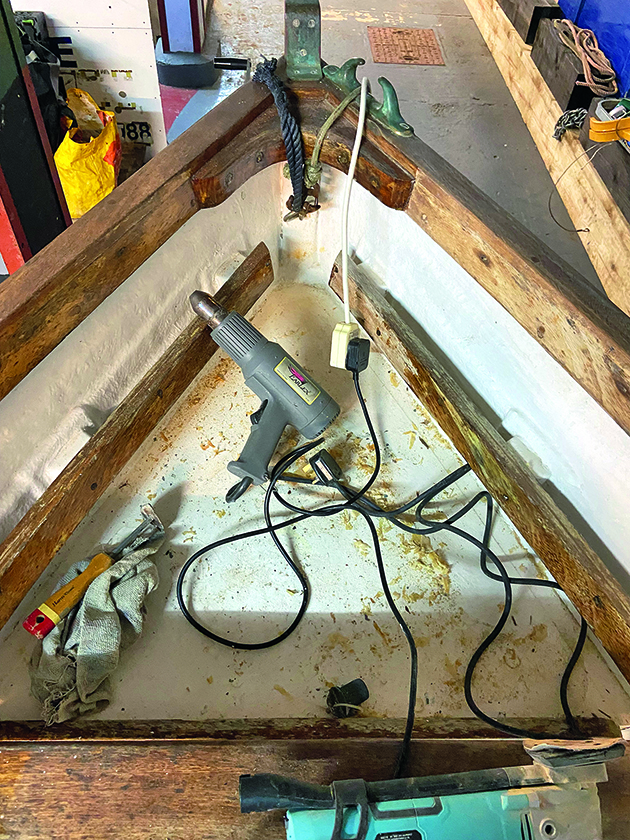
A heat gun was used to remove the old varnish. Credit: Jen Harris
A warped foot rest bar was also replaced, along with a compromised ring seal on the rear drain. Woodwork was sanded, cleaned and given three coats of teak oil. Another 500ml of teak oil diluted with white spirit was then applied. This reduces its viscosity so it penetrates deeper into new or aged wood, especially oily hardwoods like teak.
The hull interior was duly cleaned off before club member Kevin Williams applied the first coats of paint to the interior: grey paint on the floor of the inner hull, and white on the upper portions. “She looks great,” Kevin reported to fellow club members.
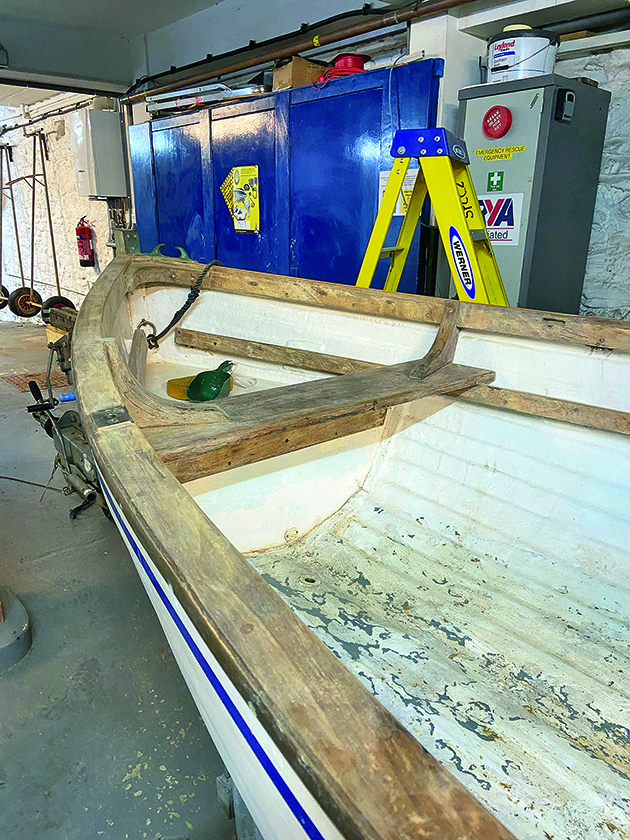
The hull interior was cleaned and the woodwork was sanded, cleaned and given multiple coats of teak oil. Credit: Jen Harris
But before the boat could be launched, there were some final fettlings to be done. Several dedicated club members sat on the boat when it was on the trailer and noticed some movement on the thwarts. So it was wheeled back into the workshop for these to be refitted and reinforced.
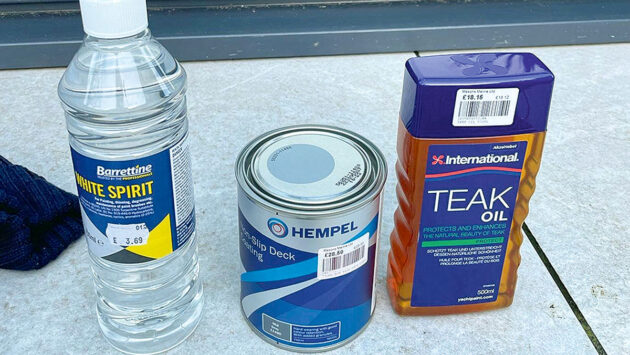
Teak oil was diluted with white spirit and applied to woodwork. Credit: Tom McFarlane
To the slipway
On launch day, Shambler was wheeled out, her stern facing down towards the sea once again. From this stable square-cut transom, the working boat would earn its keep. The seine net would be cast out from this platform. Its curve would fling out to such an extent that either side would brush the banks.
Up to three sets of fishers’ hands were then required to heave in this enormous bag. Only when the net’s last yards were brought aboard would the catch show their bellies.
The trailer slowly crept down the slipway, and Shambler swam off the supports onto that distinctive clay-coloured river. A salmon seiner built on traditional lines was back on the Exe again. There was historical resonance to the day and no small measure of local pride. There was continuity as well, with former owner Bill Folley imparting decades of wisdom from a Merchant Navy career to help brush up on oar-handling skills as well as rowing in time.
It was with the guiding hand of Adam Coupe, the club’s Rear Commodore, that SFCC had begun the search for Shambler, and now more than 30 members row the boat or help with her upkeep. “They represent all levels of fitness within the club,” says Coupe. “Ages [range] from early 30s to mid-70s. There are now often waiting lists for members keen to join midweek evening rows.”
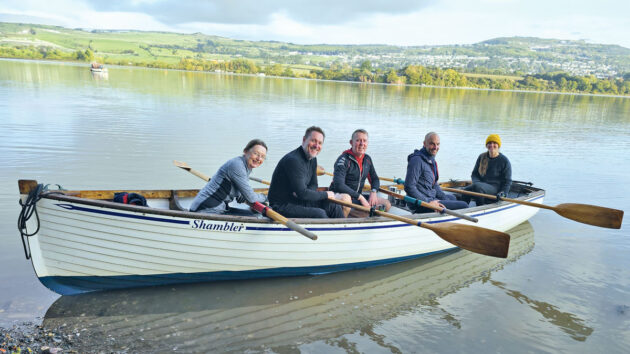
As well as rowing, Shambler may be used for wildlife watching in the future. Credit: Starcross Fishing and Cruising Club
Swanton is as enthusiastic about the prospects for the season as for the pleasure afforded by simply rowing. “It’s been lovely to finish work and go out on the water to admire the sun sink below Powderham Castle and chat with fellow water lovers.”
As for the future? Well, Shambler wasn’t specifically acquired for racing alone, although she would be right at home if taken to sea round to Teignmouth for a run there. There’s certainly a push, perhaps from some of the fitter members, to compete against any crew or boat that could be mustered from Topsham or Exmouth, although the larger pilot gig format is taken very seriously there.
The flexibility of a social rowing project for a community club is that multiple uses seem natural options. Some residents quite understandably yearn for the return of fishing on the Exe.
If that was Shambler’s only purpose, then she’d be dormant for at least another four years. Some observers say the boat might be used for wildlife watching instead of fishing. To that end, eagle-eyed viewers of the club webcam are keen to point out that it allows glorious close-up views of resident grey seals on a mid-channel pontoon.
The Exe around here is like other estuaries in southern England – a haven for visiting birdlife.
Whatever the destiny of Shambler, it’s clear that the activity of simply rowing in this peaceful natural environment, wealthy in wildlife, has brought perhaps otherwise disparate groups of people together for social reasons.
In Swanton’s words, rowers “have been rewarded with smiles, sunshine and sunsets.” May the rowing renaissance gather pace.
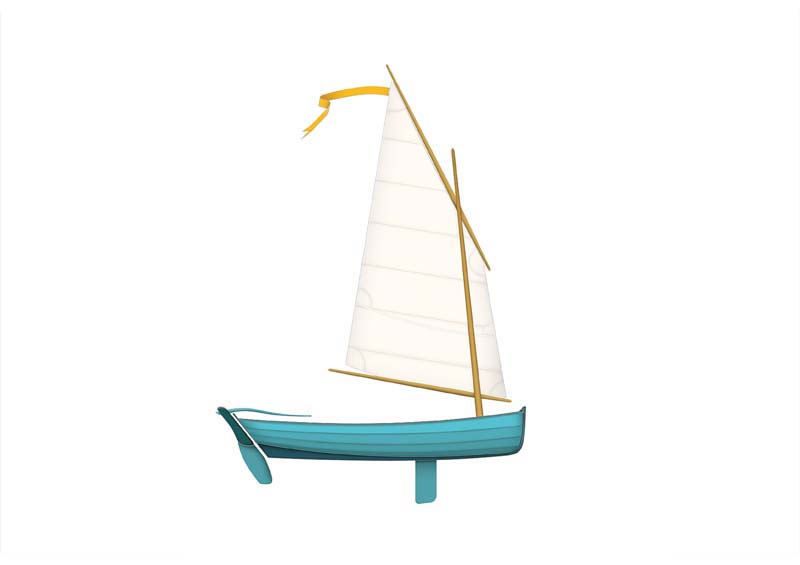
Free boat plans – Build your own Nigel Irens 14ft rowing and sailing skiff
Fancy building your own Nigel Irens-designed 14ft rowing/sailing skiff? Nic Compton explains how to get the plans for free
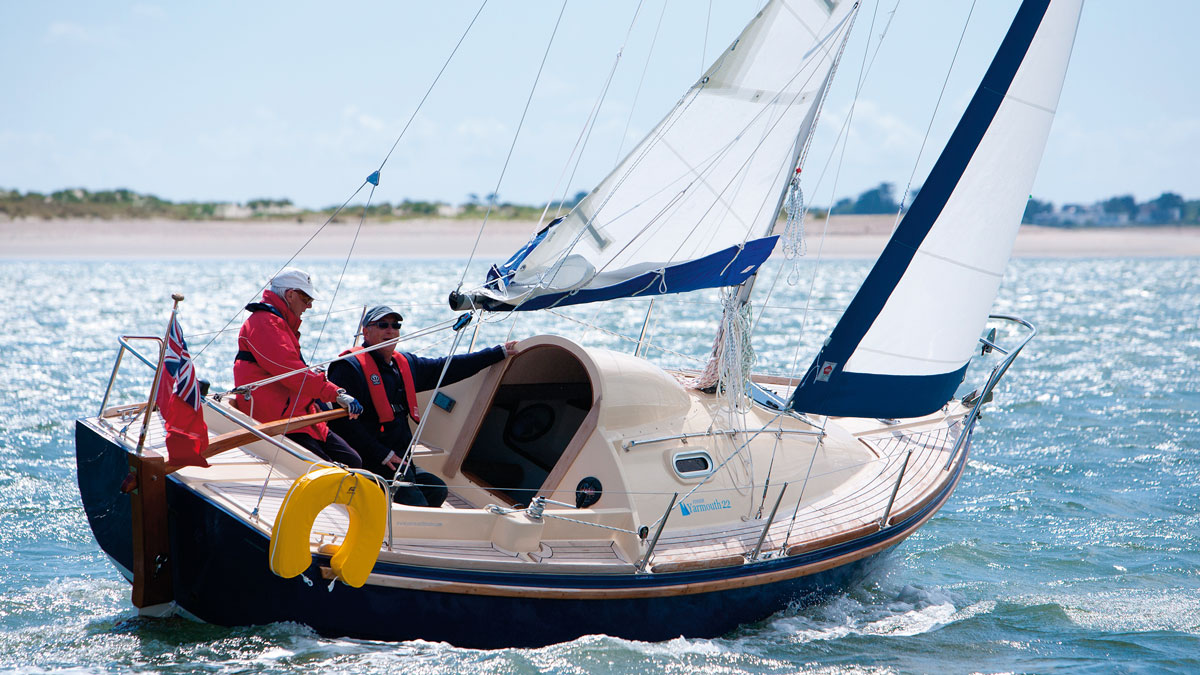
Yarmouth 22: a long-keeler which balances tradition and fractional rig performance
With her modern fractional rig and blister coachroof, the Yarmouth 22 is a long-keeler with a difference. David Harding reports
Why boatbuilding needs a broader workforce
Lola Morgan examines how a more diversified workforce is helping to preserve traditional boatbuilding skills and techniques

Restoring Tethra: how a Looe fishing boat became a dining sensation
Annie Means talks to the owners and restorers of a Cornish motor luanch which is now used for dining afloat
What to read more articles like Second life for a salmon seiner?
A subscription to Practical Boat Owner magazine costs around 40% less than the cover price.
Print and digital editions are available through Magazines Direct – where you can also find the latest deals.
PBO is packed with information to help you get the most from boat ownership – whether sail or power.
-
-
-
- Take your DIY skills to the next level with trusted advice on boat maintenance and repairs
- Impartial, in-depth gear reviews
- Practical cruising tips for making the most of your time afloat
-
-
Follow us on Facebook, Instagram, TikTok and X