



With her modern fractional rig and blister coachroof, the Yarmouth 22 is a long-keeler with a difference. David Harding reports
Yarmouth 22: a long-keeler which balances tradition and fractional rig performance

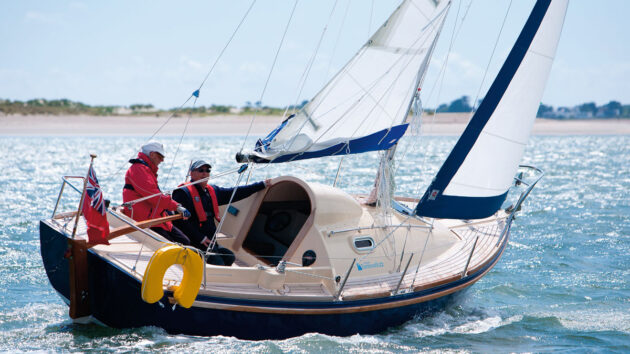
When we think of keeled small cruisers, many of us tend to picture boats of a traditional nature: boats that, like the Yarmouth 23 and the Cornish Crabbers, have a gaff rig, tan sails and a bowsprit. That’s probably because most of the relatively small number of long-keeled weekenders and coastal cruisers fit that description.
Decades ago, of course, long keels were the norm across boats of all sizes and types, including those conceived for racing: just look at the Folkboat and Twister as fine examples that are still sailed competitively. Design has moved on but, in the right hands and the right conditions, these two evergreens are capable of seeing off some of their modern counterparts. Long keels don’t mean slow boats.
New designs, other than those conceived to maximise ‘trad-appeal’, rarely have long keels. Even some of those that look traditional when afloat are thoroughly modern below the waterline. What all this means is that if you like the strength, steadiness, directional stability and ease of drying out that a long keel offers but want it in a new boat without the traditional accoutrements, you’re not exactly spoiled for choice.
You can still find long-keeled blue-water cruisers, such as the Rustlers and Tradewinds, and that’s great if you’re after a serious offshore yacht for a serious offshore budget. Should you be thinking on a smaller scale, however, the list of potential candidates is a lot shorter.
Enter the Yarmouth 22. Here’s a small cruiser with a long keel. She has traditional hull lines with a spoon bow, generous sheer and the rudder mounted on a raked transom.
Add the simulated lapstrake construction and teak rubbing strake, and she begins to sound much like boats we’ve seen before. Above the gunwale, though, things go in a different direction. Instead of a square, flat-topped coachroof and rows of round brass portholes, you find a curvy, low-profile superstructure with a blister rather than a sliding hatch forming the companionway. A jaunty oval port and stainless steel handrail add to the expression of sporty minimalism.
Stepped between blister and forehatch is the aluminium Z Spar mast of a 7 ⁄8ths, swept-spreader fractional rig. Now that’s not trad in anyone’s book – so what exactly is the Yarmouth 22 all about?
Yarmouth 22: sprightly performer
The Yarmouth 22 shares the same hull as the Yarmouth 23, but features lower topsides, a keel 15cm (6in) deeper, a modified coachroof, a fractional alloy rig, and a simpler fit-out. David Freeman, the co-designer with Gordon Wyatt, envisaged a frill-free little cruiser – his own boat had an outboard – that could be used for racing by those moving up from keelboats such as the XOD. He has sailed alongside XODs in his home port of Lymington and found that the Yarmouth 22 is pretty much the same speed. Even if keeping up with an XOD doesn’t make a boat a serious sprinter, it does give a good measure of her performance.
These modifications make the Yarmouth 22 a good deal sprightlier than the 23, at least on paper. Originally, she came with teak decks and a 13.5hp Beta diesel engine, and second-hand examples can be picked up for around £15,000. New, the Yarmouth 22 started from £46,000.
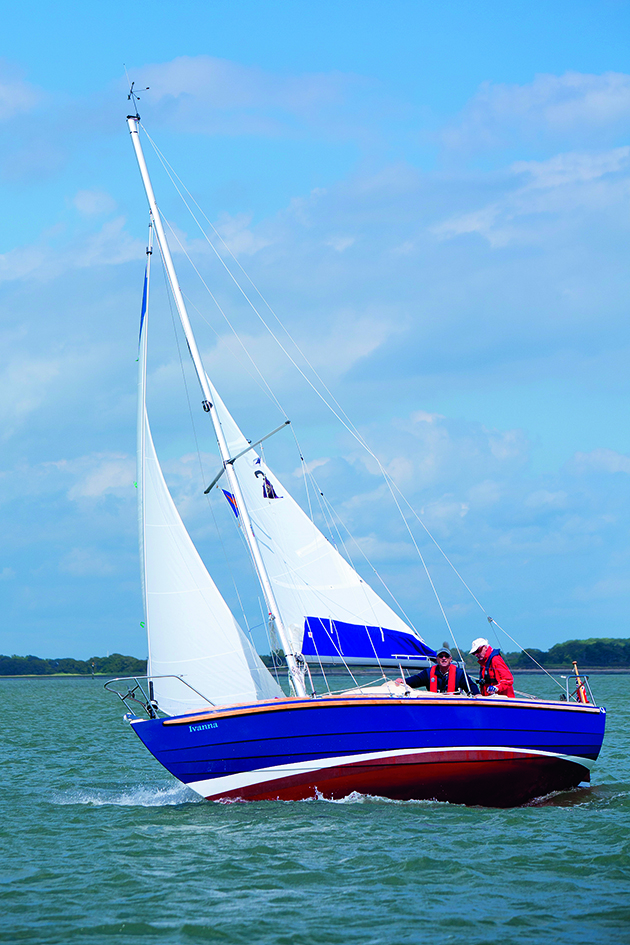
Simulated lapstrake construction adds trad-appeal to this modern long-keeler. Credit: David Harding
The only real disappointment to me was to learn that the standard prop on the Yarmouth 22 is a fixed three-blader. With two fixed blades you can line them up behind the deadwood; with three you might as well be dragging a bucket.
Still, it was one of the rare bright and breezy days in the first half of the summer, when I headed out of Chichester Marina and motored the Yarmouth 22 against the wind down the narrow channel to Itchenor, giving the three-bladed sea-anchor some exercise as it pushed us along at just shy of 6 knots. Where the channel widened we set sail, initially flying the full main but finding that, without a halyard winch and with only a horn cleat to sweat the halyard against, we could get nowhere near enough luff tension. Leech tension was equally hard to achieve without a kicking strap, as was foot tension. Since we also had a couple of broken luff-slides, we dropped in the first reef and managed a set that was less bad than before. Later builds included a kicker and a halyard winch as standard.
Powered by the reefed main and full genoa, we then tacked our way down the harbour with the 16-to-19 knots of south-westerly breeze kicking up a short, sharp chop against the spring ebb.
These were conditions that the Yarmouth 22 evidently liked. Digging her shoulder in to the point where the rubbing strake was just above the water, she ploughed her way through the waves at a steady 4 knots, staying light on the helm and throwing surprisingly little spray back over the deck. All she wouldn’t do is tack under main only, needing the extra power of the jib to bring the bow through the wind.
As with any long-keeler, handling is deliberate. It’s no good trying to spin her on a sixpence, but she’s pleasantly responsive and rewarding to sail. Fit a two-bladed prop and line it up, or better still have a folder (which was originally on the options list), and she would undoubtedly change up a gear, especially since the ballast has also been increased.
Fixtures and fittings on the Yarmouth 22
Given the equipment we had, I thought the Yarmouth 22 gave a good account of herself. If, however, you want to get more out of her and don’t mind spending a few more pennies, there’s plenty you can do. A means of tensioning the genoa’s luff would help – a tack downhaul might suffice – as would a more efficient outhaul system in the boom and an adjustable backstay, which is really needed to control the rig with a fractional configuration like this.
As standard, the blocks for the headsail sheets are mounted on the moulded spray-deflector running across the deck at the forward end of the cockpit coamings. The deflector is a useful feature when it comes to keeping the boat dry, but no one who wants to sail efficiently, especially with a roller headsail, could live with a fixed sheeting point. Backstay tackles, genoa tracks and anything else were also offered to owners.

The Yarmouth 22 was co-designed by David Freeman, best known for designing the Fisher range of motor-sailers with Gordon Wyatt. Credit: David Harding
The initial mainsheet arrangement, with its split purchase from the end of the boom to the aft corners of the coamings and a jammer block on the port side didn’t work, so the sheet was instead taken to a strongpoint on the cockpit sole and a traveller was an option.
Forward of the cockpit, the smooth gel surface of the coachroof could do with some non-slip. The decks, covered in 0mm hand-laid Sri Lankan teak, provide a good grip and easy passage forward between the lower shrouds immediately outboard of the coachroof and the caps, which are taken to the gunwale.
A chunky samson post lives on the foredeck. No anchoring provision came as standard: the anchor and rode lived in a bucket, sharing the lazarette locker with the fuel tank. As on the 23, chocks for the anchor can be fitted, as can a navel pipe: anyone who ordered a 22 could choose features or options from the 23, including bilge keels so she can dry out unaided.
Down Below
Getting below decks on some boats with keyhole-style companionways can be a slow and deliberate process. On the Yarmouth 22, it’s as quick and easy as can be: you grab hold of the top of the blister and launch yourself feet-first down the hatch into the cabin. Everything about the companionway could have been designed specifically for this style of entry. You can adopt a more conventional approach if you prefer.
Once you’ve landed, you find yourself in an appealing if unusual environment, facing white-painted bulkheads, carpeted headliner and cabin sides, parquet sole-boards and ample trim in what appears to be teak. In fact it’s not teak but Malaysian oak, or ‘rubberwood’ to its friends. Since it comes from trees that have reached the end of their latex-producing life and would otherwise be burned, it has eco-friendly credentials.
Six-footers can stand below the blister because the sole of the 22 is lower than on the 23. Few 22-footers offer full standing headroom without looking top-heavy, so this is quite an 74 achievement. Another unusual element down here is the way the interior is formed from timber bonded directly to the outer hull. I like the straightforward construction and the complete absence of inner mouldings or liners that so often do little more than waste space and restrict access to the hull, deck and important fittings.
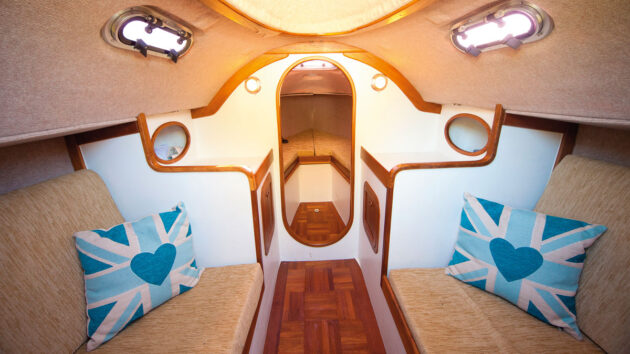
White-painted bulkheads, trim in rubberwood (otherwise known as Malaysian oak) and carpet lining create a pleasant environment below decks. Headroom beneath the blister is 1.83m (6ft). Credit: David Harding
The inside of the hull is simply flow-coated and the fastenings for the through-bolted deck fittings are accessible without being intrusive. It’s simple, unfussy, honest boatbuilding.
On earlier models, the deck was cored with plywood in way of the fittings and with foam elsewhere. On later models, it was ply throughout, allowing fittings to be moved or added. This is not the sort of boat on which a few extra ounces are going to make an enormous difference – and if you’re that fussed, you would just forgo the teak decks.
The saloon settee berths are 2.03m (6ft 8in) long and 0.68m (2ft 3in) wide. Running aft beneath the cockpit seats, they preclude cockpit lockers but the lazarette provides space to stow fenders and warps, if not an inflatable. Sitting headroom is adequate as long as you don’t lean too far back. It’s best to prop yourself forward with a cushion to bring your head closer to the centreline.
At the head of the berths is a joinery unit on each side. To starboard is a sink, with stowage beneath and space for a simple water system – or a proper pumped arrangement if you prefer. Opposite, a small cooker could be fitted. The relatively narrow beam (2.28m/7ft 6in) means that everything feels a bit more squashed in the lateral plane than on some boats of similar length.
The other side of the main bulkhead is a forecabin with a V-berth over 2m (6ft 6in) long, stowage beneath and space for a chemical toilet.
Moving aft again and lifting out the companionway steps, we find the engine with easy access to the fuel filter and water pump. There’s reasonable space all round and the cockpit sole can be removed for access to the stern gland and gearbox.
Verdict on the Yarmouth 22
It’s hard to think of anything quite like the Yarmouth 22: an uncomplicated and relatively affordable long-keeler.
She’s no speedster, but it’s easy to imagine a fleet being raced somewhere by a group of owners who want more than the full crouching headroom offered by the Folkboat.
I suspect, however, that she’s most likely to be bought by people in search of a small, simple, steady and pretty little cruiser.
Details
LOA:6.70m (22ft 0in)
LWL:5.49m (18ft 0in)
Beam:2.28m (7ft 6in)
Draught:1.07m (3ft 6in)
Displacement:1,880kg (4,144lb)
Ballast:1,135kg (2,500lb)
Sail Area:22.76sq m (245sq ft)
Displacement/length ratio:319
Sail area/displacement:ratio 14.86
RCD Category:B
Original engine:Beta 13.5hp diesel
Headroom:1.83m (6ft 0in)
Designer: Wyatt and Freeman