


Proa designer Rob Denney went to Fiji to build catamarans and wound up launching a boatbuilding school to teach women how to build their own fishing boats
New Zealand boat designer Rob Denney, celebrated for his Harryproa, a variation of the double-hulled vessel originating in the Pacific with a hull-mounted rig, didn’t start with the idea of a boatbuilding school.
He’s spent his career racing, delivering and designing yachts; among them a self-built catamaran destroyed by the Irish Navy after a failed two-handed Round-Britain Race.
He’s designed a foiling proa for the Volvo Round the World Race, now The Ocean Race, built a windmill for his catamaran, hosted workshops with late multihull pioneer Derek Kelsall, and designed nine low-cost yachts from 25ft to 80ft.
But in 2022 he took on a completely new challenge, one which didn’t involve record attempts or high-tech boatbuilding. Just a great deal of patience and innovation.
A new challenge
It came about from a project in the Marshall Islands, teaching local boatbuilders to use modern plywood techniques for sailing boats.
The traditional boats required a lot of maintenance and were not big load carriers, so Denney designed the mini cargo proa to carry a tonne of copra (coconut flesh) across a 30-mile-wide lagoon.
During this time, Denney became aware of issues with inter-island transport: the big diesel-burning ships were usually decrepit and unable to access many villages. They needed large payloads to justify a voyage.
He concluded that a variation of his Harryproa design was the solution: essentially, a large, decked-in outrigger canoe.
In other words, a modernised version of what Pacific Islanders have been sailing for centuries.
First steps
When Covid hit, Denney returned to Brisbane.
With the help of students from the University of Queensland, he spent two years and $50,000 building the 80ft cargo proa out of flat panels of solid glassfibre infused on a 12m table.
The result was ‘not pretty’, but it weighed in at just 1.5 tonnes.
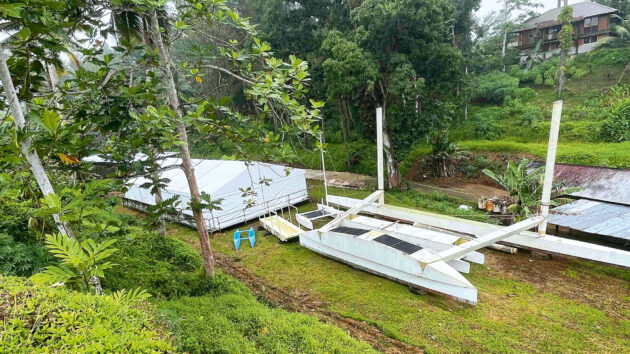
Rob Denney’s 80ft cargo proa was built in Brisbane then shipped to Fiji in parts to be reassembled. Photos courtesy of Sue Berners-Price and Rob Denney
The individual hull pieces were shipped to a rapturous reception at Fiji’s Centre for Appropriate Technology and Development (CATD). The project was launched by the prime ministers of Tonga and Fiji.
With the support of the United Nations Development Programme (UNDP), a ramp and shed were built and the boat was fitted out.
DIY kit boat
The initial concept used a conventional unstayed rig.
However, Denney discovered the solution might be to use a paraglider with the harness lines attached to the deck – something he and a Harryproa owner had been experimenting with for 20 years.
“We concluded the advantages of long-line kites (zero heeling, more wind higher up and the ability to increase power through a figure of eight pattern) outweighed the disadvantage of retrieval,” said Denney.
“By hoisting one wing tip on a spindly mast, we could prevent the kite from falling in the water. There’s not as much power as a long-line kite, but it’s far easier to control.”
Making boatbuilding sustainable
The next step, Denney felt, was education: the provision of boatbuilding skills to ensure Pacific Islanders could continue the work themselves.
And so, Fiji’s Sustainable Boatbuilding Course was developed at the CATD with assistance from the UNDP and the Australian Pacific Training Coalition.
“I didn’t know how time-consuming it would be to teach the students how to build a mini cargo proa, nor how enjoyable,” says Denney.
“The big difference is the Fiji version has no plywood or timber; it’s built from recycled PET (the same material as soda bottles) foam, epoxy and fibreglass. Consequently, there is nothing to rot and very little to maintain.”
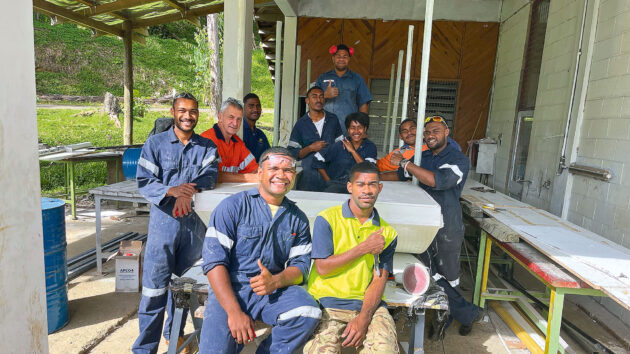
Students at the boatbuilding school creating Denney’s design for sustainable water taxis. Photos courtesy of Sue Berners-Price and Rob Denney
For safety reasons, cost and practicalities, it was important that the boats could be built without power tools.
Denney admits his expectations were inflated.
“The pilot course was a bit shambolic, due to lack of space and shelter, late arrival of materials and too many students,” he says.
Nevertheless, after eight weeks the students had built the two hulls and crossbeams, carbon spars and rudder blades.
“Not America’s Cup standard, but still half the weight of the ply version, remarkably stiff and suitable for the tropics.”
The rig – a traditional crab claw design (triangular sail with spars along the upper and lower curved edges) – was cheap and easy to make with a domestic sewing machine.
Being subjected to low loads, it would last longer than Western sails, but with the downside that it would be less effective up- or downwind and not easily reefed.
To enable reefing experiments, Denney designed a larger sail than on the Marshall Islands mini cargo proa (30m2 rather than 18m2), an adjustable rig, and efficient rudders large enough to act as leeway preventers.
First tests on the water
Launch day arrived and the students carried the boat down a muddy track (what is now a concrete path and boat ramp) to the river.
“There was lots of singing and laughter, and a bottle of soda instead of champagne,” recalls Denney. “I suffered from the usual designer nerves and elation when it floated on its lines and performed well.”
Proas don’t tack or gybe but change direction by a process known as ‘shunting’.
The proa stops or slows, the sail is moved to the other end of the boat, the rudders reverse and the stern becomes the bow. The outrigger (lateral support float) always stays on the windward side.
The boat sailed well enough for Denney to know it was better than the ply version, but, unlike in the Marshall Islands, there was no real interest in sailing.
So Denney changed focus to alternative energy sources. In particular, to solar and electric outboards.
Electric Water taxis
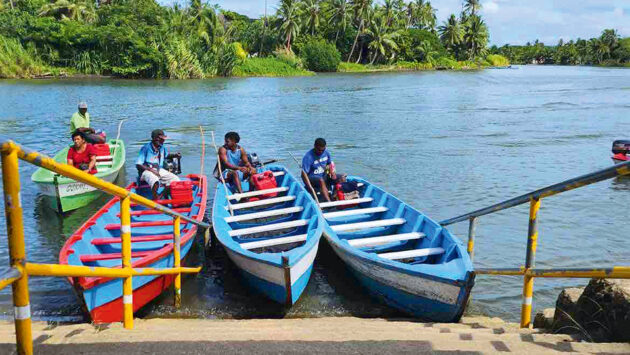
Old-style wooden water taxis have a limited lifespan and are powered by polluting outboards. Photos courtesy of Sue Berners-Price and Rob Denney
Impressed by Denney’s results, the UNDP and Fiji Development Bank asked CATD to look for a green alternative to the Rewa inland water taxis.
The 6m skiffs were hardwood planked, some with polyester resin and CSM on the exterior, powered by 15hp 2-stroke outboards.
Depending on maintenance, the hulls could be expected to last between three and 10 years.
After chatting with the drivers, Denney came up with a simple landing craft boat with seating fore and aft, as opposed to athwartships.
Still, the big challenge was finding an alternative for the petrol-burning, oil-depositing 2-strokes.
“Not just because petrol is becoming prohibitively expensive and Fiji wants to slow climate change,” says Denney, “but because, as one village elder put it: ‘When I was a boy, we caught fish as long as your arm. Now we are lucky to find them as long as your finger’. The 2-stroke exhaust oil is thought to be responsible for this’.”
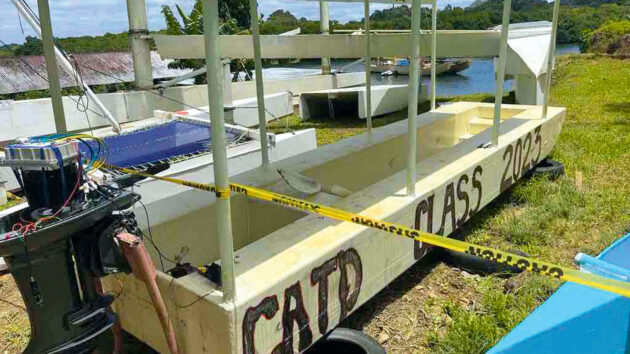
Eco water taxi is powered by an electric outboard run from solar panels. Photos courtesy of Sue Berners-Price and Rob Denney
With a class of nine students, Denney produced a water taxi with a 10kW (13hp) watercooled electric motor and five 300W solar panels mounted on the roof. It worked a treat.
The idea is that the production version can be built by graduates of the Sustainable Boat Building programme.
“Sustainable in this instance is not about building boats that will return to the environment as compost,” says Denney.
“It’s about those that will outlast their owners and can be built and used by anyone for transport, fishing or fun. These are lightweight, affordable and low-maintenance boats which can be totally recycled if required.”
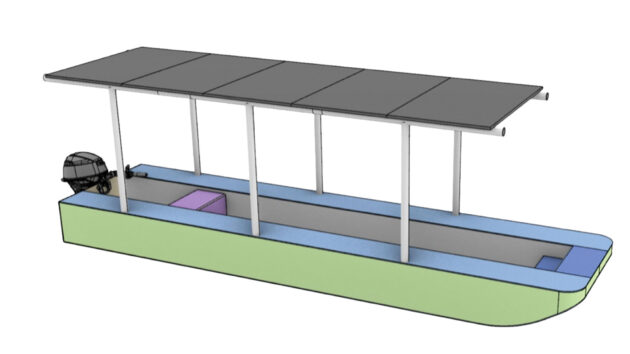
Denney designed a 10kW electric water taxi. Photos courtesy of Sue Berners-Price and Rob Denney
A boatbuilding school for women
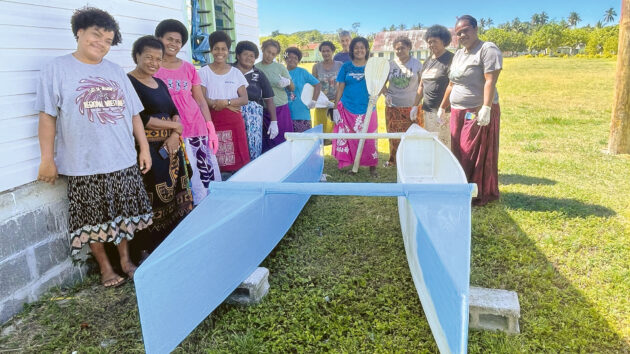
In rural Fijian communities, women play a crucial role in fishing, and so the next boatbuilding course Denney designed was a five-day workshop for 10 women to build a fishing canoe.
The requirement was that the boat could be carried to the water by one woman, as opposed to several, which was the case with the glassfibre ‘pangas’ (skiffs), hardwood skiffs or bili-bili (bamboo lashed together to make a raft).
“We achieved the weight target, but the boat was a bit tippy and a bit small for some of the women,” explains Denney. “Talking to the women, it was obvious that fishing was a social activity and the boat should carry more than one person.”
Consequently, the women built a second big hull and turned it into a catamaran, which four people could use but was still light enough, at 30kg, to be carried by two.
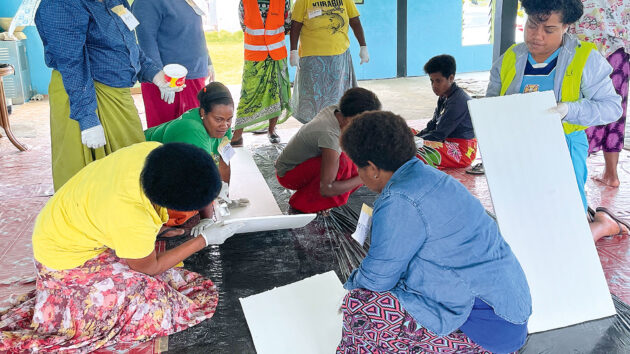
Setting to work with the simple raw materials to build the boat. Photos courtesy of Sue Berners-Price and Rob Denney
One student, Salote – a mother of six – was so enthused by the project she asked to build her own catamaran without help.
Unfazed by the journey to the college (including two buses and a 2.5km walk), she successfully built her own boat and was asked to teach the next workshop.
Testing of the two boats received considerable interest, with a dozen women from other villages wading out to look at the proa and asking if they too could have workshops through the boatbuilding school.
Salote, along with fellow graduates Siana and Lo, ran a workshop in the village of Drominunuku, where the locals had no boats but fished by standing inside the reef at high tide.
Self-sustaining projects
Together with the village women, they produced a catamaran canoe in just nine days.
“Not bad for a group who didn’t know what foam, epoxy or glassfibre were when they started,” says Denney.
Representatives from the UNDP handed out certificates on launch day, emphasising the importance of small fishing boats that are rot-proof (not plywood) and made without power tools.
Not only that, but the women discussed setting up an organisation called ‘Women on Waste’, organising beach clean-ups and persuading the Health Department to permanently provide rubbish bags and collection.
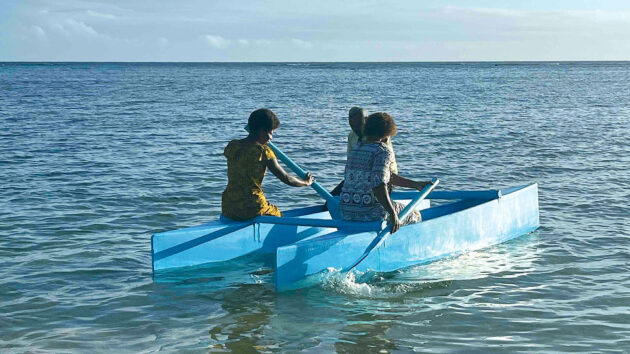
The women of Drominunuku village built themselves a four-person fishing boat in just nine days. Photos courtesy of Sue Berners-Price and Rob Denney
“The importance of communities building their own boats is that it gives them pride and ownership, plus teaches them how to maintain and repair the boats, something often missing from donated boat programs,” says Denney.
“Future boats will be owned by the women who build them. That is the purpose of the train-the-trainer model.”
Salote is now an assistant trainer in the CATD Sustainable Boat Building course.
Plastic recycling
The British High Commission in Suva funded a pilot recycling project so that unwashed waste plastic could be shredded, melted in a domestic oven and pressed into structurally reliable products.
Currently this is pavers (flooring), but potentially this could be house bricks and sheets for small-boat building.
For boatbuilders, it means glassfibre offcuts, used resin containers, gloves and floor sweepings, can be recycled on-site into useful materials.
Denney set up Moce Benu (Fijian for ‘Farewell Waste’) to market the recycled products and encourage village and community clean-ups.
The ultimate goal is to set up recycling and boatbuilding schools or projects in villages throughout Fiji.
“Fiji is a great place, the people are incredibly friendly and I am having a wonderful time,” says Denney.
“Things take longer to happen than I expect (this is more or less the story of my life!), and there’s always something more to be done so I don’t really get a big sense of achievement when things go well, but looking back at the four years I’ve been here, I definitely get a warm and fuzzy feeling for what we’ve achieved.”

Praise for proa design
Roger Nadin on traditional proa design that’s enjoying a kit-boat revival

A modern take on the traditional proa boat
Ali Wood finds out more about visionary proa boat designer, Rob Denney
Saved from the scrapyard: This budget boat renovation gave a £1, 70-year-old boat new life
‘How are you getting on with selling your boat?’ It was a simple question, which launched an endeavour to grant…
Using sawdust to plug leaks on wooden boats
Sawdust can be used to stem leaks between the wooden planks of a boat that’s been out of the water…
Want to read more articles about boatbuilding schools?
A subscription to Practical Boat Owner magazine costs around 40% less than the cover price.
Print and digital editions are available through Magazines Direct – where you can also find the latest deals.
PBO is packed with information to help you get the most from boat ownership – whether sail or power.
-
-
-
- Take your DIY skills to the next level with trusted advice on boat maintenance and repairs
- Impartial, in-depth gear reviews
- Practical cruising tips for making the most of your time afloat
-
-
Follow us on Facebook, Instagram, TikTok and Twitter