



Sawdust can be used to stem leaks between the wooden planks of a boat that’s been out of the water for some time. Richard Johnstone-Bryden explains how it’s done

A wooden boat’s planking inevitably loses some of its moisture and shrinks when it is taken out of the water, and this allows small gaps to open up between the planks. Not surprisingly, water will seep through the gaps as soon as the boat is relaunched, so an automatic electric bilge pump is necessary to keep the situation under control until the planks have taken up (swelled) again.
For added security, the boat should also remain in the slings or on the trailer until the leaks have stopped. The relaunch of the 7.9m (26ft) classic Broads motor cruiser Nipper following the replacement of some planking below the waterline is a good example.
Although the freshly caulked new planking did not leak, some of the older planking had inevitably lost some of its moisture while Nipper was ashore. Shortly after her launch, the bilge pumps burst into life while the older planks started to take up. It was confirmed that the flow of water was consistent with the “taking up” process rather than being indicative of a more serious problem. Nipper then remained in the strops while the planks were taking up and until the bilge pumps fell silent.
Sawdust To The Rescue
If you have a lot of boats to launch, leaving a boat in the strops is not always an option. Providing the leak is only caused by the natural contraction of the wooden planks, it’s possible to stem the flow more quickly with sawdust. There are two main methods for its use.
Method 1: The Broadcast Method
One method is to put the sawdust in the water and push it under the boat with a paddle where it will be drawn to the gap by the flow of water passing between the planks.
Method 2: The Targeted Approach
An alternative method, as shown on Nipper, is to take a targeted approach using a perforated can on a length of wood. The perforated can is filled with sawdust saved from various boatbuilding activities. Relatively fine sawdust should be used, and it is important to ensure that there are no large particles or rubbish.
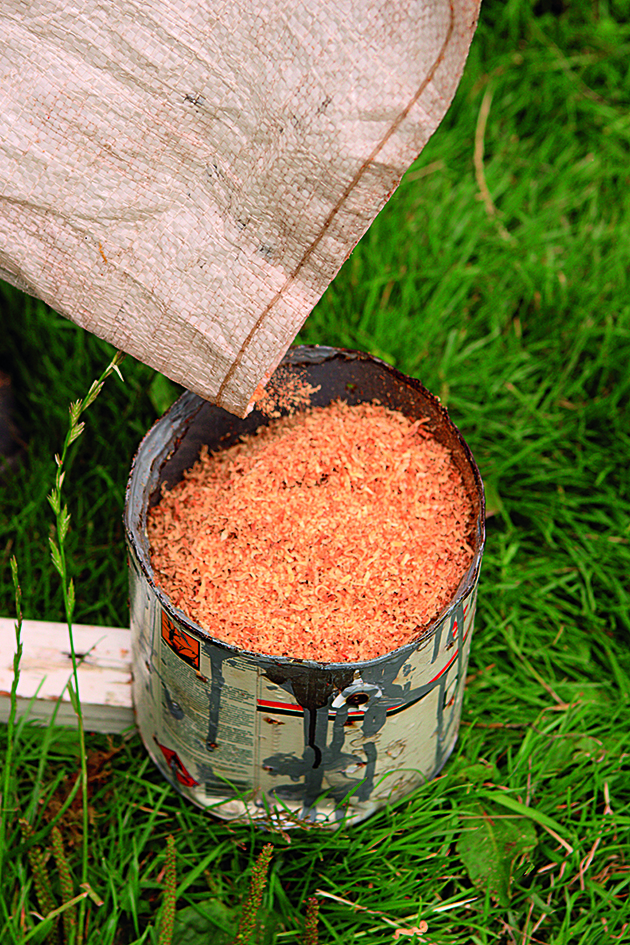
Method 2: Put plenty of sawdust in a perforated tin….Credit: Richard Johnstone-Bryden
You need someone onboard to highlight where the leaks are so the person distributing the sawdust can place the perforated can exactly where it is required. Once the tin is underneath the leak, the suction created by the water flowing through the gap will draw sawdust towards it to form a ‘clot’ and stem the flow.
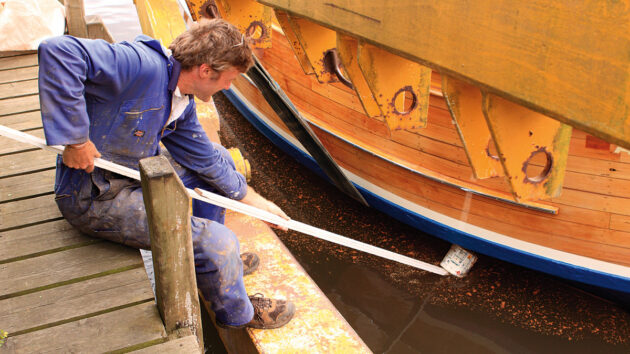
…and place the tin under the leak to float sawdust exactly where it’s needed. Credit: Richard Johnstone-Bryden
Once the clot has formed, it’s important not to head straight off on your first voyage of the season – you’ll still have to wait until the planks have fully taken up, or the movement of the boat through the water will dislodge the clot and let water back in through the gap. The time taken for the planks to swell up will depend on the size of the gaps, but it’s generally wise to allow at least 24 hours before attempting a voyage.

Boat wood: a complete guide for yacht owners
Boatbuilder and finisher Lyndon March explains which types of wood work best for different repairs and modifications on board

The art of veneering: step-by-step
Face up to the task of applying veneer with the help of boatbuilder Tony Davies

Hull plank repair on a boat: step-by-step
With a few practical woodworking skills anyone should be able to replace a plank on a carvel-built wooden hull, as…
Checking and replacing keel bolts on wooden boats
If a keel parts company from a yacht, capsize is the inevitable result, which is why checking and replacing keel…
Want to read more articles like Using sawdust to plug leaks on wooden boats?

A subscription to Practical Boat Owner magazine costs around 40% less than the cover price.
Print and digital editions are available through Magazines Direct – where you can also find the latest deals.
PBO is packed with information to help you get the most from boat ownership – whether sail or power.
-
-
-
- Take your DIY skills to the next level with trusted advice on boat maintenance and repairs
- Impartial, in-depth gear reviews
- Practical cruising tips for making the most of your time afloat
-
-
Follow us on Facebook, Instagram, TikTok and Twitter