




The Studland Bay Marine Partnership is warning that boating access to the popular Dorset sailing spot could be threatened unless more skippers pay to use the eco mooring buoys.
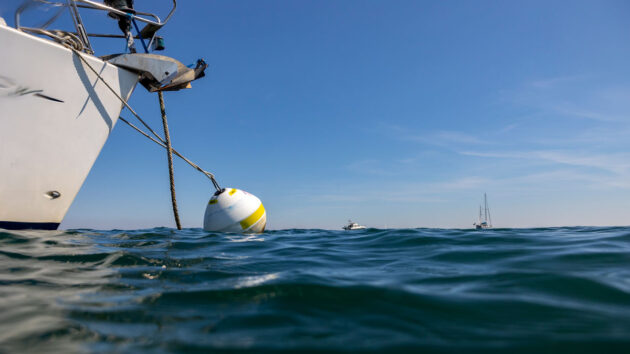
Up to 87 boats a day are using the UK’s largest site for eco moorings and the seagrass restoration scheme has been hailed a big success by the not-for-profit team.
Yet it is ‘unsustainable’ because half the boaters who tie up to the eco-moorings are not paying.
“Although the broad support by boaters has been fantastic, we are struggling to generate the income we need from mooring fees to pay for their maintenance.
“We believe 50% of users are not paying the modest fee (£7.50 for four hours, £15 overnight),” said David Brown, chairman of Studland Bay Marine Partnership (SBMP) steering group.
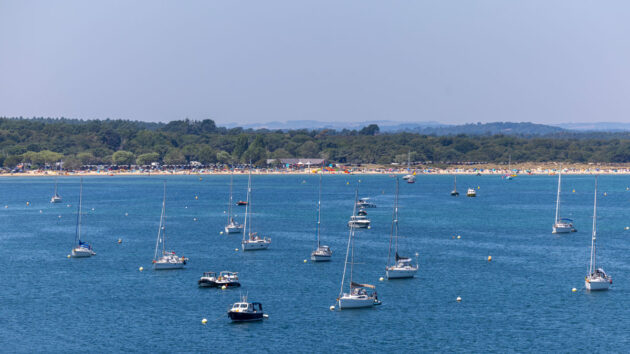
A mix of moorings fees and partner contributions currently pay for the Studland Bay scheme, and new supporters are being sought. Credit: Brad Wakefield/The National Trust
He added: “If we are unable to maintain and redeploy the moorings each spring, it puts the project at risk, potentially leading to a return to anchoring.
“If that happens, the Marine Management Organisation (MMO) would be likely to make it a compulsory No Anchor Zone and effectively end boater access to the bay.
“So, we really do need boaters to pay for the use of the moorings – both to save the seagrass and to allow boating access to continue.”
It costs £100,000 a year to maintain the eco-moorings, although annual costs will drop to £70,000 to £80,000 once the partnership can reduce costs such as public engagement activities.
Seagrass scars healing thanks to eco mooring usage
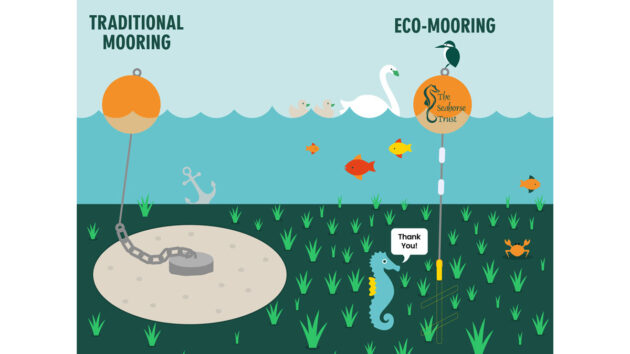
Traditional mooring versus eco mooring diagram. Credit: boatfolk
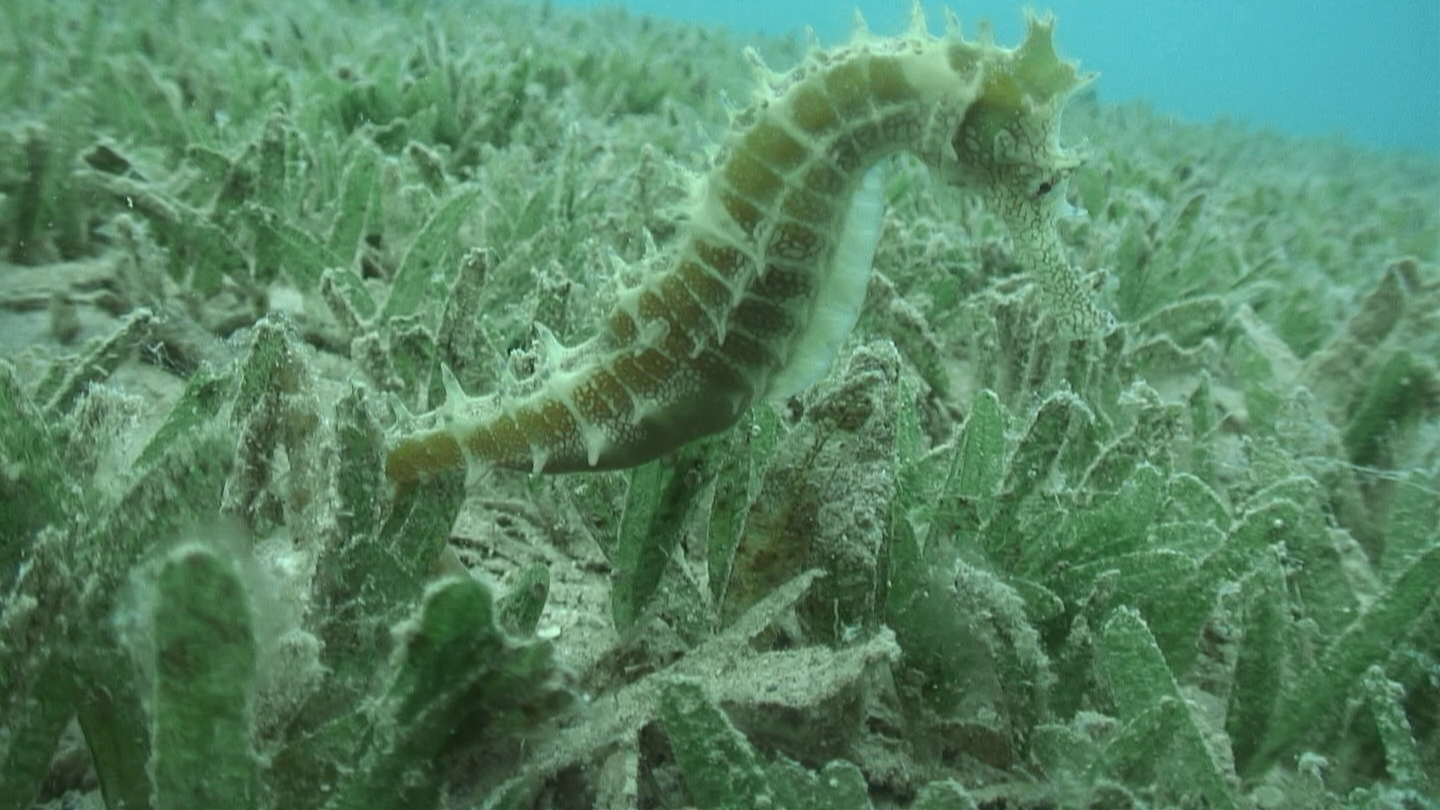
Seagrass is a ‘critically important habitat’, as a carbon sink, for biodiversity, natural coastal protection and Studland is ‘the UK’s most important breeding ground for spiny seahorses’.
A recent University of Southampton study that compared side-scan sonar surveys, historical satellite imagery, five years of monitoring data, and tracked recovery across 39 damaged seabed areas, showed every scar caused by traditional anchoring was healing.
“Some had shrunk by more than 90% since eco-moorings were first installed,” added Brown, who is an ecologist for the National Trust.
Studland Bay became a Marine Conservation Zone in 2019.
A Voluntary No Anchor Zone (VNAZ) was introduced in December 2021 and expanded in June 2022 with eco-moorings installed from 2021.
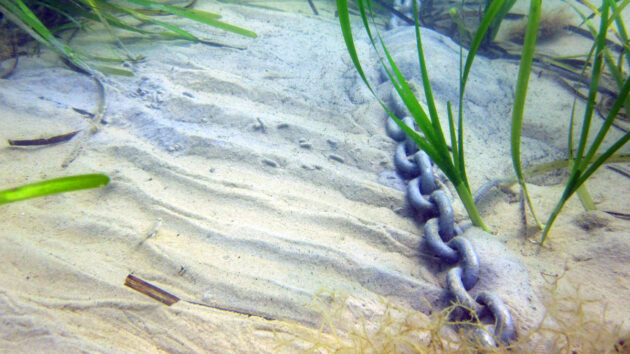
A seagrass meadow ‘scar’ caused by an anchor chain at Studland, Dorset. Credit: The Seahorse Trust
Sailor Jim Atkins, former Commodore of Christchurch Sailing Club, was opposed to the VNAZ until he joined the SBMP – at first to have his say against the scheme –and now is a full convert to the initiative.
He told PBO: “The seagrass has flourished since it became a no-anchor zone.
“I visit Studland regularly in my Jeanneau 379, and moor at an eco-mooring or anchor outside the VNAZ.
“I have used my tender to go and introduce myself as a member of SBMP to other boaters who are moored.
“They have all known about the VNAZ and have been in total support.”
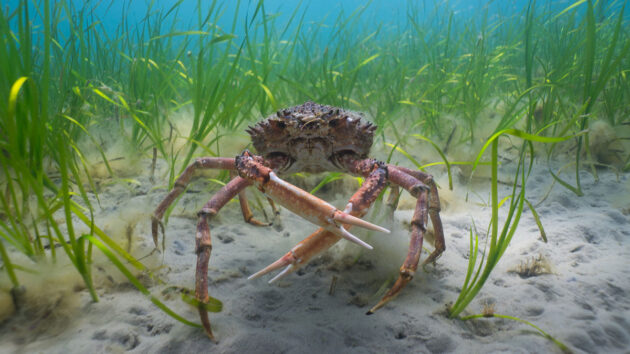
Spider crab in the Studland seagrass. Credit: Jon Bunker
Not enough skippers are paying up
Atkins added: “The VNAZ is near the cliffs of Old Harry Rocks and is the most sheltered area of the bay, because the prevailing winds are from the west or southwest.
“As you start to move back towards Sandbanks Ferry or the entrance to Poole Harbour, you’re obviously more exposed.
“I do presentations on behalf of SBMP with fellow sailor Howard Davidson and we say compliance is good, about 90% or more, so it’s great that boaters are using the eco moorings, especially as the seagrass does not offer particularly good holding for anchors.
“But our message to skippers is that the payment ratio is not good.
“Last year it was 30% and this year, thanks to a team out on the water, it’s up to 50%.
“Perhaps the signal for card payment or the App hasn’t worked for some, although generally the signal is quite adequate.
“We need boaters to support us or we won’t be able to put the buoys out, and in that case, because there will be people who do not comply with the VNAZ, that the MMO will make it a compulsory no-anchor zone.
“And that would be to the detriment of sailors.”
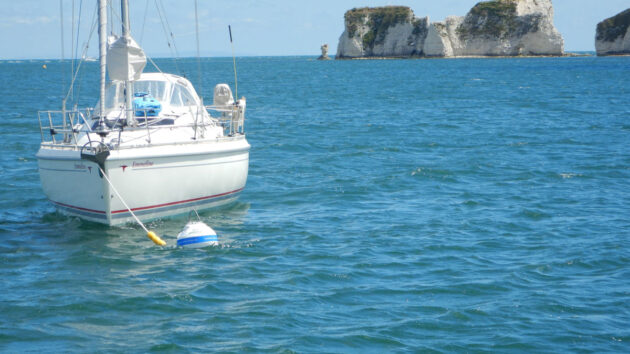
The VNAZ with the eco moorings is near the cliffs and the most sheltered area of Studland Bay, where the prevailing winds are from the west or southwest. Credit: boatfolk
The now disbanded Boat Owners Response Group (BORG) initially campaigned against any changes to Studland.
Member Michael Simons said the mooring buoys “work pretty well”, but keeping the costs “reasonable” was key.
He said: “I’d say the eventual outcome wasn’t too bad.
“There are some nice mooring buoys and I think that works pretty well actually.
“We were initally afraid we’d end up not being able to stay there.
“This year I couldn’t visit Studland as when I was in that part of the world the wind was easterly but I’ve stayed there a couple of times in the past and the payment was quite reasonable.
“The key thing is to keep the costs reasonable and then people will pay up.”
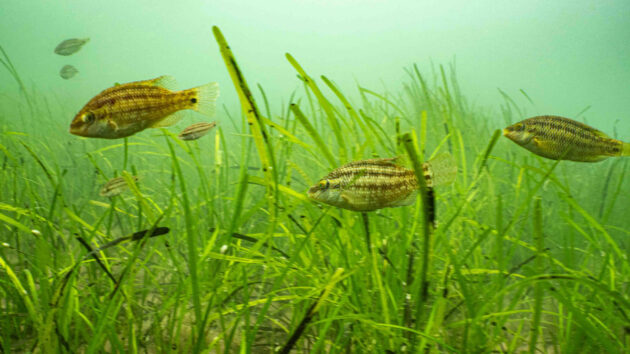
Corkwing in the seagrass. Credit: Pete Lightowler
£10 daily fee for Studland Bay eco mooring buoys
"New eco moorings protect seagrass and enable boating to continue in Studland Bay" says Studland Bay Marine Partnership chairman David…
New twist in Studland eelgrass debate
The Boat Owners Response Group (BORG) say part of the Studland eelgrass report is 'badly flawed'

RYA urges boaters to observe Studland No Anchor zone
Voluntary Zone has been in place since 2009 pending study
What to read more features like UK’s largest eco mooring site’s future at risk because half of skippers don’t pay?
A subscription to Practical Boat Owner magazine costs around 40% less than the cover price.
Print and digital editions are available through Magazines Direct – where you can also find the latest deals.
PBO is packed with information to help you get the most from boat ownership – whether sail or power.
-
-
-
- Take your DIY skills to the next level with trusted advice on boat maintenance and repairs
- Impartial, in-depth gear reviews
- Practical cruising tips for making the most of your time afloat
-
-
Follow us on Facebook, Instagram, TikTok and X