


By following a few simple mooring guidelines, you can avoid the common pitfalls and make the process of securing your boat easier and more effective. Michael Collings shows you how

Many years ago I was being evaluated, along with four other potential skippers, to take charge of a charity-run 11.9m (39ft) Westerly Sea Lord normally run to give children an experience of sailing. We set off from Southampton, and after a pleasant day carrying out manoeuvres, picked up a mooring buoy off Brownsea Island in Poole Harbour.
The skipper took charge of mooring, taking a slip from the fairlead on one bow through the ring on the top of the buoy to the fairlead on the other bow. It was dark when we moored and the tide was flowing on a high spring, about three hours after low water, while the wind was a solid Force 5 from the east. The crew went below as it was quite cold, and started preparing dinner.
I felt a little uneasy, and after about 20 minutes went on deck: no need for a torch as it was just after full moon. The yacht was tide rode, but the large sprayhood was acting as a sail and blowing the yacht over the buoy, putting heavy tension on the mooring warp.
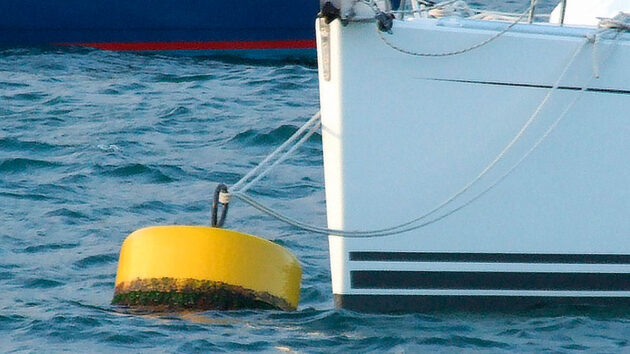
If you are mooring your boat using two fairleads, use two warps with a round turn on each
I noticed a slight clunk, which turned out to be the buoy being forced from one side of the bow to the other. Alarmingly, the warp itself – a 14mm braid-on-braid rope, probably a former sheet or halyard – had already chafed through the sheath in the 20 minutes we had been below, and a few of the inner braids had chafed through as well. Another 20 minutes and we’d have been adrift!
The skipper hurriedly found a replacement warp, this time making a round turn on the mooring ring and taking the two ends over the bow roller. The round turn stopped the rope moving on the mooring ring, and by taking both ends through the same fairlead removed any need for the rope to slide along the ring.
Since then I have always moored over a bow roller with a round turn over the mooring ring. I also leave a second, slack slip on the ring to make it easier to leave the mooring: I take the main warp off first – it often needs a hard pull because of the round turn, and if moored for any length of time will become twisted – but then the slack slip comes away easily when you’re ready to go.
Recently I have noticed several yachts mooring with just a slip from one fairlead to another. This will often be perfectly safe in light weather, but an unwary skipper might try mooring this way in heavy weather too. Get into the habit of always putting a round turn on the mooring ring and preferably using a single fairlead.
If two fairleads must be used it is better to use two warps, one from each fairlead, and put a round turn on each. Then the load will alternate between each but prevent chafe. In the picture above, it appears that cow hitches have been used rather than round turns. This will also prevent chafe, but will be more difficult to rig and release.
Preventing chafe when mooring your boat
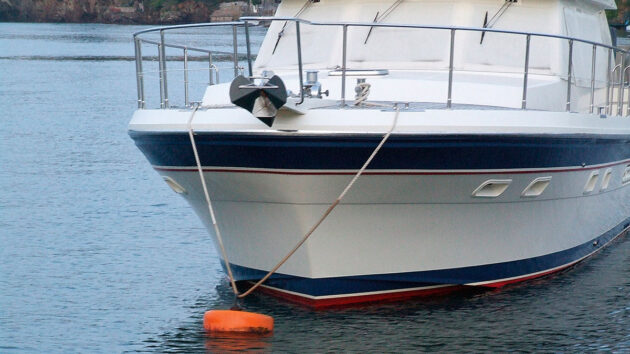
Mooring your boat: Sheathing the mooring warp in a polythene tube will help to reduce chafe on the warp itself
There are a couple of other approaches to using a slip from two fairleads. Sheathing the mooring warp in a polythene tube will help in reducing chafe, but if the mooring ring is very rough and there is a lot of movement there will still eventually be chafe in adverse weather.
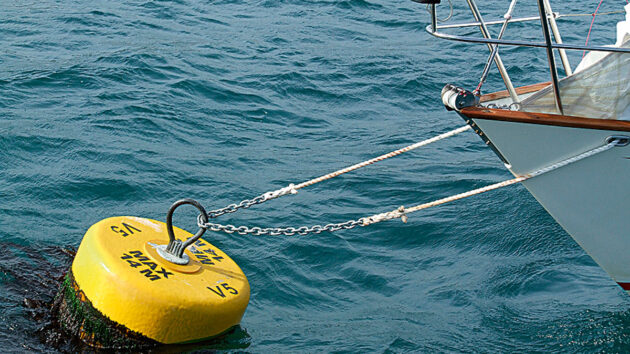
Splice a short length of chain into a dedicated mooring warp
Another method is to splice a short length of chain in the centre of a dedicated mooring warp. It completely circumvents chafe and the noise of chains in fairleads, but I wonder how much noise is transmitted into the yacht as the chain moves through the mooring ring? In the case pictured it would also have been better to take the warp over the bow roller.
Other pitfalls to avoid when mooring your boat
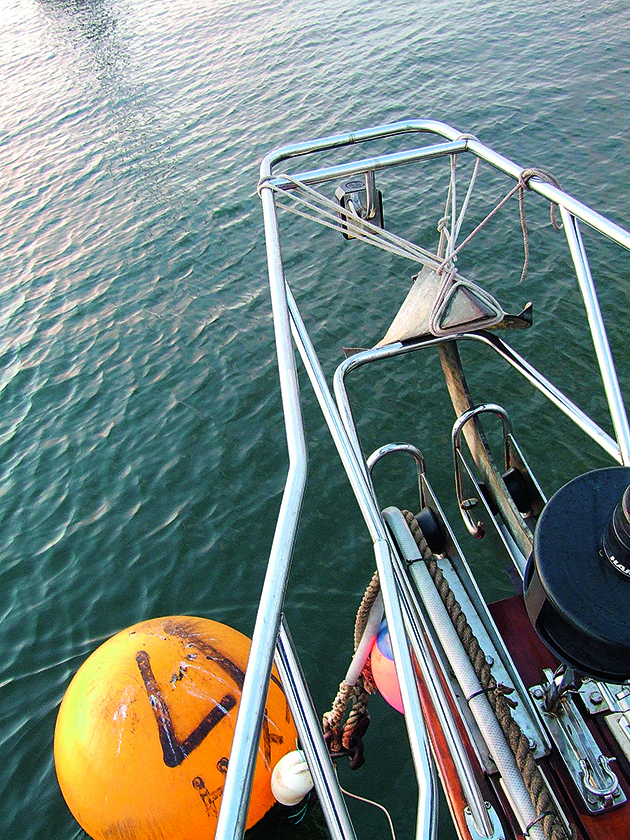
Mooring your boat: Securing the anchor upside down means the anchor blades won’t
foul the mooring warp
When permanently mooring to a buoy, make sure the mooring strop cannot foul the anchor left on the bow roller. One way to avoid this is to use two strops, one to each side of the bow, but a disadvantage of this is in a wind-over-tide situation when the buoy can be swept against the yacht. I had the painted boot top of my boat rubbed off where the buoy chafed on each side of the bow.
I now moor using a short strop so the buoy cannot touch the hull, and lash the anchor upside down so there’s no chance of the mooring strop catching under the fluke. I moor in Plymouth Harbour and use two strops for safety as the tide runs very fast on Springs.
Picking up a buoy
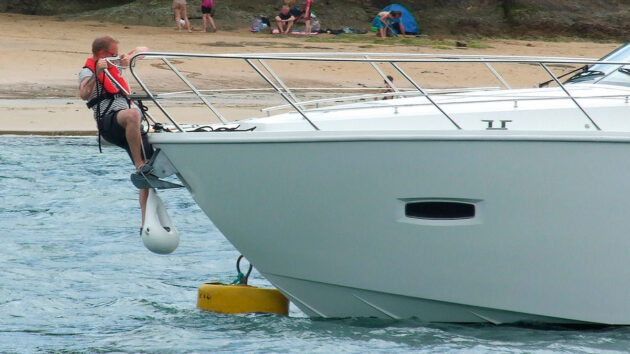
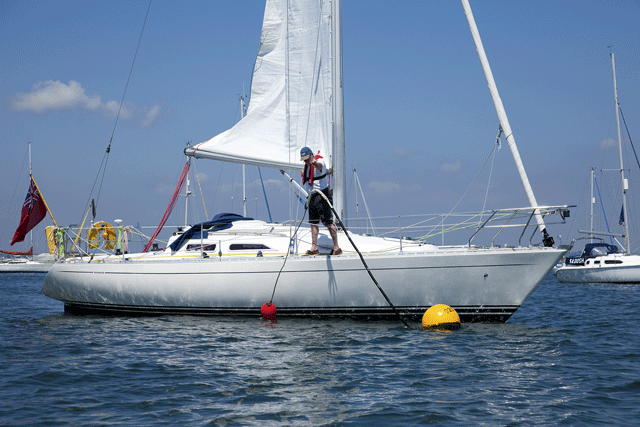
Picking up a buoy can cause problems for high-freeboard yachts. In the picture above, the skipper was using a step fender to try to get down and pass a line through the mooring ring on the top of the buoy. The person on the helm lost sight of the buoy and, of course, missed. The harbour master eventually took pity and brought a warp to the buoy.
On a motor yacht with a stern platform, it is easier to rig a line from the mooring cleat and take it aft to the platform. The helmsperson can then bring the stern to the buoy and the line can be safely attached. Then simply let the boat fall back on the tide while taking in the slack.
Use a lasso
Another way to get initial contact is to use a lasso. Coil a nylon or polyester rope (use either of these because they sink) and divide the coil in half. Hold an end in either hand, and when the buoy is close – preferably just beside the bow – throw the rope over the buoy by casting your arms wide.
This is very much a temporary measure, and a permanent mooring should be made as soon as possible to avoid damaging the buoy or riser chain. There are several devices on the market to help thread a line through the ring or large shackle on a buoy, and these can be very useful. The other alternative may be to get the dinghy out to make the permanent mooring.
Cleating techniques when mooring your boat
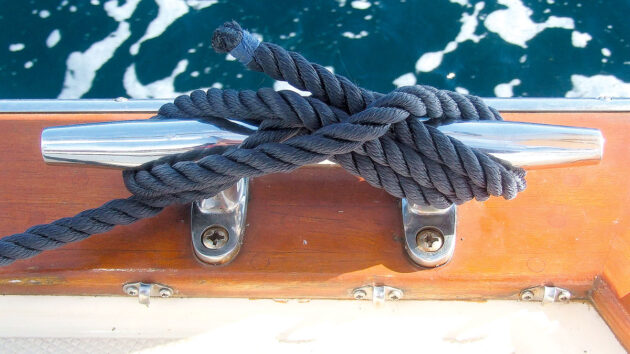
Look at how different skippers belay ropes on cleats and you’ll find 101 methods. To be fair, most usually work – but there is a proper way to cleat a rope all the same. If the strain is coming from an angle, take the rope round the ‘open’ side of the cleat as in the photograph, then round the back and other horn. Follow this with a couple of ‘figure of eights’, and for security a half-hitch with the fall lying parallel to the last figure of eight.
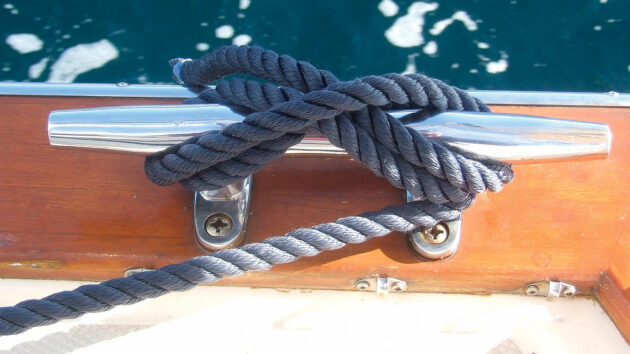
The reason for taking the rope round the open side of the cleat is that when casting off (or letting a little out) with a heavy load on the standing end, leaving the first turn round the cleat will allow the rope to be eased under control. If taken to the ‘closed’ side of the cleat, as in this photograph, the rope can jam under the cleat’s horn.
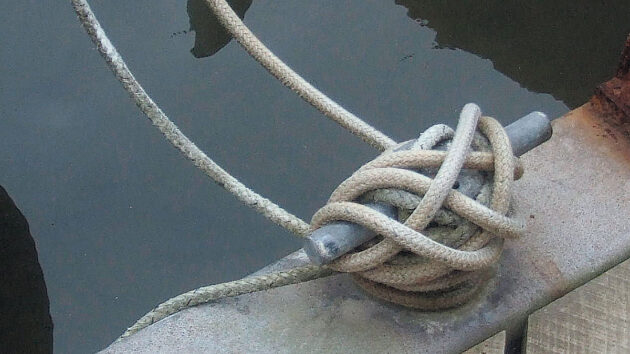
There is no need to put more than one or two figures of eight on the cleat: friction holds the rope fast, and any more are superfluous. Similarly, the tail of the half-hitch (if used) should lie parallel to the crossing strand to give more area for friction. Again, if it crosses it will not matter in terms of security in light weather, but if the rope is moving in heavy weather it must be finished properly.
Only use a half-hitch on ropes that do not need to be released quickly, eg mooring warps and halyards. Do not use a half-hitch when making sheets fast as they can jam when wet and become difficult to cast off.
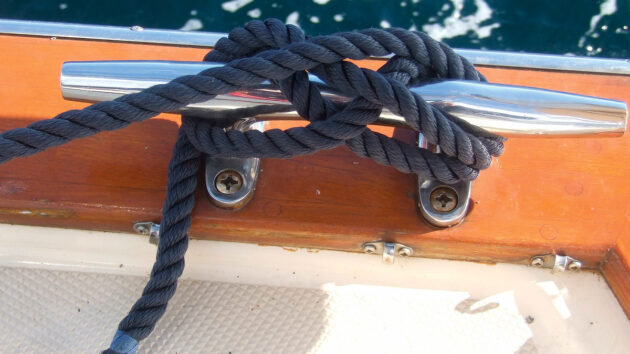
One of the most dangerous ways of cleating a rope is to use the standing end instead of the fall to form the hitch: under load it can become impossible to undo. It is difficult to make this mistake when mooring alongside or to a buoy, but it can be easily done when anchoring – especially in a small yacht without an anchor winch.
Without a winch, it is good practice to flake out (or fake out) the required length of cable for the anchorage and make it fast before anchoring. This is the time to really concentrate on which part of the cable to use to cleat the chain or rope.
It is only too easy to use the wrong part and, if under heavy load, it is almost impossible to uncleat. Been there, done that… and learnt the hard way!
Did You Know?
We nowadays regard mooring as tying up to a pontoon, quay or to a buoy – but the term ‘to moor’ originally meant anchoring with two anchors!
Can I trust this boat mooring?
Most sailors use traditional moorings without knowing about their condition or how they are made. Ben Sutcliffe-Davies explains
Rigging pile mooring pick-up lines
If you have a pile mooring, permanent and properly rigged pick-up lines will make life a lot easier. David Parker…

Swinging mooring setup: What I learned from trying a cheaper mooring option
After almost two decades of being marina berthed and concerned with the ever-increasing mooring fees, myself, and my partner, Brian,…
How to sail off a mooring
In many situations, leaving the mooring under power is the only sensible option. But if conditions allow, why not spare…
Want to read more articles about mooring your boat?
A subscription to Practical Boat Owner magazine costs around 40% less than the cover price.
Print and digital editions are available through Magazines Direct – where you can also find the latest deals.
PBO is packed with information to help you get the most from boat ownership – whether sail or power.
-
-
-
- Take your DIY skills to the next level with trusted advice on boat maintenance and repairs
- Impartial, in-depth gear reviews
- Practical cruising tips for making the most of your time afloat
-
-
Follow us on Facebook, Instagram, TikTok and Twitter