



Phil Clandillon chats to YouTubers Jo and Tim about refitting their Etap 30 Hat Trick and how engine failure scuppered their first season
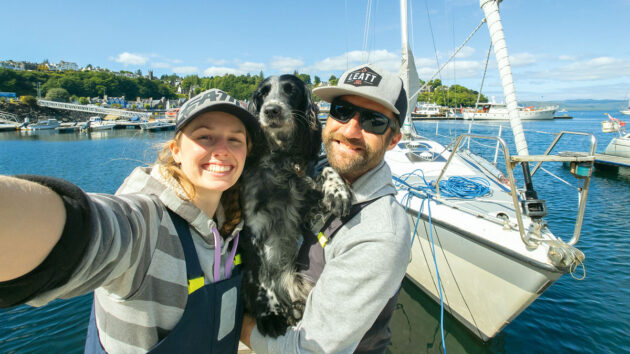
When YouTube recommended one of Jo Heard and Tim Foster’s well-produced sailing videos, I was surprised to see such a tidy-looking Etap 30. As a used-boat obsessive, I fantasised that they’d found a unicorn: a 1980s yacht with a single fastidious owner, maintained (as the cliché goes) regardless of expense.
When I dug deeper, however, I began to realise it was all the result of the resourceful couple’s hard work. Jo runs a leathercraft business by day and promotes it very successfully on YouTube. Tim grew up sailing dinghies on family holidays in Cornwall and bought a 16ft trailer-sailer so he could explore more of the coast.
Eventually, though, life got in the way and sailing was put on hold, but when he, Jo, and their sprocker spaniel Skylar started spending summers camping in Scotland, the subject resurfaced. They were pitched up at Ardfern on the Craignish peninsula, gazing at the view, when Tim suggested it would be a magical place to explore by boat. Jo was keener than he expected, and on their return home they began to turn the idea into reality.
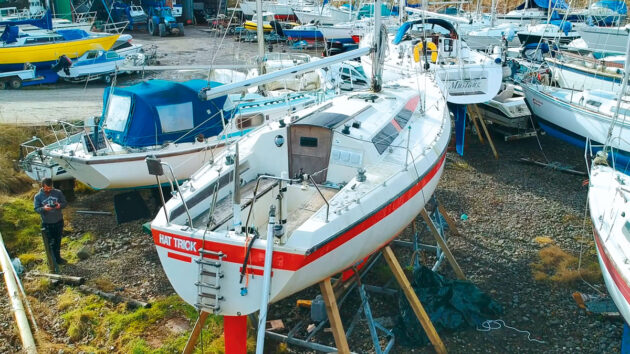
Hat Trick was basically sound, but the Etap 30 needed work on her deck, cockpit and interior. Credit: Jo Heard and Tim Foster
The couple organised a week-long charter with a sailing instructor on Scotland’s west coast, with a brief to avoid marinas and seek out secluded spots. The trip was slightly more exciting than Jo was expecting after the skipper misinterpreted their desire for solitude as a penchant for rough seas. Nevertheless, the experiment was a success, and in 2019 they found their first yacht, a Leisure 23 named Salty Sea Dog.
They cruised Salty around Loch Fyne and the Isle of Arran for two seasons. After taking her around the Mull of Kintyre, they decided it was time for a bigger boat. “If we wanted to push up the west coast and further out, we knew we needed something a little bit more substantial,” explained Jo.
Scoring a Hat Trick with an Etap 30
That winter, sitting by the fire in their stone cottage on the edge of a small North Wales village, they began to research Salty’s successor. Tim had spotted the Etap 32i, which looked perfect for their needs. That model turned out to be over budget, but Etaps in general piqued their interest.
The Belgian yard was famous for building double-skinned hulls with a layer of closed-cell foam between. They were marketed as unsinkable, but for sailing in Scotland, the real benefit is the insulation the foam provides.
Tim joined the Etap group on Facebook, and it wasn’t long before he was contacted by the owner of an Etap 30 in Holy Loch. “We made the mistake of going to have a look and imagining what it would be like if she was our boat, and before we knew it, we were shaking hands,” said Tim.
At the end of the 2022 season, Jo and Tim became the new owners of Hat Trick, a scruffy but complete 1986 Etap 30, purchased for £10,000. They motored her back to their base at RB Marine in Rosneath, hauled her out and started making a list of jobs.
The initial refit
On deck, Hat Trick’s original Treadmaster non-slip had started to go dog-eared at the corners. Tim peeled, scraped and sanded it off before painting the deck with Hempel Multicoat, a combined primer, undercoat and topcoat with good UV resistance. The Etap 30’s decks have moulded recesses to accept non-slip panels, so they decided to reinstall a Treadmaster equivalent called Tread Deck.
Thanks to Jo’s day job, pattern-making is second nature to her. To achieve the myriad shapes required, she cut out paper templates on the deck before marking up the Tread Deck on the boatyard’s stony hard standing. She cut the outer corners with heavy-duty scissors, used a craft knife and steel ruler for the straight edges, and a small knife for the internal corners.
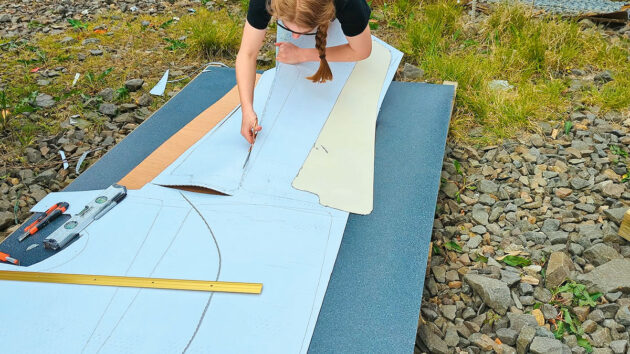
Jo made templates and used them to cut the Tread Deck for the perfect fit. Credit: Jo Heard and Tim Foster
“I chose the smallest, easiest panel to start with, as I knew if I got that one wrong, I’d have enough material to do it again,” said Jo. “I cut the panels slightly larger than required, then double-checked them on deck, making any final adjustments before fitting.”
Hat Trick’s windows were UV-damaged and leaking, so Tim used a circular saw to cut new ones from acrylic before bedding them in with butyl tape. Jo and Tim had several wooden items to replace and wanted a lower-maintenance alternative. They settled on EKOPly, a sheet material manufactured in South Wales from 100% recycled plastic and available in 12.5 mm and 19 mm sheets.
Starting with Hat Trick’s rotten interior floorboards, Jo made up paper templates and used a jigsaw to cut the sheeting to shape. Tim then covered the boards in grey, wood-effect vinyl for the final finish. The Etap 30 has an unusual cockpit construction with hinged teak bench lids that fold down, and in some places, plywood locker lids underneath – like an exterior version of the lockers you get under berths.
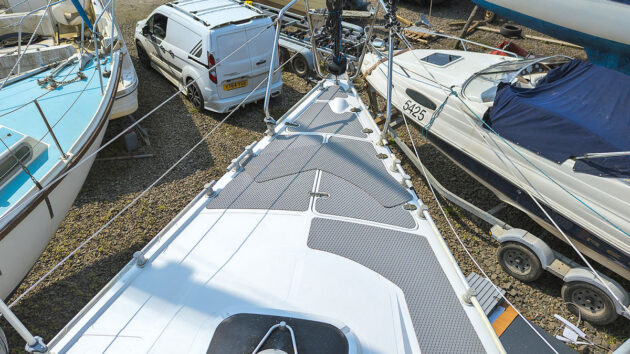
The TreadDeck made a big difference to the deck. Credit: Jo Heard and Tim Foster
Hat Trick’s teak was too weathered to save, so the couple also used EKOPly to build the new seat tops and lids. They chose the 19mm version for the seats and the 12.5mm for the locker lids. As the edges of the seats would be exposed, Tim filled and sanded the unfinished sides of the EKOPly sheet with car body filler.
The material is softer than wood, so he cut out stainless steel backing plates to through-bolt the hinges and prevent them from going wobbly over time. For a cost-effective yachty finish, he glued teak-effect grey vinyl on top. “I’m pretty happy with the finished result, and unlike any sort of wood, you know this stuff will never rot,” noted Tim.
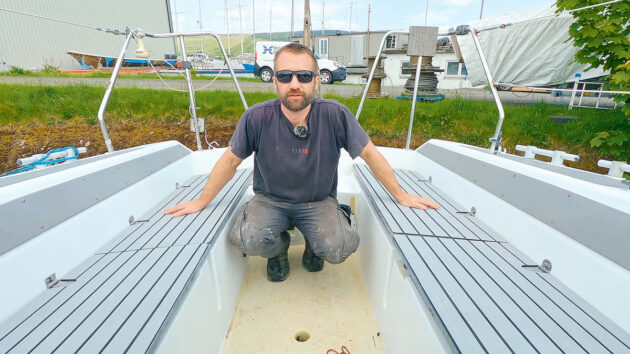
EKOPly was used for cockpit improvements. It can be nailed, screwed and glued, and the sheeting can be cut without splinters. Cut edges do not need to be sealed. Credit: Jo Heard and Tim Foster
Over the years, water ingress through leaky windows and hatches had taken its toll on Hat Trick’s interior, so Jo and Tim decided to paint the main bulkhead, the wood trim above the saloon benches, and the settee fronts. Tim sanded down the woodwork to remove the old finish and applied three coats of a matt white exterior paint from a DIY store, which had the advantage of requiring no primer. Jo masked off the beaded edge trim and highlighted it in matt grey.
Tim found the oil inside Hat Trick’s Volvo 120S saildrive had emulsified, suggesting the seals had allowed water ingress. The age of the saildrive’s gaiter was also unknown, and there was some unpleasant-looking surface corrosion on the retaining ring. He decided to remove the unit and take it home to replace the seals and anodes, treat the rust, and repaint it.
Engine woes
After some championship-level boat yoga, Tim successfully reinstalled the saildrive and prepared to start the engine to check that everything was working. However, no matter what he did, the Etap’s 18hp Volvo Penta 2002 refused to fire. “After two or three days messing around, the engine had pretty much defeated me. I’d run out of time, and I knew that if I couldn’t get it running, we weren’t going sailing,” he said.
The day before they were due to launch, Jo and Tim finally managed to get a mechanic to visit the boat. Their hopes for a simple fix were dashed, however, when the engineer drained and inspected the oil. “There was a fair bit of emulsification, and initially we suspected the head gasket had failed,” explained Tim.
Still hopeful of squeezing in a couple of weeks cruising, Tim worked with the yard to lift the engine out before taking the head off, only to find the gasket still intact. He then carried out a compression test by filling the two cylinders with diesel and walking away for a couple of hours. When he returned, the worst was confirmed.
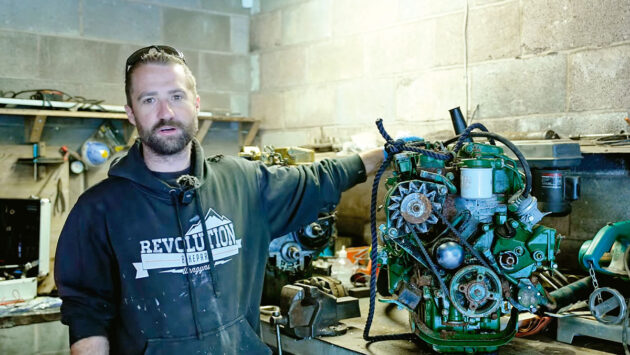
Tim combined the best parts of two Volvo Penta 2002 engines to create a reliable unit. Credit: Jo Heard and Tim Foster
The level of diesel in cylinder one had dropped considerably, meaning the cylinder lacked compression and the engine would need to be stripped down for further investigation. With their hopes of sailing finally dashed, Jo and Tim loaded the engine into their van and headed home.
Once on the bench, Tim found that the top two piston rings on cylinder one had seized. The engine needed a rebuild, but not all parts were immediately available, and Tim was reluctant to take on such a big job. Instead, he sourced a used Volvo Penta 2002, complete with saildrive and switch panel, for £950.
He then took the better-condition starter motor, alternator, and exhaust from Hat Trick’s existing motor and transplanted them. He built a test rig to ensure the new power plant ran, and then tidied it up, ready to go back in the boat. “I placed the rebuilt second engine on a test rig. Despite sitting in a container for three years, it fired up on the second or third crank! I began to feel cautiously optimistic,” recalled Tim.
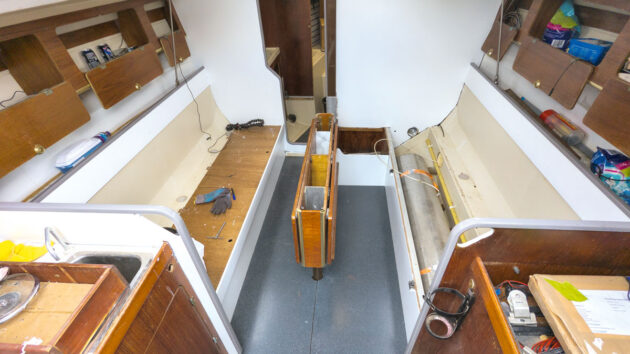
Matt white exterior paint transformed the main bulkhead, saloon benches and settee fronts. Credit: Jo Heard and Tim Foster
Frustratingly, the saildrive had been slowly dripping oil onto the hard, so that had to come out again for another set of seals. The yard then lifted the replacement engine into Hat Trick with their telehandler. Mating the engine’s drive plate to the splined input shaft of the gearbox was fiddly and took a couple of hours.
Once that was done, Tim found it straightforward to reconnect the engine’s plumbing and wiring, and soon the moment of truth had arrived. “All that remained was for me to press the starter button and see if we were going sailing that year!” he said. Happily, the engine fired right up and Hat Trick could finally go back in the water.
Jo and Tim are now in their third season sailing Hat Trick in Scotland, where they’ve been gaining experience and gradually pushing themselves further. With Skylar on board, they transited the Crinan Canal, visited the spectacular Burnt Isles, and made it to the Isles of Eigg and Skye. Tim also sailed single-handed around the Mull of Kintyre, and crossed the Irish Sea to Rathlin, Northern Ireland’s only inhabited offshore island.
“When everything aligns, it’s just perfect. When we went to Raasay, there were no other boats, the weather was great, and it’s just a stunning location,” said Jo. “When you’re in places like that, you forget all the hardship and the scary things that you’ve been through because for the next few hours, you’re in paradise and it’s just the three of us.”
Future plans
When I spoke to Jo and Tim, they were just about to head north for a six-week cruise, departing in May when the Scottish weather is often at its best. This season they kept their plans looser, working with the weather and seeing where they end up. They’ve realised not every trip has to have a strict itinerary, and with Skylar entering her 13th year, their canine crew member will appreciate the change of pace.
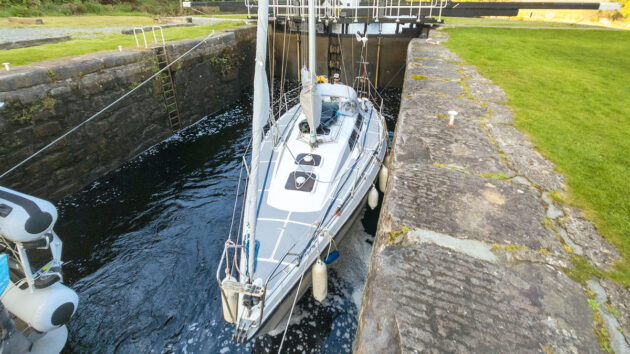
Jo and Tim have cruised extensively
in Scotland aboard Hat Trick – including the Crinan Canal. Credit: Jo Heard and Tim Foster
They’ve installed an extra 120W of solar power with the hope of running the engine less, and they’re also taking a very large rechargeable power bank to keep Jo’s growing collection of cameras up and running. In the longer term, Tim would like to circumnavigate Britain, and much as she loves Scotland, Jo would like to try sailing somewhere warmer, like the Mediterranean.
- Visit Jo and Tim’s YouTube channel to see detailed videos of all their refit work, and to tag along on their future voyages with Skylar. Jo also posts photos and videos of Scotland’s wildlife and scenery on her Instagram page @joheardphotography
Etap 30
Belgian builder Etap was famous for its ‘unsinkable’ construction, achieved with a double-skinned GRP hull with closed-cell foam between. This 9m Jacques De Ridder design was the largest boat in their range when it debuted in 1985. She has a fin keel, spade rudder and a tall fractional rig.
A ballast-to-displacement ratio of 38% means she can stand up to her canvas well, while an easily-driven hull means performance is respectable even in a lighter breeze. When the Etap 30 hit the market, French boats had already switched to a double aft cabin and aft heads layout.

Around 200 Etap 30s were built in nine years; their double-skinned GRP hull with closed-cell foam makes them unsinkable. Credit: Jo Heard and Tim Foster
Although this configuration came to dominate the market, in a smaller boat it has the disadvantage of pushing the saloon forward into a narrower part of the hull. The Etap 30 has the heads between the saloon and forecabin, meaning the saloon table is at the widest part of the boat.
Aft on the port side, there’s a sensible L-shaped galley, with a full-size, forward-facing nav station opposite, and a single quarter berth behind. The port settee can be converted into an occasional double, meaning she can sleep six at a squeeze.
Etap built around 220 boats until it was replaced by the 30i in 1995. Like all older yachts, condition and spec can vary widely, from almost original boats, to those which have been re-engined and had modern systems installed. Stanchions are aluminium and are easily bent, causing the bases to leak. Windows and hatches can also be a source of water ingress. Water doesn’t tend to get trapped between the double skins, but instead collects at the base of the mast step.
As found with Hat Trick, the windows are simple to replace, but the hatches are a custom design, and spares may need to be fabricated. Water-damaged interior woodwork is common, and sometimes the best solution is to just paint it.
Power was originally from an 18hp Volvo Penta 2002 mated to a Volvo 120S saildrive. These are old engines and parts can be difficult to find. Later boats had the newer Volvo Penta MD-2020. Prices can be as low as £6,000 for a project boat, and rise to £18,500 for a well-looked-after example with modern equipment.
Ollie Boyes: the You Tube sailor on crossing the North Sea in a 20ft boat
Phil Clandillon talks to Southwold YouTuber Ollie Boyes about crossing the North Sea in a £1,400 trailer-sailer

Sailing Uma: ‘How we built an electric sailboat to take us around the world’
Katy Stickland talks to Sailing Uma’s Dan and Kika Deckert about the three year refit of their 1972 Pearson 36…
Sir Robin Knox-Johnston: sailing with a legend
Sir Robin Knox-Johnston talks to Ali Wood about self-steering, plum duff and why he was told to ‘slow down’ for…

Etap 24i: the boat that will do whatever you want
Small enough to trail, big enough to cruise for a fortnight and fast enough to win races, the Etap 24i…
Want to read more articles like From engine nightmares to sailing in a Scottish paradise: one couple shares how they restored a £10,000 Etap 30?
A subscription to Practical Boat Owner magazine costs around 40% less than the cover price.
Print and digital editions are available through Magazines Direct – where you can also find the latest deals.
PBO is packed with information to help you get the most from boat ownership – whether sail or power.
-
-
-
- Take your DIY skills to the next level with trusted advice on boat maintenance and repairs
- Impartial, in-depth gear reviews
- Practical cruising tips for making the most of your time afloat
-
-
Follow us on Facebook, Instagram, TikTok and Twitter
PBO web categories