




Mark Prior commits the ‘cardinal sin’ of painting over varnished wood aboard his 1988 Moody 376 – and is delighted with the results
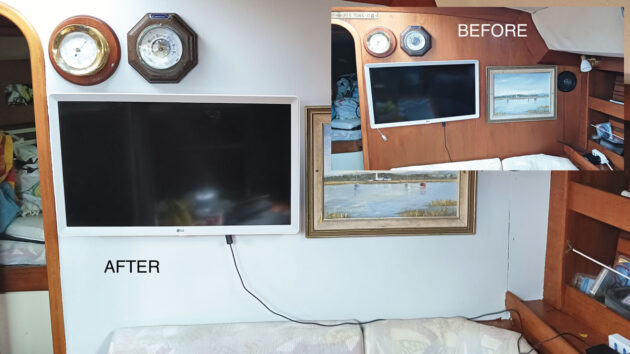
Firstly, a trigger warning. This article contains graphic images of varnished wood being painted over, surfaces being covered with things other than paint or varnish, and scenes of a light and airy boat interior.
Have you braced yourselves for the heresy that is non-traditional boat decor? Okay, let’s start.
I have lived aboard Grace Richard, a 1988 Moody 376, for 10 years now, and very happy I am too. Centre cockpit, aft cabin as an inner sanctum, original engine still chugging away. The aim is to try to keep everything in as-new condition as possible, and not smelling damp, if you get my drift.
It’s not exactly a complaint but there are quite a number of dark corners in the boat – the forepeak lockers, the aft cabin cupboards, the nether regions of the oven.
And all for the good reasons that portlights are fairly small and most of the interior surfaces are of richly varnished dark wood panelling, redolent of a stately home library or a members only gentlemen’s club.

Liveaboard cruising life aboard the 1988 Moody 376 is now brighter below deck. Credit: Mark Prior
When first refitting Grace Richard someone suggested breaking up the uniform magnolia of the two, yes two, heads in a 38ft boat, with a stripe of colour.
I will do pretty much anything to cover up magnolia and at the time was replacing the cove lines with vinyl strips.
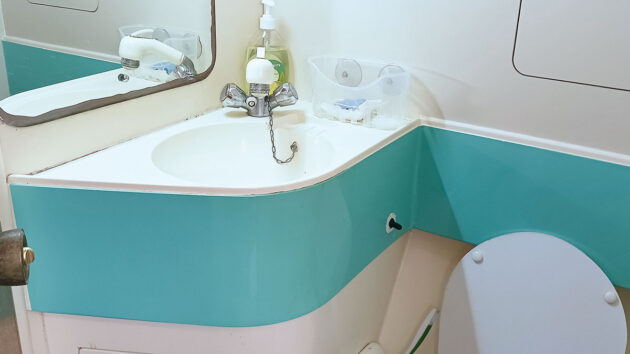
Green room: the forward heads. Credit: Mark Prior
In a moment of inspiration I asked for two wide strips, in light green and light blue, modern swimming pool style.
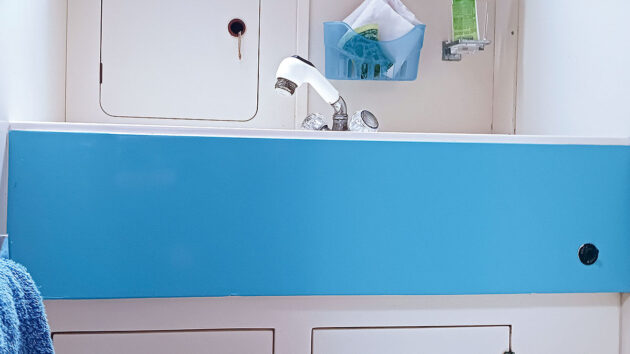
Blue loo: the aft heads. Credit: Mark Prior
Within an hour the vinyl was stuck onto the midriff of both areas, resulting in the jolly, and hopefully tasteful, strips you can see pictured above.
They may not smell any better, but at least they look better.
Painting over varnished wood
A mere 20,000 miles later, and 3,650 nights staring at the dark and gloomy aft cabin transom, I took another deep breath. I committed the sin of painting it in a very light grey satin all-purpose paint, matching the new headlinings.
Being abroad, I couldn’t find a paint to really key to the varnished surface, despite sanding thoroughly and cleaning with acetone, so touching up is necessary occasionally. However, online a number of paints are available which claim to successfully cover varnish.
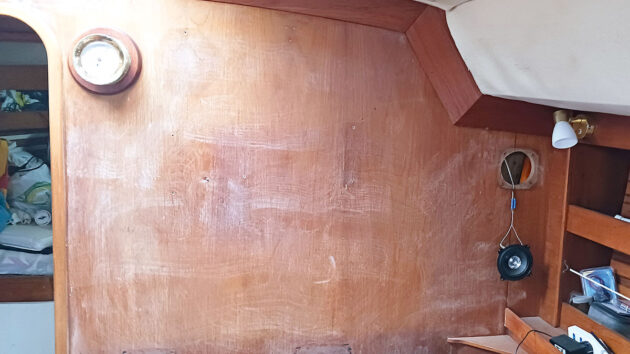
Abrade new world: the saloon bulkhead after sanding. Credit: Mark Prior
It could have looked disastrously tacky, but made the cabin feel much larger and very noticeably more light and modern.
Emboldened – commonly defined as about to completely lash up something – I took an orbital sander to the huge surface area of the forward saloon bulkhead.
Brightening effect
After wearing myself out and several sheets of 80-grit paper, it was cleaned with acetone.
The trick with painting is to take extreme care with the masking tape, because of the stark contrast between dark brown and whatever shade of light paint takes your fancy. Light grey satin finish was again my choice, nicely matching the upholstery.
As with most cover-in-one-coat paints, after four coats it looked okay.
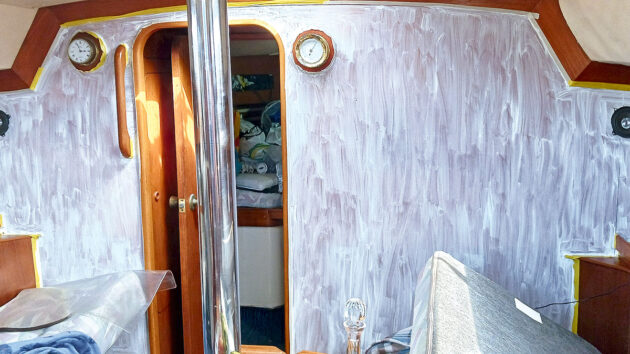
Brush strokes: it took four coats to look good. Credit: Mark Prior
The worry was that it would look totally out of place. In fact, it is barely noticeable when entering the saloon. What is noticeable is that all the gloomy corners are now lighter and the saloon has had VAT added to its apparent size. And I found a long-lost tool at the back of a locker.
Emboldened again – defined commonly as not knowing when to stop – the forepeak was the next target for the Let There Be Light immersive experience.
It is a small space with awkward areas so the decision was to cover only the outsides of the shelves, which are essentially flat and easy to access. They also are subject to heavy use, so traditional paint would not do.
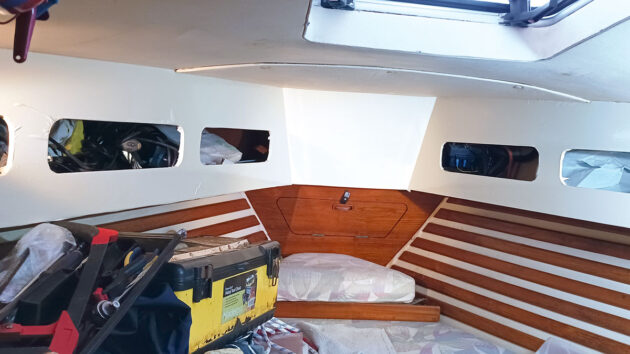
It’s a wrap: the forepeak is recovered in vinyl. Credit: Mark Priora
What would do was, again, a vinyl wrap.
Easy to apply – just look on YouTube – it is shiny, professional-looking and hard-wearing.
In fact, because of the access difficulty, it didn’t go on perfectly, but it will do.
You can remove small bubbles by pricking gently with a pin to exclude air. Wrinkles can be removed by slicing along their length with a sharp blade and then pressing down.
Lighten up
The only people likely to criticise the odd blemish are the guests who sleep in it. I give guests my cabin and sleep in the forepeak, so there is only one person to moan about the odd wrinkle.
And at a certain age you learn to accept the odd wrinkle.
To recap, or wrap, Grace Richard now sports a number of small but significant decorative changes, all of which I am delighted with.
Hopefully this might help you too to pluck up the courage to lighten up and, well, lighten up.

Painting and varnishing a boat: how to get the perfect finish
Kit boat builder Polly Robinson shares her tips for painting and varnishing a plywood-epoxy boat
How I built a DIY boat doghouse using an old bath as a mould
When traditional plywood didn't match the curves of his Corribee 21, Jake Kavanagh found an ingenious—and free—solution at the local…
Plywood veneer: how to cut and fit it
Wood veneer can revitalise and add a touch of class to many boats. Richard Johnstone-Bryden shares advice on techniques for…

Surface preparation for polishing or varnishing a boat
Mirka’s Andy Mierau shares trade tips on how to prepare surfaces for polishing or varnishing
Want to read more practical articles like Painting over varnished wood: Is it ever OK?

A subscription to Practical Boat Owner magazine costs around 40% less than the cover price.
Print and digital editions are available through Magazines Direct – where you can also find the latest deals.
PBO is packed with information to help you get the most from boat ownership – whether sail or power.
-
-
-
- Take your DIY skills to the next level with trusted advice on boat maintenance and repairs
- Impartial, in-depth gear reviews
- Practical cruising tips for making the most of your time afloat
-
-
Follow us on Facebook, Instagram, TikTok and X