




Stu Davies explains how he used a commonly found condiment to free up his prop, accidentally finding a marine growth solution
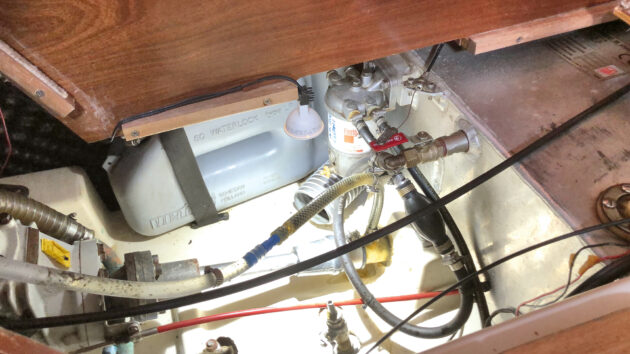
Sometimes life throws us a curveball, and last year it happened to us.
Our boat is based in Portugal. We are having a ball there but unfortunately, due to illness, we weren’t able to visit for seven months.
I was worried about the boat’s deterioration while we were away. Portugal’s sun can be very unforgiving, causing UV damage, and the summer temperatures can get quite high.
My chief concerns were about mould in the cabin, the batteries, and possible growth on the underside.
A good friend who often goes offered to jet-wash the topsides, for which I was very grateful.
We arrived in October and found to our great relief that the inside of the boat was clean with no mould, the batteries were showing 13.8V, and everything worked.
I have solar panels mounted on swivels on the guard rails which I leave vertical while not there.
This results in a reduced capacity that allows for a trickle and charge regime with the Victron controller helping keep everything topped up.
Prop problems
The next day I proceeded to check the engine and transmission.
Before doing anything I turn the prop shaft in the engine room by hand to make sure it moves okay.
I’ve had issues with marine crustaceans, like barnacles, growing between the prop and the cutless bearing and making ‘crunchy sounds’ when it is turned.
This time it wouldn’t even turn!
I got a screwdriver as a lever between two of the flange bolts and gently wriggled it.
I could feel the rubber cutless bearing ‘flexing’, and eventually I got it to turn a little and then more as I worked it back and forth. The key was to be gentle.
I knew the bearing was okay, as I’d replaced it seven months previously after getting a prop wrap.
Once I got it turning again, I could then hear that telltale crunchy sound; there was marine growth in and around the cutless bearing and prop shaft.
Lateral thinking to find the solution for marine growth
I put my thinking cap on: how do I clean this without an expensive lift again?
On older Beneteaus, the shaft passes through a Volvo shaft seal fixed to a glass fibre stern tube which exits the hull in a stainless steel tube where the rubber cutless bearing fits.
Water is circulated through a tube in the engine room and it exits through the cutless bearing or vice versa.
There is a small 10mm OD (original design) copper pipe glued into the prop shaft housing behind the Volvo seal which is connected to a through-hull fitting for circulating water to lubricate the seal.
I had a ponder… If I could get some ‘acid’ in there, would it dissolve the marine growth?
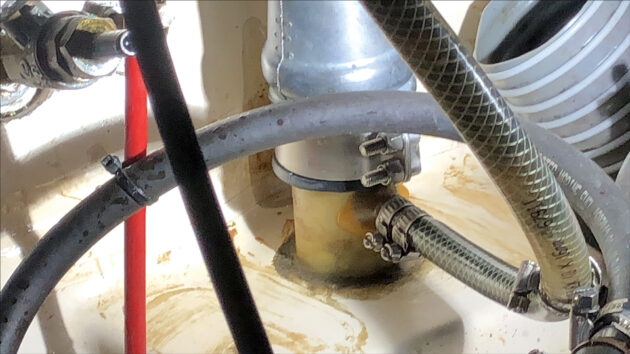
Stu rigged a piece of flexible pipe to the stern tube which allowed him to flush the system. Two jubilee clips hold it fast. Photo by Stu Davies
I set to work. I disconnected the water pipe from the copper tube and rigged up another tube connected to a funnel through which I could pour fresh water or acid.
The waterline of the boat is such that if I kept the funnel at cabin bed level it would flow down and through the stern tube and out.
What sort of acid could I use? In Portugal, you can buy all sorts of exotic chemicals such as muriatic acid (hydrochloric acid) in supermarkets.
I phoned PBO contributor and retired metallurgist and chartered engineer Vyv Cox and he confirmed that diluted muriatic acid would be good for the job.
I went and bought some, but found out that it was really strong stuff, 30% it said on the bottle; another call to Vyv confirmed my thoughts that it was a bit too strong at that dilution.
In Greece, where Vyv’s boat was based, it is sold at just 6% solution, and I was a bit wary of putting the strong stuff into the stern tube. So instead I tried some vinegar!
I put a litre into the stern tube and watched.
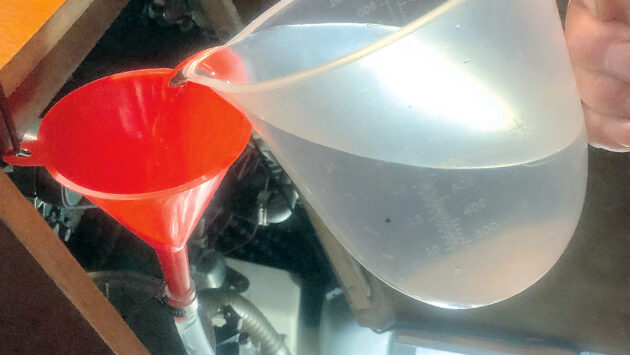
With the funnel at cabin bed level, the vinegar and then water flowed easily through the stern tube and out of the boat. Phot Stu Davies
It worked! Bubbles could be seen making their way back to the funnel.
So I spent all afternoon pouring another 3lt through and working the shaft by hand.
It was working, becoming less crunchy until eventually it was as smooth as silk. I then poured several litres of fresh water through and greased the Volvo seal. All was good.
Other checks
There was some rubbish in the seawater filter, which fits before the raw water pump, so I cleaned it out and did the same vinegar trick on the through-hull seacock, which has a slotted basket ‘filter’ on the outside of the hull.
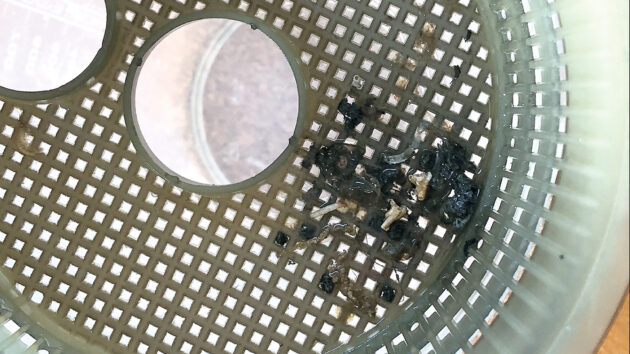
Vinegar helped flush out the seawater filter. Photo by Stu Davies
I then removed the Speedseal cover on the seawater pump to check the impeller.
It looked a bit dirty inside from the seven-month-old stagnant seawater and the impeller had a couple of slightly set blades, but was otherwise okay.
I cleaned and greased the internals with some blue Volvo seal grease and fitted a new impeller.
Then I started the engine for the first time in seven months; it fired immediately, the gearbox was good, the prop shaft was quiet and not vibrating.
I ran it in forward and reverse for about half an hour, working up to full revs at just over 3,000rpm. Everything worked perfectly.
I also removed the so-called sealed house battery cell screw plugs and checked the acid level. It was up to the mark on the three 110Ah batteries; the Victron controller and reduced power solar panels had clearly done their job.

Boat solar panels: Everything you need to know to get started
Topping up the batteries with solar power has never been easier, says Ali Wood, but how do you decide which…

How to change a water pump impeller
Stu Davies shows you how to check and replace an engine’s raw water pump impeller, and explains why it’s an…

Raw water pump: rebuild or replace?
PBO reader Clive Hathway has a leaking raw water pump. Should he buy a replacement or rebuild it? Stu Davies…
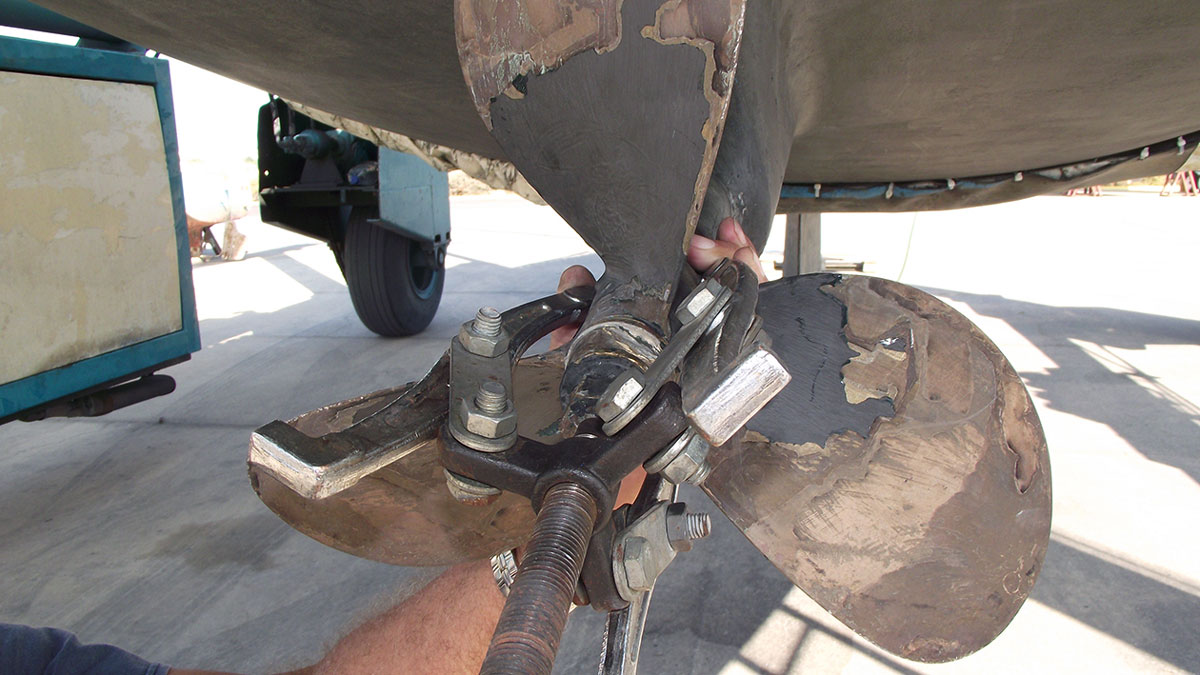
Cutless bearing replacement: step by step
Stu Davies explains how to fit a cutless bearing on your boat
Want to read more articles about marine growth solutions?

A subscription to Practical Boat Owner magazine costs around 40% less than the cover price.
Print and digital editions are available through Magazines Direct – where you can also find the latest deals.
PBO is packed with information to help you get the most from boat ownership – whether sail or power.
-
-
-
- Take your DIY skills to the next level with trusted advice on boat maintenance and repairs
- Impartial, in-depth gear reviews
- Practical cruising tips for making the most of your time afloat
-
-
Follow us on Facebook, Instagram, TikTok and Twitter