


When his drive failed near sandbanks, Bob Angell thought he could sail out of trouble... until the wind picked up

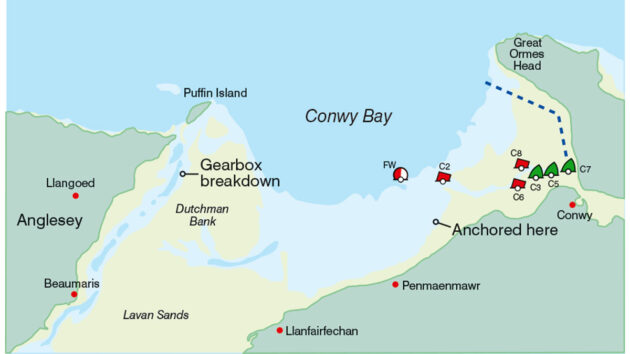
I left the mooring around 1200 at the top of the tide to use the ebb to leave the Conwy River. I motored out through the North Deep channel, alongside the Great Orme in company with Rosie, a Westerly Centaur. Both single-handed, we kept in contact visually and by VHF radio.
The plan was to sail to Moelfre on the east coast of Anglesey. The forecast was for south-west Force 3-4 winds, which would give us a sheltered anchorage for the night, but a later forecast from Holyhead Coastguard for south-west Force 4-5 rising to north-west Force 5-6 would leave Moelfre anchorage exposed and uncomfortable. We decided the Menai Strait would be more sheltered so motored across Conwy Bay and around Puffin Island.
About 1½ miles from Beaumaris the engine tone on my 1902 9.7m (32ft) Morecambe Bay prawner, Quest changed and I lost all drive. The engine, an 18hp Petter diesel engine, kept running but we started to drift back with the tide, so I called across to Rosie to wait while I sorted out the problem.
On investigation I found all the bolts had sheared off the drive plate from the engine to the gearbox – so no drive.
I was now starting to drift down-tide towards Lavan Sands, which were becoming exposed on the falling tide. Rosie tried to give me a tow to deeper water to anchor, but a Westerly Centaur is not heavy or powerful enough to tow a 10-ton gaffer against the wind and tide.
I decided the best course of action would be to sail back to Conwy. The seas in the lee of Puffin Island were comfortable, but sailing across the bay it was now becoming quite rough.
I planned to try and get into the entrance channel; it was a falling tide so I did not expect to get into the river, but hoped to get behind the sandbanks and anchor in the shelter of the land in deeper water and try to make a repair.
Not for the chop
However, there was not enough water to get into the channel either so I anchored inshore in 3m. This gave me a chance to have a good look at the drive plate where I found I’d need to remove the gearbox to drill out all the broken bits of bolt – not a job to be undertaken at anchor in a choppy sea.
The tide was dropping and the rising wind, which by now had gone around to the west, was causing an uncomfortably choppy sea with wind over tide. I struggled to get the anchor up, then unrolled the jib and started to sail across the wind towards deeper water near the fairway buoy, planning to head back to the lee of Puffin Island and wait for the tide to turn.
As I started towards deeper water a big gust hit us, ripping the clew from the jib, and the sheets wrapped themselves around the forestay.
I dropped the anchor to stop Quest from being blown onto the sandbanks near C2 (the east channel buoy) that were starting to show. I was now in just 2m of water on a falling tide (Quest draws 1.2m), so I let out plenty of anchor warp to make sure we held in the shallow water.
It took some time to replace the ripped jib with a smaller, stronger one, and unravel the sheets, and by the time I was ready it was close to low water, the tide had dropped and we were bumping the bottom in the big waves. I was glad it was sand not rocks.
Turning the tide
I then had to wait for the tide to rise, so I made something to eat and had a cup of coffee. As the tide turned the sea became less choppy but a big swell had built up. Rosie had been motoring around by the fairway buoy, waiting for more water. We had kept in contact by VHF radio. I asked him to make sure the club launch would be on hand to help pick up my mooring, it being 100m from Conwy Bridge. I didn’t fancy attempting it on my own with no engine, with 5m of tide behind me.
When there was plenty of water under the keel I started to pull the anchor warp up and soon regretted that I had put so much out. It was a real struggle as I was pulling against 2.5 knots of tide and a strong wind. It took me 45 minutes and I had to use the cockpit winch for the last 6m (20ft).
Once underway with just a small jib I was doing 6.5 knots over the ground. I called the launch and arranged to meet him just inside the river. He came alongside and got two ropes on Quest. We managed to negotiate the moorings safely but there was too much tide running to go to the mooring safely and so I was put on a spare pontoon berth instead.
It was now 2200, and all concerned adjourned to the club bar to discuss the events of the day over a well-earned drink.
Later, when I removed the gearbox, I found that two of the engine mounting bolts had broken – this had caused the engine to move in the rough sea and shear off the bolts in the drive plate. I drilled out and replaced the bolts in the drive plate, and fitted four new engine mounting bolts while I was about it.
What I learned from the experience
- A better option would have been to anchor in the lee of Puffin Island and wait for the tide at the start of my predicament.
- Regular checks of the engine compartment should include close inspection of the engine mounts.
“A Force 8 gale turned the sea off Dover into a ‘cauldron of confusion’ that nearly overwhelmed our Halmatic 30”
Tim Butler had to struggle back to the port he'd just departed when his Helmatic 30 began rolling violently in…
A stroke off the Isles of Scilly: How a medical emergency left this skipper’s wife “hanging from a wire in a near gale”
Early July 2025 found my wife, Veronica, and I sailing in our Dufour 40, Spook from Falmouth in Cornwall to…
Left for dead after falling overboard: how one sailor survived 5 hours lost at sea before rescue
Roger Cottle was presumed dead after falling overboard a 27ft yacht and lost at sea for five-and-a-half hours in a…
“I was on Lyme Bay harbour wall in only my soggy underpants”: how a test voyage became a crash-course in seamanship
My first test voyage onboard my boat Draken was, to say the least, quite a rude awakening. After years of dinghy…
Want to read more seamanship articles like “A big gust hit us, ripping the clew from the jib”: How I got to the marina safely after engine failure, a ripped sail and sheet wrap while sailing against wind and tide?
A subscription to Practical Boat Owner magazine costs around 40% less than the cover price.
Print and digital editions are available through Magazines Direct – where you can also find the latest deals.
PBO is packed with information to help you get the most from boat ownership – whether sail or power.
-
-
-
- Take your DIY skills to the next level with trusted advice on boat maintenance and repairs
- Impartial, in-depth gear reviews
- Practical cruising tips for making the most of your time afloat
-
-
Follow us on Facebook, Instagram, TikTok and Twitter