


If you are looking for a fast, capable, go-anywhere cruiser of around 40ft (12m), the Sigma 41 should be a serious contender, says David Harding
Sigma 41: Is This Forgotten 1980s Cruiser Actually the Most Seaworthy Boat Ever Made?

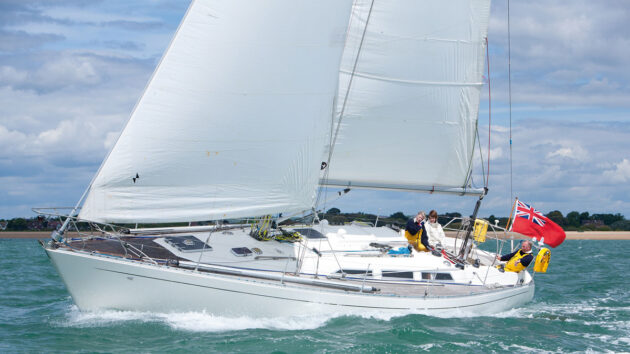
To many cruising sailors, the name Sigma stands for racing: big fleets, lots of shouting at the marks and dozens of crew hiking energetically on the rail.
To be fair, this is what the Sigma mark is best known for. The Sigma 33 and 38 were successful One Designs that attracted top sailors and enjoyed close competition in big fleets for many years. While numbers have dropped since their heyday, both classes are still raced.
Other Sigmas were raced less widely, but were quick and competitive boats nonetheless. There was the 292, the rare 35, the rigged 36 and 362 widely used by sailing schools and the 400 – the only Sigma not designed by David Thomas.
Given this racing pedigree, a Sigma of any description is perhaps not the first boat most people would consider buying for more leisurely sailing, though the 33 was also built in cruising guise with a masthead rig as the 33C.
Then there was the biggest Sigma of all, and the one that is probably least recognised: the Sigma 41.
It wasn’t built in large numbers – about 70 rolled out of Marine Projects’ yard in Plymouth – and the Sigma 41 doesn’t even look distinctively Sigma-like as some of the other small models. Identification is made harder by the fact that the 41 came in both masthead and fractional guises, the former being marginally the more popular.
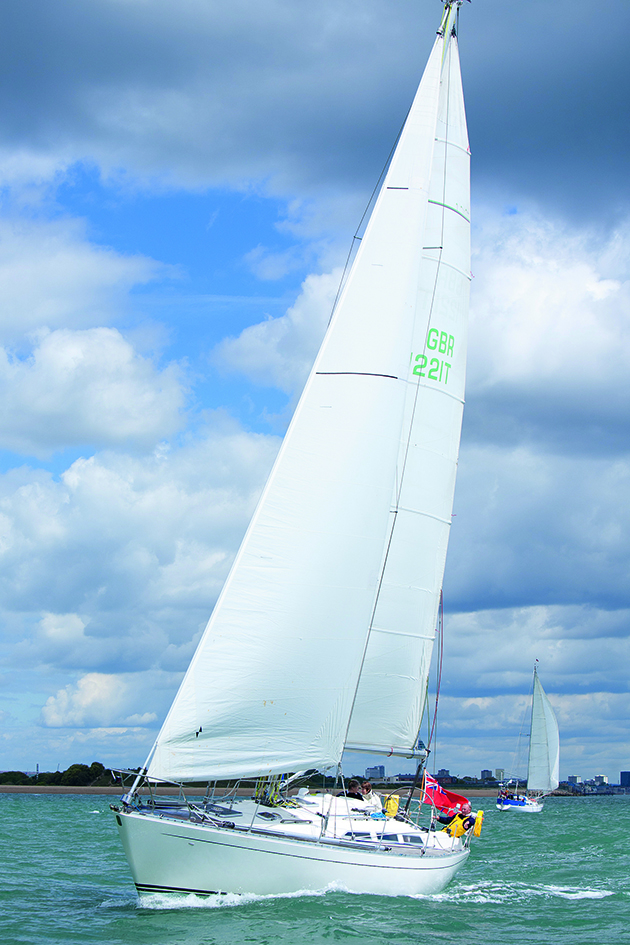
The No3 headsail works well for short-handed cruising. Credit: David Harding
Whatever the 41 might lack in numerical popularity or recognisability, it more than makes up for in enthusiasm from owners, who have sailed far and wide.
“The Sigmas are great boats,” says one in California. “Powerful, strong, fast, a delight and a challenge to sail, and built like a brick outhouse without being too heavy. You eventually get tired of people asking you if it is a Swan.”
Of course, owners are often enthusiastic about their own boats. Unlike some, however, those who have a Sigma 42 tend to be experienced, well-travelled sailors who have owned several boats, covered a few miles and learned the hard way what makes some boats better than others.
An owner on the south coast of England who has competed in a number of Fastnets and who regularly takes his Sigma 41 across the Channel, enthuses: “This has to be the safest, the most exhilarating and best boat ever made.”
Another sums up their view by saying: “If you want one of the most seaworthy boats of its size, then the Sigma 41 has few equals.”
Comments like these, from such a diverse range of racing and cruising sailors all over the world, say a lot. Sigma 41 owners love their boats. The fact that many have been prepared to spend a good deal of time, money and effort repairing or replacing bits of them is testimony to their dedication.
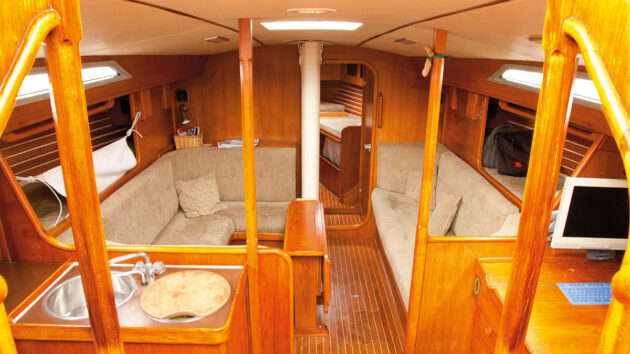
Plenty of handholds are a feature of the Sigma 41’s practical seagoing layout. Credit: David Harding
One quality immediately apparent to anyone who experiences the Sigma 41 from behind the wheel is that the boat is a pleasure to sail; light on the helm, well balanced and extremely responsive.
The 41 is also well laid out for short-handed sailing. The big wheel gives a good range of helming positions wiht a lear view forward. Running on a track immediately ahead of the pedestal, the main sheet is within easy reach and its 6:1 purchase could be supplemented by use of a centrally-mounted Lewmar 40 self-tailer.
While single-handing would need some thinking about because the primary winches (Lewmar 48 self-tailers) are at the other end of the cockpit, for two-handed sailing, the arrangement works well; the primaries are set inboard, making it easy for the grinder to adopt an efficient bracing position.
For single-handing you could always press some of the other winches into action: two more pairs sit atop the coamings each side, principally for spinnaker use but available for any tasks that might come their way.
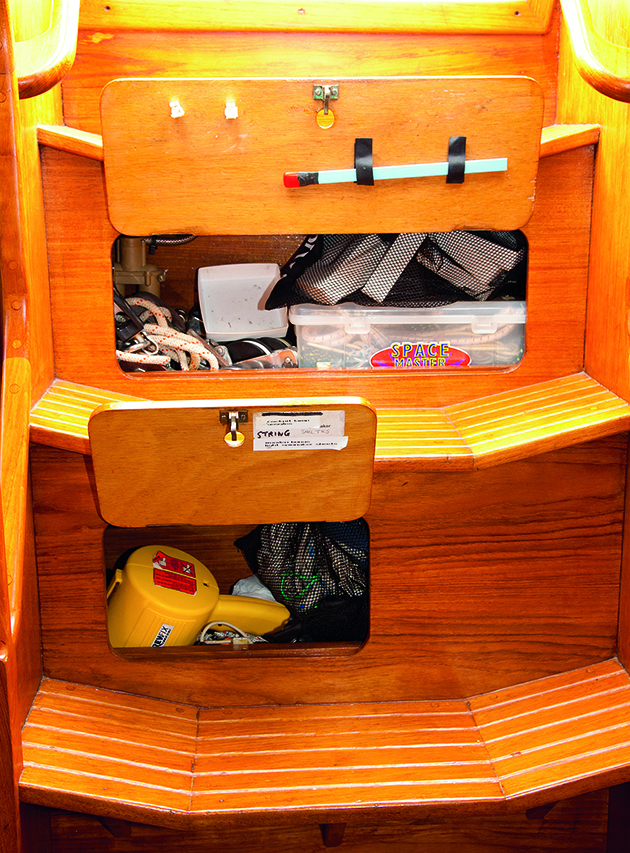
Handy lockers in the companionway steps for ready-to-grab items. Credit: David Harding
Unlike cockpits on most modern boats of similar length, the Sigma’s is a good leg-bracing width. It has an enormous full-depth locker to starboard and stowage for a liferaft beneath the curved seat across the stern.
A low coachroof and wide side decks – teak-covered, as on many 41s – make for easy passage forward, which is just as well because the reefing pennants and most of the halyards are at the mast. Here they’re handled by another trio of winches, taking the total to 12.
One system that works particularly well for short-handed sailing on a boat of this size is the twin-pole arrangement for the spinnaker. By all accounts downwind sailing is what the 41 likes best, and that’s when she tends to make up time on her competitors. Despite the masthead rig and large kite, the deep rudder keeps her on track in most conditions and broaching is a rare occurrence.
Even with a boat-tester on the foredeck who had never met the system before, the hoists, drops and gybes proved to be remarkably straightforward.
Accommodation on the Sigma 41
As a practical seagoing layout, the Sigma’s takes some beating. Four of the nine berths are in the saloon, where a pilot berth each side keeps off-watch crew out of the action zone. Pilot berths also make useful places to sling kit bags for weekend sailing.
As befits a boat designed for offshore sailing, the galley to port is right by the companionway and provides a good bracing position against the engine box.
A half-Admiralty size chart table is opposite, complemented by ample stowage for books and mounting space for instruments.
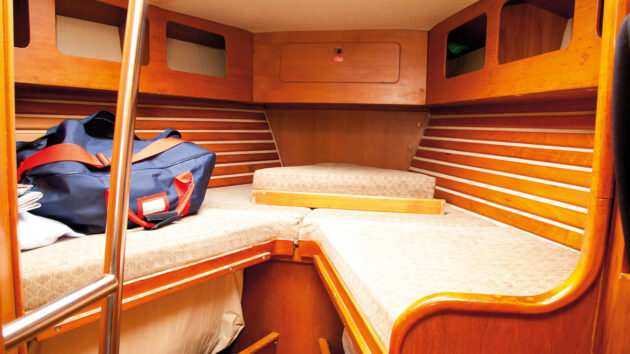
The bunks in the forecabin hinge up to clear the space for sail stowage. Credit: David Harding
Both galley and chart table halfbulkheads have pillars extending to the deckhead. Together with good handholds by the companionway, more beneath each deck in the saloon and others dotted around in useful places, they make sure that you’re never far from something to grab hold of.
Interior mouldings are limited to the heads compartments forward and aft. Elsewhere the accommodation is formed by joinery that’s bonded directly to the hull and, as in the case of the main bulkhead, to the ply- and vinyl-lined deckhead as well.
Plenty of bulkheads and fore-and-aft joinery members should lead to a stiff hull.
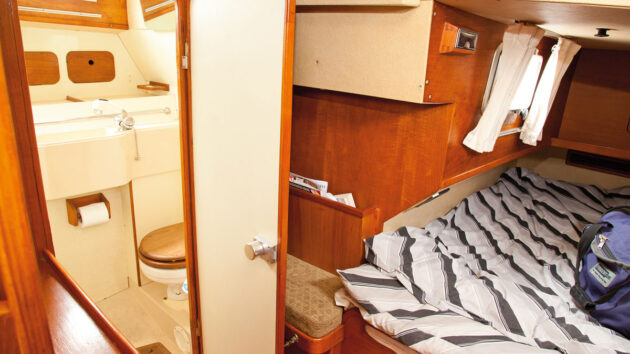
A walk-through from heads to aft cabin beneath the high bridgedeck. Credit: David Harding
The absence of interior mouldings contributes to so much stowage that it would be easy to make a Sigma 41 very heavy indeed, even if a few voids remain that could be put to use.
Water tanks are under each saloon berth, giving a capacity of around 168lt (37gal), ample enough for a crew of six on a 16- day Atlantic crossing.
Extra useable stowage is found beneath the sole boards in the saloon, where food that needs to be kept cool can be stowed in plastic boxes.
Removing panels of the engine box allows access to every side of the original 36hp Bukh engine. Many 41s have been re-engined with lighter modern alternatives, often trimming slightly bow-down as a result.
A slight list to starboard is another characteristic common to the breed, resulting from the distribution of the heavier domestic items below decks.
Verdict
It’s hard to do justice to such a multi-faceted boat as the Sigma 41 in such a brief report. This is a big, fast, powerful, seaworthy, comfortable and capable yacht that can go – and has gone – almost anywhere in any weather.
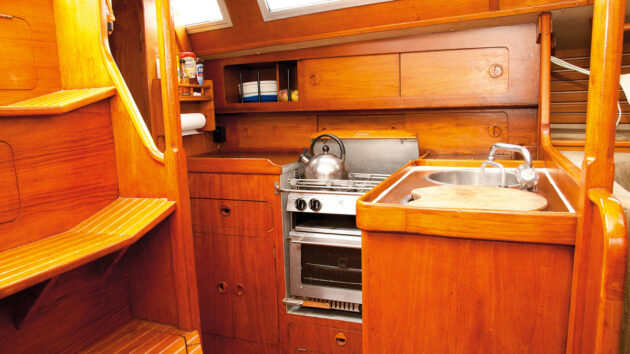
The well-appointed galley is right next to the companionway. Credit: David Harding
Anyone looking for a serious long-distance cruiser could do a lot worse, while those in search of a competitive all-rounder on the race course are unlikely to be disappointed as long as light-airs performance isn’t a priority. (If it is, one of the few tall-rig versions would be worth seeking out.)
Rugged, easy to sail and blessed with directional stability greater than that of many longkeelers, Sigma 41s will need some work to keep them up together – as will any decades-old boat – but structurally they’re generally pretty sound.
Details
LOA:12.73m (41ft 9in)
LWL:10.16m (33ft 4in)
Beam:3.91m (12ft 10in)
Draught (deep fin):2.30m (7ft 6in)
Draught (shallow fin):1.83m (6ft 0in)
Displacement:10,000kg (22,200lb)
Ballast:3,674kg (8,100lb)
Sail Area (main and foretriangle – fractional rig): 74sq m (797sq ft)
Sail area/displcement ratio:16
Displacement/length ratio:270
Engine (original):Bukh 36hp diesel
Headroom:1.90m (6ft 3in)
Designer:David Thomas
Builder:Marine Projects/Sigma Yachts