


Rupert Holmes looks at the gear you need to safely navigate the inland waterways on your boat
What inland gear do you need for exploring the waterways?
Equipping a boat for use on inland waters may appear straightforward, especially to those used to voyaging on tidal, coastal, and offshore waters.
If the engine works, if there are mooring warps, fenders, and maybe a few engine spares and tools, then perhaps most bases are covered.
But in reality the situation is more complex, and in many respects, the gear needed for navigating inland waterways has many parallels with that required for going to sea.
While there are no legal requirements for equipping privately-owned leisure boats of less than 45ft (13.7m) used on coastal and offshore waters, as a minimum those used inland must satisfy the requirements of the Boat Safety Scheme (www.boatsafetyscheme.org).
This is designed to reduce the risk of boat fires, explosions, carbon monoxide and pollution and lays down standards for fuel, gas and electrical installations, plus fire prevention and firefighting equipment, among others.
Inland gear: Personal safety
Most of Britain’s canal network is reassuringly shallow, often no more than four feet, but that’s still deep enough to drown, or for the boat to sink, while locks typically have a rise of 8-10ft (2.4-3m) and some double that figure. Equally, certain areas of rivers can be much deeper, especially if you venture out to the tidal sections.
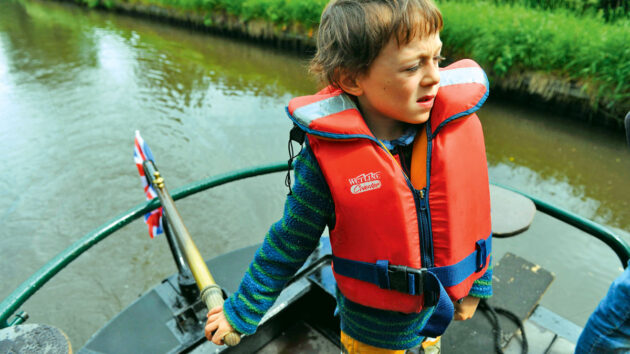
Lifejackets and buoyancy aids are therefore an essential starting point. Each boat should have a personal flotation device compliant with CE/UKCA standards for everyone on board, even if the vessel is based in what appears to be shallow water.
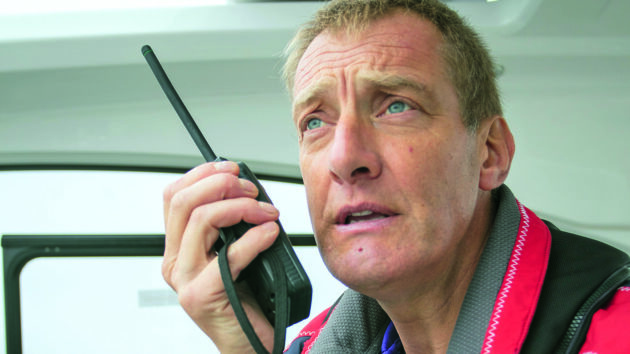
All boats should carry at least a handheld VHF radio. Credit: Richard Langdon
Unlike a sailing boat, where being hit on the head by the boom or mainsheet is a possibility, the chances of someone being unconscious when they fall overboard are reduced, making manually activated lifejackets without a safety harness or spray hood acceptable in many cases.
Nevertheless, crotch straps are essential and automatic inflation means you don’t need to manually activate the firing mechanism while simultaneously dealing with the effects of cold water shock.
It’s also important to be aware of the differences between a buoyancy aid that typically supplies only 50N of buoyancy, and is intended only as an aid to swimming, and proper lifejackets that are rated at 150N or more and are designed to turn your face up within five seconds.
The latter are, unfortunately, more expensive and require annual inspection/servicing, but their performance is far superior.
The importance of the servicing aspect must never be underestimated. When my sailing/fishing club recently carried out a lifejacket clinic in conjunction with the RNLI, a staggering 80% failed inspection for issues such as empty or corroded gas bottles, incorrect or outdated firing mechanisms, missing crotch straps, damaged bladders, or failing stitching.
A lifebuoy and throwing line make a huge amount of sense to retrieve someone from the water. The throwing line is especially important on rivers, where the casualty can be swept frighteningly quickly downstream, especially if the river is in spate. Even if you are never underway at night, it’s by no means impossible to fall overboard when transferring from the bank to the vessel, so a light for the lifebuoy makes sense, as does a whistle.
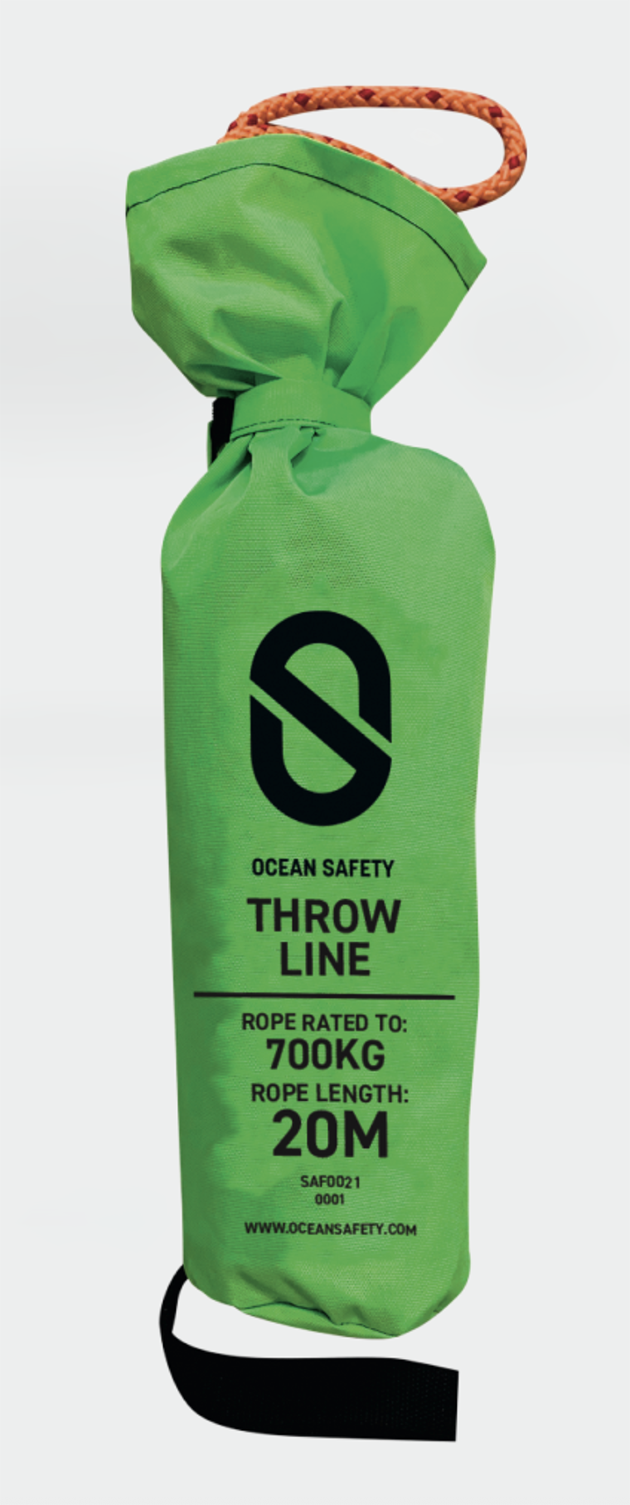
Inland gear: A throwing line is essential safety kit on rivers. Credit: Ocean Safety
Bilge pumps are necessary inland gear
The prospect of a boat ‘sinking’ in only four feet of water may sound less scary than doing so in the middle of the English Channel or North Sea. Nevertheless, it can still wreck both your summer holiday and your boat, so taking similar precautions to owners of sea-going vessels makes sense.
Both electric and manual bilge pumps therefore have their place, as does a bilge alarm to warn of unexpected water ingress at an early stage. And as a last-ditch back up it’s surprising how effective two stout buckets can be at removing water from a boat.
It’s also worth remembering that narrowboats in particular can sit low in the water, so it’s important to recognise where the lowest point of water ingress is.
The Marine Accident Investigation Branch (MAIB) reported on a case in the early 2010s where a narrowboat sank on the tidal Thames near Limehouse due to water ingress through an engine room vent that was insufficiently far above the waterline. That vessel had no lifejackets for any of its five crew and the outcome might have been very different had their plight not been spotted by a passing police launch.
Self-sufficiency
Fire extinguishers and blankets are also essential and it’s important to install alarms for smoke, carbon monoxide, and gas used for cooking. Much of the UK’s inland waterways network is in rural areas, well away from roads, and it can take time for emergency services to reach a casualty.
It therefore makes sense to carry a similar level of first aid kit as for coastal sailing. In addition to a kit for general use, a sealed CAT C kit, as required by the Small Craft Codes of Practice, means you can be sure of finding the items needed in a genuine emergency situation.
Be prepared
Few canal boats carry a conventional anchor, though some use a mud weight to add to options when mooring. It’s a different matter for craft used on rivers or on commercial waterways, when an easily deployed anchor can be essential in the event of engine failure or a fouled prop. The most popular type is a relatively inexpensive Danforth style with enough rode (ideally all chain) for five times the river’s greatest depth.
While much of the UK’s inland waterways are reassuringly clean, there are also many sections with a variety of debris including plastic sheeting, nets and rope that can foul a propeller. Narrowboats typically have a weed hatch above the propeller that enables you to reach down to clear a prop, but cruisers with a stern drive, and especially a shaft drive, can’t be so easily cleared, so a good rope cutter will stack the odds in your favour.
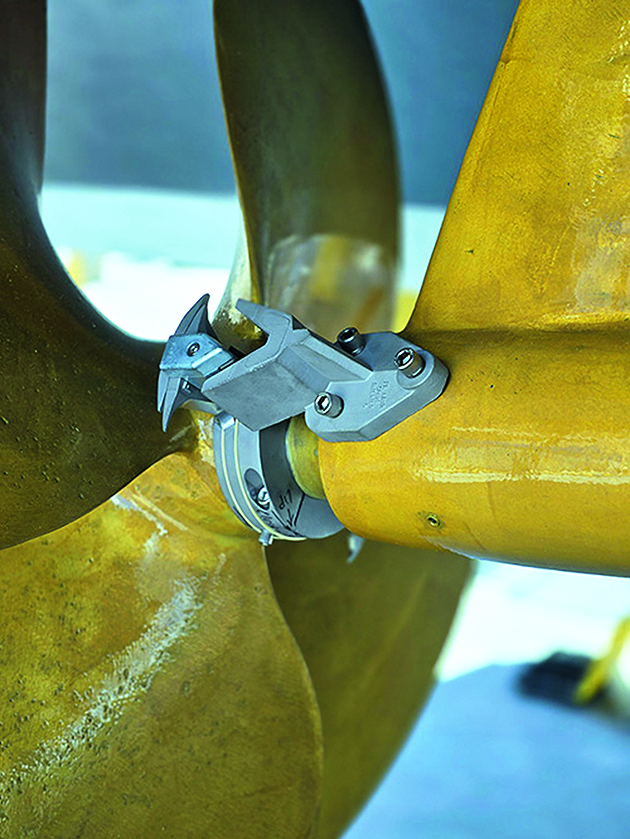
The Spurs Line Cutter. Rope cutters are essential for cruising the inland waterways. Credit: Spurs Marine Manufacturing
When I sailed a single screw yacht down the tidal Thames from the Pool of London, just above Tower Bridge, with a Port of London pilot on board, he was very keen to be sure we’d be able to deploy the anchor quickly in the event of a fouled prop.
The engine and ancillary systems also warrant attention; having a selection of engine spares and a basic tool kit, including fuel filters, is prudent. Some people also take a small emergency fuel reserve, but this shouldn’t be necessary if you know the size of the boat’s tanks and hourly fuel consumption, allowing for a 20% margin.
Keep in touch
VHF radio is increasingly used for communication inland and the Inland Waterways Association strongly recommends that boaters carry marine band VHF radio on all major tidal waterways and on other waterways where locks and bridges are equipped with VHF radio. As distances tend to be short and there’s unlikely to be scope to mount an antenna up high, a handheld unit will suffice in most cases and doesn’t require time-consuming installation.
Full navigation lights are needed for navigating at night or in reduced visibility, except for narrowboats used only on narrow canals and some other waterways, which are only required to carry a single headlight at the bow.
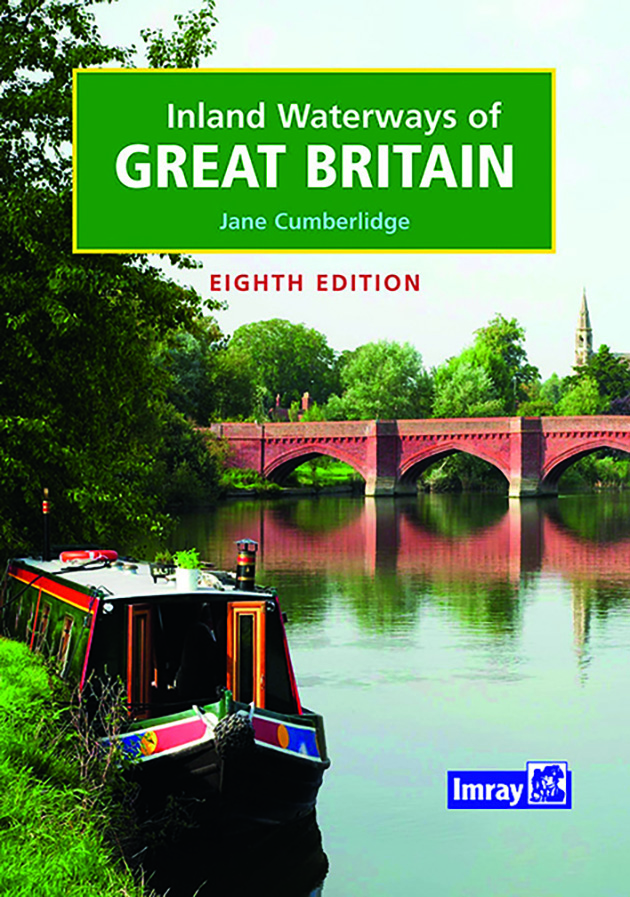
It’s worth investing in Jane Cumberlidge’s Inland Waterways of Great Britain, £32.50, available from imray.com
The Canal & River Trust (canalrivertrust.org.uk) and Inland Waterways Association (waterways.org.uk) offer navigation guides including maps, route planners, and pilot-style guides.

Inland boating in the UK: a beginner’s guide
Rupert Holmes and Jonathan Mosse look at boats, seamanship skills, planning and destinations in their guide to inland boating in…

Slow boat around Wales – coastal and inland circumnavigation in a Vivacity 20
When we first moved to Deganwy I saw a programme on Welsh television with a couple of guys from Aberaeron…

Boat charter holiday destinations in the UK and Ireland away from coast
Katy Stickland highlights some of the spectacular and magical places to charter away from the coast in the UK and…

Why traditional Broads motor cruisers are our favourite charter boats
Every few years my wife, Brenda, and I hire a boat on the Norfolk Broads for a rest and some…
Want to read more articles about inland gear or kit for sailing around the coast or offshore?
A subscription to Practical Boat Owner magazine costs around 40% less than the cover price.
Print and digital editions are available through Magazines Direct – where you can also find the latest deals.
PBO is packed with information to help you get the most from boat ownership – whether sail or power.
-
-
-
- Take your DIY skills to the next level with trusted advice on boat maintenance and repairs
- Impartial, in-depth gear reviews
- Practical cruising tips for making the most of your time afloat
-
-
Follow us on Facebook, Instagram, TikTok and Twitter