



Genevieve Leaper shows how to lower a mast while your boat is on the water
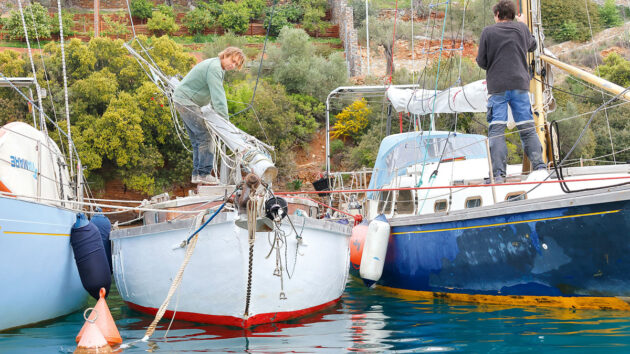
Our friend Stepke recently had a job preparing a small wooden yacht for transport by road. Getting her ashore would be easy at the local boatyard in Milina, Greece, which can handle much larger boats. The problem was unstepping the mast – the yard takes boats out with a tractor and trailer, and there’s no crane.
Hiring a crane would be prohibitively expensive, but there is an alternative. All you need is another two yachts, and with just three people the mast can be taken down on the water.
My partner, Aleko, was roped in to help, along with his boat. The technique, which the two of them have employed many times before, is to use the masts of two other boats as a crane.
Kelani, a 1947 Johnson and Jago, was an easy job, at 25ft (7.5m) being rather smaller than Aleko and Stepke’s boats (both Nicholson 32s). However, in the past they’ve dealt with the masts of larger boats, reckoning a 15m mast to be about the maximum (the Nicholson 32 mast is just under 12m).
With boats and people organised, it was just a question of waiting for a calm day.
Considerations when mast unstepping afloat
The first thing to consider is this is a technique for calm conditions. It could be dangerous as well as difficult in strong winds or waves. Even in calm weather the wash from other boats moving around could cause the boats to roll. So choose a quiet place or a quiet time of day.
Not all boats are suitable for use as a crane. A good, solid rig is required; a light racing yacht with a fractional rig and bendy mast would not be a good choice. Multihulls are also unsuitable; the angle of the halyards would be too shallow due to their extra beam. The same problem would occur with trying to lift the mast of a multihull.
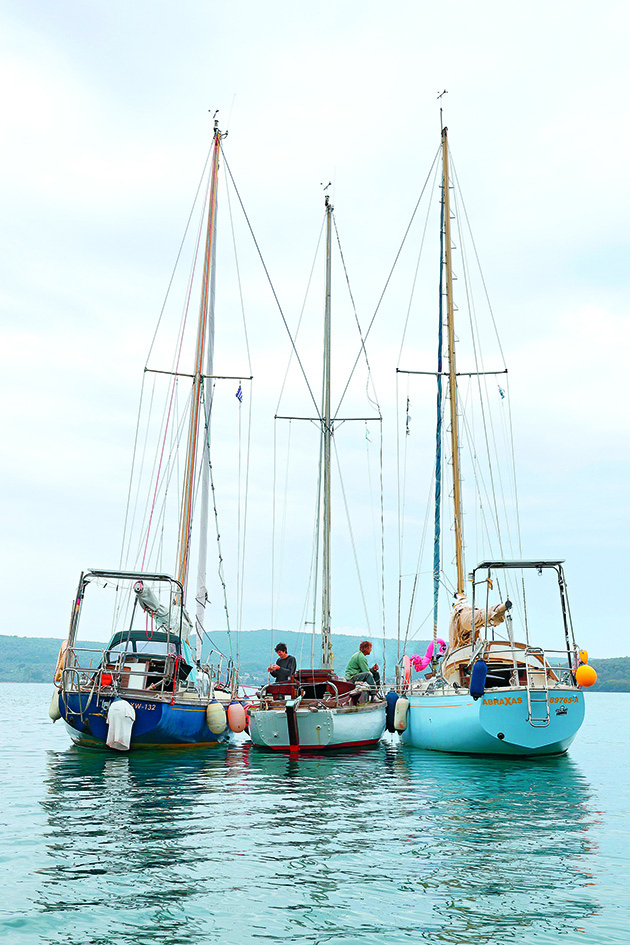
The halyards on the outer boats are tied to the mast, ready for lifting. Credit: Genevieve Leaper
Good halyard winches are another prerequisite. There’ll be a heavier load than normal, and it’s essential the crew can winch up and lower away smoothly.It goes without saying that halyards used for lifting should be in good condition. The two crane boats and their masts should be of similar size for an even lift.
It is possible to lift the mast of a slightly larger boat, but think carefully of the forces involved. The main variables are relative mast heights which affect the geometry of the lift and the weight of the load compared to the strength of the lifting rigs.
The aim is to lift as vertically as possible, so the higher the masts of the crane boats above the lifting point, the better. A mast with more than one set of spreaders is an added complication.
You want to lift from near, but slightly above the centre of gravity, to ensure it is easy for the crew on deck to control. The lower spreaders may be below the centre of gravity (risk of pivoting and top of mast crashing down), and the upper spreaders too high (too much weight at mast base). It can be done, but it will be more complicated to attach the halyards at a suitable lifting point between the spreaders.
A mast is heavier than a sail for which the halyard was designed – the mast plus rigging of even a fairly small cruising yacht is likely to be over 100kg, and you could be dealing with two or three times that weight.
Bear in mind that masts vary considerably in weight depending on material and construction, and a longer spar with a thicker section will be heavier per metre.
When lifting the heavier mast of a larger boat, it would be a good idea to have an extra crew member on board to help guide the mast into place. Lowering the mast only takes minutes, but, as with most jobs, preparation is essential and is always the longer part of the operation.
Before starting:
- To save time while the other boats are involved, boom and running rigging could be taken off in advance
- Make sure you have all the necessary tools for undoing the rigging and unstepping the mast (pliers, spanners, hammer etc.)
- Assuming you’ll be raising the mast again, notes or photos of where and how everything attaches may be useful (especially if you haven’t done it before)
- Decide which way the mast is to lie on deck – usually mast base forward
- Consider how the mast will lie on deck and prepare supports or crutches if necessary, along with ropes you’ll need to lash it down
When tying the other boats alongside, the three masts must be in line, regardless of the size, hull shape and mast position of the different boats. This may be awkward, so plenty of fenders and extra springs may be needed.
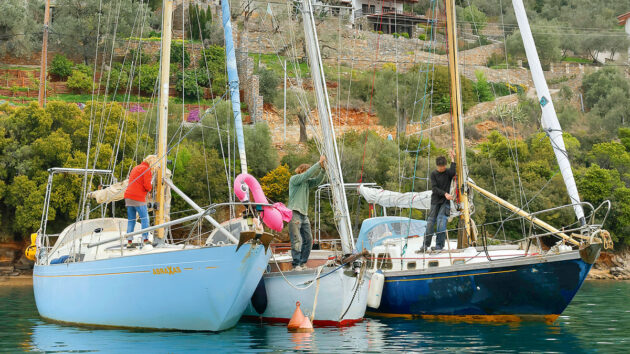
The assistants need to work together to keep the same tension on both halyards as the mast is lowered. Credit: Genevieve Leaper
Check that the spreaders won’t clash and that the halyards from the crane vessels are led correctly, fore or aft of stays on each boat as appropriate. If it’s not possible to pull a bowline up to the spreaders, it may be necessary to climb the mast to attach the halyards.
Why lower a mast on the water?
For many owners, raising and lowering the mast may be a job that is routinely left to the boatyard, which makes sense if the boat is being craned out. But if the yard doesn’t have a crane and you want the mast down for the winter, it will be easier to lower it while the boat is still afloat.
Kelani was going ashore for road transport. Other situations which might necessitate lowering the mast on the water include going under bridges or for mast work which can’t be done by going aloft.
Another friend in Milina, who used to manage a large charter fleet, remembers having to take the masts down on 20 new boats due to a recall on a rigging fitting. This was a matter of some urgency as one boat had already suffered a forestay failure while out on charter.
At least they had some older boats with reliable rigging to do the job. And what about raising the mast again? Simply reverse the procedure. It is a little harder work than lowering, but no more complicated.
Mast unstepping while afloat: step by step
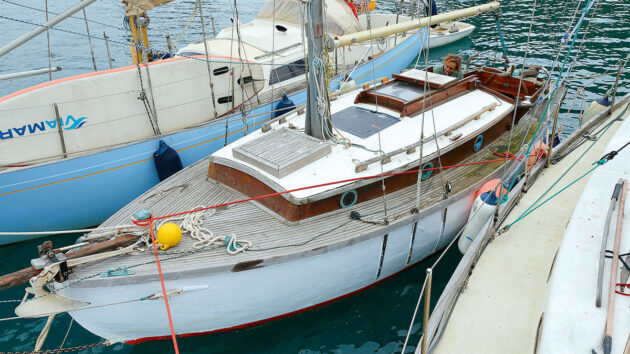
Credit: Genevieve Leaper
1. With Kelani on her mooring, the two Nicholsons are manoeuvred into position and tied securely alongside. They’re fastened together with springs as well as bow and stern lines. The boats are positioned such that the masts of all three are in line.
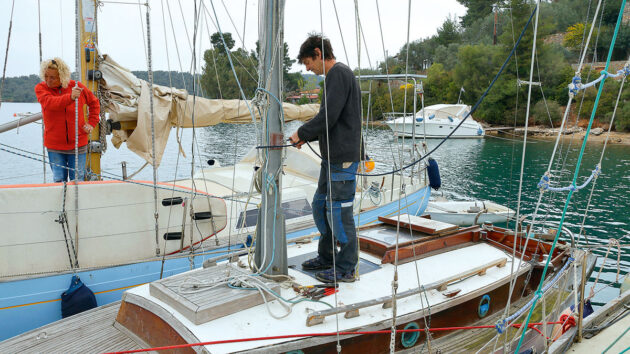
Credit: Genevieve Leaper
2. The main halyards of the ‘crane’ vessels are tied in loose bowlines around Kelani’s mast, hoisted up to the spreaders and tensioned. As the load comes on, the outer boats heel inwards. The halyards are about 25° from vertical, which is a good angle for the lift.
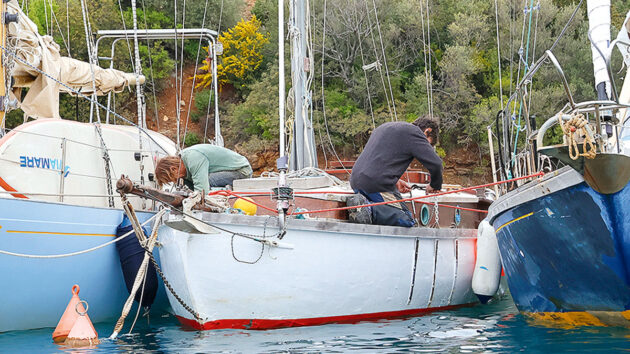
Credit: Genevieve Leaper
3. The boom is removed and all the standing rigging is detached from the deck and tied to the mast so it won’t snag. Finally, the bolt at the mast step is removed and the mast freed.
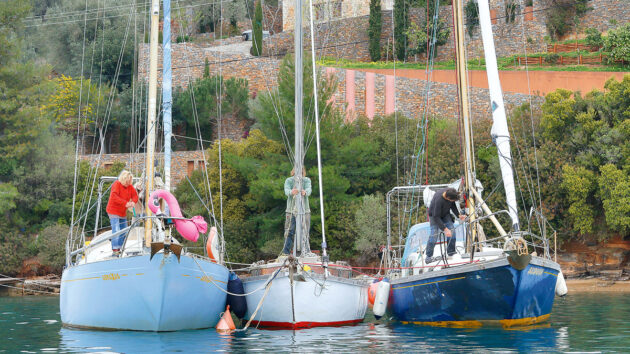
The assistants need to work together to keep the same tension on both halyards as the mast is lowered. Credit: Genevieve Leaper
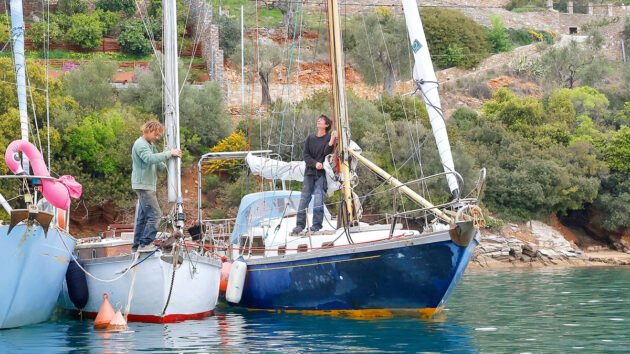
4. The assistants man the halyard winches on the crane vessels. Obviously, they need to work together, keeping the same tension on both halyards. Stepke on Kelani is in charge of the operation and co-ordinates the lifting.
Credit: Genevieve Leaper
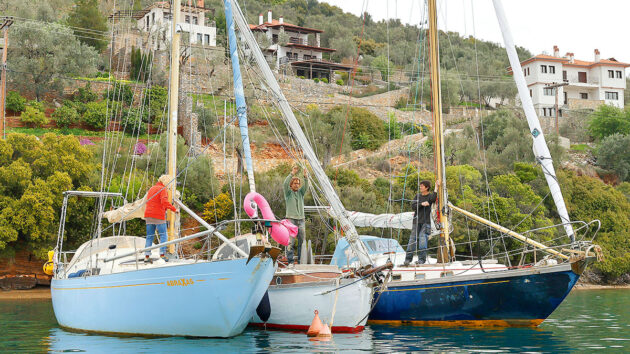
5. The mast is first winched up a little to lift it clear of the mast step, then Stepke swings the mast base forward, and it can be slowly lowered.
Credit: Genevieve Leaper
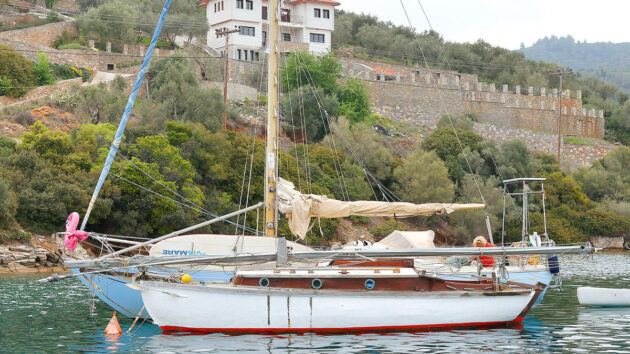
In just a few minutes, the mast is down on deck.
Credit: Genevieve Leaper
6. With the mast tied down and all tidied up, Kelani is ready to be taken out of the water.
Hoisting and lowering the mainsail: troubleshooting problems
What can you do if your mainsail is hard to hoist or reluctant to drop? David Harding offers some advice

Do-it-yourself mast stepping
If you’re thinking of hiring a boatyard crane to step your mast, why not consider this low-tech, low-cost alternative? Rupert…

Rebuilding a damaged mast step
Rupert Holmes repairs a compressed water-damaged mast step – a common problem for boats with a deck-stepped mast - and
How I gave my Albin Ballad’s mast and standing rigging a major upgrade
When I bought my 1973 Albin Ballad Moments of Clarity many years ago, the first job I did was to…
What to read more practical articles like Mast unstepping while your boat is still afloat?
A subscription to Practical Boat Owner magazine costs around 40% less than the cover price.
Print and digital editions are available through Magazines Direct – where you can also find the latest deals.
PBO is packed with information to help you get the most from boat ownership – whether sail or power.
-
-
-
- Take your DIY skills to the next level with trusted advice on boat maintenance and repairs
- Impartial, in-depth gear reviews
- Practical cruising tips for making the most of your time afloat
-
-
Follow us on Facebook, Instagram, TikTok and X