


Andy Turner suffers a debilitating heart condition while sailing his Bowman 46 offshore with his son and a friend, resulting in an HM Coastguard helicopter airlift from an RNLI lifeboat.
Originally, we’d set off from north Wales with the intention of coastal cruising down the English coast and eventually making our way to France.
However, last summer we decided to return to Wales because my wife Melissa’s dad had become poorly, so the trip to Europe was postponed while we dealt with his care needs.
By now, we were in Torquay, it was August, and Melissa and I decided that rather than coastal-hopping, I’d sail back up in one hit with our 13-year-old son, Jack, and my best friend, Andy Darlington, while Melissa drove back with our baby, Alaska, and son Oliver, aged two, by car.
My friend Andy is an extraordinarily experienced sailor who has worked on Challenge Wales, now part of the Tall Ships Youth Trust sail training ship, and I’ve got thousands of miles under my belt.
Jack, who was 13 then has probably got more sea miles than most adults. He’s done RYA level 1 and 2 sailing courses and several thousand miles of coastal cruising.
We planned to do the 300-mile passage in one go, staying well offshore around the headlands – it would take longer but also avoid the turbulent water near the rocks.
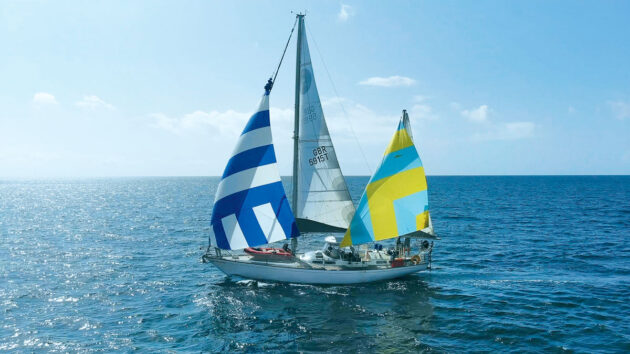
The multitude of rigging on the back of Andy’s yawl meant an airlift would have been tricky without RNLI assistance. Credit: @SailingMelody
Warning signs
Prior to setting off, I went up the mast in Torquay to fix a problem with my masthead light, and I’d noticed a bit of chest pain.
However, I felt that it was muscular, just from being a bit older and a bit fatter and climbing up the mast for two days.
In hindsight, as a paramedic by trade, that was the first shot across the bow I should have really paid attention to.
But, I didn’t know it at the time, so we set off from Torquay at 1300 in great visibility.
The forecast was lovely as we sailed offshore around Start Point and then set a course for The Lizard, the most southerly point of the UK, again staying well offshore.
The boat was on song, everything was working perfectly. We got into the groove, sailing well and got the Hydrovane (windvane self-steering) working for the first time properly.
We’d had the Hydrovane on the boat a while but it was nice to finally use it in earnest.
I’ve been around The Lizard quite a few times in several different boats and in various conditions. On that particular day it was a millpond.
As we were crossing towards Land’s End, we noticed that all of our freshwater had gone from the tanks.
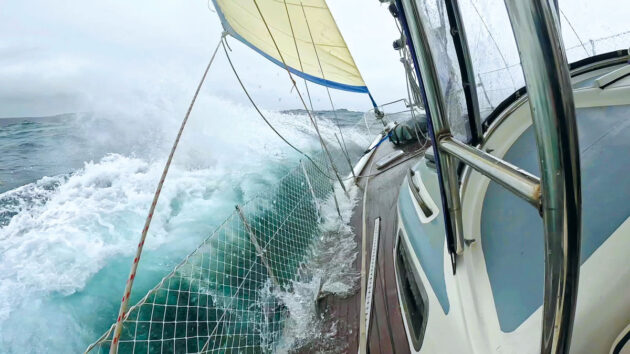
The sea state was around 3m by the time of the rescue and RNLI tow. Credit: @SailingMelody
Necessary diversion
We had been motor-sailing in the calm conditions and it turned out that one of the water pipes in the engine bay had rubbed against the alternator belt and rubbed through, the water had leaked into the bilge.
We were a bit annoyed because we didn’t want to go into port at all, but we diverted to Newlyn fishing port for fresh water and a quick fix on the pipe.
That was all fine, and within an hour we headed out.
Having rounded Land’s End, we set course northward with the intention of going straight up the middle of St George’s Channel, between St David’s Point and Wexford.
We put a couple of tacks in because the wind, as always, was dead on the nose.
The forecast showed a storm from the Atlantic was due to hit Cornwall in 48 hours, but we weren’t too concerned, as we thought, ‘we’ll be 150 miles north by then.’
In hindsight, perhaps it would have been better to go to Padstow then hop across to Milford, but we were set on doing the passage in one.
I noticed a niggling chest pain that was worse when I was sitting back and better when I leant forward, which again with hindsight, is a sign of pericarditis, an infection in the sac around the heart – like pleurisy is an infection in the sac around the lungs.
The heart sits in something like a rubber balloon, in a fluid that allows the balloon to stretch and contract as the heart beats.
If you get an infection in that fluid, it’s extremely painful.
One of the signs is that it’s relieved by leaning forwards and worsens when you sit back.
Despite my paramedic training it just didn’t twig.
I thought it was because I’d been sat in the cockpit of a boat for two days and a night.
On longer passages you’re stiff for a few days but then your body acclimatises and you get used to it. On a three- or four-day passage you just feel a bit sore – boat cockpits are not the comfiest places in the world.
We were heeling and there was a bit of sea state.
I thought, ‘No, you’re just being a wimp.’
At this point, it was just a niggle.
I went off shift and when I came back up on deck, Andy and I had a chat about this storm that was coming in behind us.
Windy and PredictWind were forecasting 25-28 knots so we thought, ‘We’ll put a reef in now; in fact, we’ll put in two reefs.’
Even if that slowed us down a bit then, we didn’t want to be reefing in the dark night in a big sea. So we did all of that, perfect.
It was great fun reefing but quite physical in 1.5-2m swell, bashing up and down.
It gets your heart rate up and when I got back to the cockpit, I said, “Oh God, my chest is really quite painful.”
Andy said, “Go and take five minutes, have a cup of tea and sit down below.”
I went down and then it just hit me like a ton of bricks.
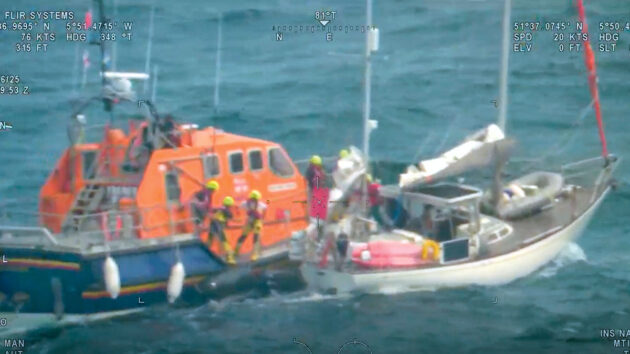
Andy’s friend held his harness to keep him steady as he awaited the yacht to lifeboat transfer. Credit: HM Coastguard
Sense of doom
It felt like an elephant sat on my chest and that’s when I thought, “Oh crap, here we go.”
Because I had all of the classic signs of a heart attack: pain radiating into my neck and into my left arm, central and left-sided chest pain that felt crushing in nature, and an impending sense of doom.
I’ve heard before that you get this feeling of doom, which sounds really dramatic but you really, really do.
You go into panic almost but it wasn’t an anxiety attack that caused the chest pain, it was the chest pain that caused the anxiety.
So I thought, “Just rest, have a cup of tea and if it doesn’t die down in 20 minutes, we’ll do something.’
After 20 minutes, it hadn’t died down, so I said to Andy, “I think we should head for Dale Anchorage,” which is just in the mouth of Milford.
We realised that with the prevailing wind, the fetch would be going straight into the anchorage, it was going to be awful in there.
So I said “Why don’t we go into Milford Haven marina, and if I need to get a taxi to Accident and Emergency (A&E) to get an electrocardiogram (ECG) or checked out, I can.”
Andy radioed Milford Marina to see if we could get a berth and an ambulance on standby.
Their obvious answer was, “You what? He’s got chest pain? We’re not sending an ambulance to wait there for two hours. We’ll send the helicopter out.”
At which point, I was like, “Oh no, no, don’t do that.”
That’s a skipper’s worst nightmare, having the helicopter come out.
As a paramedic I’ve seen lots of call outs to chest pain and they mostly turn out to be nothing.
I was convinced it was muscular chest pain. If you head back into port at every little niggle, you’d never go anywhere.
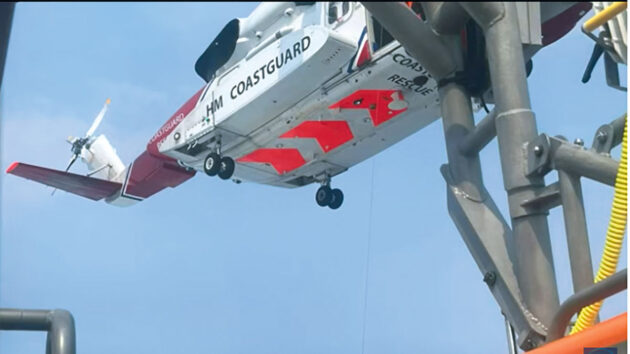
The HM Coastguard Search and Rescue helicopter circled Ocean Melody before requesting RNLI assistance for the airlift. Credit: @SailingMelody
Feeling mortified
I was embarrassed to need the helicopter because I was thinking of all the scenarios of where I should have headed for port earlier.
I felt mortified. But also, deep down, I knew this was necessary because the pain had increased.
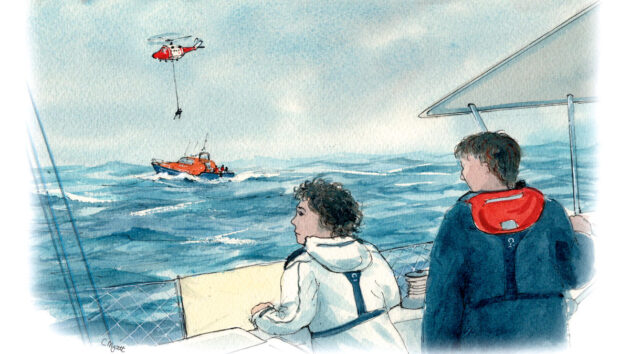
The Coastguard helicopter came out, circled the boat, and decided that they couldn’t lift off our yawl because there isn’t a big back deck and there’s lots of rigging.
So they got the Angle Lifeboat to come out, to whom I’m forever grateful.
It took about an hour for the RNLI crew to get to us; by now the sea state was 3m.
They came alongside and got me onto their boat.
Then the helicopter paramedic winched down onto the back deck of the lifeboat, got me in the harness, and whisked me up.
In the helicopter, I was given morphine, which didn’t do much for the pain at that point but it is a vasodilator and relieves load on the heart.
The paramedic did an ECG and said, “You look, for all the tea in China, like you’re having a heart attack, but the ECG’s very reassuring that you’re not.”
It was the same thing at Royal Cornwall Hospital, the doctor said: “Well, you look like you’re having a heart attack.”
But another ECG said, ‘Not so much.’
Various tests later it turned out that I’d got pericarditis, an infection not a heart attack. So I was pleased.
I had learned in my clinical practice how similar they can look and feel but experiencing it for myself was an eye opener.
Until you wire somebody up to a machine and get bloods done, they’re very difficult to tell apart.
I’m very grateful to HM Coastguard for co-ordinating the rescue and RNLI Angle Lifeboat for coming out. I’m also glad to have such trusted crewmates.
Andy is so switched on that as soon as I got up on the side deck at the stanchion gate to step across to the RNLI boat, he’d already got hold of the back of my harness.
Jack really took it all in his stride too.
After I was airlifted, my boat’s engine was playing up and wouldn’t switch on.
Andy said to the RNLI crew he’d sail into Milford Haven but might need a tow into the marina to get onto the berth.
And they said, “We’re not going to leave you out here sailing back, we’ll tow you in.”
Which they did. They’re just fantastic.
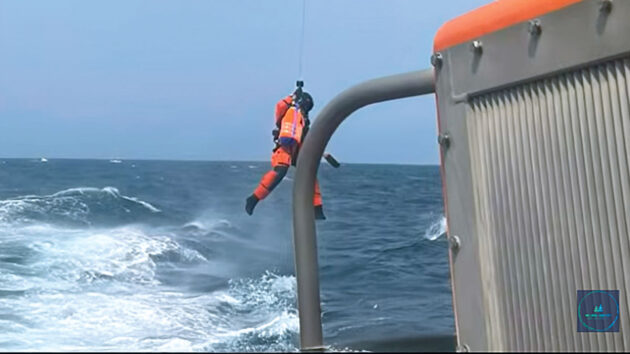
Andy’s airlift was captured by his
onboard cameras. Credit: @SailingMelody
Lessons learned
- Don’t mess about with chest pain. I’m reluctant to say call 999 for every twinge because you don’t want to do that either.
Be rational, but if you think it’s cardiac-related, call for help. - Tell a friend about the niggles. From the moment I said “I’ve got a bit of chest pain”, within 20 minutes it felt like an elephant was sitting on my chest.
- Make a thorough passage plan. Ours was great; we had secondary ports all the way along so we knew where to go if we had a problem.
- Reef early. Putting two reefs in well before inclement weather was expected, was a very good call.
- Pan-pan relay. Throughout the passage, we’d used the VHF antenna to get Met Office forecasts, which we wrote in the logbook.
But when we came to use the radio to talk to Milford, it would only work on receive only.
So we used the VHF handheld radio to do a pan-pan relay via the Celtic Wildcat fishing boat. Have a backup radio and know how to use it. - Satellite communication. We were 25 miles offshore. Our Starlink recreational vehicle (Roam) package does not work more than 12 miles out.
You get a text message saying, ‘Would you like to switch to the maritime package?’ which is the same satellites but £250 a month compared to £95. - Another thank you. It took about eight weeks before I felt better again.
However, I needed to move the boat to Wales after a couple of weeks to avoid racking up a big marina bill.
Andy wasn’t available but a Neyland Yacht Club member came to the rescue and kindly accompanied Jack and me.
About the author
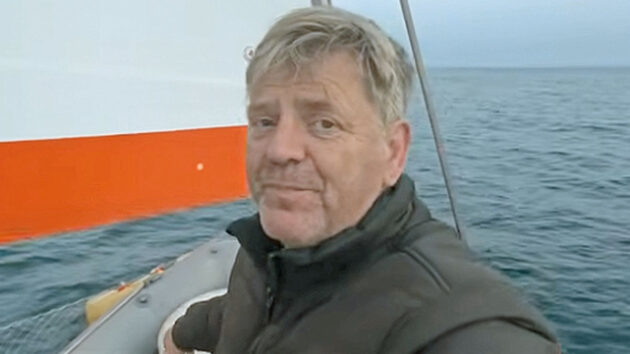
Andy Turner. Credit: @SailingMelody
Andy Turner, 52, grew up in Snowdonia, North Wales and was a keen rockclimber and mountaineer for many years.
His family live aboard their Bowman 46 Ocean Melody and are currently based at Deganwy Marina.
Watch a video about the rescue on YouTube channel @SailingMelody.
Expert response
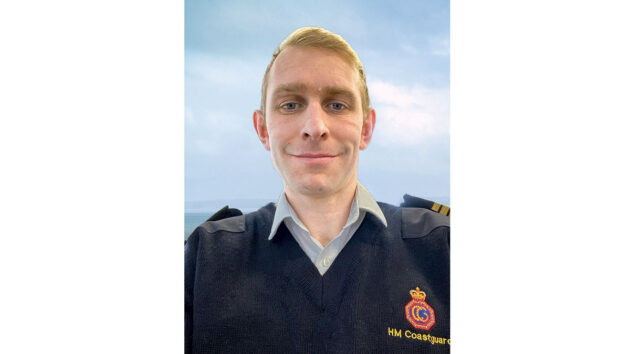
Lawrence Ramsay, Rescue Centre Coordination Manager (RCCM) for HM Coastguard. Credit: HM Coastguard
Lawrence Ramsay, Rescue Centre Coordination Manager (RCCM) for HM Coastguard, comments:
Just like anything else, trips out on the water can and do sometimes go wrong.
What’s important is how boaters and water users react to emergencies, as multiple factors come into play that can help with a rescue.
Several aspects contributed to Andy’s safety:
Firstly, he wasn’t travelling alone.
Other people on board can provide invaluable assistance and support during an incident – by updating emergency services on your condition, directing in a nearby vessel for help, or readying the vessel for a rescue attempt.
Having a proficient and well-briefed crew was a major factor during this incident, and we praise the efforts of Andy’s best friend and son, who both remained calm, focused and safety-minded, despite what must have been a very challenging situation.
We urge mariners to always advise someone of your intended time of departure, time of arrival, and route, so they can raise the alarm if there are any issues or you do not re-establish contact.
And to always carry a means of contact, like a VHF radio and a mobile phone in a waterproof pouch.
Andy was wearing a good quality and fully serviced lifejacket which is vitally important when stepping between vessels, especially while feeling unwell.
If you are incapacitated, a lifejacket will ensure that your airway is clear of submersion, you remain visible in the water and, in the case of Personal Locator Beacon (PLB)-equipped lifejackets, you’re able to provide a frequently updating location to emergency responders.
Finally, we often hear of casualties who feel guilt around calling for emergency assistance, either over raising the alarm too soon, or their rescue ending up being a false alarm, albeit with good intent.
I understand Andy’s concerns but it’s so important to call the Coastguard if you feel you’re in trouble at sea or on the coast.
Prompt and accurate reports provide us with valuable time and information that could prove crucial.
We’d rather stand down a response than be too late.
Send us your boating experience story…
…If it’s published you’ll receive the original Claudia Myatt-signed watercolour which is printed with the article. Email: pbo@futurenet.com
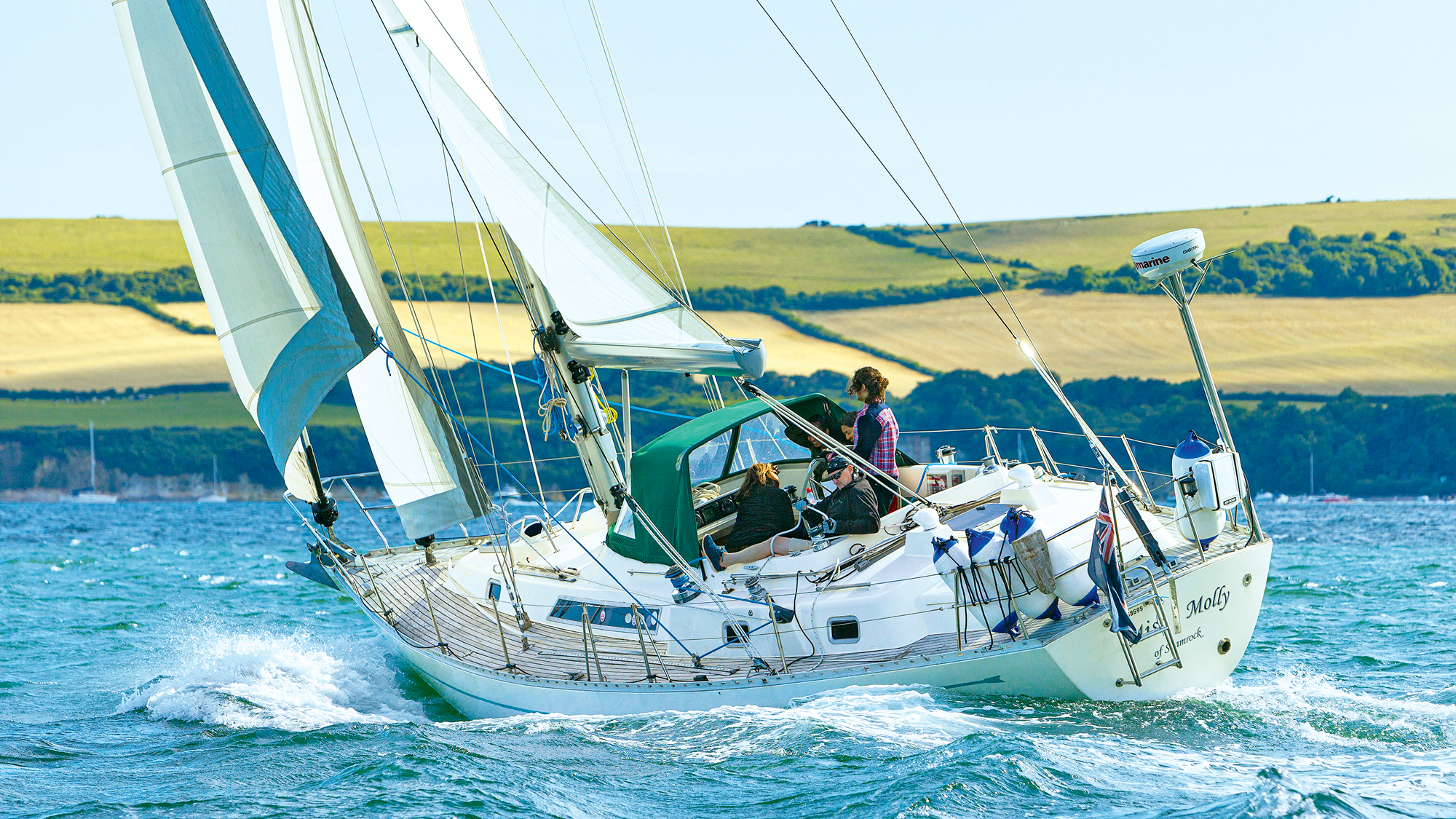
Comparing the Oyster 406 and 7 other designs
Lovers of the Oyster 406 and other centre cockpit concepts will know that the style has largely died out among…
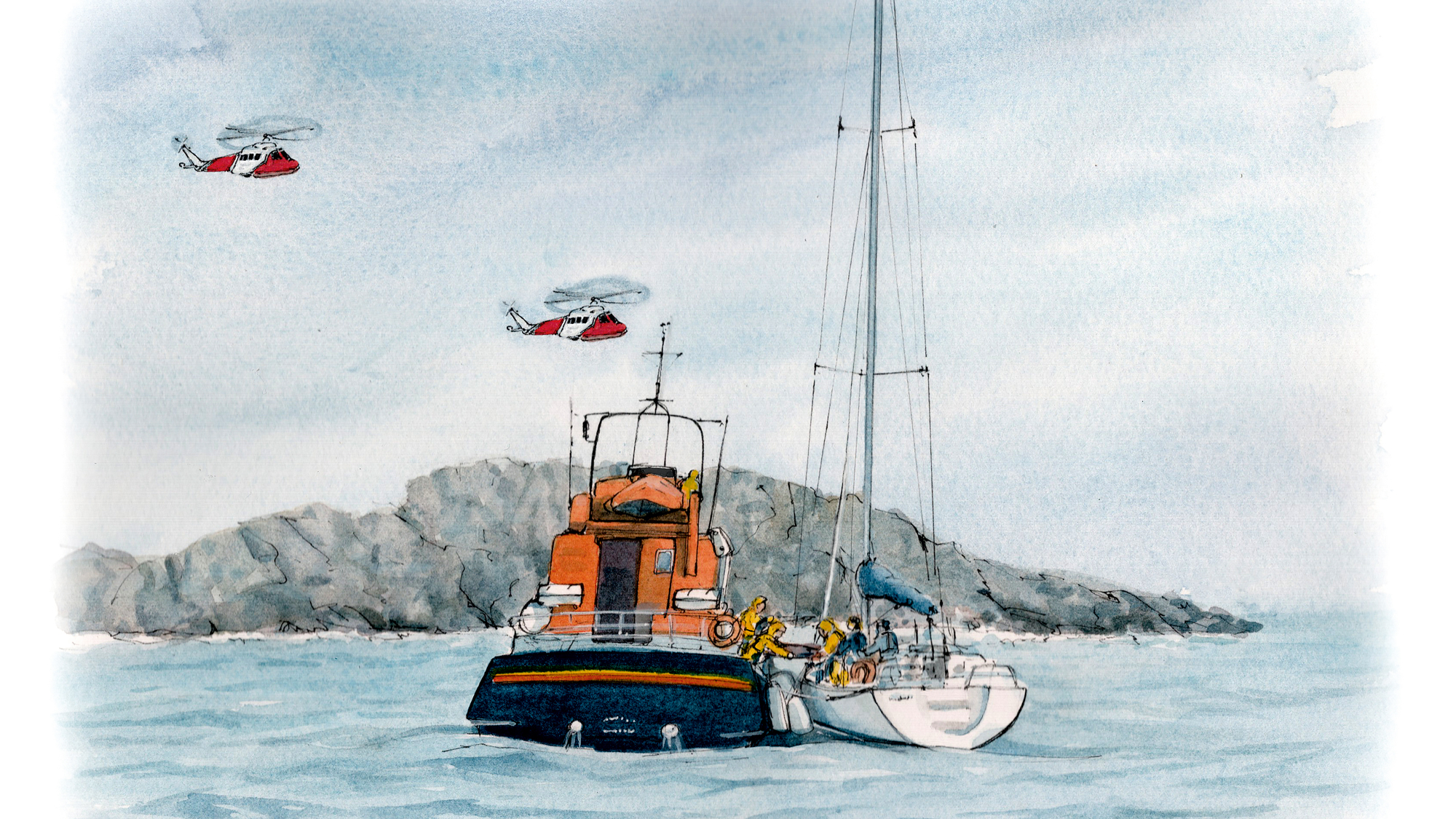
A stroke off the Isles of Scilly: How a medical emergency left this skipper’s wife “hanging from a wire in a near gale”
Early July 2025 found my wife, Veronica, and I sailing in our Dufour 40, Spook from Falmouth in Cornwall to…

English Channel boats: the best power and sail vessels under 40ft
You don't need a big boat to cross the English Channel, just the right boat. Duncan Kent recommends some suitable…
What to read more Learning from Experience tales?
A subscription to Practical Boat Owner magazine costs around 40% less than the cover price.
Print and digital editions are available through Magazines Direct – where you can also find the latest deals.
PBO is packed with information to help you get the most from boat ownership – whether sail or power.
-
-
-
- Take your DIY skills to the next level with trusted advice on boat maintenance and repairs
- Impartial, in-depth gear reviews
- Practical cruising tips for making the most of your time afloat
-
-
Follow us on Facebook, Instagram, TikTok and X