



Keep a very long rope handy and, if launching single-handed, find a bystander to help... preferably one without a Rottweiler, advises Clive Marsh
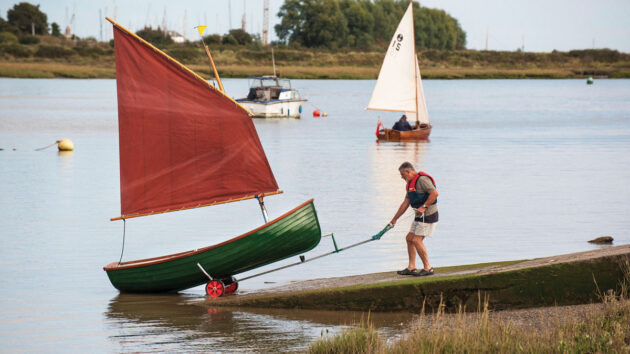
When dinghy launching, I plan the procedure very carefully. But often a last-minute event will throw a spanner in the works, like a rogue wave or wash from a trawler.
I tend to sail single-handed so retaining the boat while taking the trailer back up the slip requires the dexterous use of long ropes. Often while I am faffing around a passing trawler will push against the flood tide and create a standing wave that repeatedly lifts and drops my beloved dinghy onto the concrete slip, or worse drags her out into the river. There is simply nothing to tie the boat onto apart from a wall with submerged metal projections that can split a boat’s gelcoat.
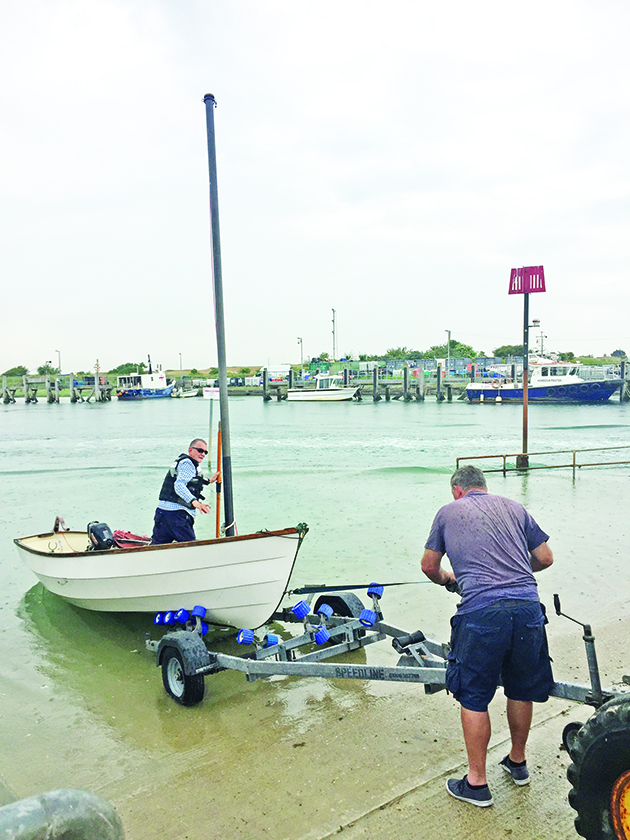
Clive keeping his feet and bearings dry. Credit: Maurice Burgess
But somehow, something or someone usually turns up and a few weeks ago it was a slightly built woman with a giant dog, which turned out to be a Rottweiler-German Shepherd cross. I approached cautiously putting on my best dog-friendly face. It was having none of it and gave me a fixed look. The dog owner reassured me that her pet was fine (as owners always do) and mumbled something to her beast which accepted me as a temporary but very probationary member of the pack.
She kindly offered to hold the painter and not let go. This worried me a bit because the slipway ends abruptly with a 17ft drop. I now had one extra thing to watch out for and if I had to grab her the dog would certainly have taken a dim view. But all went well. I dumped the trolley and ran back to my helper, perhaps a bit too fast for her dog’s comfort.
Sometimes you can’t plan for everything and you need to spot an opportunity or have a bit of luck.
Various dinghy launching methods
Some people rely on divine intervention, which reminds me of an old shipmate who was the son of a Welsh offeiriad (a parson).
As you’d expect he was a religious chap and carried a bible, often quoting phrases to me when faced with a new problem. It seemed to work for him, he was very competent and relaxed most of the time. As the senior cadet officer, I wondered what he had done wrong to end up with me on this old tub, soon to be scrapped. I would soon find out.
A year earlier he was assigned to one of the company’s better ships on its way to Cuba. It was the time of the Cuban Missile Crisis and the company regularly traded between Russia and Cuba. He decided that, as a protest I suppose, he would delay the ship. Between watches, and with the help of a mate, he launched the ship’s jolly boat. This was done at night with the use of a very long painter. Of course, they were not missed until due on watch.
The ship re-traced its course with all hands on lookout for this needle in a haystack. They were not found but with divine intervention – or luck – they were spotted by the US Coast Guard and recovered.
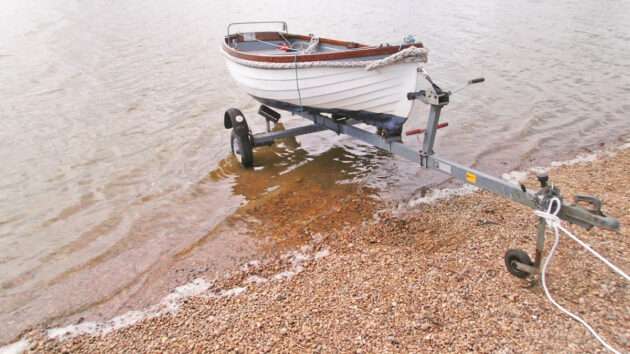
Use a long rope in places where a car can’t get close. Credit: Clive Marsh
It is not at all easy to launch a boat from a moving ship unless the vessel has specially designed equipment and a rigid inflatable boat (RIB). This merchant ship just had a swing davit, pulleys, ropes and the long painter. The ship would have been travelling at about 14 knots with those on the bridge unaware of what was going on.
The risk of collision with the ship and capsize would have been high. With no prior practice, my friend’s level of seamanship must have been good. It would have been useful in a man overboard situation where a boat needs to be launched quickly to make a recovery. He eventually became a ship’s captain. But before then, he had to serve his time on the aged old tub with me.
Enough of old yarns and back to the single-handed launching of small boats from a slipway or hard with an unbraked trolley with a jockey wheel…
Single-handed dinghy launching from a trolley:
1 Have a rope (painter) long enough to secure to the nearest strong point that will reach the boat when it floats off.
2 Ensure there is a line attached to the front of the trolley.
3 Proceed cautiously down slipway – at an angle if it’s steep, to reduce speed.
4 Make sure the painter is long enough to keep the boat afloat just a little way out.
5 Take the trolley up the slipway to a safe position.
6 Untie the painter from the secure point on top of slipway and walk to the boat, You have control.
7 Pull the boat in, stow the rope, climb aboard and go.
This is how I recover:
1 Walk the painter (attached to the bow) up slipway and attach to a strong point.
2 Bring the trolley down and float the boat onto it. Secure stem/bow to trolley.
3 Pull the boat up the slipway at an angle.
4 If it’s too heavy, you will need a winch on your trolley attached to the long rope.
5 Have wheel chocks in case you need to secure the trolley during the operation.
6 Once the boat and trailer are on the flat, it will be easy enough to push.
7 If need be, remove the mast, yard, boom, oars, rudder etc to make the boat lighter and easier to move.
Of course, if there are willing hands about to help you might be able to avoid all this and just roll her down and up.
Having got the boat safely ashore on her trolley, I might want to pull it onto a road base trailer. This can be done by hand or winch and will require careful handling and alignment. It gets easier with practice.
For bigger boats I use my car or hire a tractor and use my swinging cradle trailer. The only problem here is congestion on the main slipway. Using the tractor with a driver I can at least keep my feet dry.
When trailer-sailer launching or hauling out by car, I always use a long rope in order to keep the car wheels well clear of water or slimy mud on the slipway, especially when using a vehicle without four-wheel drive.
Before detaching an unbraked trailer from a tow bar, and before attaching a rope, I chock the trailer wheels so it does not go careering down the slipway.
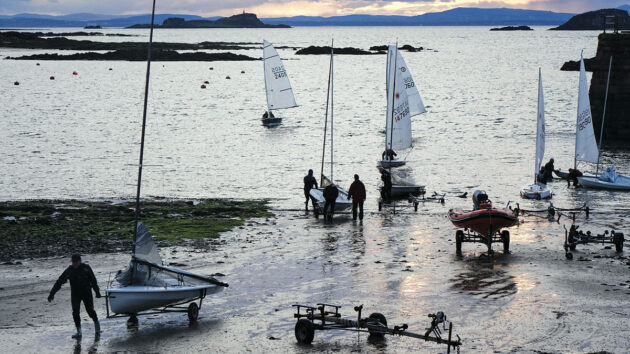
End-of-evening dinghy recovery. Credit: Derek Braid/Alamy
To avoid the challenge of reversing a trailer in the yard or down a busy slipway, I fitted a removable tow bar to the front of my Jeep, which made it is much easier to manoeuvre the boat in front of the vehicle. However, there are strict rules regarding the installation and use of a front tow bar. Seek advice from an authorised fitter.
Launching and recovery requires different techniques depending on the ground (concrete, sand, mud, stones, etc) and also on the prevailing conditions of wind, tide and surf. Each combination of these challenges requires a different set of techniques, but I find a stout and very long rope solves most problems.
Careful planning and the use of the brain rather than brawn is always key and will help prevent back and other injuries.
If things don’t go to plan, and you ask a bystander to assist, make sure they are strong looking and able to follow your instructions. Avoid those with big dogs.
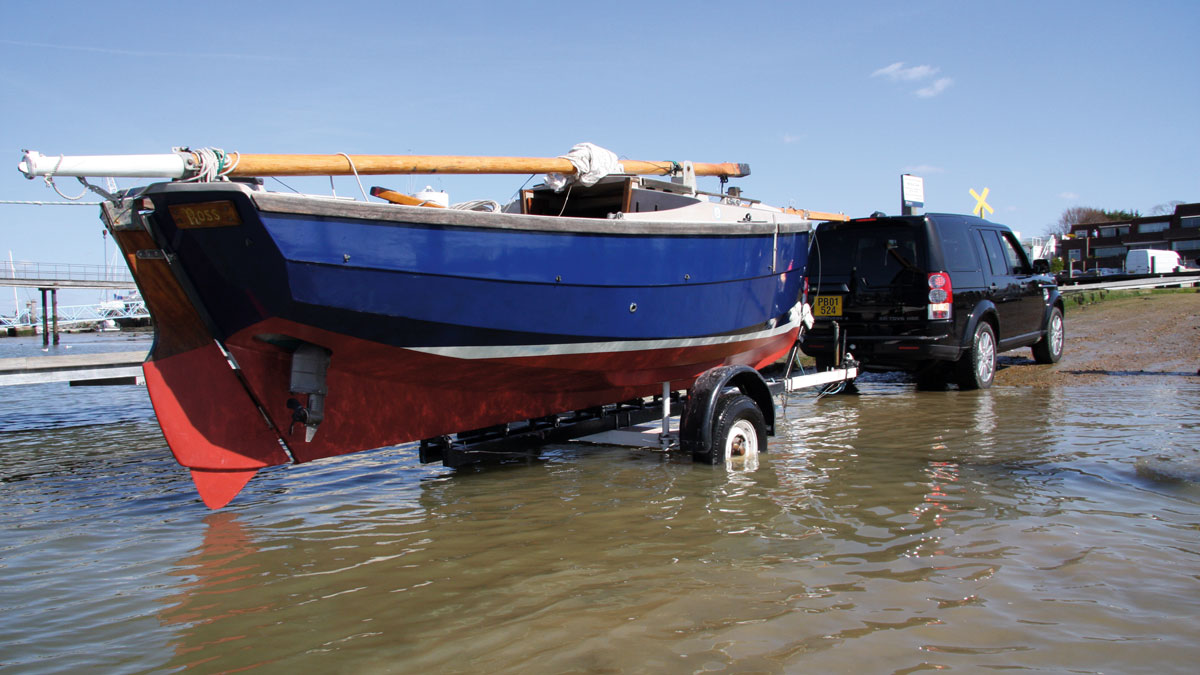
Boat launching and recovery without the drama
Launching a boat off a trailer should be a piece of cake, but tricky slipways can easily turn your dream…
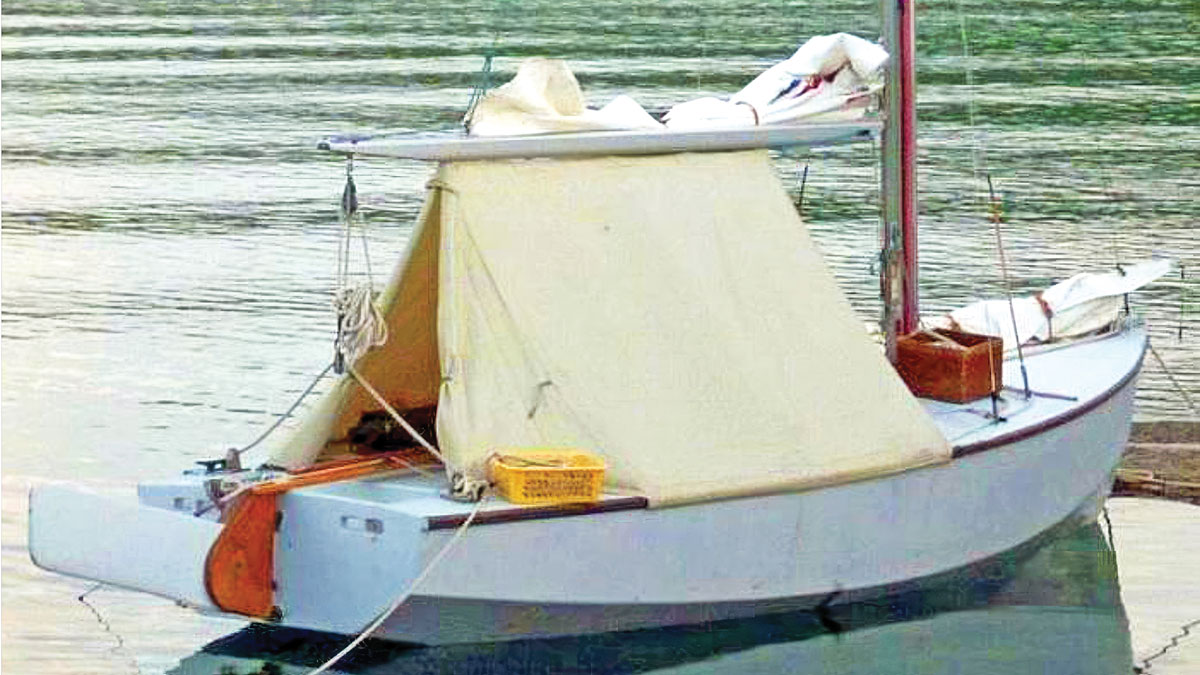
The Grey Boat: A masterclass in DIY dinghy design
Sometimes the most inspiring craft can come in modest forms. Clive Marsh looks at The Grey Boat
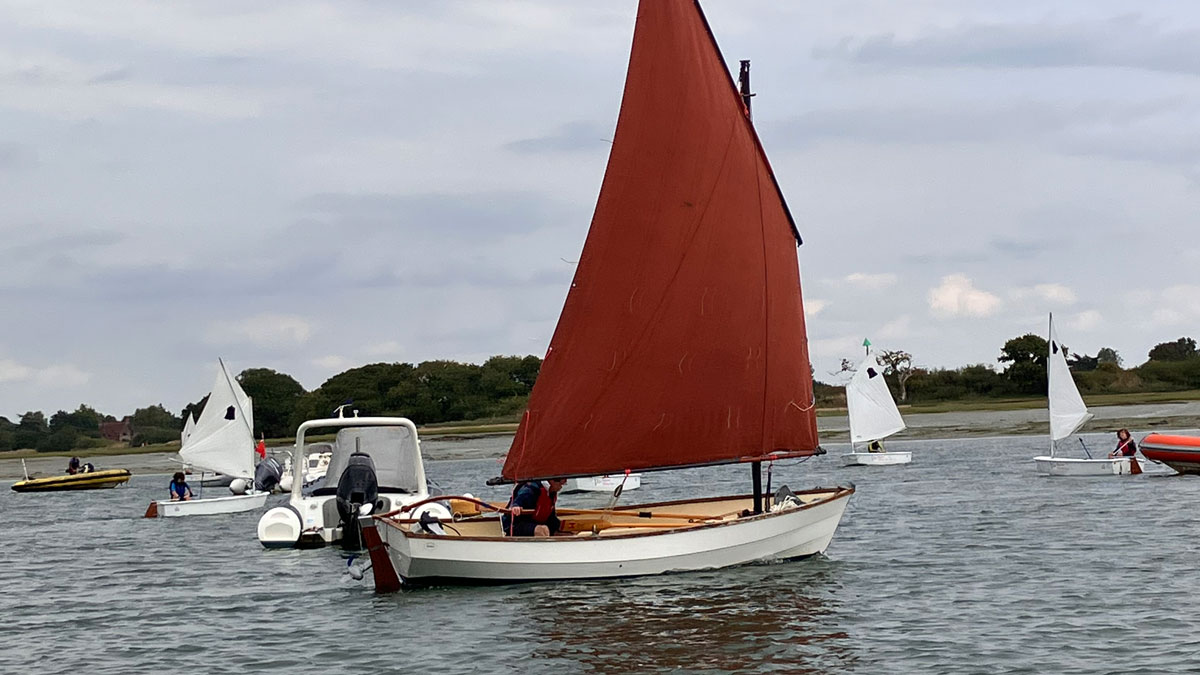
Boom droop and other start of season ailments
Beware the insidious boom droop and your crew will thank you for it – and don’t forget to dig out…
Which is the best cruising dinghy?
Clive Marsh explains what he looks for in a lightweight cruising dinghy
Want to read more articles like Dinghy launching tips from a prolific small boat owner?
A subscription to Practical Boat Owner magazine costs around 40% less than the cover price.
Print and digital editions are available through Magazines Direct – where you can also find the latest deals.
PBO is packed with information to help you get the most from boat ownership – whether sail or power.
-
-
-
- Take your DIY skills to the next level with trusted advice on boat maintenance and repairs
- Impartial, in-depth gear reviews
- Practical cruising tips for making the most of your time afloat
-
-
Follow us on Facebook, Instagram, TikTok and X