



Sometimes the most inspiring craft can come in modest forms. Clive Marsh looks at The Grey Boat
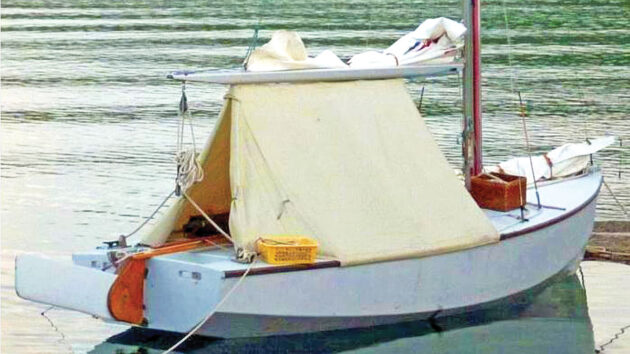
Keeping my boats in various mud berths at Rye, I’ve found that it has always helped to have a grey hull. If you don’t your boat will soon end up grey anyway. Of course, grey is also the preferred colour of our own Grey Funnel Line, and they always look smart with their crisp white ensigns.
They are not so visible at sea but that’s how they like it. But on a pleasure boat grey is such a restful colour, and I’ve had many.
I was, therefore, delighted to recently see The Grey Boat (not just any old grey boat). Over the years the Dinghy Cruising Association (DCA) has been following the exploits of The Grey Boat’s designer and owner John Perry and his partner Josephine Street.
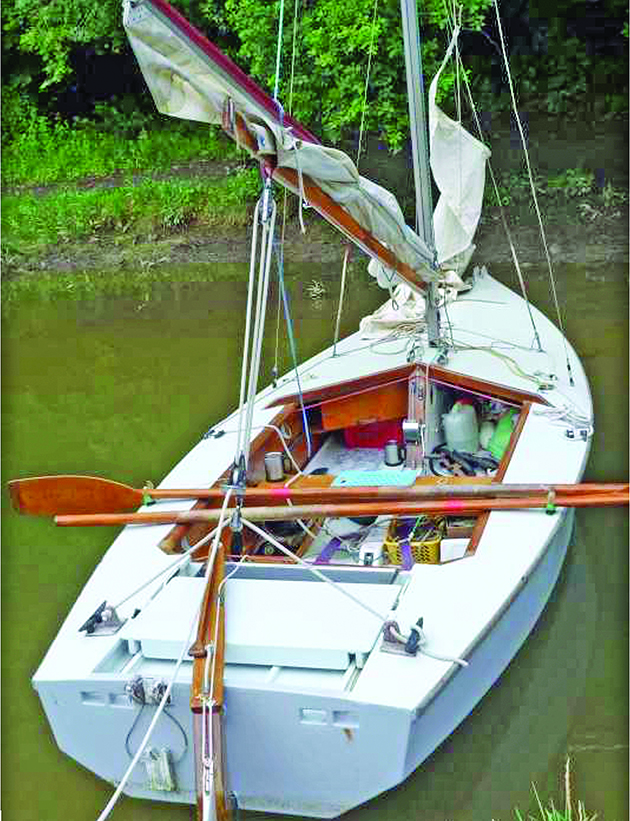
The Grey Boat has a tensioned steering line that runs around the cockpit, routed through four small pulleys and one small metal fairlead. Credit: John Perry
It was 50 years ago when Perry designed and built The Grey Boat to meet his specific requirements and since then the couple have sailed her to the Channel Islands and cruised off France, Spain, Croatia, Amsterdam, Friesland, the Venetian Lagoon, the UK coast and a whole lot more. In all, many thousands of miles and many more places visited than by many yacht owners.
One of the great benefits of dinghy cruising is the ability to tow your boat to many different locations. I too have visited far more harbours and stretches of coast in cruising dinghies than I ever managed in yachts.
I’ve now owned around 70 boats and the reason for this is because I have not yet found one that has all of the features I like, and the compromises have often meant that if I want one thing then I have to forego another.
Neat features on The Grey Boat
The great advantage of building your own boat is that you can incorporate all of your own ideas and get a boat that is perfect for you. Perry is an engineer so would have a natural ability to solve problems and get things right just as he wanted them to be.
Here are some of the features and dimensions of The Grey Boat:
- A unique tensioned steering line that encircles the cockpit. This enables the craft to be steered from any position in the cockpit up to the mast. What a great idea. As a single-handed sailor, I’d find this very useful.
- A choice of rigs, gunter or Bermudian. The gunter rig has a shorter mast which is easier to stow when trailing and easier to step.
- A cunning device that allows water to flood one side of the buoyancy tank if there is an inversion to enable easier righting.
- A 10gal freshwater tank to keep you going for a few days. This is housed under the cockpit sole and, therefore, adds to internal ballast thus increasing stability.
- 35 cubic feet of stowage including space for a galley. This is quite an achievement in a 15ft boat.
- She is double chined, plywood with GRP sheathing. Perry mentions that today he would have chosen epoxy rather than polyester but 50 years ago epoxy was not so readily available. I don’t like GRP sheathing either but, for the most part, it seems to have lasted well.
- 75kg of lead ballast is positioned near the tip of the centreboard with the intention of making her self-righting.
- She is self-draining and designed to be unsinkable (more about self-draining follows).
Sensible solutions
Engineers are natural problem solvers and Perry’s boat is full of sensible solutions and ideas to counter the inconveniences we meet while sailing dinghies.
The self-draining cockpit is particularly useful if you want to keep the boat afloat on a mooring. Yachts generally have a more complex draining system which may involve tubes, jubilee clips and seacocks, all requiring maintenance. Even worse, they may require a hole in the hull beneath the waterline.
I once had a nice little 17ft trailer-sailer that just had two drain holes a little above the waterline at the after end of the sloping cockpit sole. Any water simply drained into these and out through the transom. No holes beneath the waterline, until the boat was heeling – perfect for mooring afloat and no maintenance.
For sailing I tended to keep two quick release plugs in the holes to prevent ingress when heeled. I often wondered why more cruising-type dinghies didn’t incorporate this system. I have never been a huge fan of those self-draining metal flaps used on the sole of racing dinghies that might let water in when going slowly if you forget to close them. Also, even when closed, they often leak.
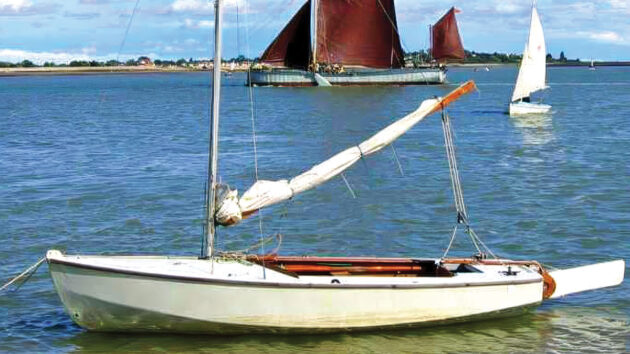
The Grey Boat at Mersea, Essex. Credit: John Perry
The Grey Boat has considered self-draining for a cruising dinghy and has come up with an appropriate solution. While on the subject of self-draining several of my boats simply had drainage from the side benches (Drascombe Lugger, Dabber and Sailfish). A pump was used to clear the sump and sole. This was a good solution and enabled the cockpit sole to be deeper so that the boats were more sit-in than sit-on.
To help avoid a capsize and facilitate at least a degree of self-righting the Grey Boat has the lower end of its GRP centreplate filled with lead providing a lower centre of gravity than can be achieved with just a steel plate. This, under certain circumstances, will reduce the risk of capsize and aid with recovery.
The more features and strength built into a boat, the greater the weight. This might not be a problem if you always intend to use your car for launching from a slipway. I prefer hand launching so that I’m not limited to crowded slipways, so weight reduction is important to me.
The DCA is full of members who, like Perry, have many ideas to share about how to build, find or modify a boat that fits your needs. Their meetings around the country are well attended and are useful events to exchange and learn new ideas.

Dinghy Cruising Association at 70
The Dinghy Cruising Association may be 70 years old – but it’s never been so on trend, reports Laura Hodgetts

Dinghy cruising: 30 ways to experience the ultimate small-boat adventure
Ben Lowings shares his tips for dinghy cruising around the UK and further afield
Which is the best cruising dinghy?
Clive Marsh explains what he looks for in a lightweight cruising dinghy

Cornish Crabber 12: the dinghy that combines gunter rig tradition with surprising stability and space
Dinghy design is a complex balancing act, but the Cornish Crabber 12 manages to be roomy, stable, and fun to…
Want to read more articles like The Grey Boat: A masterclass in DIY dinghy design?
A subscription to Practical Boat Owner magazine costs around 40% less than the cover price.
Print and digital editions are available through Magazines Direct – where you can also find the latest deals.
PBO is packed with information to help you get the most from boat ownership – whether sail or power.
-
-
-
- Take your DIY skills to the next level with trusted advice on boat maintenance and repairs
- Impartial, in-depth gear reviews
- Practical cruising tips for making the most of your time afloat
-
-
Follow us on Facebook, Instagram, TikTok and X