



Which is the best single-point vertical lift recovery method when faced with a man overboard? David Harding examines the best way for MOB recovery
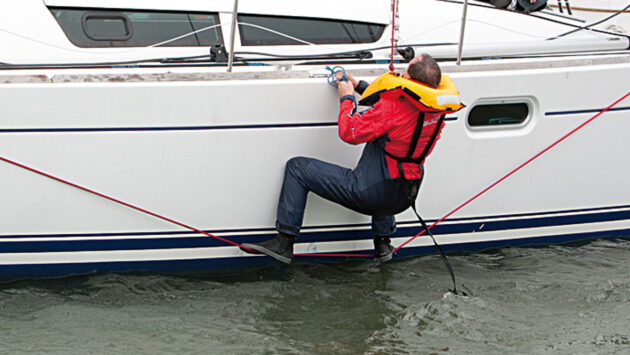
Two words guaranteed to set the adrenaline pumping on a boat are ‘man overboard‘. If there were only two of you to start with, you might just hear a splash followed by a muffled cry for help – but the effect is the same: you need to locate and then perform MOB recovery to get the crew member back on board.
In this article, we will be looking at the logistics of hauling a waterlogged person back on deck. For the exercise, we joined forces with RYA Yachtmaster instructor Sticky Stapylton, Aquasafe Powerboat School and members of Newbury Yacht Club who had lined up their boats alongside the pontoon at Lymington.
Each boat has one of its crew – or another volunteer – jump in the water so they could test their own particular MOB recovery method. Some crews used patented devices but most had developed their own system
We’re looking mainly at those that rely on the MOB being conscious and able to attach a halyard or lifting tackle to the ring on their lifejacket. That way, he or she is secured by a single point and lifted out vertically.
All of the recovery methods were first demonstrated with the boats alongside a pontoon before several headed out into the Solent to try them underway.
MOB recovery method: single-point vertical lift
Double-ended boathook clipped onto lifejacket and spinnaker halyard
The system developed by Debby Lloyd and Philip Clement on their Jeanneau Sun Odyssey 37, Galadriel, is a good example of a single-point vertical lift that works when the MOB is wearing a lifejacket.
It uses equipment that’s fitted to many boats, including a spinnaker halyard and an electric anchor windlass, together with something more unusual in the form of a specially-made boat hook with a hook on each end.
The significance of this is shown in the photo sequence below. Debby and Philip performed the MOB recovery under power.
Credit: David Harding
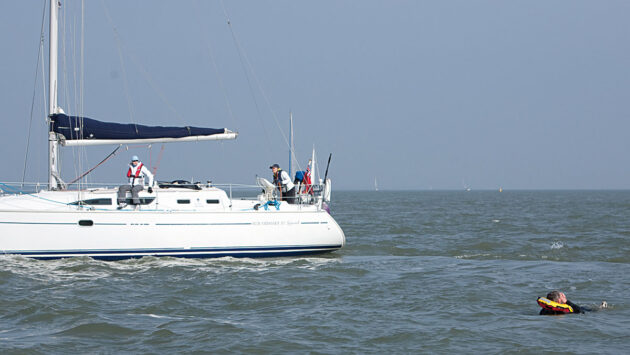
1. Philip is in the water and Debby spins the boat around in a circle to get back to him…
Credit: David Harding
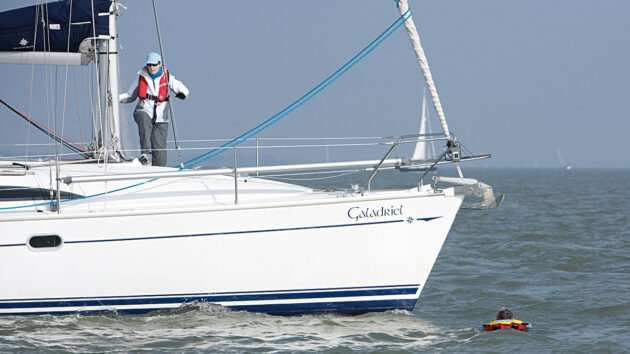
2…before approaching from the windward side to keep Philip in the lee of the hull.
Credit: David Harding
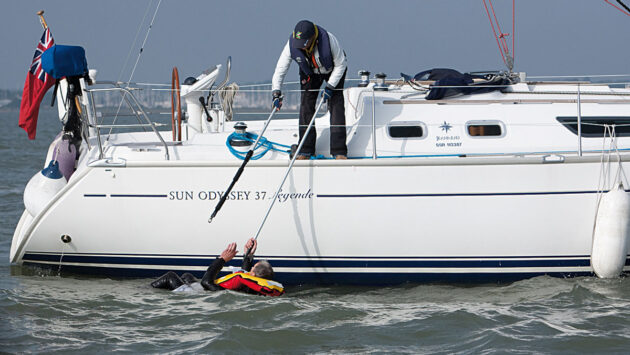
3. Debby uses a conventional boat hook that Philip grabs hold of to make the initial contact with the boat. She then passes him the double-ended boat hook and holds him alongside with the other one while he clips the hook on to the ring of his lifejacket.
Credit: David Harding
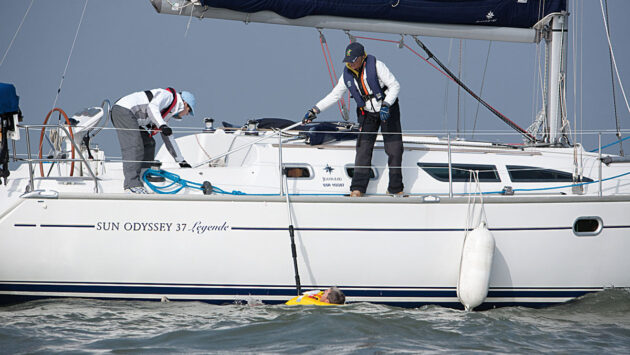
4. This is a crucial phase of the MOB recovery operation. Philip is now attached to the boat and is not going to drift away while Debby prepares the recovery system.
Credit: David Harding
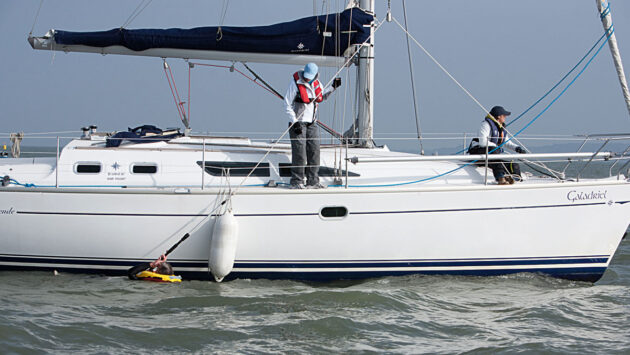
5. Debby has shackled a block with a 2:1 purchase to the spinnaker halyard. She attaches one end to the boat hook and takes the other end through a bow cleat to feed it on to the anchor windlass.
Credit: David Harding
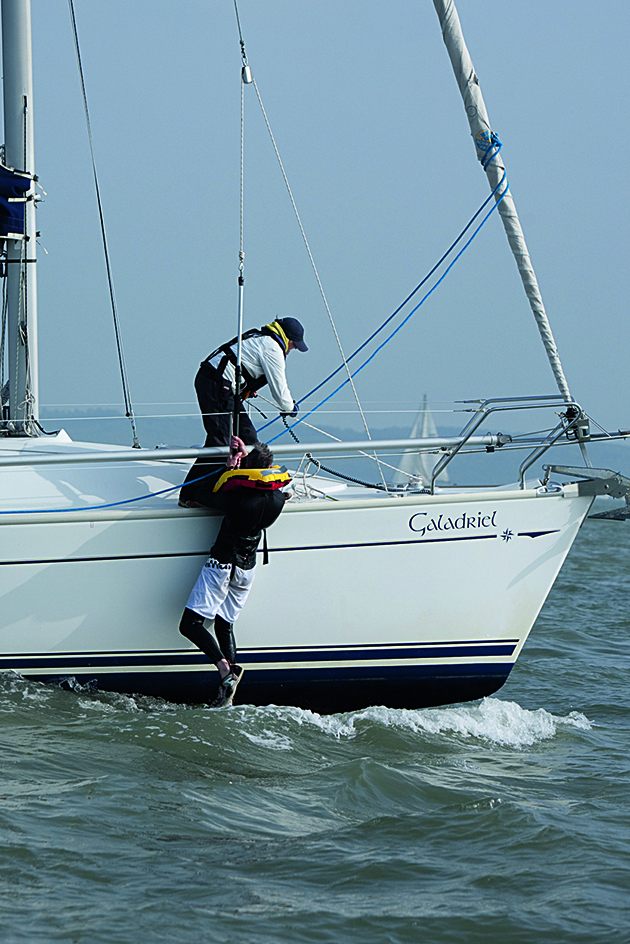
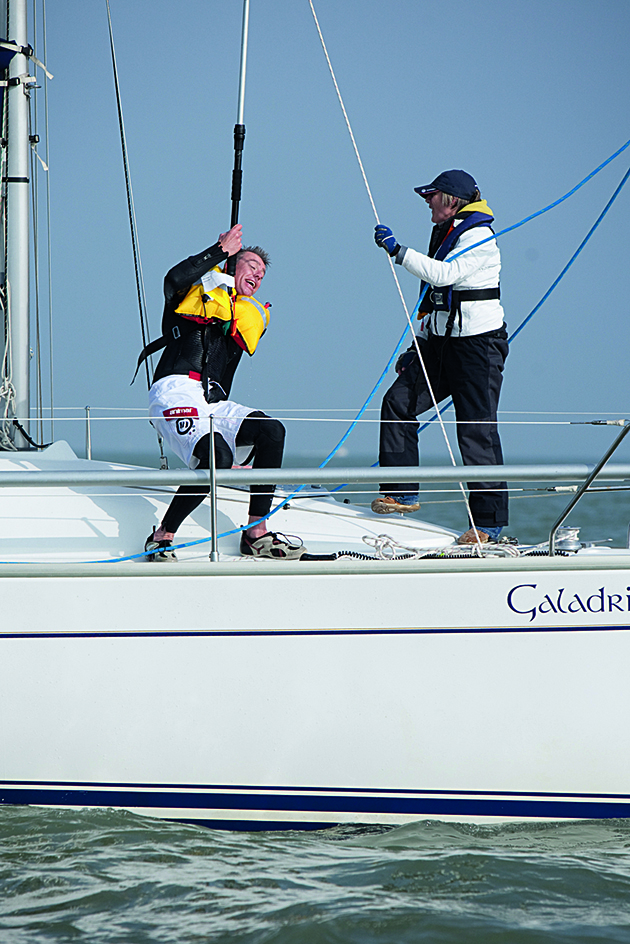
6. Having winched the halyard higher to raise the block further off the deck, Debby now uses the windlass’s remote control to start hauling Philip out of the water…
Credit: David Harding
7…and back down on the deck. Note how the boat hook remains in place throughout.
Sticky Stapylton comments:
Using the double-ended boat hook is a good way to secure the MOB once you’ve got back to her or him, otherwise there is always a danger of becoming separated again while you are rigging up the recovery system.
On the other hand I wonder what the effect would be in a heavy sea of the rigid connection between the MOB and the boat?
Other potential drawbacks include the fact that the crew is operating from the foredeck, where the boat’s movement is likely to be greatest and from where – if you’re the only person left on board – it’s not possible to reach the throttle or sails to control the boat’s position or its angle to the wind or seas.
Those points apart, it seems a simple, reliable and effective system. It also employs two boat hooks, which is a good thing because it is all too easy to lose one when trying to recover an MOB.
PBO comment:
It is vital to secure the MOB alongside while you are preparing the recovery system.
Variations of this MOB recovery method
1. Securing strop clipped on to lifejacket and spinnaker halyard
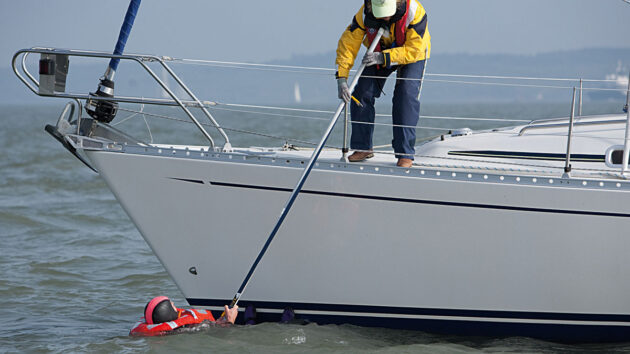
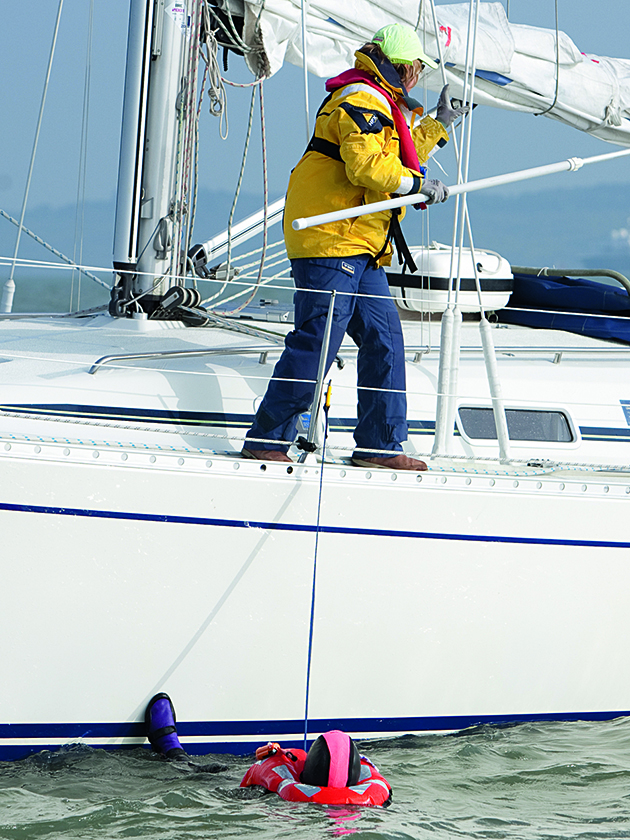
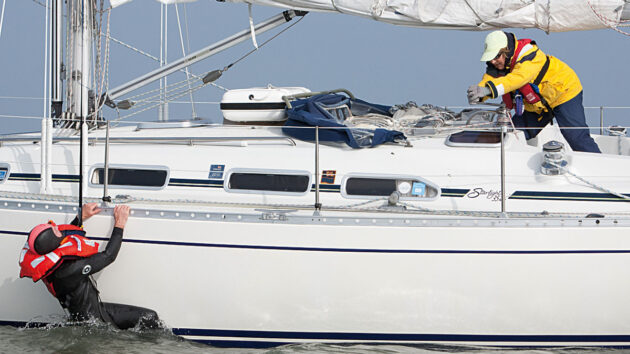
On their Starlight 35, Aurora, Peter and Chris Jones used a similar system to that developed by Debby and Philip on Galadriel. Instead of a second boat hook, however, they favour a simple lifeline (a length of webbing with a hook at each end) to secure the casualty in the water.
Credit: David Harding
1. Chris passes the boathook with the lifeline attached down to Peter in the water.
Credit: David Harding
2. Peter clips one end to his lifejacket and Chris secures the other to the guardwire…
Credit: David Harding
3. …before attaching it to the spinnaker halyard and lifting Peter back aboard using the coachroof winch.
Sticky Stapylton comments:
This shows the alternative approach to that employed on Galadriel: use of a strop rather than a boat hook to secure the MOB alongside the boat, and a coachroof winch rather than the anchor windlass to provide the lifting power.
Both achieved their objectives admirably in the conditions we experienced on the day. Which would be more successful in extremis we can only hope the crews never have to find out!
PBO comment:
A few simple lifelines with a hook at each end can be useful in many situations on board/
2. Securing strop clipped on to tackle and spinnaker halyard
Charlie Close-Smith uses a 6:1 purchase (handy billy) attached to the spinnaker halyard of his Mystery 35, Agatha. The tail of the purchase is run aft through the headsail’s sheet car to the coachroof winch. Charlie says this provides enough purchase even for his eight-year-old daughter to winch him back aboard.
This time it was Charlie doing the winching and a life-size (and weight) dummy that was thrown overboard.
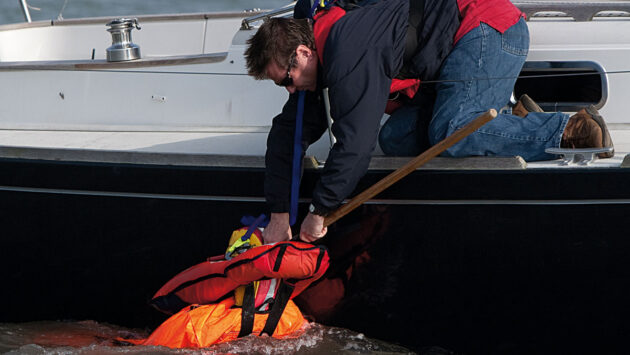
Credit: David Harding
1. Agatha’s low freeboard makes it relatively simple for Charlie to grab the dummy with the boat hook and secure ‘him’ to the boat.
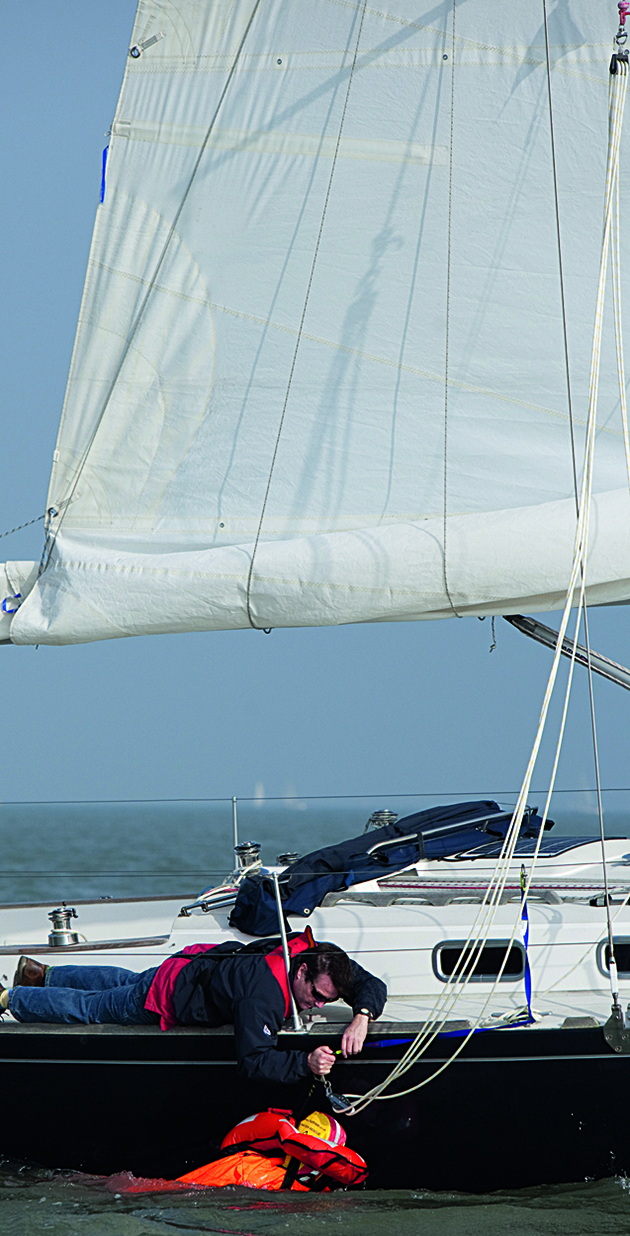
Credit: David Harding
2. Being this close to the water, Charlie doesn’t have to rely on the MOB being able to attach himself to either the temporary strop or to the lifting tackle.
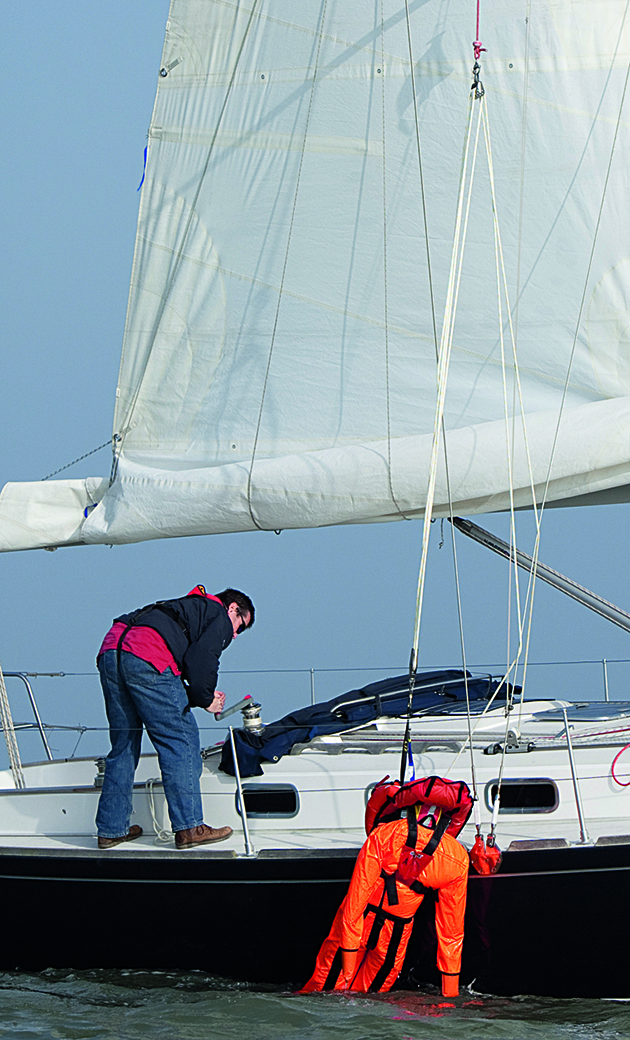
Credit: David Harding
3. With the fall of the purchase led down through the headsail sheet’s car on the coachroof and aft to the winch, Charlie now lifts the dummy out of the water.
Sticky Stapylton comments:
Most modern boats have such high freeboard that it’s impossible for the on-deck crew to reach the MOB. The Mystery 35‘s deck is relatively close to the water and this makes life much easier.
The combination of a 6:1 tackle and a coachroof winch provides so much power that very little effort is needed to lift even a fully-grown, fully-dressed, waterlogged man back aboard.
PBO comment:
A handy-billy is another piece of kit worth keeping in the locker for all sorts of applications
3. Oscar rescue sling and spinnaker halyard
The only crew to use a patented MOB-recovery system for our exercises were Tom and Karen Sperry on their Sigma 41, Nightlife. The Oscar rescue sling was used to bring Tom back to the boat and stop him from drifting away while Karen passed him a lifting strop attached to the spinnaker halyard.
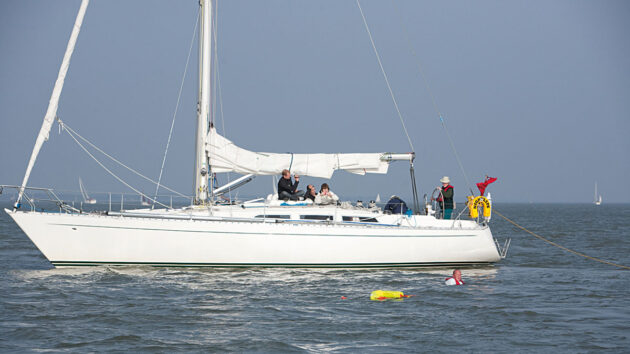
Credit: David Harding
1. Using the Oscar, Karen has no need initially to bring Nightlife right alongside Tom: she circles so he can grab the sling.
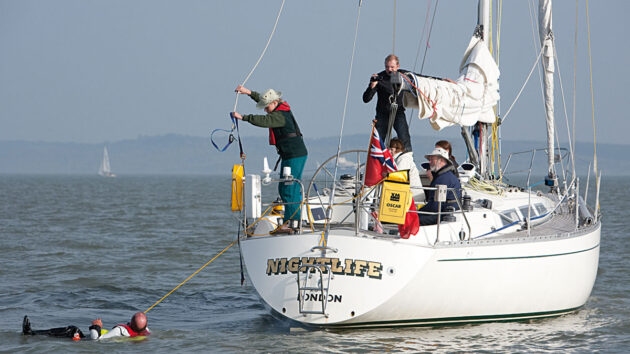
Credit: David Harding
2. Now Tom has climbed into the sling and the retrieval line has been winched in to bring him close to the boat. Karen passes him two lifelines with carbine hooks joined together.
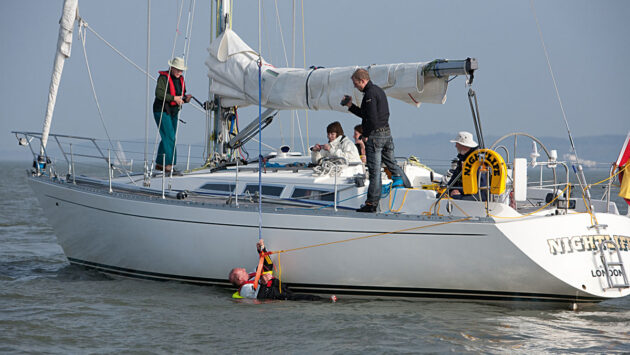
Credit: David Harding
3. Nightlife has a self-tailing spinnaker winch at the mast, which Karen uses to haul Tom back up on deck.
Sticky Stapylton comments:
Manoeuvring the boat to bring the rescue sling close to the MOB isn’t as easy as it might appear – it takes practice. Once the MOB is in the sling, he’s attached to the boat and not going alongside, the retrieval line can always go far. When he’s moved to secure him at a better angle if necessary.
After this, it’s a similar recovery as with the other vertical-lift systems, though in this case the attachment to the MOB doesn’t rely on his wearing a lifejacket because the rescue sling has its own attachment point.
PBO comment:
Stow the rope in rescue slings with care to make sure it doesn’t go overboard in a tangle
4. Backstay-tensioning tackle
Another crew to engage the services of the dummy were Mike and Jo Bassett on the Nordship 32, Hotch Potch. They decided to make use of what they had most readily available to lift him back aboard: a 4:1 tensioner on the split backstay. That meant bringing him in over the stern.
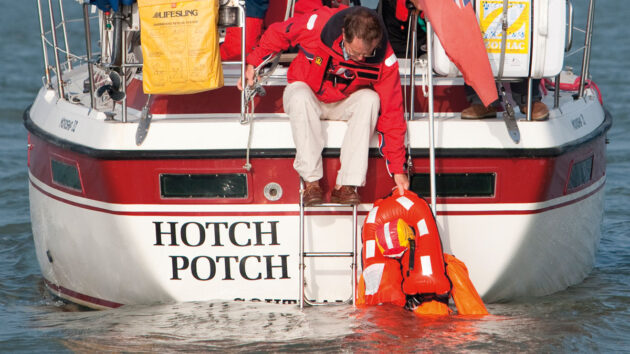
Credit: David Harding
1. Mike sits on the stern, keeping the dummy alongside with one hand and with the backstay tackle ready in the other.
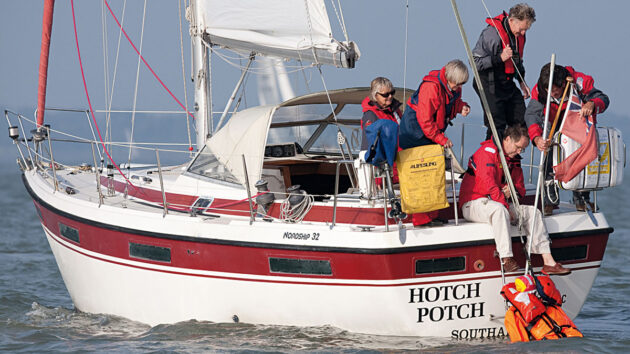
Credit: David Harding
2. The dummy is now secured from his lifting point and Mike starts hauling on the tackle to bring him up the transom.
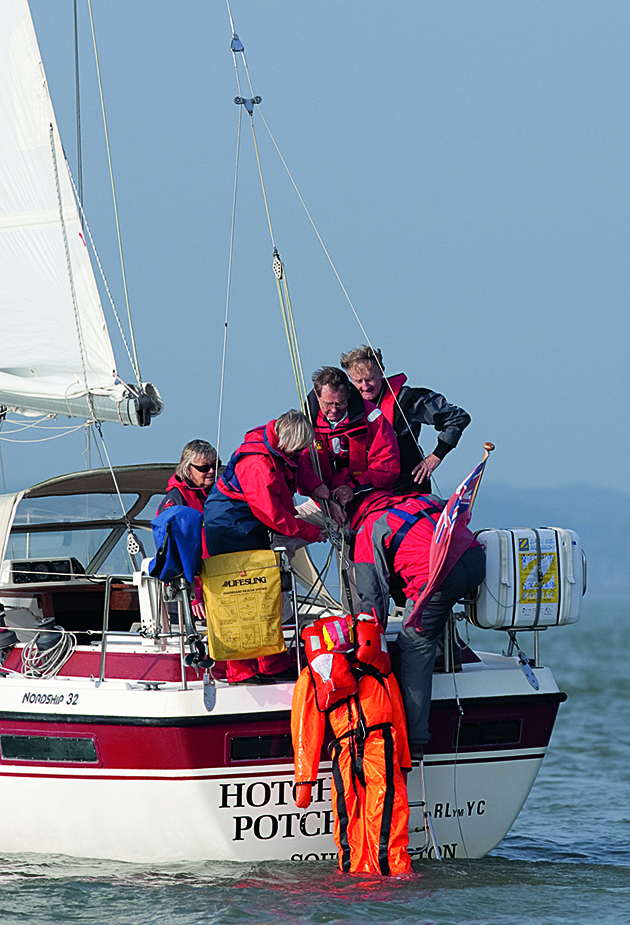
Credit: David Harding
3. Nearly there: it might not be the easiest or most comfortable recovery ever, but the system is working and the dummy is nearly back aboard.
Sticky Stapylton comments:
Recovery over the stern has potential drawbacks, not least of which is the danger of the MOB being hit on the head by the transom. Proximity to the prop and, for that matter, the rudder, should also be borne in mind.
That said, the system worked well in flat water and there’s less chance of the MOB being swung around and knocked against the hull or rigging when the boat rolls than if he’s being lifted by a spinnaker halyard.
PBO comment:
Immersed transoms are less likely than retroussé sterns to hit the MOB on the head
5. Spinnaker halyard and foot-support line
Andy and Jane Holloway’s approach on their Jeanneau Sun Odyssey 36i, Selko, is to rig up a foot-support line running from bow to cockpit that the MOB can stand on at the waterline. A spinnaker sheet is used for this.
The rest of the lifting is done by means of the spinnaker halyard attached to the lifejacket’s ring. A strop secured to the toerail amidships gives the MOB something to hold on to so he stays next to the boat.
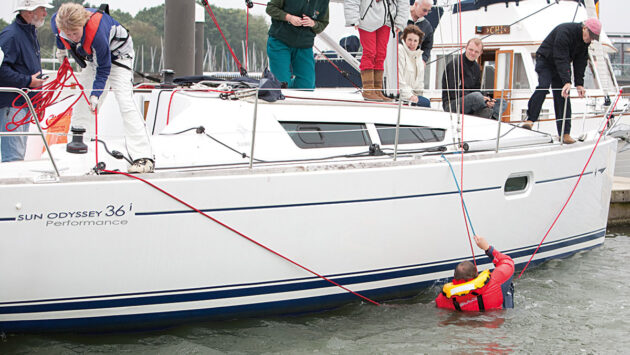
Credit: David Harding
1. Andy holds onto the midships strop while Jane rigs up the foot-support line.
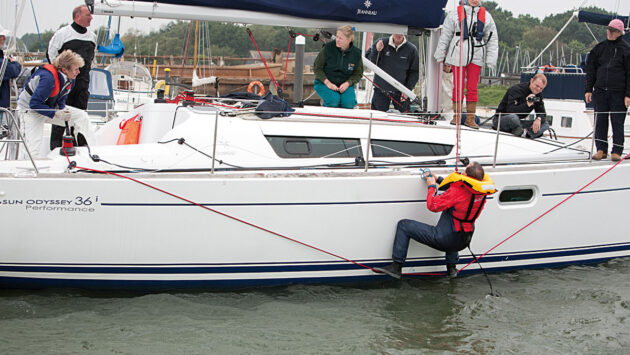
Credit: David Harding
2. Having taken some weight on the spinnaker halyard, Jane now winds the foot-support line tighter to bring Andy clear of the water.
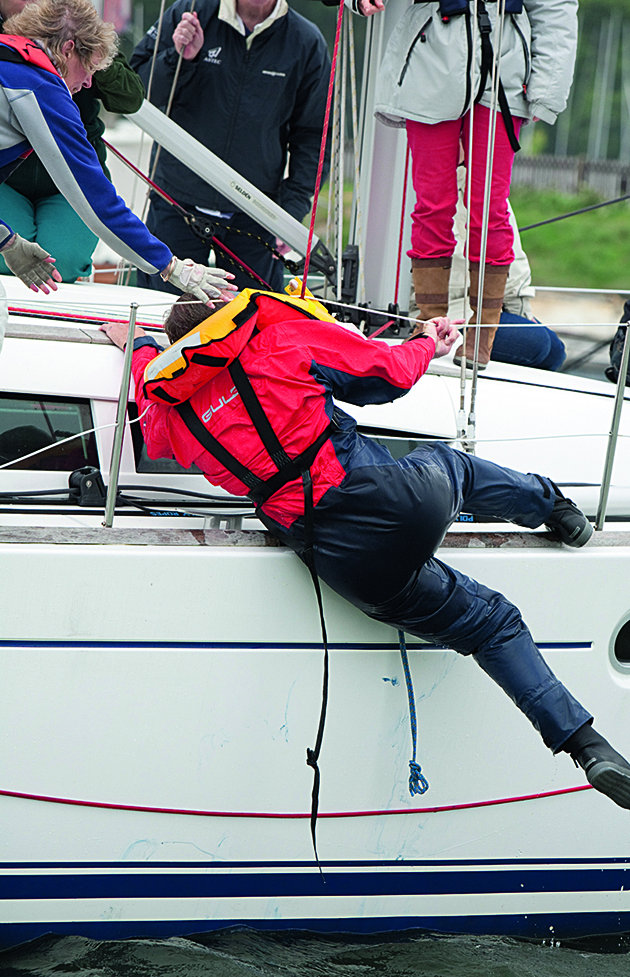
Credit: David Harding
3. With the lower lifeline slackened, it’s easy for Andy to slide beneath it and back on to the deck.
Sticky Stapylton comments:
This system appeared to work very well, though two thoughts come to mind that might make it even better. One is that a series of bights tied into the midships strop would make it easier for the MOB to hold on to.
The other is that it might be quicker to use a genoa sheet for the foot-support line rather than rig up a spinnaker sheet: it’s already in place and could easily be re-roven as necessary.
PBO comment:
A strop hanging down the topsides can be a vital lifeline for a conscious MOB
6. Rope footstraps joined to safety harness line on 2:1 halyard
A different approach on the classic yawl Puffin saw Mike Dickens passing a pair of rope loops attached to two lifelines down to Tom Schaefer in the water. Although the low freeboard may facilitate recovery compared with a boat with higher topsides, even 18 in (45cm) is still too far for most people to climb unaided. Ed’s note: wearing a lifejacket is recommended.
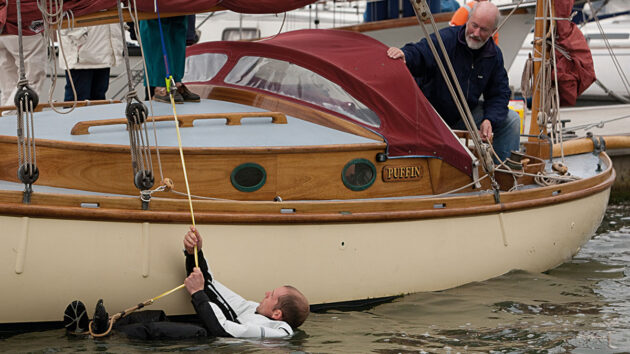
Credit: David Harding
1. Tom gets his feet into the strops while Mike mans the 2:1 peak halyard that’s led aft to the primary winch.
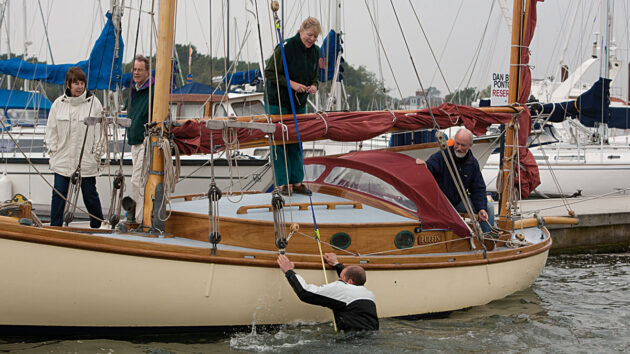
Credit: David Harding
2. Grabbing the gunwale, Tom stands up as Mike takes up the slack. Two lifelines are used to make the halyard long enough to reach the winch.
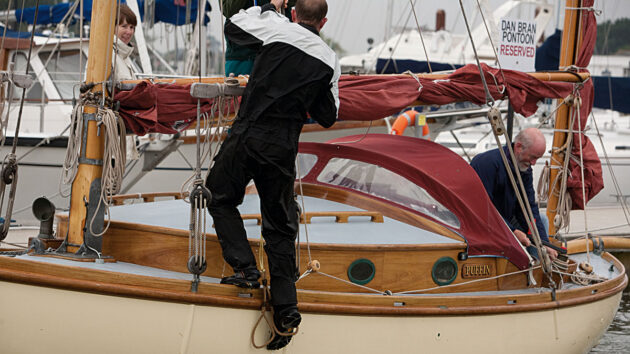
Credit: David Harding
3. Using the shrouds for support, and with no guardwires to climb over, Tom is soon back aboard.
Sticky Stapylton comments:
The MOB doesn’t have to be wearing a lifejacket in this case but does need to be fully conscious and strong enough to stand up. Low freeboard makes recovery simpler, as does the lack of guardwires, but only the young and very fit could climb back aboard without any help – cold combined with waterlogged clothes would usually make it impossible.
PBO comment:
If you have a means of standing at the waterline you’re half way to getting back aboard.
Important lessons about MOB recovery
Three significant points emerged during our exercises:
1. One is the importance of having spare halyards. Relying on the main halyard isn’t a good idea because you first have to lower the mainsail. That takes time and, without a mainsail as a steadying influence, the boat will roll more violently. A spinnaker halyard or second genoa halyard will work, though if you hoist from abaft the mast it will need to wrap around the spreaders. A suitably strong topping lift is. an alternative.
2. Point two is the ability to release the lower guardwire quickly (and ideally the top one as well) to make it easier to get the MOB back on deck. A lashing can be cut or a pelican hook undone. Most boats have bottlescrews, so quick release is impossible.
3. Point three is the value of extra boat hooks. Many of the systems relied on a boat hook to manoeuvre the MOB into position. It’s easy to lose a hook during an operation like this, so carry at least one spare. Sticky Stapylton recommends carrying three on board.
Conclusion
Recovering someone from the water is no easy task, even in a controlled situation or when the weather is benign. Buying an MOB system – or developing your own – and carrying it on board is only a start. You need to practise with it, short-handed, in open water and rough conditions.
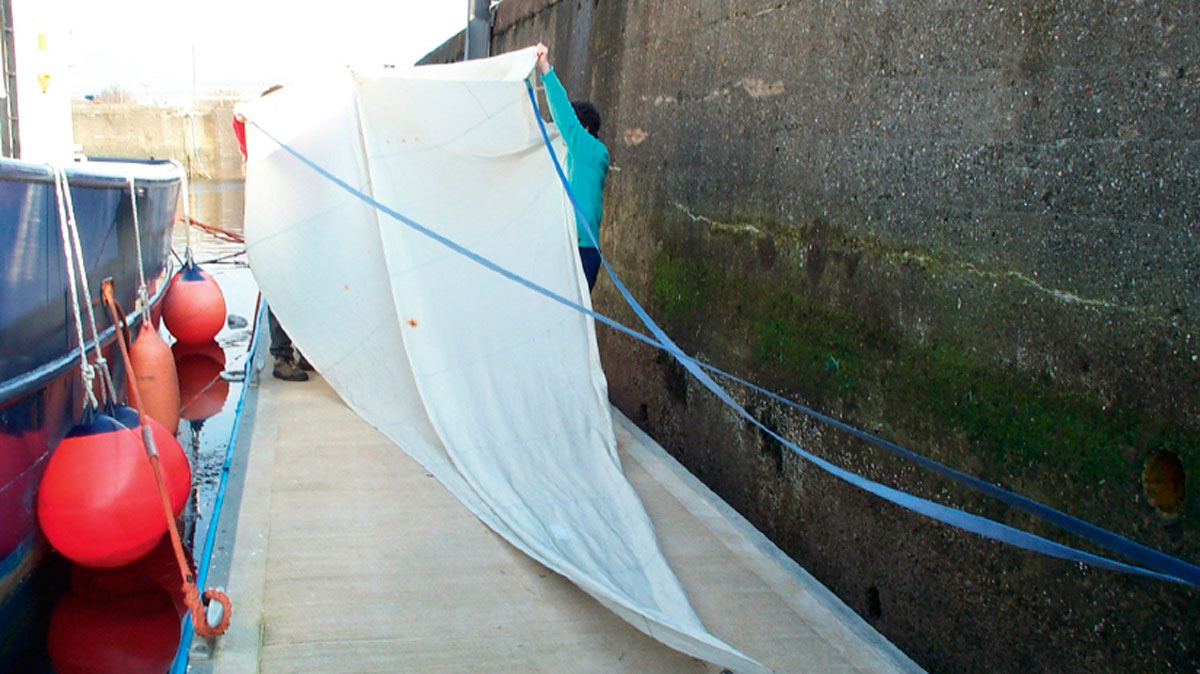
Turning old headsails into an MOB recovery scoop and sea anchors
Paul McNeill shows how redundant old headsails can be successfully recycled as items of MOB recovery equipment or as sea…
“It was like doing a MOB recovery wearing a neck brace” – says Round the Island Race 2024 man overboard skipper
As if this year’s Round the Island Race wasn’t tough enough for competitors with winds gusting 45mph and a rough…
‘I thought it was all over’: man overboard drama hits Mini Globe Race 2025
Overnight (17 October), Eric Marsh of Sunbear took a chilling tumble. It was the first man overboard in the Mini…

Man overboard rescue procedure: An alternative approach
Can rigging your jackstays in a different way really save lives? PBO reader Willem Bijl reckons it can, so David…
What to read more seamanship articles like MOB recovery: which is the best single-point vertical lift technique for getting a crew member back on board?
A subscription to Practical Boat Owner magazine costs around 40% less than the cover price.
Print and digital editions are available through Magazines Direct – where you can also find the latest deals.
PBO is packed with information to help you get the most from boat ownership – whether sail or power.
-
-
-
- Take your DIY skills to the next level with trusted advice on boat maintenance and repairs
- Impartial, in-depth gear reviews
- Practical cruising tips for making the most of your time afloat
-
-
Follow us on Facebook, Instagram, TikTok and X