


Yachtmaster instructor Paul McNeill shows how redundant old headsails can be successfully recycled as items of MOB recovery equipment or as sea anchors
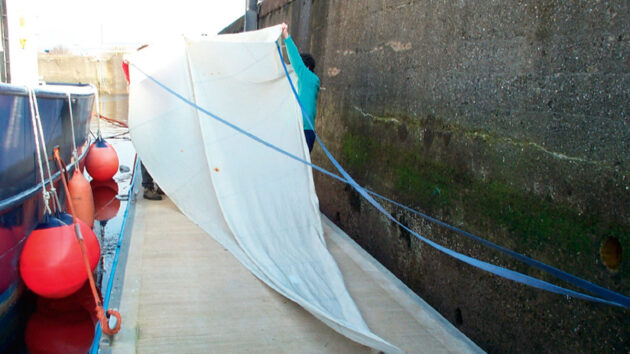
There is no single method for getting a disabled or partly-disabled person back on board a boat after falling overboard, but we all know that it’s no easy task. I was about to discard one of my headsails – an old working jib – but decided to experiment with it as an improvised ‘recovery scoop’. I asked my sailmaker to put some eyelets along the foot of the jib, but he persuaded me that sewing on tapes with shackles would make a stronger attachment to the toerail. The victims of subsequent experiments with the scoop – three clients on separate courses – were led to believe that they were indeed the first to try it out, and I was impressed by the amount of faith they put in their fellow crew members on the halyard!
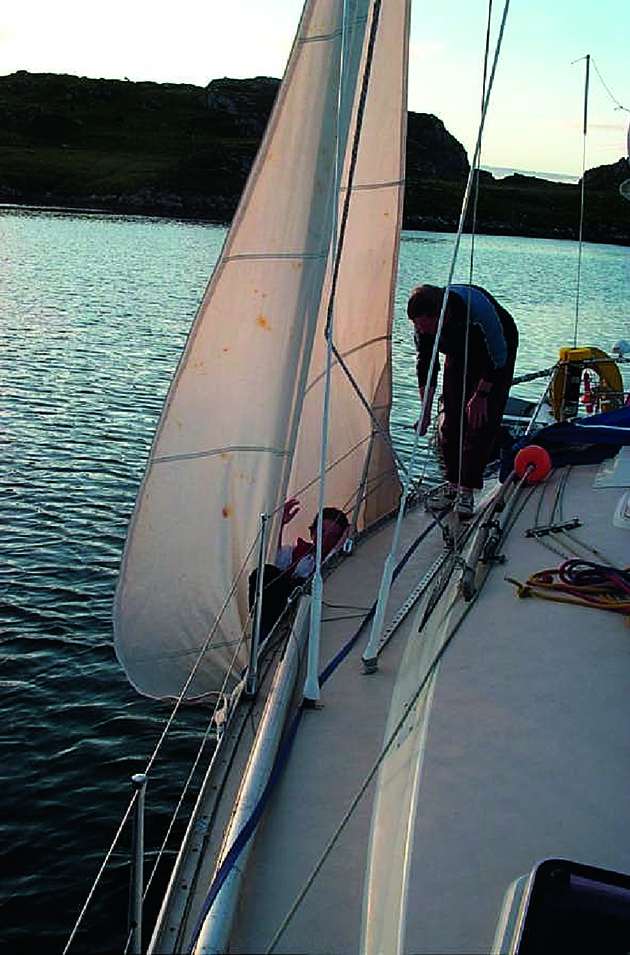
Recycling headsails: Man overboard recovery experiments took place successfully using an old working jib as an improvised ‘scoop’. Credit: All photos Paul McNeill
Each experiment led to minor adjustments, such as how far forward or aft to attach the foot of the scoop to the toerail and whether to have the clew of the scoop forward or aft. It is now a dedicated item of safety equipment on my Sigma 33 OOD Westbound Adventurer and is stowed with the liferaft as this has a dedicated and instantly accessible locker in the cockpit.
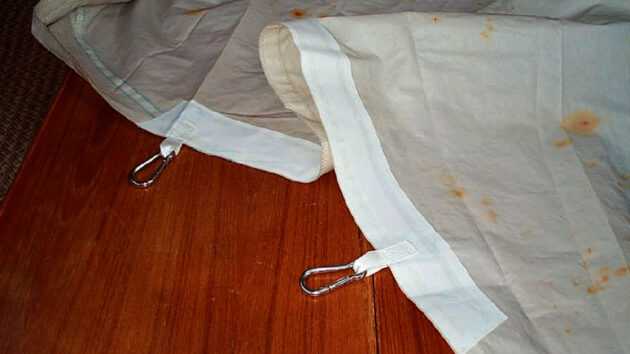
Sewing on tapes with shackles make a stronger attachment to the toerail than eyelets
It does take several minutes to set up this system, but the exercise assumes that the MOB is securely tied alongside, albeit unable to climb the boarding ladder with assistance. The important issue is to have a plan, then rehearse it to iron out at least some of the difficulties: the tools used are only a means to an end. In a real MOB situation, the only correct method is the one which works!
Improvising a sea anchor from old headsails
A sea anchor is an important item for most blue water cruising folk, but many would consider it a bit over the top for coastal and offshore cruising. I would tend to agree, but Westbound Adventurer does not lie hove-to particularly well in lively conditions, so I decided to conduct three experiments with old headsails.
The first experiment used a pre-rigged headsail with three lines from head, tack and clew joined at a swivel, then connected to 5m of chain with a shackle on the end of the chain. This is stowed in a bag ready for connection to a long warp before deployment. A fender was attached to the tack and one to the clew to help the sail take up shape when submerged. It was deployed from the bow and a second line was attached to the warp about 30m from the inboard end. This second line came inboard at the quarter and was secured to a cockpit winch. This simulated the Pardey bridle method, so that the sea is taken about 50° or 60° off the bow and a slick is created. This is sea anchor A in the results below.
The second experiment used the same equipment but with a larger old No2 furling genoa to see if the size of the sail made any significant difference. This is sea anchor B in the results below.
The third experiment attached the tack and clew of the old No2 genoa to either end of the spinnaker pole with the pole bridle attached to a long warp deployed from the bow, and a second warp attached to the head of the sail and deployed from the quarter. This is sea anchor C in the results below.
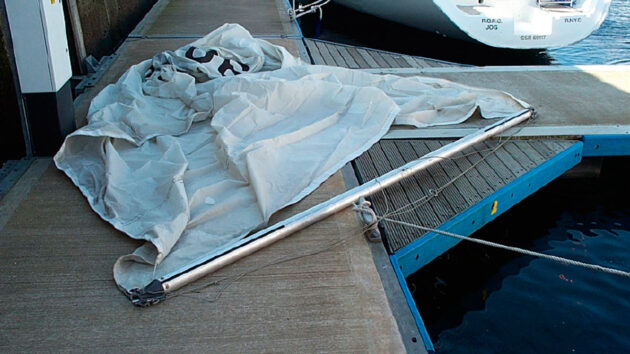
Recycling headsails: Sea anchor C gave a drift of 0.60 miles in an hour in 15-18 knots of true wind
The results are compared with the drift rate of the yacht when hove-to under the same conditions. Westbound Adventurer does not lie hove-to particularly well by the traditional method of backing the headsail: she was made to lie hove-to with 0.0 on the log with no headsail, the main sheeted in tight and the helm lashed well down to leeward.
Results of experiments to date
One hour drift in 15-18 knots of true wind as measured by GPS:
Hove-to – 1.4miles
Sea anchor A – 0.48 miles
Sea Anchor B – 0.32 miles
Sea Anchor C – 0.60 miles
As a result of these experiments, I now have model B permanently rigged as a dedicated sea anchor. I await suitable conditions to test it in a real blow, but by experimenting in light to moderate seas, I have already ironed out some snags with deployment and retrieval.
Don’t throw away that sailbag either!
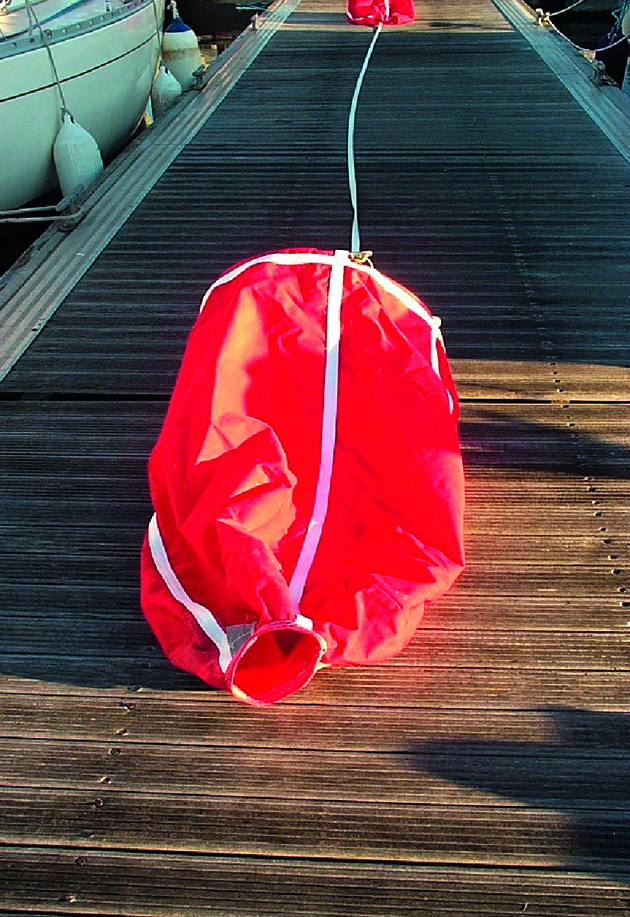
Sausage sailbags can be converted into reasonably effective drogues
I was reluctant to part with a redundant sausage sailbag in good condition, so I handed it to my sailmaker with some spare rigging wire and instructions. This resulted in two drogues which can be deployed separately or in tandem.
When motoring at 5 knots in a flat sea, the deployment of a single drogue from the starboard quarter reduced boat speed to 3.7 knots. When the second drogue was deployed from the port quarter, boat speed was reduced to 3.1 knots. When both were deployed in tandem (on one line), the same reduction in speed was achieved.
Sausage sailbags can be converted into reasonably effective drogues. As required by the current regulations for sailing school yachts, the drogues are stored beside the liferaft in a dedicated locker in the cockpit. Apart from meeting this requirement, will they ever be used in anger?
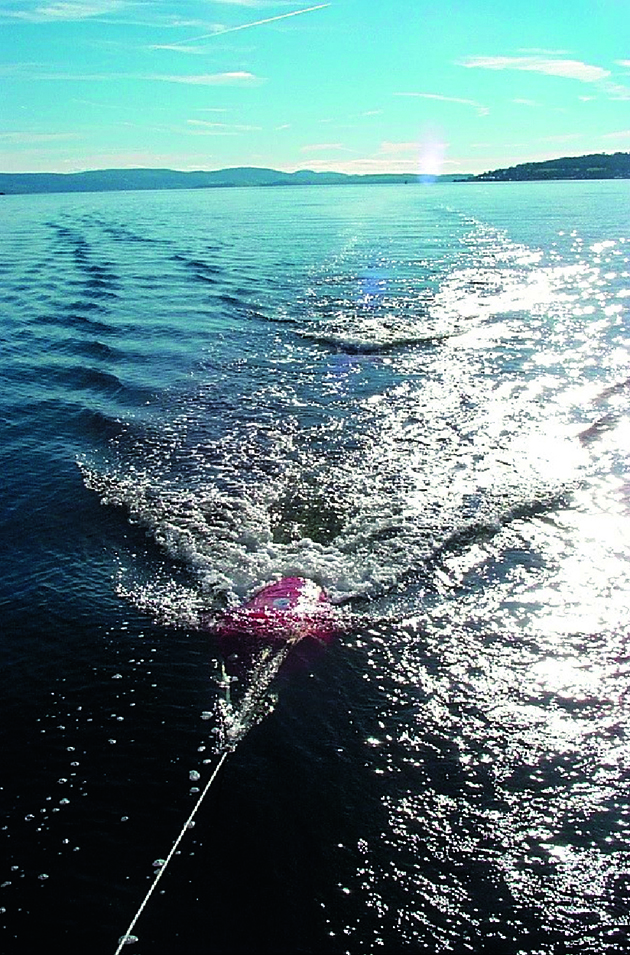
The drogues can be deployed separately or in tandem
There are three possible scenarios in which they might be deployed:
- When running before the wind under minimum sail, as an alternative to heaving-to or deploying a sea anchor. I am not talking about survival conditions in an ocean storm: I am talking about making the motion of the yacht more comfortable while we still have sea room at our disposal.
- As an item of safety equipment for the yacht’s tender when exploring sea lochs or fishing.
- As a set of brakes when coming alongside a marina pontoon or harbour wall without an engine. In some situations, having the crew step off at 1 knot rather than 2 can make a difference.

Man overboard rescue procedure: An alternative approach
Can rigging your jackstays in a different way really save lives? PBO reader Willem Bijl reckons it can, so David…

Where to recycle old sails and end of life kit – drop off points across the UK and Europe
Got old sails and old rope that you don't want to put into landfill? The ReSail platform allows sailors to…

Which drogue should you buy? 7 drogues on test
When your boat’s being battered by a storm and you want to ride things out, a drogue will make things…
200 miles offshore with no rudder: How four sailors built a jury rudder from cabin doors
Stranded 200 miles offshore in big seas without a rudder is every sailor’s nightmare. The crew of Quokka found a…
Want to read more articles like Turning old headsails into an MOB recovery scoop and sea anchors?
A subscription to Practical Boat Owner magazine costs around 40% less than the cover price.
Print and digital editions are available through Magazines Direct – where you can also find the latest deals.
PBO is packed with information to help you get the most from boat ownership – whether sail or power.
-
-
-
- Take your DIY skills to the next level with trusted advice on boat maintenance and repairs
- Impartial, in-depth gear reviews
- Practical cruising tips for making the most of your time afloat
-
-
Follow us on Facebook, Instagram, TikTok and Twitter