


Many sailors like to switch from a yacht to a motorboat as they get older – yet Debbie and Jeremy White did the opposite and saved a small fortune in their cruising costs

Sailors we meet often tell us that ‘when the time is right’ they’ll move from sail to power. The reasons are usually the same: age, reduced agility, comfort and sometimes to placate a long-suffering partner who has, for years, put up with their opposite number’s pursuit of all things sailing.
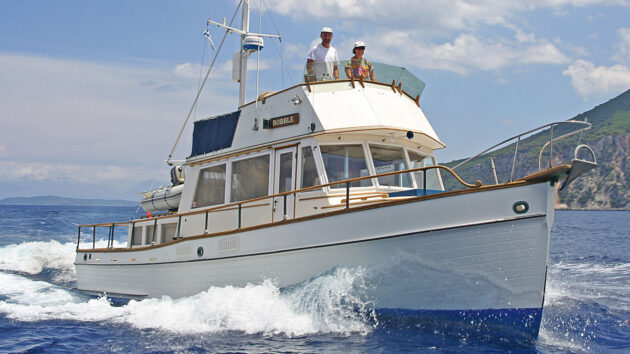
Debbie and Jeremy on board their Grand Banks 36, Bobble. Credit: Debbie and Jeremy White
Why, then, do my retired husband and I find ourselves replacing our very comfortable 11m (36ft) Grand Banks motor yacht with the 8.5m (28ft) Bénéteau Océanis Kapsali, which has no hot water, no oven, no mains electricity and barely room to swing a cat? Add into the mix the fact that neither of us has much sailing experience, and there you have it, a mid-life crisis of a very serious kind!
Moving from power to sail: time for change
It all started when we entered the beautiful Ionian in Greece, which is simply made for sailing boats. The area is considered to be excellent for learners, with predictable summer winds and safe havens no longer than an hour apart.
As much as we loved our 1975 Grand Banks Bobble, which we’d owned for 13 years, she somehow felt out of place and more suited to northern waters with her huge windows (too hot in the Greek summer), limited cockpit area and twin 120hp engines. Our decision to change vessels was confirmed when a number of global problems occurred that made keeping the Grand Banks a very expensive option.
We’d had her berthed in Lefkas Marina for two years, and during that time the pound plummeted against the euro, fuel prices almost doubled overnight and interest rates around the world crashed to the lowest levels ever recorded. So for us, living off pensions and investments, we found our income down, our outgoings up and the cost of a two-hour picnic trip in our boat an expensive outing.
Sadly, it was time for her to go, so in November 2008 we placed Bobble on the market. Surprisingly, given the state of the world economy, we had quite a lot of interest, both locally and further afield. We had an offer in March 2009, which we were delighted to accept, and so began the search for a replacement boat.
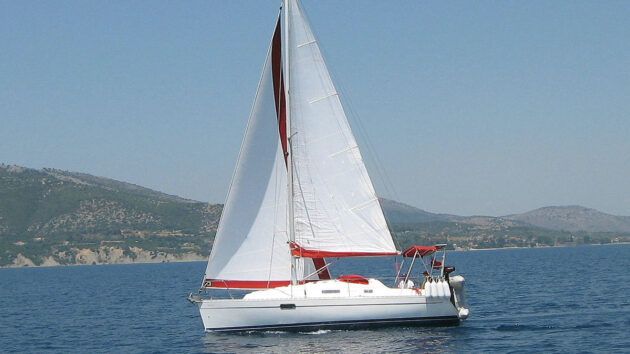
Debbie and Jeremy White learnt the ropes of sailing ex-charter boat, Kapsali. Credit: Debbie and Jeremy White
Choosing a sailing boat
We had a number of requirements that had to be met and these included things such as an overall length of 10m (33ft) or less (cheaper to moor), a fridge, a separate toilet, on-board shower, hot water, shore power, cheaper running costs, and a spacious cockpit (at the expense of cabin space if necessary).
Initially, we looked at small sports and semi-displacement motorcruisers. But we were put off by high prices and running costs and, after the Grand Banks, we were disappointed with the living space and facilities.
Then, a curious thing happened. We were strolling around Lefkas Marina and noticed that OCC, a Dutch charter fleet operation based in the marina, was selling off some of its 8.2m (27ft) Alohas. The owner of the fleet kindly showed us over one and we were pleasantly surprised by the interior and cockpit space, price and running costs. We suddenly found ourselves seriously considering sailing yachts for the first time, which was a whole new world to us!
We looked at a number of ex-charter boats and then came across a privately-owned former Sunsail yacht on the hard in Galatas near Poros in the Peloponnese, around five hours’ drive away. The boat was a 1995 Beneteau Oceanis 281. It had been on charter with Sunsail for 10 years and privately owned for the next two. It sounded right up our street and it seemed reasonably priced.
The owners were at home in England, so when we arrived for the viewing we were handed the keys and left alone to have a good rummage. We spent four hours examining every nook and cranny and found the boat to be in excellent condition, surprisingly spacious with a very roomy cockpit. All our basic requirements were not only met, but also exceeded in some cases as the boat had new sails and rigging, a very impressive cockpit cover and a new outboard.
We found a couple of problems with the fridge and batteries, so we made a reasonable offer which was accepted – and that’s how we became the proud owners of our very first sailing yacht!
Learning the ropes
By April, we were ready to bring Kapsali to her new home in Lefkas Marina. As we had no idea how to rig her and also had a lot of kit to bring on board, we hired a large car and set off with some experienced friends.
Rigging was a jigsaw puzzle. Kapsali has a furling genoa and a lazy jack system for the slab-reefed mainsail. It was really confusing and, of course, new to us motorboaters, so our friends’ input was invaluable. After a couple of hours, we had everything where it should be and we were ready to launch.
It went without a hitch and we ambled over to Poros for our first night afloat, slightly unnerved by our closeness to the water and the small 10hp engine. For the next couple of days, our friends took us sailing, to check how she handled and show us the basics of yacht handling.
The furling genoa proved very stiff, probably due to the length of time Kapsali had been on the hard. On the day before we were due to set off for home, we furled and unfurled a number of times to loosen the mechanism and then, just as we tried to furl for the last time, the genoa got stuck and then fell down altogether in a huge heap on the deck. The halyard had become untied and was now lost inside the mast.
The good news was that we were safely tied up; the bad news was that we intended to set off on our 200NM journey to Lefkas the very next day. Fortunately, we also had an inner forestay and a working jib, which we were able to rig. It wasn’t as easy to use as the furling genoa, but it was sufficient to enable us to sail some of the way home.
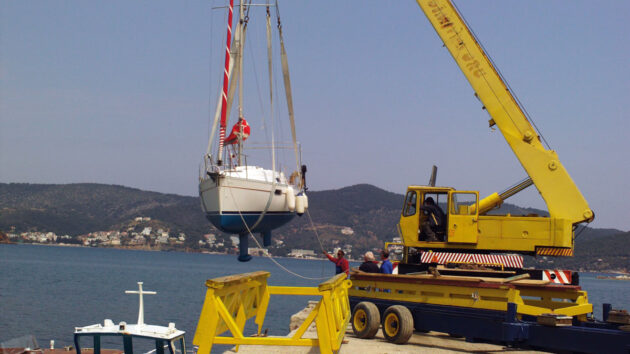
Launch day and the end of Kapsali‘s stay on the hard at Galatas near Poros. Credit: Debbie and Jeremy White
Heading for home
On the morning of April 28, we waved goodbye to our friends (they drove back with the hire car to Lefkas) and then set off under motor for our first port of call, Korfos, which was 24NM away. Kapsali felt very small and light in comparison to the Grand Banks and we were too nervous to attempt to put up the sails so we motored the whole way and it was with relief that we entered Korfos and anchored at the first attempt using our new ground tackle.
The weather forecast was not great for the next few days and so our only window seemed to be an early start to arrive at our next destination by lunchtime. We set out as planned only to encounter very strong westerly winds on the nose within an hour of leaving Korfos.
Our destination was Corinth, 21NM via the canal, and we knew that the further west we travelled, the worse the wind would become. We also knew that the sea state at the western end of the canal would be substantial and so, as the winds strengthened, we lost our nerve and headed back to Korfos.
En route, in the shelter of Korfos Bay, we gave the sails an airing for the first time. After a fantastic two hours playing, we were hooked. Kapsali performed brilliantly, our confidence rose, and we were complete converts to sailing.
Corinth and onwards
After two days of strong westerlies, we set off once more for Corinth. The trip along the canal was amazing and we had only one other boat for company. Corinth harbour is very small, but we had no problem mooring alongside the harbour wall.
The next day, after a slight problem with the starter battery, we set off for the very beautiful town of Galaxidhi, 39NM away, and here had our first experience of mooring Kapsali stern-to on the quay. We were also unused to the effect of prop walk, and it took us a few attempts to handle this when going astern.
Luckily, we had no wind and once way was achieved, the rudder bit and we were fine. But it was very different from the twin 120hp engines we had before, which could make Bobble swivel on a sixpence!
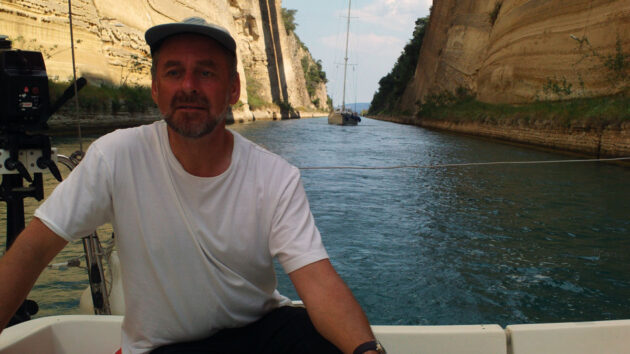
The narrow Corinth Canal was an exciting trip. Credit: Debbie and Jeremy White
The next morning, we headed off on the 19NM passage to Trizonia. This is a delightful island and we found a great position well inside the marina where we were able to moor alongside. On this leg of the journey, we encountered rain and also discovered the inevitable leaks in the hatches and port lights.
Next, we headed under the Rion Bridge to Messolonghi, a long 37.5NM hop, but as the weather was cool and we were still getting to know the boat, we decided we wanted to get back to more familiar territory as quickly as possible. We had the wind and a current against us as we passed under the bridge, and at one point our speed dropped to under 3 knots.
We knew the engine would be slow to windward, but this leg of the journey made us think that we should upgrade to something bigger like a 20hp motor – something that would get us out of trouble if the need arose.
Once through the bridge, the current and wind changed, and we made up some time arriving at Messolonghi after a long nine-hour journey. Our confidence in the boat was increasing and we hoisted the sails during our next 26NM leg from Messolonghi to Petalas. Unfortunately, by the time we hoisted, the wind had completely died, so we motor-sailed, which was a very pleasant experience and allowed us to quickly capture any wind that did not arise during the rest of our journey. Petalas is a huge, safe bay with nothing much ashore, where we had a very comfortable night at anchor.
Our final leg was from Petalas to Lefkas Marina, 35NM. We had a fantastic sail for most of the journey, motor-sailing for the last 10 miles. We completed four tacks and a controlled gybe!
No regrets switching from motor to sail
During the 2009 summer season, we spent 10 weeks on board Kapsali and had plenty of opportunities to improve our sailing skills with the help of friends and family. The past season, we spent 14 weeks on board, covering 600NM, a substantial amount of which was under sail. Our fastest speed was an exhilarating 7.7 knots on a beam reach.
We have absolutely no regrets changing from motor to sail, and what’s even better is that our annual running costs have reduced by 80%, insurance has reduced by 70% and the berthing fees have reduced by 30%. Kapsali is a perfect boat for our needs, and we’re now busy upgrading various things and installing what we consider to be essentials from our original wish list, such as hot water, solar panels, mains electric, autopilot, new halyards and sheets and a chartplotter.

Why we swapped sail for power: 10 motorboaters explain their big switch
Many moons ago I had a premonition that Hunter Boats ought to build a classy little motorboat for customers who…
Prop walk: how to use it to your best advantage
Daria and Alex Blackwell share the close-quarters manoeuvring techniques they’ve picked up at the helm of a 57ft, heavy-displacement classic…
First-time charter holiday with family
Katy Stickland introduces her non-sailing family to life afloat on a charter holiday in Greece’s spectacular Ionian Sea
Want to read more articles like Cut your boating costs: The surprising benefits of ‘downsizing’ from motor to sail?
A subscription to Practical Boat Owner magazine costs around 40% less than the cover price.
Print and digital editions are available through Magazines Direct – where you can also find the latest deals.
PBO is packed with information to help you get the most from boat ownership – whether sail or power.
-
-
-
- Take your DIY skills to the next level with trusted advice on boat maintenance and repairs
- Impartial, in-depth gear reviews
- Practical cruising tips for making the most of your time afloat
-
-
Follow us on Facebook, Instagram, TikTok and Twitter