


Overboard without a lifejacket in the dark Irish Sea, Prue Nash had to tread water for two hours before she was rescued. But what was she really thinking as her yacht disappeared into the gloom that stormy night? From the PBO archives, Louay Habib tells her remarkable story
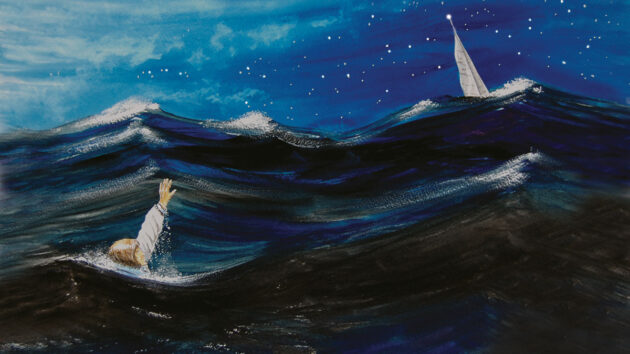
Prue Nash’s survival is one story that every sailor should know. A freak set of events conspired to leave her alone, without a lifejacket, in pitch black, confused seas, 50 miles north-west of Land’s End. Prue was lost at sea and survived in those horrendous conditions for more than two hours.
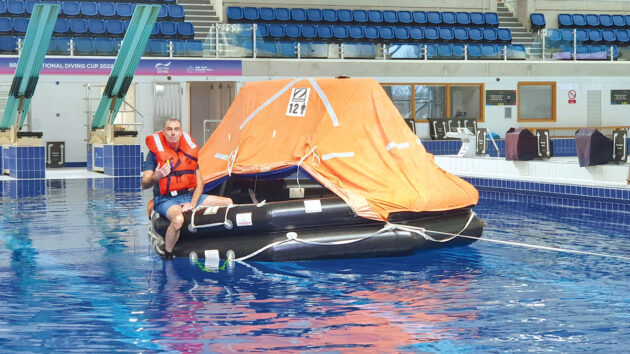
Prue had recently completed a sea survival course which included abandoning ship procedures and search and rescue briefing. Credit: Jayne Toyne
Just a few months before the incident, Prue had completed a one-day RYA Sea Survival Course, involving a morning of lectures, followed by a practical test in a swimming pool and a debrief. The lessons learned that day would prove to be true lifesavers for Prue.
Weather break
On Sunday 18 July 2010, at just after 0100, Prue Nash was on board Buccaneer, a First 40.7, returning to Hamble from Cork Week. It was a dark, cloudy night with no moon, the wind speed was about 20 knots from the southwest and the boat was fetching on a starboard tack.
A week of depressions had come across the Atlantic but at the time of the passage there was a decent break in the weather before another front was expected.
After several days of rough weather, though, the sea state was very confused, with no discernible wave pattern.
There were five crew on board Buccaneer that night, three of whom were on deck at the time of the incident. Penny Pariso, a highly experienced sailor, was at the wheel, and sitting to her left on the leeward side was Prue Nash. The skipper, Peter Randall, was standing in the companionway and indicated to the crew that they could ease sheets to round Land’s End.
Prue made her way up to the windward side behind the helm to ease the main. She was wearing a Spinlock Deckvest lifejacket and harness and was clipped onto the helmsman’s D-ring, on the high side of the boat. Prue was not wearing a crotch strap – she knew that the life vest was correctly fitted and would not ride up if she happened to go into the water.
‘I was crawling across the back of the boat,’ said Prue, ‘towards the high side, the safest route to the main, when I was thrown off balance by a wave hitting the side of the boat.
‘I fell down onto my front and rapidly slid down to the low side. I fell through a small gap in the bottom of the pushpit, and went over the side feet first, facing the hull.’
Prue’s lifejacket inflated when she went into the water and her 2m tether held fast: working against each other they pinned her under the leeward topside of the heeled boat.
Trapped underwater
‘I was under water and being towed at about six and a half knots,’ she said. ‘The lifejacket was preventing me from going up and the tether was stopping me from going down.
‘All I could think of was to get out of the lifejacket. I had two knives, one attached to my lifejacket and the other in my pocket, but because of the force of the water I couldn’t get to either.
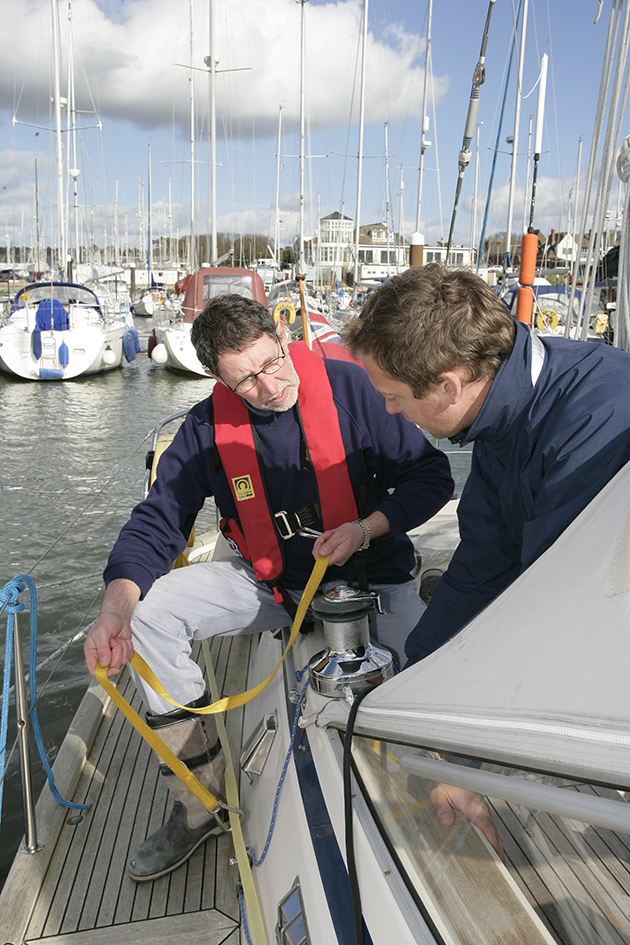
How long is your lifeline? Is it short enough to keep you on the boat? Credit: Graham Snook/Future PLC
‘Fortunately, the lifejacket I was wearing meant that I could release the plastic clip, under load, with just one hand.
Prue overboard and lost at sea
Prue was now fully overboard, treading water and without a lifejacket.
‘Because of the time of year, the water wasn’t very cold and as I was already wet before I went in it didn’t knock the stuffing out of me. But the boat was moving away at over six knots and, in a matter of seconds, it was some distance from me.
‘Pretty soon I realised that my waterproof jacket was too heavy and that if I could get it off I might be able to use it as a flotation device. But the waves made it
impossible to get it off.
‘I had a wind-up style, dynamo torch and I was trying to get attention. I could see the boat for about 20 minutes. It was getting further and further away, but I knew they would come back for me.
‘The skipper, Peter, is an instructor and I had spent time with him prior to the delivery, practising picking up buoys in the Solent under sail and under power. I knew he wouldn’t give up, I knew that he would find me. I just kept telling myself – “Don’t give up, keep paddling, he will come”.’
All alone, lost at sea
‘Then there was a long period when I saw no lights, nothing. I am a pretty strong swimmer but the waves were crashing over me. When I could hear them coming, I would take a breath in so I could blow out, to minimise the amount of water I was taking in. But I was still swallowing seawater and it was making me sick. It was a very horrible feeling.’
Aboard Buccaneer
When Prue went over the side, Penny Pariso was at the helm of Buccaneer. Penny, a qualified Yachtmaster with thousands of ocean miles experience, including Atlantic crossings, describes what happened:
‘When Prue slid down the boat she knocked me around and I was then struggling to get back on the wheel and heave to. I was trying to talk to Prue but I was getting no response.
‘Peter grabbed the wheel and I reached down to grab her, but I just came up with an empty lifejacket.
‘All of this happened in just a few seconds. I threw the lifebuoy off the back along with her lifejacket. One of the crew down below issued a Mayday call, while Peter and I concentrated on turning the boat and staying in the area.
Untimely malfunction
Skipper Peter Randall, an extremely experienced seaman and sailing instructor, describes what happened next.
‘The mainsheet failed at that crucial moment, the force of a gybe shearing the screws of the stopper at the end of the traveller track and sending the mainsheet line flying off into the water,’ he said.
‘I released the main halyard but the slider gate came out allowing most of the sliders to exit the mast track. Once we’d tamed the front of the main, we lashed the aft end of the boom to the guardrails.
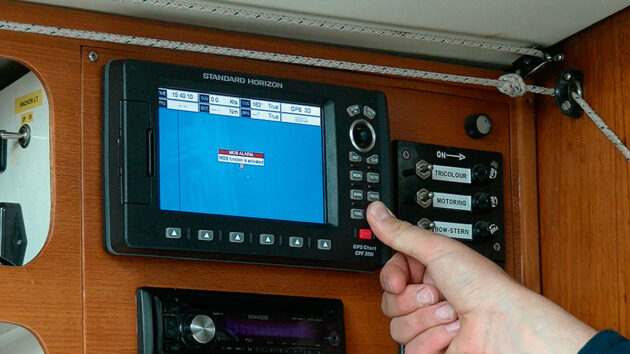
As soon as a member of the crew is overboard, press the MOB button
‘A verbal Mayday was issued immediately and our position noted, but in the panic there was a misunderstanding about pushing the man-overboard button on the chartplotter and the DSC radio. However we were able to see our track log on the Raymarine C60 chartplotter.
‘I was concerned that there were still parts of the mainsheet in the water, so we didn’t use the engine in case we fouled the prop. We were making good boat speed under headsail, and having the engine on wouldn’t have gained us anything.
‘I made a rough calculation as to where Prue might have been and we followed our track back. In that situation you lose all sense of time, but I guess it was a good 20 minutes before we could turn the boat around and sail back to that area, and by then there were already several other boats searching in the area.
‘We could see the searchlights from other boats but there was no sign of Prue. We kept looking but the phosphorescence on the water in the searchlights made it really difficult to see anything.’
Peter said the coordination between the coastguard and the boats that responded to the emergency was extraordinary.
‘Each boat was patrolling an area – it was something that happened naturally, we all just realised that was what we had to do.’
Joining the search
Within 12 miles of Prue’s MOB position there were five other yachts: a French yacht, Lutra, and four others returning from the same regatta – two J/109s, Jeez-Louise and Juke Box, and two Reflex 38s, Puma Logic and Jaguar Logic.
An RAF air/sea rescue helicopter had been scrambled by 22 Squadron at RMB Chivenor immediately upon receiving the Mayday alert – the Sea King arrived on the scene within the hour. The RNLI also sent the Sennen Cove and St Mary’s all-weather lifeboats to the scene.
The yachts and the helicopter were relaying information to each other, coordinating the search for Prue.
But as time went by, the chance of finding Prue alive was getting less likely.
Hopes fading
Steve Heap, who was skippering Jeez-Louise, continues the story.
‘We judged her survival chances as being nonexistent,’ said Steve. ‘We figured that if we did find her body, we were only capable of marking it. With just two of us, getting anyone aboard in such a vile sea would be too risky.
I made an arbitrary guess at the drift rate of a person in the sea state and so we headed for just below it, with the plan of working upwind from there.
‘Under double-reefed main only, we arrived on station to leeward of the other boats and helicopter, Rachel (Jeez-Louise crewmember, Rachel Scarfe) fired up the spotlight as I drove, scanning the seas around us.
‘After a few minutes we caught sight of what looked like a torch or an LED light flashing in the water and headed towards it. Rachel made her way below to check our position and I was left in the darkness. ‘Then I thought I heard a voice.’
Trick of the wind?
At this stage, I thought I was hallucinating, as there was no chance I could be hearing other crews over the waves – it never really occurred that someone would actually be there.
‘Nevertheless, I figured I may as well tack on it – and then heard another faint cry.
‘Still thinking I was sleep-deprived, I shouted out whether anyone was there, and heard a “here!”
‘Diving for the search lamp, I screamed “shout louder!” and started wildly scanning in the direction of the voice.
‘Utterly amazingly, there was a person bobbing about 15m from the boat. I fired the JonBuoy off the transom as she passed to leeward, the boat just a few metres from her. I screamed that the helicopter would be there soon. After that we lost her, so concentrated on staying relatively stationary, while the helicopter homed in on us.’
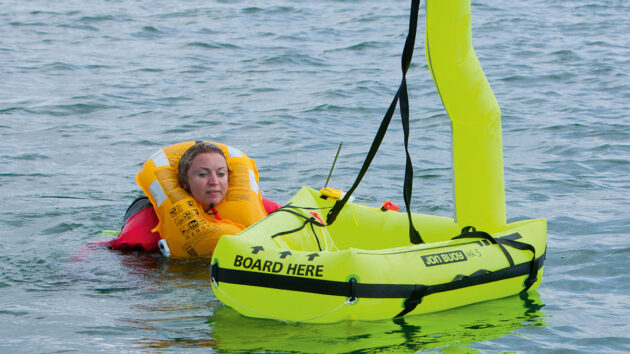
Know your rescue equipment. There is no point in having a JonBuoy on board if you do not know how to use it. Credit: David Harding
Prue takes up the story again: ‘I was talking to myself, out loud – “Any time now that helicopter is going to find me!”
‘I saw a murky light and as it came closer, I realised it was a yacht and I started shouting at them, they flipped their torch over me and then I knew they’d seen me. As the boat came closer, what really helped was that Steve shone his torch on the mainsail, which acted like a lampshade putting a glow about the area, far better than blinding me with the torch,’ said Prue.
‘He managed to get close enough to throw the JonBuoy at me and I finally wriggled out of my jacket to try and get to it, but I was too exhausted by now and it floated away.
‘It was then I saw the helicopter. It hovered very low and put a man down on a winch.
‘He caught hold of me and I wasn’t going to let go!
Prue was threaded into a harness, and then winched up into the helicopter.
She continued: ‘I got out of my wet clothes and the winchman dressed me in a Merino wool smock and a warm hat and gave me a big hug and said how pleased he was to have found me. They were fantastic, the crew were telling me bad jokes and making me good coffee – they were amazing guys.’
The helicopter crew hailed Jeez-Louise, who relayed the welcome message to the yachts searching below: Prue was cold but conscious and in good spirits. She was flown to the helipad at the Royal Cornwall Hospital where she was given a full and thorough medical examination and placed under observation.
Lucky to be alive
Falmouth Coastguard rescue manager James Instance said he was amazed that Prue had been found alive.
‘In those conditions, with no lifejacket, away from land in the dark with any sort of sea, the numbers rescued alive are very low,’ he said.
Prue Nash was back at work just days after the dramatic rescue – and soon back on the water and under sail as part of her job at Port Hamble.
Her training and her iron will are the fundamental reasons that she is alive today.
How Prue Survived
The sea temperature was about 17°, and life expectancy at that temperature can be more than six hours. In this incident shock, fatigue and secondary drowning were the immediate threats to Prue’s life.
Prue remained calm and deliberately prevented herself from secondary drowning by blowing out when the waves crashed over her.
Prue was wearing:
- Jeantex Sailing Boots
- Henri Lloyd high fit drop seat coastal salopettes
- Round the Island cotton T-shirt
- Musto BR1 Coastal Jacket
- Bobble hat
RYA Sea Survival course
The RYA’s Sea Survival course was a key element of the training that enabled Prue to remain focused. The course includes:
- Use of personal lifesaving appliances
- Abandoning ship procedures (liferafts)
- Search and rescue briefing
- Use of flares
- Use of location aids
- Prevention and treatment of hypothermia
Lessons Learned
Buccaneer skipper Peter Randall:
I have experienced man overboard situations before but never in open sea, at night, in confused seas. These are my lessons learned:
- Don’t panic.
- It’s better to tack not to gybe round after an MOB – it’s a far better way to keep in control of the boat.
- I will definitely be buying an EPIRB. Rescue helicopters can home in on them and the rate of drift when thrown overboard would have been similar to Prue’s.
- Clip on in such a way that if you fall you remain on the boat. Try to be on the high side whenever possible.
- Carry a torch, whistle and knife (if possible) at night. If you’re the only one on deck, consider adding a handheld VHF radio and GPS to this list.
- Training courses save lives. Prue’s sea survival course meant that she knew what to do in the water, and what to expect others would do.
- Yachting is a community. We are indebted to our fellow sailors for saving Prue’s life.
Jeez-Louise skipper Steve Heap:
- We should have maintained contact with Prue, using the spotlight for her and handheld flares to get the helicopter over.
- Given that we were short crewed, it may have been an idea to use a handheld VHF radio and keep us both on deck, though I’m not sure if the wind would have precluded a useful transmission.
- We were close enough to use a throw line and I tried, but it came back like a boomerang. Had I calmed down a bit and actually looked at it, I would have realised that the Velcro collar needs removing before you throw the thing.
- Had we been the only people there, I shudder to think what we would have done – it’s something I’m still trying to figure out, especially after the JonBuoy had gone.
- Know your rescue equipment. It’s no use figuring out how things work in the dark in a panic at sea.
- Finally, a massive amount of praise goes to all those involved. Jukebox’s crew were amazing, as were Puma and Jaguar Logic for all the coordinating.
Don’t go overboard!
- If Prue’s lifeline had been shorter she would not have gone overboard. However, as Spinlock’s James Hall explains, the latest International
Safety Standard for safety lines, ISO12401 (now replaced with ISO 12401:2009), dictates that they are 2m in length (on three-clip versions one leg should be 1m, the other leg 2m). - Some sailors shorten their lifeline by tying a loop in it.
- Most jackstays are near the edge of the boat, as are some D-rings. Take a fresh look at your boat’s securing points and consider moving them or adding new ones. Some round the world race sailors attach themselves to the steering wheel base area with very short lifelines.
- There is debate about the best way to detach yourself from a lifeline if you’re being dragged, or you’re trapped, as Prue was. Some advocate quick-release clips but others say there is not one on the market that can be released under the kind of load experienced by a person being dragged fast by a yacht. ‘Spinlock favour carrying a knife as a method of quick release’, says James Hall. ‘All our Deckvests now include an integral safety-line cutter knife.’ Their knives are designed to be more accessible than Prue’s were, but deploying a knife while being dragged along would still be a challenge for any sailor.
- Wear footwear with good non-slip soles