



Gilbert Park takes steps to prevent a sinking by making his own collision mat
The Solent recently had two incidents where containers fell off cargo ships. One had containers full of bananas, which were blown up onto the coast making roads slippery; the other filled the beaches with sliced potatoes – a chip wreck.
Humour aside, not all the containers have been recovered, and when a pilot vessel struck a submerged object to the east of The Nab Tower in the early hours of one morning, I thought it was time to make myself a collision mat.
A collision mat is a tough, impermeable cloth that can be secured in place over a hole below the waterline, with water pressure holding it in place and hopefully staunching the leak.
I’d been thinking about this since I watched the movie All is Lost with Robert Redford, where his yacht is eventually sunk when it collides with a submerged shipping container.
Shortly after watching the movie I heard a loud bang while on a boat at the mouth of the River Loire. When I inspected the boat a large chunk had been taken out of the forward edge of one of the chines.
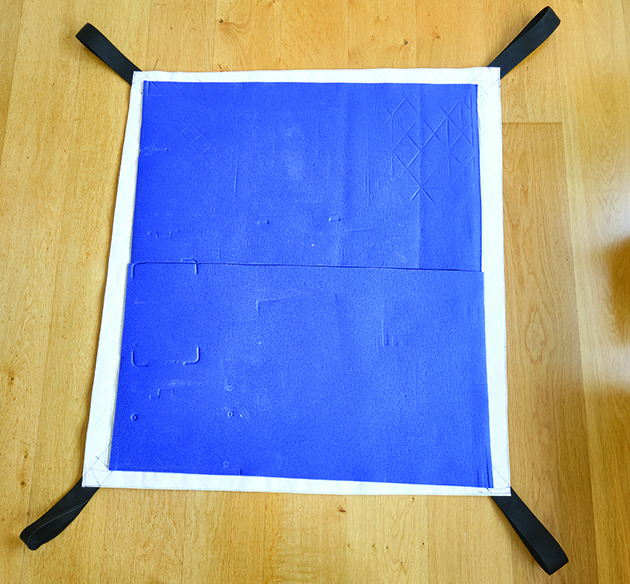
Foam is glued to the back to cushion the material against jagged holes. Credit: Gilbert Park
I looked online for a collision mat and was amazed at the cost before realising these were designed for offshore sailors who might need them for days. The furthest I am from shore these days is about 35 miles, or about 6-8 hours, when crossing the Channel so I didn’t need one as robust as those that are sold.
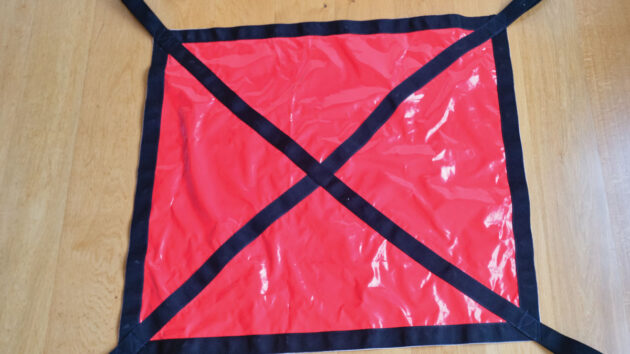
The design is straightforward. Boats usually hit things in the area around the bow, so the mat has each corner reinforced strongly with a loop to which a rope is attached. From one edge two ropes are taken around the bow to the opposite side of the hole, leaving the other two on the side with the hole. The ropes are adjusted so the mat sits over the hole with the ropes holding it in place and stopping the water pressure from pushing the mat right through the hole.
The materials for my mat were inexpensive – a foam sleeping mat (£9.99), approximately 2m of tough, waterproof material 1.5m wide (£8 on offer) and a tin of contact adhesive (£7.50). I already had some 2in webbing left over from another project.
Once the shape and size have been decided the first thing to do is to sew the webbing to the fabric. It goes all the way around the edge and across to give strength. Loops are formed at the corners.
Next the foam is stuck to the fabric using the contact adhesive. The foam’s there to hold the material in a jagged hole and prevent it from tearing the material. Attach ropes and that’s it, job done. My mat is stored in the same under-floor locker as the grab bag and other emergency equipment.
I haven’t used it yet, but perhaps with the next lot of containers falling overboard near the Nab… who knows?
‘My boat was a write-off’: Lessons learned from an on-the-water boat collision
Leo Heaney’s regular yacht club race night quickly turns dangerous after an unexpected boat collision. After seven months of repairs…
Avoiding boat collisions: understanding COLREGS
If you’re at the helm, can you spot a risk of collision with another boat? Do you know when to…
Sailors urged to report collisions with whales and other marine life
Sailors around the world are being urged to participate in an anonymous global survey to document collisions at sea between…
200 miles offshore with no rudder: How four sailors built a jury rudder from cabin doors
Stranded 200 miles offshore in big seas without a rudder is every sailor’s nightmare. The crew of Quokka found a…
Want to read more practical projects like How to make low-cost collision mat?
A subscription to Practical Boat Owner magazine costs around 40% less than the cover price.
Print and digital editions are available through Magazines Direct – where you can also find the latest deals.
PBO is packed with information to help you get the most from boat ownership – whether sail or power.
-
-
-
- Take your DIY skills to the next level with trusted advice on boat maintenance and repairs
- Impartial, in-depth gear reviews
- Practical cruising tips for making the most of your time afloat
-
-
Follow us on Facebook, Instagram, TikTok and X