



There are two widely taught techniques for recovering someone who has fallen overboard. David Harding looks at both and explains the different approaches
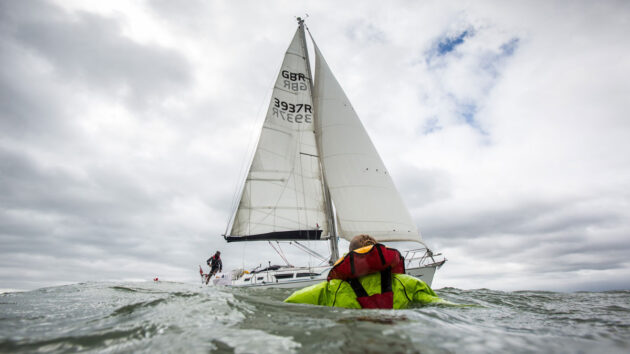
Practising man overboard turns and recovery drills is vital for any boat owner or crew.
The more you practise, the better you get – and the more you become aware of the difficulties involved. The exercise reinforces what we all know already: that it’s a much better idea if nobody goes overboard in the first place.
However careful you are, the chances are that sooner or later you may have to recover someone who has gone for an unplanned swim.
When it happens, you won’t want to spend too long thinking about what to do: you should switch straight into recovery mode, using a method you’re familiar with.
In the UK, the standard RYA technique is the most widely taught. It might look a little long-winded and does involve sailing away from the sailor in the water (the man overboard) for a while – which he or she might not find reassuring – but it’s designed to avoid a gybe and to give you time to line up for a controlled approach.
The technique promoted by the Royal Ocean Racing Club (RORC) and widely used in the USA keeps you closer and might well get you back sooner. Controversially in some circles, however, it does involve a gybe.
In this feature we’ll be looking at both the RYA and the RORC approaches to man overboard turns.
Whichever you use, one skill is essential: you need to be aware of the wind direction in relation to the boat and the position of the man overboard.
Lack of ‘wind awareness’ on the part of the helmsman is probably the most common reason for the failure of a recovery attempt.
Many other factors play a part, of course, and much can go wrong even on a calm day in the middle of summer. Highly experienced sailors have been lost when it’s like this, such as Rob James, who tragically drowned after falling from the trimaran Colt Cars off Salcombe during a delivery trip in 1983.
Whatever the weather, one thing you soon learn about recovery is that it’s a three-stage process. It’s no good having one part or even two parts worked out if the third doesn’t work as well.
First you have to get back to the person in the water. Then you have to keep him or her alongside while you rig up the recovery system. It’s all too easy to drift apart at this stage.
Here we put the RYA technique into practice before studying the RORC approach. You might want to practise both, modify either to suit your boat or crew, or develop your own. What matters is that it’s safe and it works.
Man overboard turns: The RYA technique
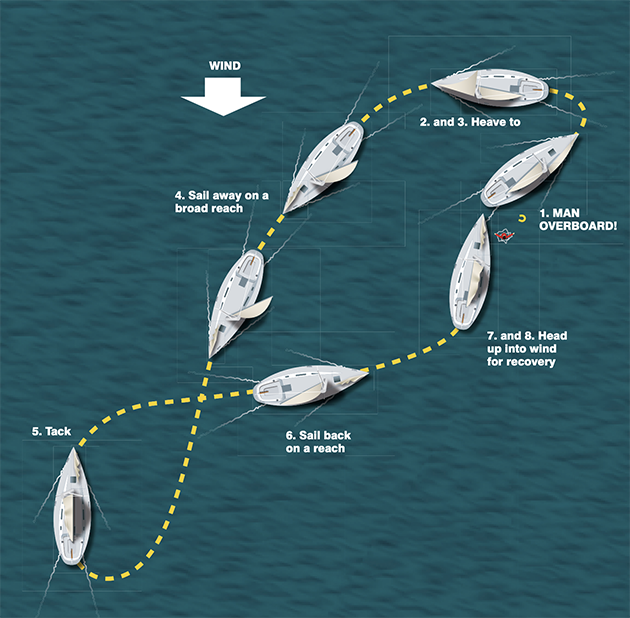
The RYA technique. Credit: Practical Boat Owner
Apart from manoeuvring the boat to get back to the man overboard, there are several procedures the RYA recommends. As soon as you see someone falling in, you should alert the crew by shouting ‘Man overboard!’, then press the MOB button on the GPS and get someone to send out a Mayday call on the VHF radio.
If you’re alone, make the call yourself as soon as possible. The rescue services would rather hear that you’ve recovered the person when they’re already on the way than arrive to find a dead body.
You should throw the lifebuoy and danbuoy into the water as soon as you can when you’re close to the MOB, both so he or she has something to hang on to and to
mark the spot. A buoyant smoke flare is useful, too, because it’s highly visible and shouldn’t drift away. A lifebuoy will soon disappear downwind if the drogue doesn’t open properly.
Again, assuming you’re not left alone on the boat, get someone to watch the MOB the whole time and keep pointing at him or her. Some skippers like the nominated person to call out the direction and distance to the MOB until the helmsman confirms that he can see the casualty in the water.
As far as the manoeuvring is concerned, the standard RYA method assumes that the boat is under sail at the time but that the engine will start and you’re going to want to use it to give yourself extra control (having made sure there are no ropes over the side near the stern).
The first job is to sheet in the mainsail, unless you’re already sailing close-hauled, then heave to. This keeps you close by while you’re preparing for the recovery. Then drop or furl the headsail and sail away a few boat-lengths, heading downwind if necessary so you’re in a position to head back towards the MOB on a close reach.
Only by making your approach on a close reach can you sheet in the sail to speed up and let it flap to stop. If you approach from too far upwind you won’t be able to ease the sail enough, and if you’re too far downwind the boat won’t sail at all – though having the engine on will allow you to keep moving.
You should approach with the MOB on the leeward side so the boat provides a lee and will drift gently towards rather than away from him or her. It’s also easiest to work
from the leeward side because it will be closer to the water.
For our exercise, we were sailing a Beneteau Oceanis 40. Our ‘MOB’ was a fender with a couple of lengths of rope attached to act as a drogue.
Out on the water
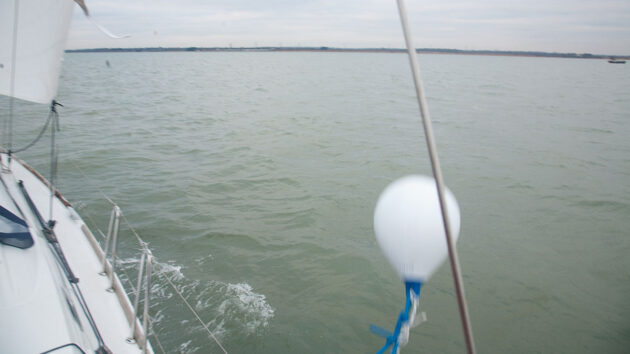
Credit: David Harding
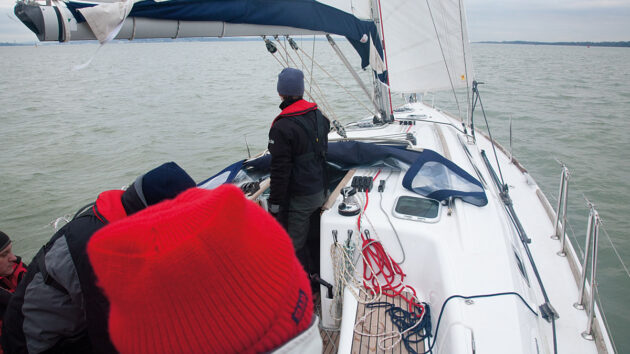
1. The ‘casualty’ (a fender with ropes) is thrown overboard
Credit: David Harding
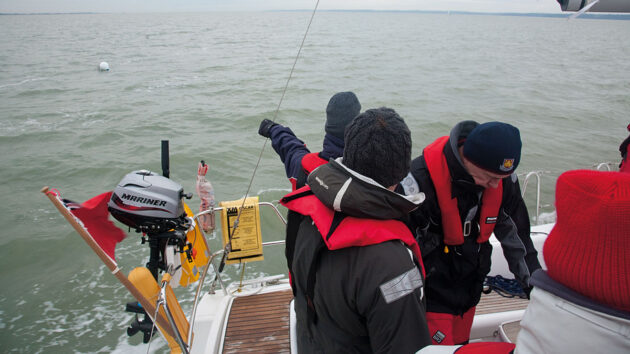
2. By heaving to, the helmsman keeps the boat close to the MOB and moving slowly
Credit: David Harding
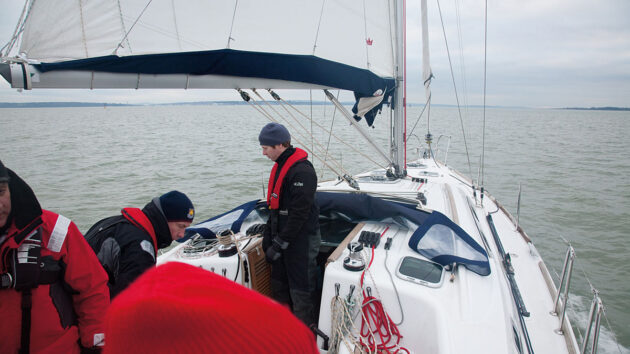
3. The MOB is now a couple of boat-lengths directly downwind as the crew gets organised
Credit: David Harding
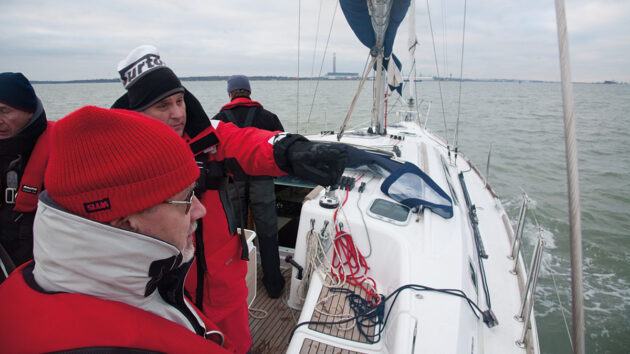
4. Because the boat was upwind of the MOB, the helmsman now heads off on a broad reach to get downwind…
Credit: David Harding
5… before tacking, making sure that the helmsman is still aware of the MOB’s direction
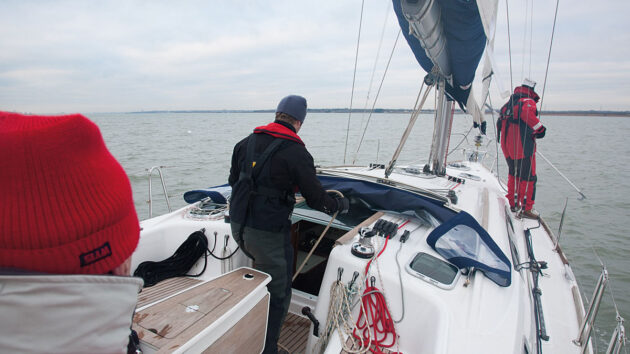
Credit: David Harding
6. The boat is heading back on a reach, aiming slightly downwind of the MOB
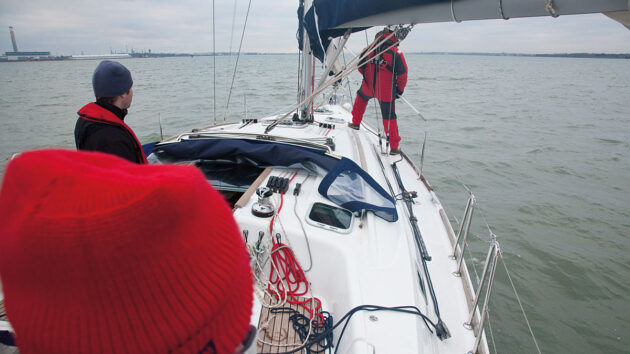
Credit: David Harding
7. Now the helmsman heads up to lose speed on the final approach. Keep the MOB on the leeward side…
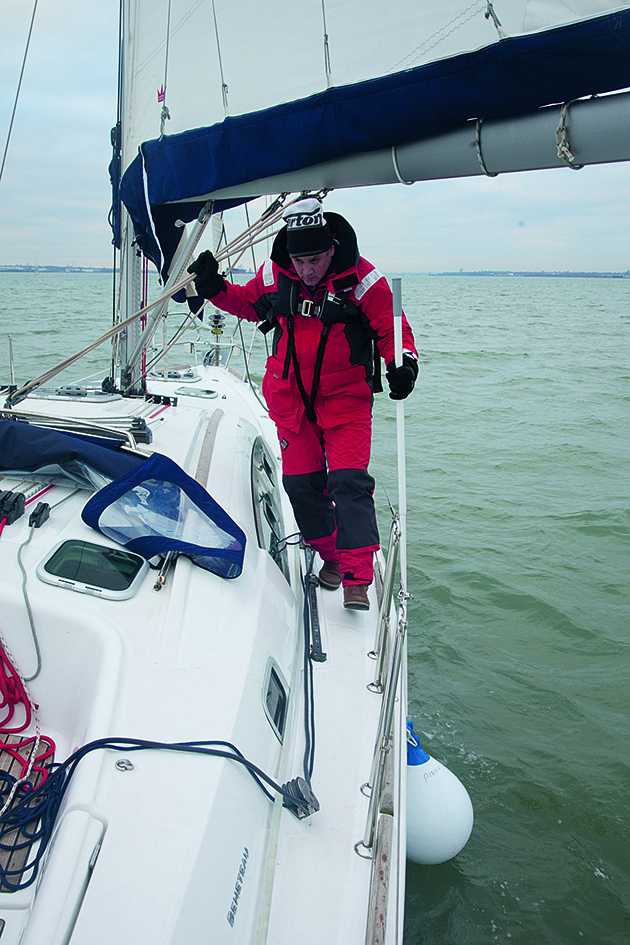
Credit: David Harding
8. … so that a crew can grab the MOB with the boathook
Man overboard turns: the RORC technique
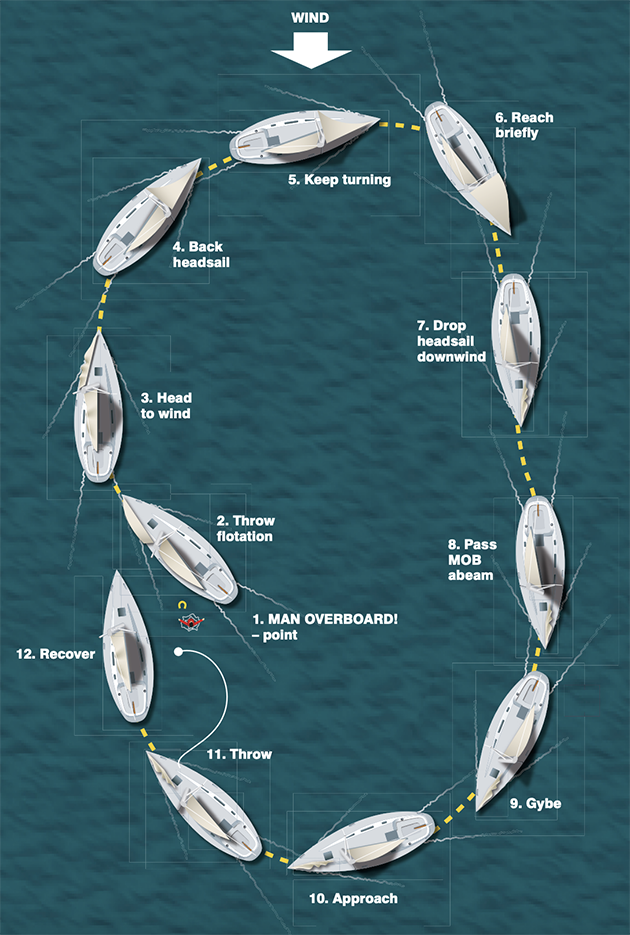
The RORC technique. Credit: Practical Boat Owner
Avoiding a gybe is a fundamental part of the RYA’s approach. Especially in heavy weather, with a crew that’s suddenly facing an emergency situation and having to think of lots of things at once, a gybe can lead to injury or damage.
Nonetheless, several weighty bodies in the USA – including the US Yacht Racing Union Safety at Sea Committee, the US Naval Academy Sailing Squadron and the Cruising Club of America Technical Committee – advocate a method that does include a gybe. They favour the ‘Quick-Stop’ approach on the basis that it keeps the boat close to the casualty and moving slowly.
This method is also promoted by the Royal Ocean Racing Club (RORC), the London-based club that organises such events as the Fastnet, the Round Britain and Ireland Race, the RORC Offshore Series and the Commodores’ Cup.
As with the RYA method, the boat is put through the wind and into the hove-to position immediately. The difference is that it’s then allowed to bear away further, on to a broad reach, before heading directly downwind. The boom stays centred to keep the speed to a minimum and the headsail is lowered or rolled away.
When the casualty is abaft the beam, the boat is allowed to gybe and the final approach is made on a close reach.
A further distinction from the RYA method is that recovery is carried out on the windward rather than the leeward side. Keeping the boom centred until the final approach is essential, both to minimise the boat’s speed and to stop the boom from crashing across during the gybe. A mainsail that’s sheeted in tightly can lead to a very calm and controlled gybe even in strong winds.
On the other hand, some boats – especially those with long booms – will simply refuse to gybe unless the mainsail is eased. If they do gybe, they might then round up rapidly unless the sheet is eased.
This variation in the behaviour of different designs is one of many reasons why it’s vital to practise with your boat in a range of conditions. Seeing whether a boat will bear away and gybe round with the sheets pinned in is standard practice in PBO boat tests.
If your boat will gybe like this, the Quick Stop method is worth considering because it keeps you closer to the MOB and makes it less likely that you will lose sight of him or her.
If you have reservations about gybing, or it’s hard to keep your boat under control downwind in heavy weather, the RYA’s reach-tackreach approach might be a safer option.
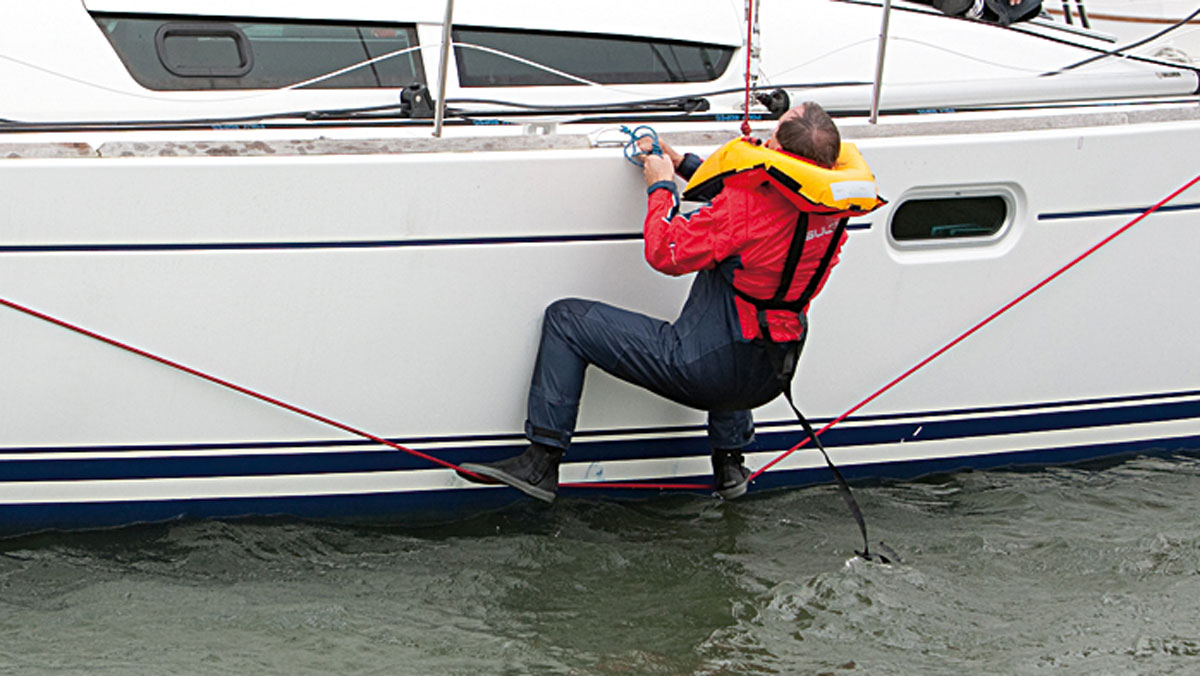
MOB recovery: which is the best single-point vertical lift technique for getting a crew member back on board?
Which is the best single-point vertical lift recovery method when faced with a man overboard? David Harding examines the best…

Man overboard rescue procedure: An alternative approach
Can rigging your jackstays in a different way really save lives? PBO reader Willem Bijl reckons it can, so David…
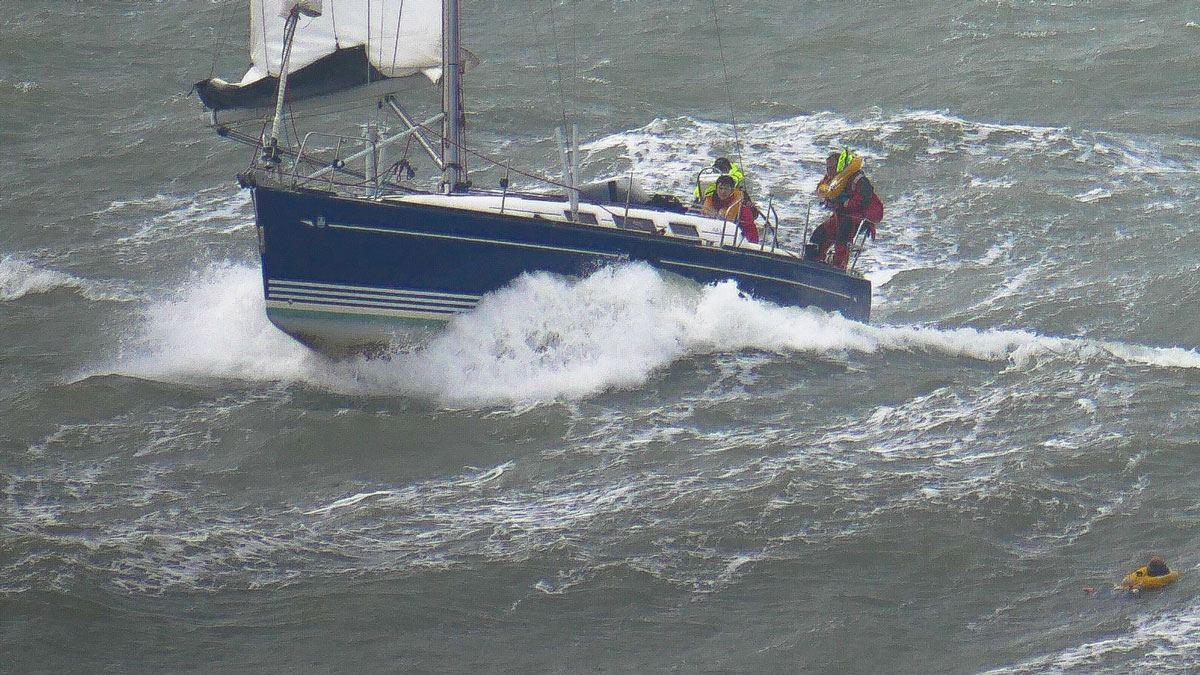
“It was like doing a MOB recovery wearing a neck brace” – says Round the Island Race 2024 man overboard skipper
As if this year’s Round the Island Race wasn’t tough enough for competitors with winds gusting 45mph and a rough…
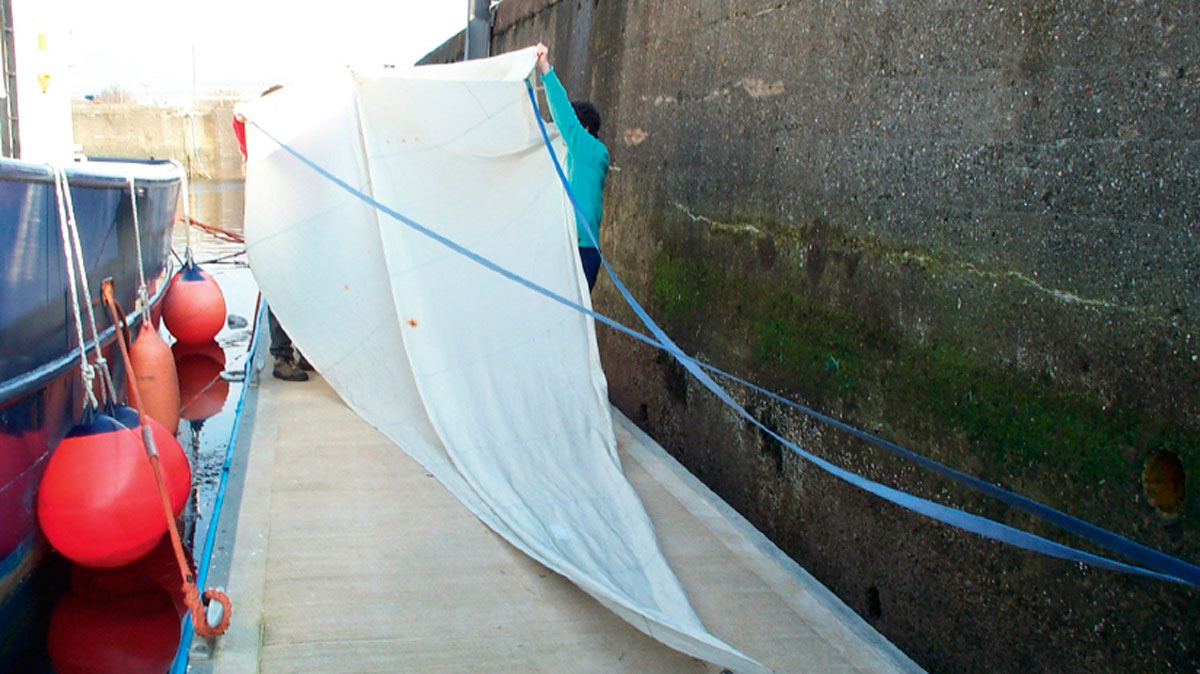
Turning old headsails into an MOB recovery scoop and sea anchors
Paul McNeill shows how redundant old headsails can be successfully recycled as items of MOB recovery equipment or as sea…
Want to read more articles like Man overboard turns: getting back to the casualty in the water?
A subscription to Practical Boat Owner magazine costs around 40% less than the cover price.
Print and digital editions are available through Magazines Direct – where you can also find the latest deals.
PBO is packed with information to help you get the most from boat ownership – whether sail or power.
-
-
-
- Take your DIY skills to the next level with trusted advice on boat maintenance and repairs
- Impartial, in-depth gear reviews
- Practical cruising tips for making the most of your time afloat
-
-
Follow us on Facebook, Instagram, TikTok and Twitter