



Built in southern Brittany, the Cormoran is a day-sailer developed from traditional working craft. David Harding went to France to test the boat
The Cormoran: tradition with a twist

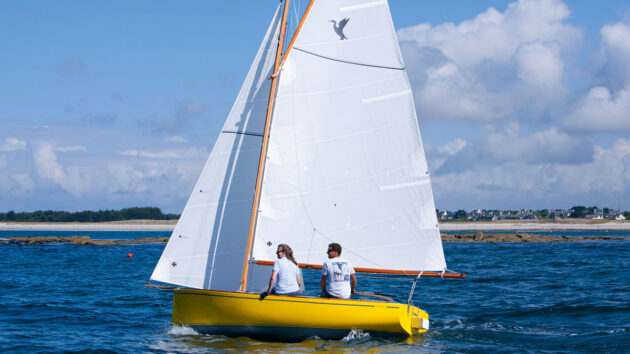
The Cormoran stands out. With her beautiful finish, high-quality hardware, teak decks and massive rig she’s clearly different and, despite measuring a mere 4.5m (14ft 9in) on deck, is much more in the style of a small yacht than a big dinghy.
Traditional-style dayboats come in varying degrees of authenticity. Some are developed from real working craft, others draw inspiration from them and a good few simply nod in their direction.
The Cormoran is firmly in the authentic division, the original design evolving in Carantec, near Roscoff, where teams of seaweed-harvesters would pull the boats behind them in knee-deep water before sailing back to base.
Almost inevitably, racing soon started and a set of rules was drawn up to restrict the principal dimensions.
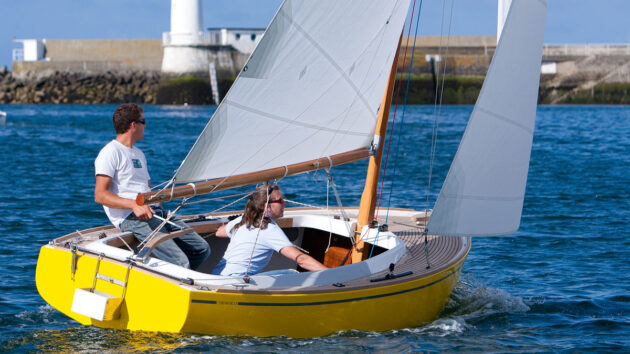
Coloured hulls are optional; this is the first to be moulded in yellow. Credit: David Harding
Cormorans were built to their own designs by many yards in Brittany until, in the 1950s, Francois Dervin produced a set of drawings for his own boat in the hope of standardising the lines of the hull. When Michael Moal built a mould for GRP production in the early 1980s, the shape was based on Dervin’s design.
Since 2001, ACCF has produced over 150 Cormorans from this mould adding to the 100-plus wooden boats already sailing. Wooden Cormorans are still built in small numbers by Jézéquel in Carantec, but differ in significant ways and are aimed more at the enthusiast.
The ACCF model was conceived to be more family-friendly, yet still competitive in the racing fleets that regularly attract sailors from classes such as the Mumm 30, Figaro and Mini-Transat as well as big-boat cruising sailors moving down in size.
Cormoran: Little boat, big rig
The most striking feature of the Cormoran is her enormous rig: 22sq m (237sq ft) is a lot of sail on a hull just 4.5m (14ft 9in) long. With such a powerful sail plan it’s no surprise that she performs very nicely in light airs and quickly reaches hull speed.
A beam of 1.9m (6ft 3in), however, allied to 190kg (419lb) of ballast in her long shallow keel and stainless steel centreplate, means that she’s also reassuringly stiff.
Sailing the Cormoran is very different from sailing most modern gaffers. By nature she’s closer to the Oysterman 16 than to boats such as the Cornish Crabbers. Like the Oysterman, I suspect she would leave a lot of newer, larger gaffers – and a good many other boats for that matter – for dead in under 10 knots of wind.
I sailed a Cormoran from Hamble with a good 12-15 knots of wind, which was about enough for full sail and allowed us to keep pace with a slightly weedy-bottomed Hawk 20 when we gave chase on a close reach.
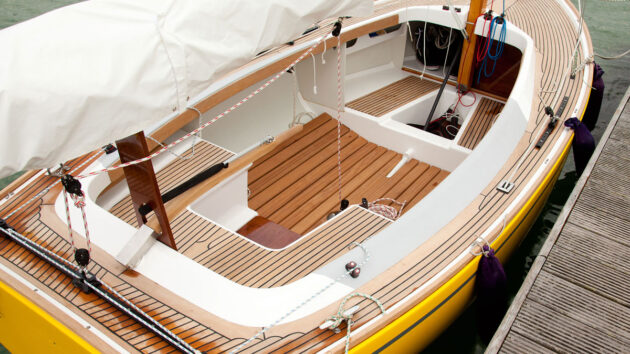
A roomy layout with plenty of nicely-finished timber trim. Credit: David Harding
In these conditions, as the builder accepts, she’s prone to developing substantial weather helm off the wind. This is by no means uncommon among gaffers and could be addressed only if the older boats were made obsolete. It’s a characteristic you just have to get used to and minimise as best you can.
Reefing in good time is one answer.
In France we were greeted by 9-11 knots – exactly what the Cormoran was made for. She trammed along at 4.5-4.8 knots on the wind, quickly picking up to well over 5 knots when the sheets were eased and semi-surfing down the small waves at up to 6.2 knots.
She’s remarkably responsive and enjoyable to sail, and it’s easy to see why she has established a keen following as a racing class.
Regional championships have been held for many years, as well as a national championship.
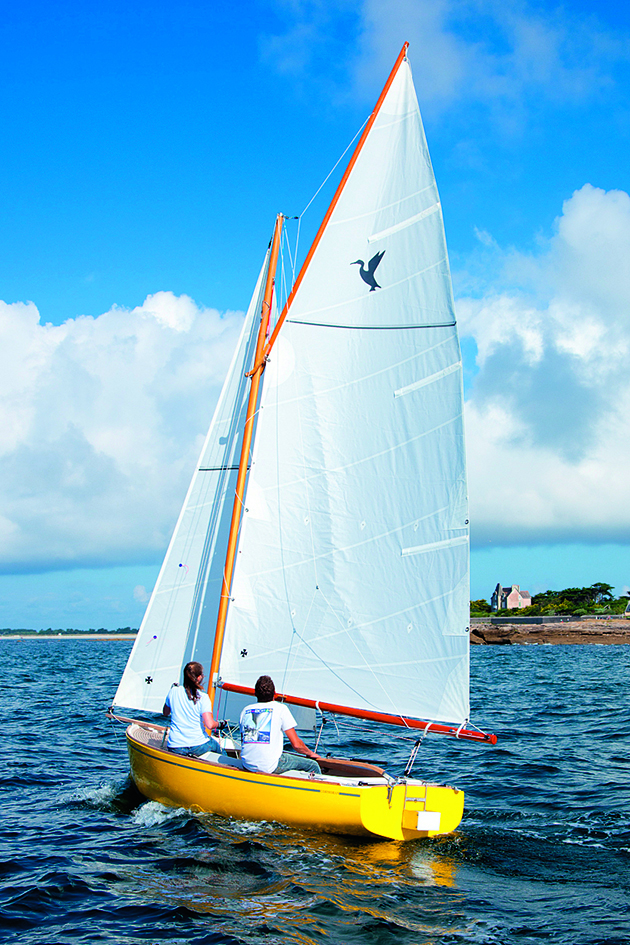
A Cormoran beats out of Le Guilvinec. Credit: David Harding
Unlike the wooden Cormoran, on which the top of the centreplate case extends almost to deck level as an anti-swamping precaution, the glassfibre version has enough buoyancy to render her unsinkable.
As a result the casing is entirely below the sole, leaving a clear, open cockpit with plenty of room for at least three people.
Teak is optional, both in the cockpit and on the decks, but 90% of Cormoran owners choose to have it, typically spending around €40,000 (around £34,500) on a boat whose base price is €24,400 (just over £21,000).
Together with the top-grade hardware and generally high level of finish, it creates a pleasant environment in what is a beautifully stylish and thoroughly engaging little ship to sail.
Details
Cormoran GRP Version:
Price (from approx):£21,000
Length on deck:4.50m (14ft 9in)
Length inc. bowsprit:5.10m (16ft 9in)
Beam:1.90m (6ft 3in)
Draught:0.5m-1.1m (1ft 8in-3ft 7in)
Weight:450kg (992lb)
Ballast:190kg (419lb)
Sail Area:22.0sq m (237sq ft)
RCD Category:C