


Ned Coackley needed a retirement project and an International 14 racing dinghy from the 1920s needed complete renovation. Here's how he restored the boat for £1,000
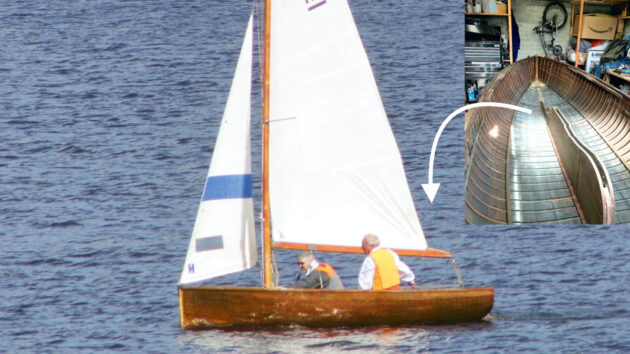
Sixty years ago on the wild North Wales coast, I learned to sail in Cadets. Moving up to a Heron, Enterprise and Hornet performance class dinghies as I got older was exciting, and some sort of progress, writes Ned Coackley. In North Wales we were far away from the World Championship and Olympics-bound sailors down south and only read about them and grand competitions in magazines. Those seriously hot ships, the 505, Dutchman, Tempest etc were just to be drooled over and maybe, just maybe, one day we’d get a ride in one. And then there was the International 14.
That much sail on a GP 14-sized hull with so few measurement rules that a designer could draw almost what they liked – are you serious? Occasionally one of them would appear at the local Menai Strait regattas and we kids would wonder how was it possible to sail that fast and stay upright in such a beautiful, varnished hull?
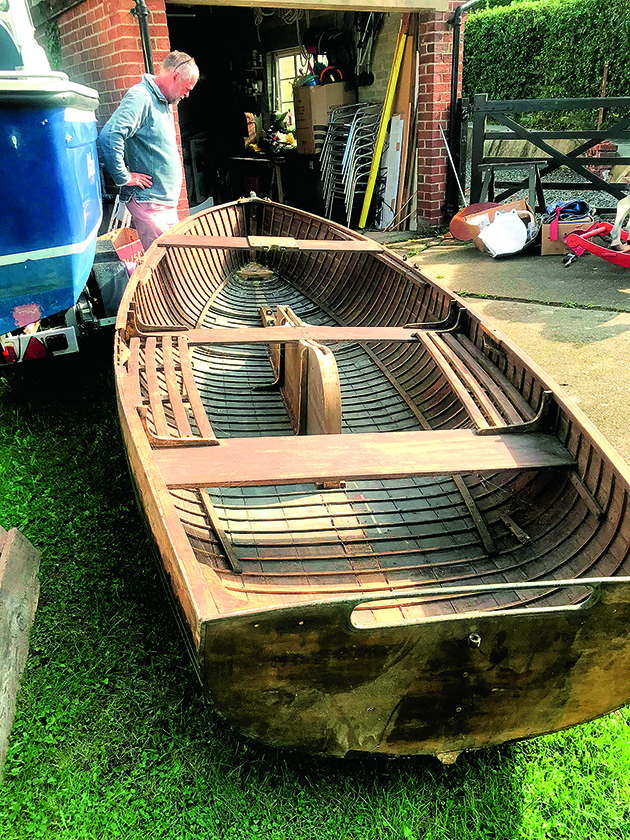
Before – the 1920s-built Uladh had been hanging in a barn near Saltash for the past 20 years. Credit: Ned Coackley
Sixty years and a sailing career later, the Covid pandemic came along, retirement antics ground to a halt and shortly thereafter orders were received from my wife to ‘find something to do – or else!’ Having already converted an 8ft tender into a lugsail knockabout for the grandchildren, a recycling website brought up a 14ft dinghy in need of renovation.
Life-threatening home environment temporarily removed? Possibly! A few phone calls and photos later it was established as an ancient International 14. Navigating the differing Wales/England travel rules at that time found me driving to Exeter to examine said vessel. The deal was done and the anonymous 14 hauled up north.
Now I needed help in identifying the hull as no numbers had been carved into the hog, there were no sails, no rig and the seller didn’t tell me where he’d obtained the boat except that it had been hanging in a barn near Saltash for 20 years!
Community support for the International 14
Enter the Classic and Vintage Racing Dinghy Association (CVRDA) where member Pat Jones had advised me to ‘Buy it!’ and Chris Barlow, with not a little International 14 experience to his credit said: ‘Send the information you have and we’ll work it out.’ With a few photos also posted on the association’s social media page, the floodgates opened and wise and wonderful ‘Vintage and Classic’ 14ers piled in with advice.
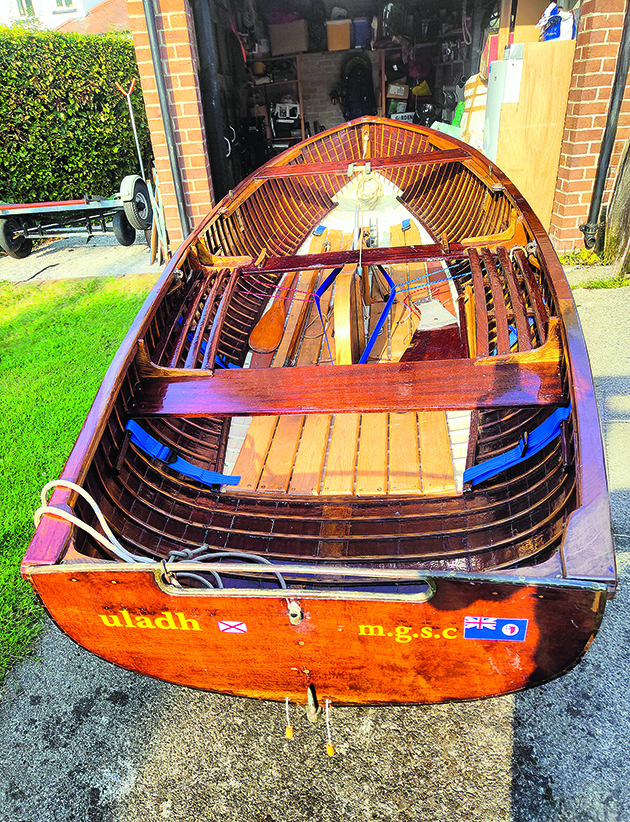
After – Ned Coackley’s rebuilt vintage International 14 Uladh. Credit: Ned Coackley
The only solid basis for identification was the builder’s plate, which stated Joseph Vella, Malta. This made it a Morgan Giles design and from Tom Vaughan’s book The International 14 Foot Dinghy, 1928 – 1964: Handbook and History it was confirmed as K 243. As well as the rebuild, the challenge of tracing the history of the boat became a task in itself.
Back home, territorial rights were proclaimed for the single car garage at the bottom of the garden as a 14ft hull fits cosily inside with just enough space to walk around. As I moved her into her new home boating colleagues came to inspect this new arrival – standing 6ft apart of course – and departed with grim expressions, ‘good luck’ comments and head shaking.
So the task began. Tom Vaughan’s book gave the name ‘Uladh, say ‘Oola’ which is Gaelic for Ulster and the last registered owner as Peter Ross. The International 14 Association has a gap in their records for a few boats around this registration number, which was not unusual when builders were issued a batch back in the 1920s and 30s. This gave my challenges of rebuilding and researching a starting point.
A work plan required a complete back-to-bare-wood strip-down to remove years of ancient paint and varnish and assess what could be saved, repaired or what would need to be replaced.
Daunting task
All fittings had long gone, there were no spars, a flimsy floorboard arrangement, 56 cracked frames, a transom hanging on by a few nails, and a ‘half-guitar’ shaped centreboard case which had its top split, probably by overenthusiastic raising of a steel centreplate in the past. However, Mr Vella seems to have had access to some good wood in Malta in the 1920s as 95% of planking was in excellent condition – a little dry – but showing through as a beautiful red Honduras Mahogany when eventually varnished.
The hull had the rigidity of a wicker basket on first inspection which was remedied by refastening all thwarts, seats and the centreboard case as well as resorcinol glueing a new cap rail to the gunwale. This triangulated with the solid stem and centreline to stiffen up the whole boat.
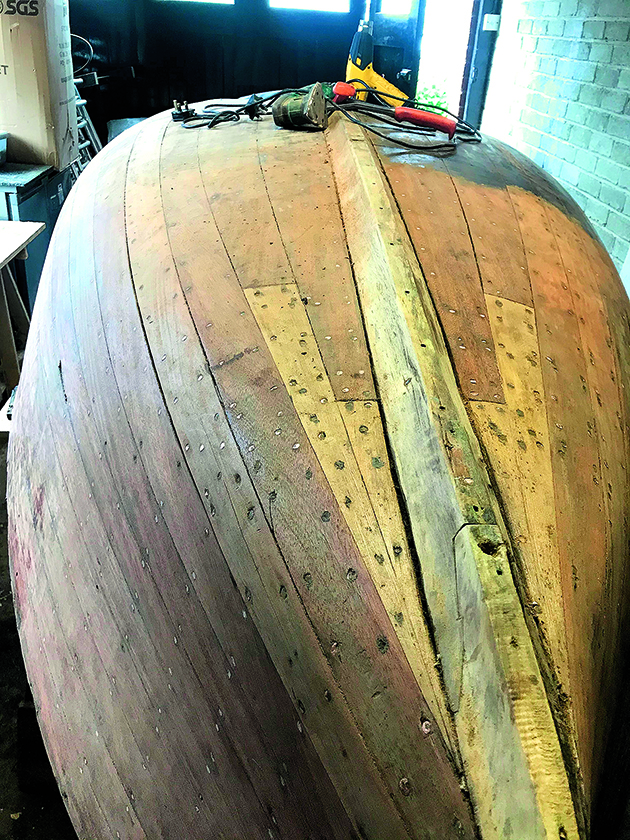
Honduras Mahogany planking stripped. Credit: Ned Coackley
The transom required a futtock to make good its joint with planking while the mast thwart needed re-fastening. The mast thwart told a story in itself where a 4in hole indicated a bamboo mast originally and plugged holes at deck edge showed it had been repositioned a few inches forward at some point.
Broken frame repairs at the forefoot were removed and planking nib ends reinforced with… sorry, glass cloth and epoxy. All bench seating came out and finally the centreboard case.
This left the bare hull with 80-plus ½in X ¼in rock elm ribs and a lot of stripping or sanding to do. A heat gun and scraper were effective tools before using the ‘Dutchman’ method to repair the cracked frames – using profiled wood to spile a new section and glue it where the crack had been.
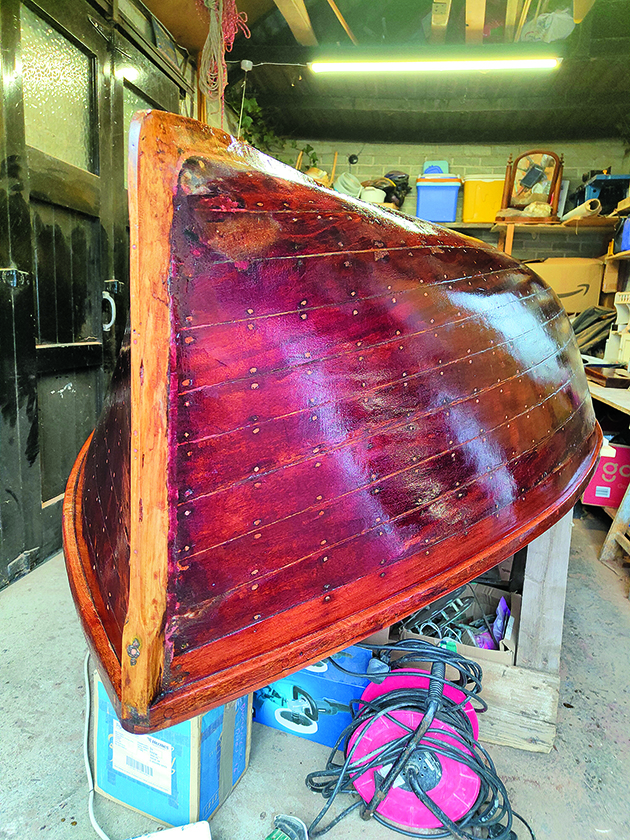
Honduras Mahogany planking varnished. Credit: Ned Coackley
After the first sail in a blow, a further 19 cracks appeared which were repaired in the same way. Clenched copper nails sometimes proved obstructive but nipping and knocking through dealt with them.
Cracking on
The centreboard case came out easily when unscrewed but revealed 6in of wood degradation on the port side and years-old putty and paint as bedding. Many hours of scraping and sanding later, Uladh was ready for reassembly.
Ratchet straps had held her tight athwartships and a shaped cradle had supported her fore and aft on the garage floor. Some movement had occurred but gentle persuasion and occasional grunt saw the case back in place with the thwarts, knees and breasthooks locking the hull into the correct shape. Discreet use of epoxy and glass tape sealed the hog to the garboards and a modern sealant was used as a bedding compound where necessary.
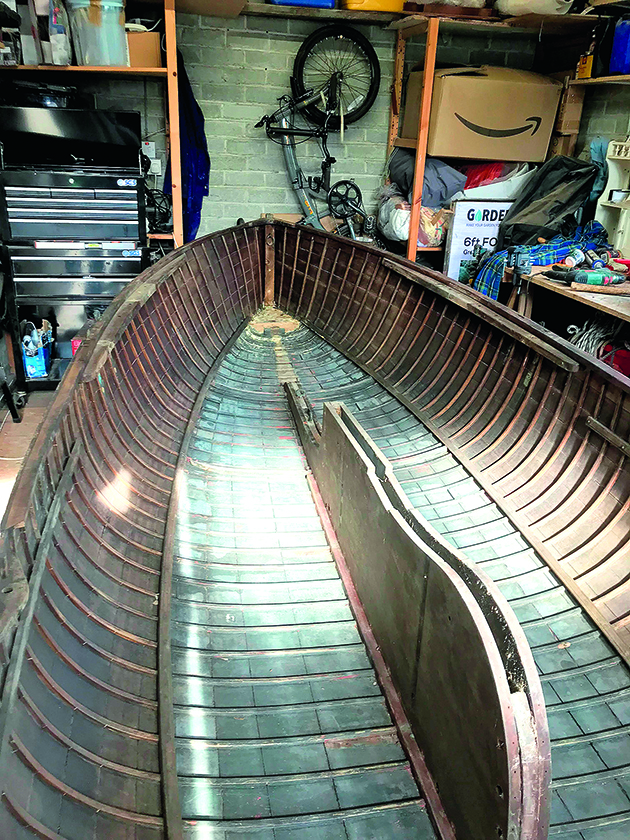
Centreboard case before restoration. Credit: Ned Coackley
With no means to steam bend a new top to the ‘half guitar’ centreboard case all the way forward to the mast step, laminating three layers of 1.5mm oak veneer onto the top edges of the case proved successful. Future over-enthusiastic raising of the board is prevented by a stopper knot on the winch.
A medium weather board was installed; wood but with 5kg of lead cast into the lower sections and an original Morgan Giles brass winch recovered from a Humber Yawl to raise it. Caulking a dry old hull raised some discussion but the realisation that Uladh would continue to spend most of her life ashore dispensed with the need to allow for soaking up – the likelihood of 10-15 hours per year afloat does not give much time for planks to swell.
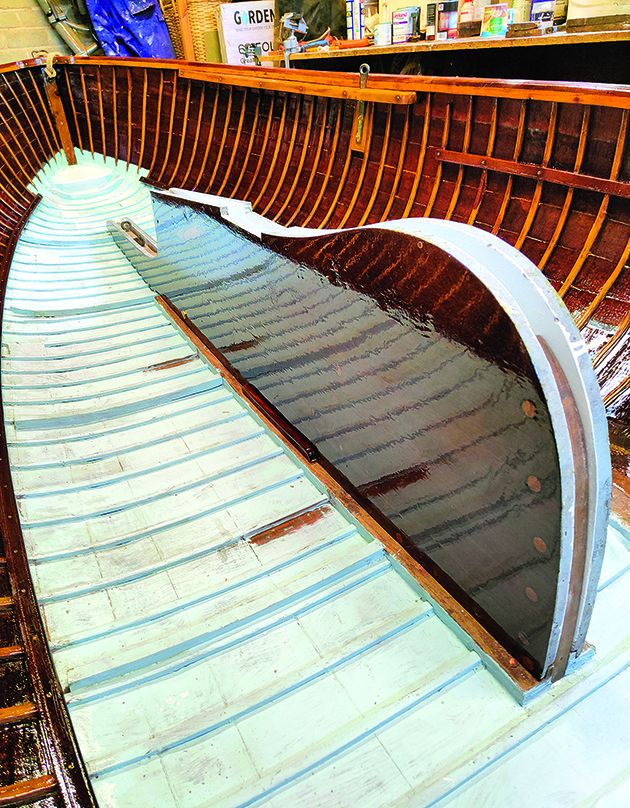
Centreboard case after – showing old split capping and new oak veneer capping. Credit: Ned Coackley
CT1 is a builder’s compound used for installing windows and is adhesive, flexible, paintable and comes in a choice of colours. Sikaflex EBT was also used. Seams were raked out and epoxy-coated before caulking and Epiphanes high UV varnish applied. The red Honduras Mahogany was quite a sight before inevitably oxidising.
Obtaining appropriate fittings was a long term exercise. A Humber Yawl boom, brass gooseneck from Boston, bullseye fairleads from California, manila coloured sheets and lines from a French supermarket and the inevitable haul of Tufnol from eBay.
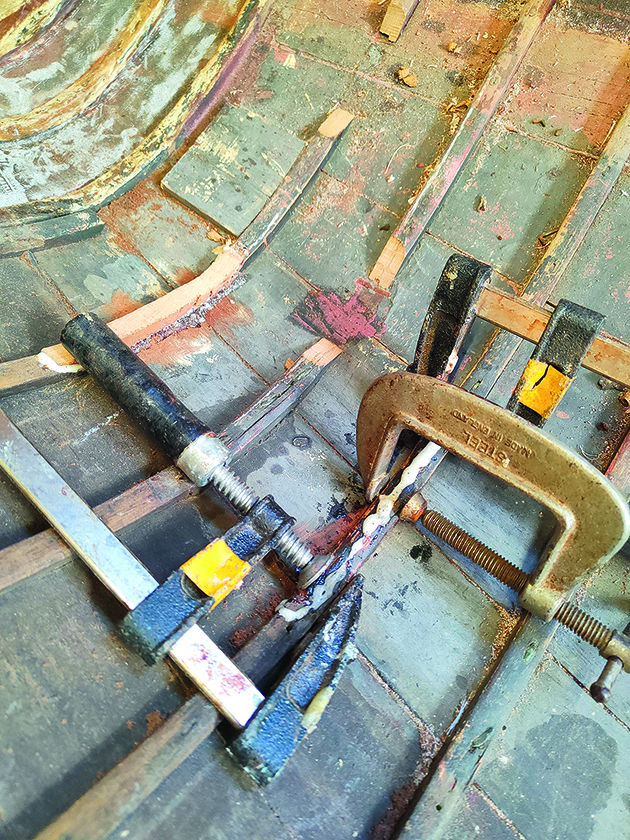
Rib profiled wood spiled and glued in place to repair cracks. Credit: Ned Coackley
A full suit of cotton 14 sails, as well as Dacrons, was sourced from here and there. A wooden Seafly mast was extended by 2ft to take the tall rig with a stainless steel ‘parrots perch’ spreader made to support the upper sections. As the rudder pintle and gudgeon are riveted through the transom and knee, a rudder had to be found to fit those dimensions. A Fairey Marine 1950’s rudder with an aluminium stock and made to aircraft standards was found to be a close fit when used with a small spacer.
Sea trial
No excuses remained and she had to get wet. While all this was going on, the history of the boat was coming to light with a most interesting central character at the helm. Lieutenant Commander Peter Ross was probably not the first owner as his service record shows he was never Malta-based. He is on record as sailing at Portchester in 1930 and a photograph of him and his wife Angela sailing Uladh in Bermuda coincides with his posting to the West Indies station 1934-36.
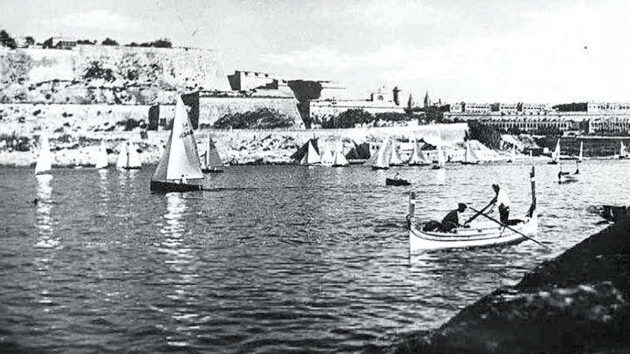
Malta Garrison SC International 14 racing in Marxsamett Harbour, Malta, 1930s
His next posting was to HMS Liverpool on which he met a tragic end while trying to isolate an aviation fuel tank in the cruiser’s bow following an Italian torpedo attack on the ship in 1940. Ross probably moved Uladh about the globe as personal property aboard his ship and by this means she arrived in the UK again but the route and timeline is not known.
If he’d lived he would have become the 26th Baron de Ros of Strangford, hence the name Uladh. The current 27th Baron has been most helpful in this research and supplied the photo from Bermuda. Sadly no details of her missing years are available, though presumably she was sailed close to Saltash on the Tamar river near Plymouth maintaining a Royal Navy connection.
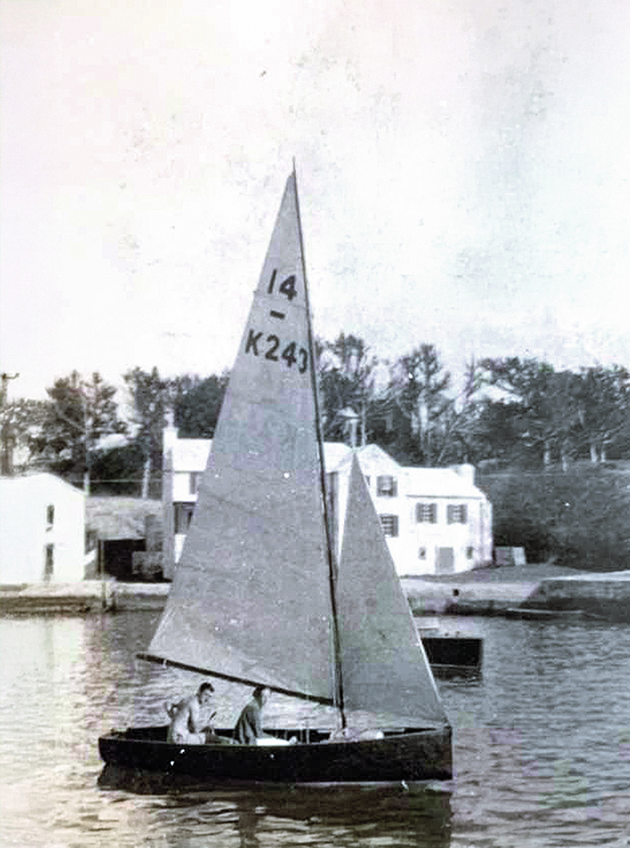
Peter and Angela Ross sailing Uladh in Bermuda
Uladh sailed for the first time in 30 years in 2024 and has participated in several CVRDA and Classic International 14 regattas alongside her modern sisters. She is currently looking for a new caring home.
Cost of restoring an International 14
Gratitude must be expressed to CVRDA members and others interested in preserving and using classic wooden sailing dinghies. Equipment exchanges, free obsolete gear gathering dust in sheds and useful somewhere else have been extremely welcome.
Somewhere in the region of £1,000 has been spent on Uladh excluding travel costs and labour. The most expensive items were varnish and finishes at about £300, and the second-hand centreplate winch at £250. Used sails, new lines and rigging, used fittings, a rudder at £25 and carrier costs make up the remainder.
The Flying Fifteen: the spirit of sailing
Clive Marsh sings the praises of the Flying Fifteen – an attractive, self-righting and popular fixed-keel dinghy that sails brilliantly

Dinghy cruising: 30 ways to experience the ultimate small-boat adventure
Ben Lowings shares his tips for dinghy cruising around the UK and further afield
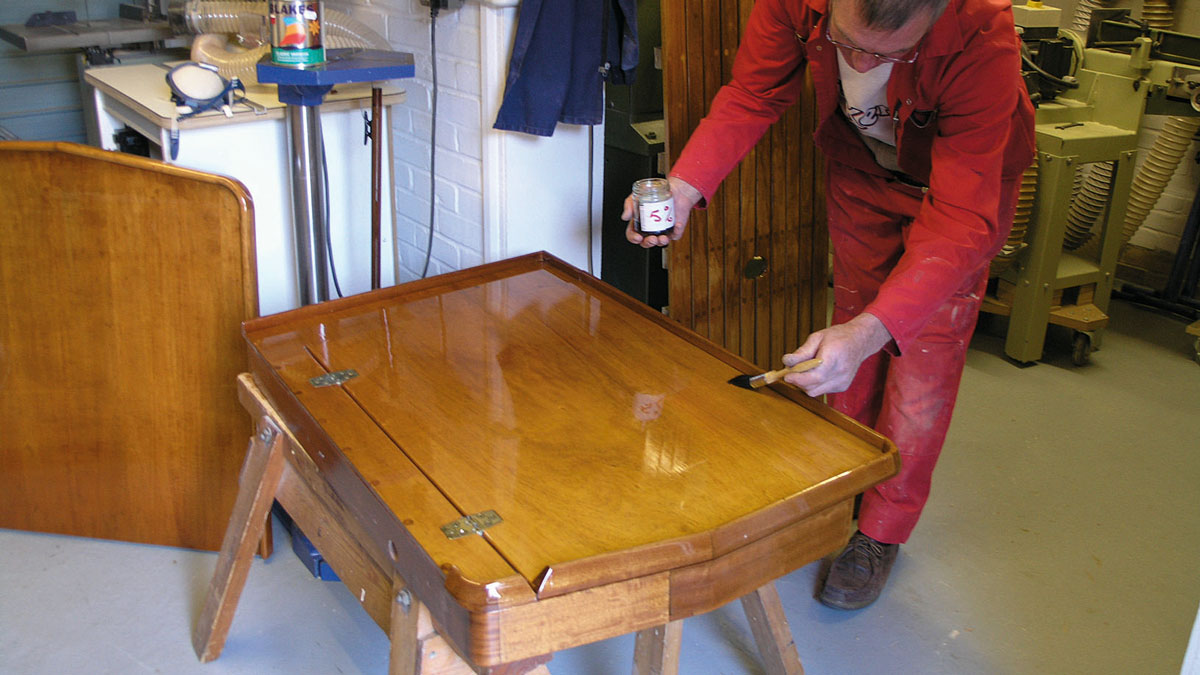
Marine varnishing: an expert guide to making your woodwork shine
Few things look better on a boat than beautifully varnished woodwork. The best results are all down to the preparation…
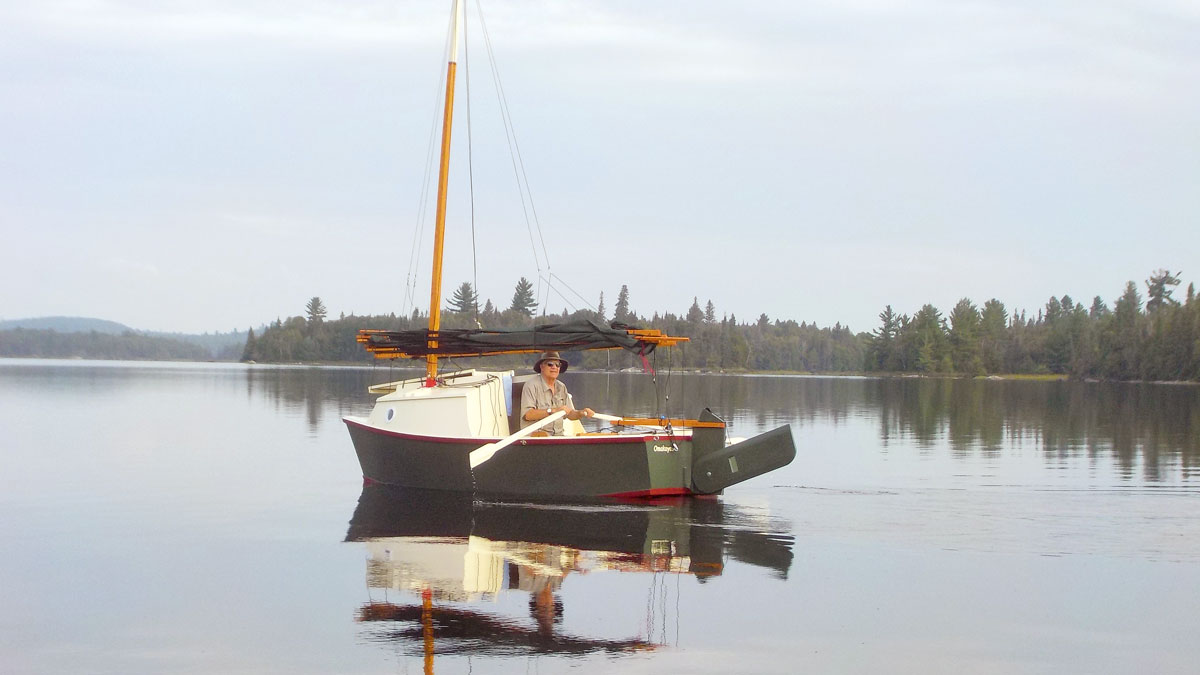
How I built my dream minimalist trailer-sailer to navigate the Canadian wilderness
Herb McLeod explains how he designed and built his flat-bottomed 3.6m Omakayas
Want to read more articles like Restoring a lost International 14 racing dinghy found in a barn after 20 years?
A subscription to Practical Boat Owner magazine costs around 40% less than the cover price.
Print and digital editions are available through Magazines Direct – where you can also find the latest deals.
PBO is packed with information to help you get the most from boat ownership – whether sail or power.
-
-
-
- Take your DIY skills to the next level with trusted advice on boat maintenance and repairs
- Impartial, in-depth gear reviews
- Practical cruising tips for making the most of your time afloat
-
-
Follow us on Facebook, Instagram, TikTok and X