


The Garlandstone is one of the last wooden trading vessels of its type. HE Ross questions why she sits derelict while sister ships thrive as charter vessels, and the future of classic boat restoration.
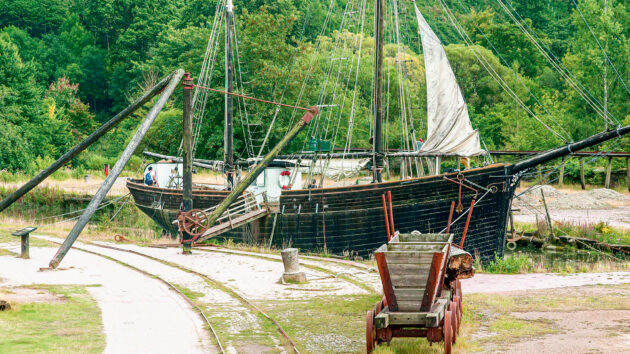
‘The Garlandstone is immensely important,’ said the late Martyn Heighton, creator and director of National Historic Ships. It’s time for classic boat restoration to turn its attention to this iconic ketch trader.
The Garlandstone, ‘Is one of the last wooden trading vessels built in the South West and was made from timber from the Cotehele Estate and built locally at Calstock,’ said Heighton.
‘There are very few trading vessels like her now remaining anywhere. The Garlandstone is surely one of the best examples of the wooden working boats which traded around the UK coast.’
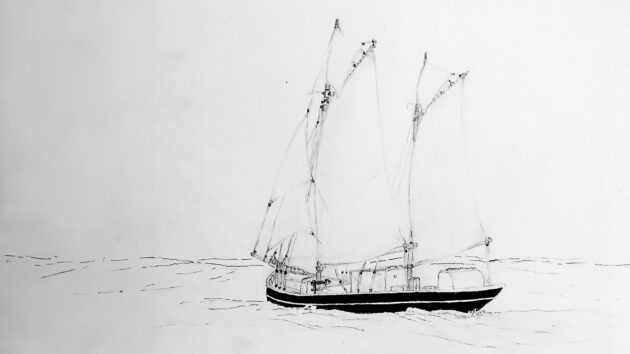
HE Ross’s drawing of the Garlandstone in her prime; she was built without an engine at the James Goss Shipyard on the River Tamar, and was launched in 1909. Photo: HE Ross.
The Garlandstone is the old boat whose rounded counter stern can be seen by anybody moving along the River Tamar and passing Morwellham Quay.
I went to see her and was able to board and walk on the still stout deck planks. What was obvious was the neglect that was looking toward extinction.
Once, little puffs moved her toward Ireland with a crew bored stiff by the lack of progress. Once, she felt the brunt of a Norther as she beat her wet way to Calstock to deliver fruit from Brest. She got stuck a few times making her way up the Tamar and had to string and pull lines from shore to complete a voyage.
Now I was seeing more than neglect; she had become a monumental show of no importance.
The go-anywhere ship
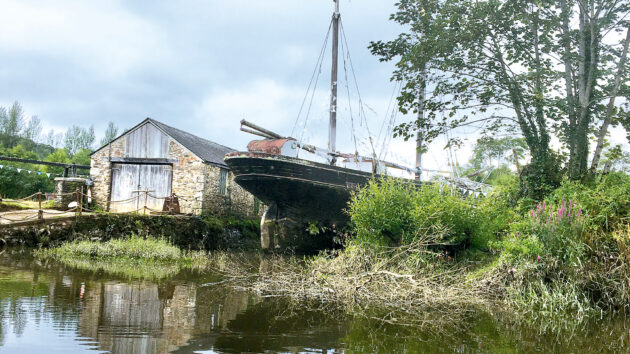
The Garlandstone’s distinct, rounded counter stern. Photo: HE Ross.
The Garlandstone was one of up to 700 West Country trading ketches working from the south-west of England.
The 76ft gaff topsail trading ketch was designed and built by James Goss, who had a vision that the ship could be sailed mainly coastal but with the option of deep water.
She was a gamble by Goss; there was a market when construction began, but the build took six years before the ship was sold and launched on 27 January 1909.
The market was just about to move on to engine-driven vessels, and the Garlandstone did not have an engine.
Goss had a reputation for designing and building safe, well-built vessels, but Garlandstone proved to be the second-to-last sailing trader to be built in the West Country.
She was built and launched at the James Goss Shipyard across the River Tamar from Calstock in Devon, where the Ferry Farm is now located.
Her first owner was Captain John James Davies Russan, who had been watching her construction for years. He not only named her but commissioned her as the first deepwater trader built this far up the Tamar.
The Garlandstone worked almost continuously under six owners until 1961, when she was sold to an American and converted into a yacht.
Preservation
She didn’t work out as a yacht and lay derelict until the 1970s, when RA Kyffin and Colin Lansdown obtained her and had her towed to Porthmadog, Wales.
This marked the beginning of a long, piecemeal restoration under the umbrella of the Gwyneld Maritime Museum and eventually the National Museum of Wales.
In 1987, she was towed to Morwellham Quay for more restoration before a £120,000 grant from the National Heritage Lottery funded 13 more years of work.
This restoration was only to give her ‘museum quality’ completion, and she was used as a floating exhibit at the Morwellham World Heritage Site; 13 years later, she was moved ashore at Morwellham Quay.
And there she sits without funding to even maintain her.
Classic boat restoration leads to a revival
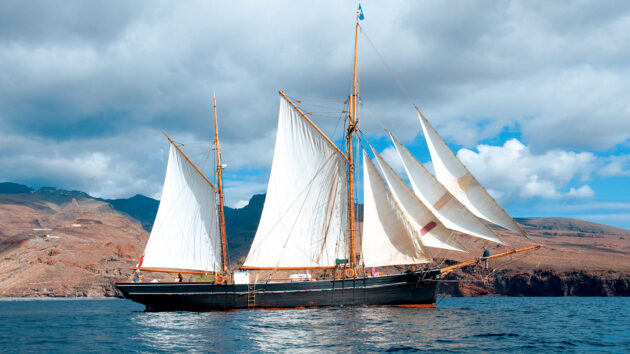
The Bessie Ellen has been fully restored and is now a charter vessel. Photo: Pete Ivermee / Alamy.
Two deep-water West Country sailing traders have recently been fully restored and are working as charter vessels.
The 84ft gaff topsail ketch Bessie Ellen has a 118ft sparred length carrying 330m² of sail.
The Bessie Ellen was launched in 1904 at the William S Kelly yard at Mount Batten, Plymouth. She was bought by Captain John Chichester and launched in 1907.
Like Garlandstone, she was built as a speculation between 1904 and 1906 to keep the shipwrights busy between other work.
She was purchased off the stocks by John Chichester, a north Devon home trade captain who registered her at Barnstaple in January 1907.
She was named after the owner’s two daughters, who launched her on 3 January 1907, Bessie, aged 13, breaking the wine bottle on the ketch’s bow, while Ellen, 11, officially called her name out to welcome her.
The family worked her carrying mixed cargo until the end of World War II, when she became uneconomical and was purchased by Captain Christian Moller and sailed to Frederiksvaerk in Denmark.
She became again too old for work in the Baltic and sat derelict for 20 years until 2000, when Nikki Alford bought her, carried out some work before sailing the boat under jury rig to Charlestown, Cornwall, where she was rigged. She began charter work in 2003.
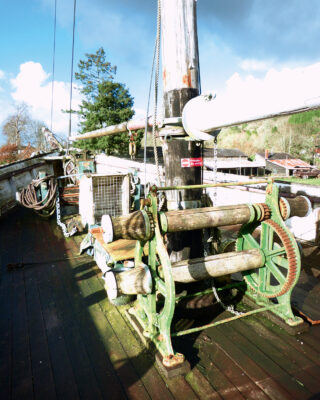
Planking, caulking and rigging on the Garlandstone all need replacing. Photo: HE Ross.
The 85ft West Country trading ketch Irene was launched on 29 June 1907, again on speculation, at the Bridgwater yard of FJ Carver & Sons, Somerset.
The topsail ketch carried her first brick cargo for her owner, Colthurst Symons, three weeks later. She sailed actively to London, Rotterdam, France, Scotland and Ireland.
After being sold twice, she was eventually re-sold to her original owner with a 70hp Bollinder engine. That was replaced, and she became more of a motor-sailer. Her last cargo was in 1961.
Sold again in 1965 after a couple of wreckings, she was turned into a boathouse. She underwent extensive restorations in 1980, with the restoration completed two years later.
A preservation society was formed, and in 1998, she sailed to the Caribbean.
At Sint Maarten in 2003, she was gutted by a fire and sank. Amazingly, Irene was raised and towed by the schooner Avontuur across the Atlantic to Bagmill Creek, Cornwall, for a major restoration and eventually re-floated in August 2007.
In April 2011, she embarked under full sail on a trip to Bordeaux. In 2022, Irene was leased to the Cornwall-based charity, Sea Sanctuary, for sailing experiences; she is also a charter boat with Simply Sailing of Falmouth.
Both Irene and Bessie Ellen are working, self-supporting and community involved.
Classic boat restoration and the future of Garlandstone
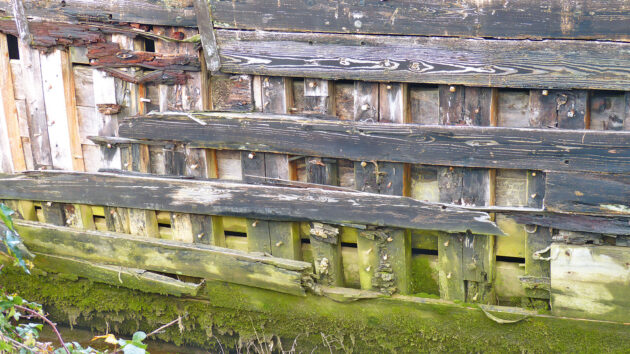
Garlandstone’s hull is markedly deteriorating. Photo: Peter Worth / Alamy.
The only other West Country trading ketch registered as a National Historic Ship is the Garlandstone.
The work to be done on her involves replacing planking, plugging drainage holes, replacing rigging, deck caulking, masts restoration or replacement and sail design and building.
The hardware and decking are in good shape still, given the lack of maintenance, but the rest of the classic boat restoration work will be expensive, and to raise funds, the classic boat’s restoration work will need a firm purpose.
At a time when Government funding for cultural preservation is not a high priority, it does not seem that this historically relevant Cornish sailing vessel will be saved, but you never know who might be out there to help preserve one of the last examples of these great, working vessels, which assisted in the development of the River Tamar communities.
HE Ross grew up in San Francisco and worked as a maritime columnist for the Pulitzer Prize-winning newspaper, Point Reyes Light, before he moved to the Caribbean in 1979. He founded the Cayman Maritime Heritage Foundation and the Turks and Caicos Maritime Heritage Federation. He has sailed and overseen the restoration of boats such as the Cayman Catboat.
Fit for the future: the pioneering boat by BlueTree
Annie Means talks to the founders of BlueTree about their innovative approach to boatbuilding design and construction
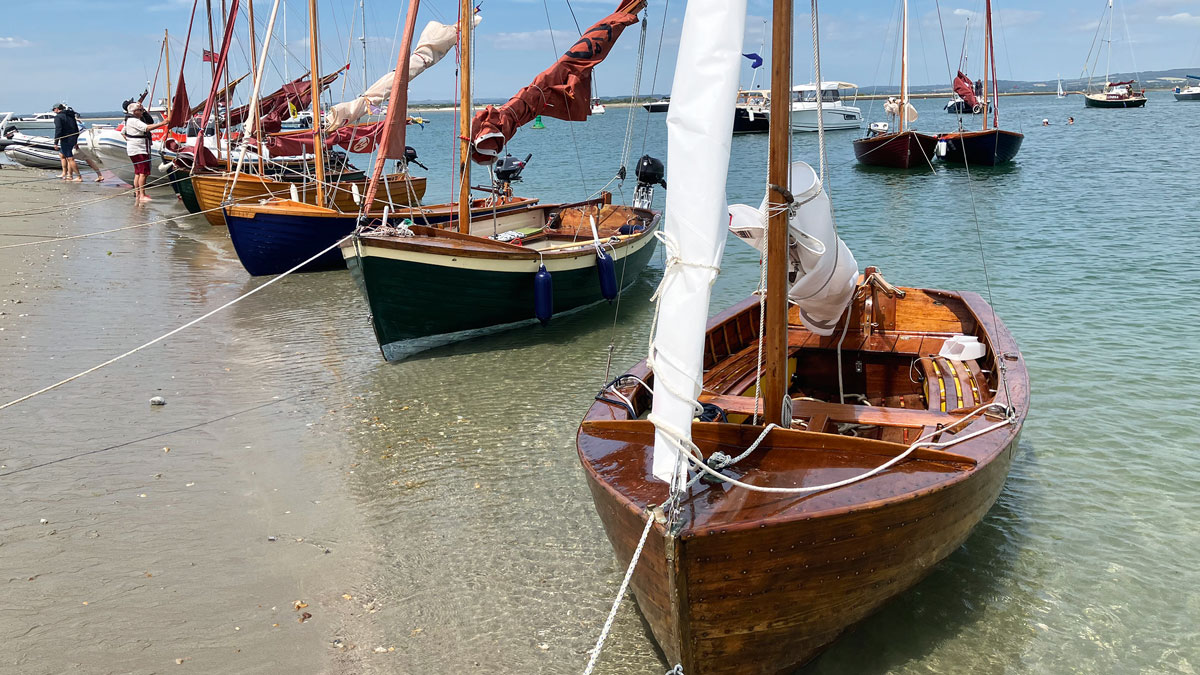
The Tideway dinghy: celebrating the classic trailer-sailer
While the 10ft option is easy to row and a delight to sail, Clive hails the 12ft trailer-sailer as one…

Contessa 32: the second-hand classic + 6 alternative boats
Rupert Holmes analyses this extremely seaworthy classic and suggests a dozen other viable lower-cost alternatives

Classic cruiser boats: Why GRP models are now being welcomed into the fold
Sprawled, glass in hand, in the cockpit of my friend James Stock’s beautiful Stephen Jones-designed Mystery 35, I pondered on…
Want to read more articles about classic boat restoration?
A subscription to Practical Boat Owner magazine costs around 40% less than the cover price.
Print and digital editions are available through Magazines Direct – where you can also find the latest deals.
PBO is packed with information to help you get the most from boat ownership – whether sail or power.
-
-
-
- Take your DIY skills to the next level with trusted advice on boat maintenance and repairs
- Impartial, in-depth gear reviews
- Practical cruising tips for making the most of your time afloat
-
-
Follow us on Facebook, Instagram, TikTok and Twitter