


Pete Hill and Linda Crew-Gee explain how they used power fin sculling to make it easier to row their dinghy

Like in a dream, over the calm turquoise seas of the tropical lagoon, Pete effortlessly rowed us out of French Polynesia’s Raivavae harbour in Crake, our 8ft Bolger Nymph.
It took us about half an hour to get to one of the most beautiful tiny tropical motus (small reef islet made of sand and coral) I’ve ever seen.
On one side there was a pristine beach separated from an outer reef with a fast-running channel.
Huge waves were breaking on the reef with thunderous force, while we were safe from them just a short way away. Numerous tropical fish swam in shallow rock pools.
The rest of the island was partially protected from the reef by a steep coral reef that encircled the shore. The interior was a dense tropical forest.
On its outskirts, partially facing the rough seas of the reef and hiding in the calm waters of the lagoon, was a very rudimentary shack snuggly shadowed by the palm trees.
I could understand why Pete said: “It would be nice to have a house here!” And astonished, as I could not believe that he uttered those words. Would he ever want to have a house!?
By the time we wanted to row back to the Polynesian village the wind had picked up a lot. The long row back, into a strong headwind, was a different story to our arrival.
Pete was really struggling to make any progress while I was sitting there, a dead weight.
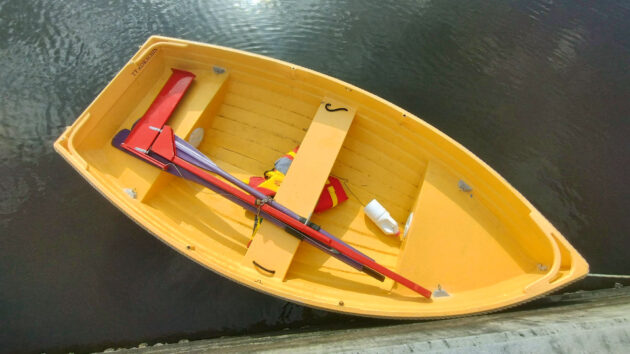
Power fin sculling works by producing forward motion as the fin flips from side to side. Photo by Pete Hill and Linda Crew-Gee
It frustrated and worried me a lot. I wanted to, but could not help. Being inexhaustible, he rowed for hours and we eventually made it safely back. I was grateful but remained worried.
I did not want a similar situation to be repeated with an unhappy ending.
Months later and we were exploring reefs in Tonga in Crake, with our guest, Roger, in tow.
Having spent some time exploring we noticed dark clouds gathering.
We made a quick dash to the dinghy and then the race with the clouds started.
They were dark and low, looking very threatening. The dinghy was quite loaded with three of us on board and only Pete was rowing, making slow progress.
It did not look good. I realised that I could help him by hanging off the stern, the flippers on my feet propelling us forward.
It was exhausting, and it went on for ages, but I did not give up. After this, my back complained for a while.
Having had those two experiences, we had to find a way that I could meaningfully contribute to the dinghy rowing.
Analysis
We need to have a dinghy that is light, easy to carry and lift aboard, that rows well and is simple to repair and inexpensive to replace.
We did not want an inflatable, as they tend to be heavy, do not row easily, can be punctured, are expensive with a relatively short life, one gets wet sitting on the tubes and they are often the target for thieves.
We also wanted problem-free, simple propulsion – oars; we did not want to be dependent on complicated mechanics or technology and it needed to work, even if it was obsolete.
Petrol outboards are noisy, smelly, heavy, need fuel, are expensive, create pollution, require maintenance and are attractive to thieves.
Even electric outboards are expensive and are reliant on limited recharging capacity on board and some can take a while to recharge.
The solution: Power fin sculling
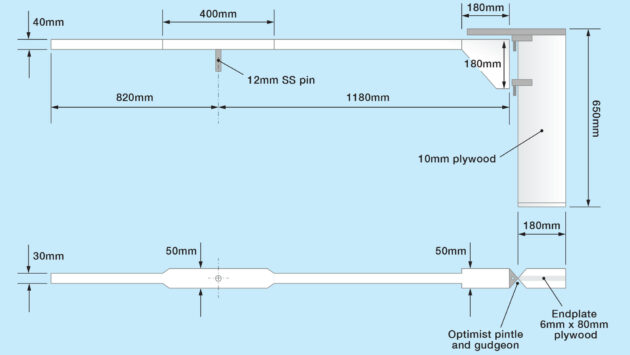
Photo by Pete Hill and Linda Crew-Gee
One of the problems with a typical dinghy that fits on a normal cruising boat is that it is too small to accommodate two people rowing.
Our 9ft/2.7m dinghy is bigger than the average 8ft hard dinghy on most boats. Two people rowing in tandem would depress the bow too much to be effective or safe.
It would probably need to be 10ft/3m or bigger to allow two rowers in tandem.
Not only would this be too large to stow on the deck of most boats but also too heavy to be convenient to lift on board or carry up the beach.
Pondering a possible solution Pete toyed with the idea of a Hobie Mirage Drive fitted into the dinghy; however, this was complicated to fit and expensive, almost the cost of an outboard motor.
Pete eventually came across a YouTube video by Atsushi Doi, a Japanese man who had developed a power fin sculling system.
It looked to be just what we needed. There were no plans available so Pete just designed something that could work.
What is power fin sculling?
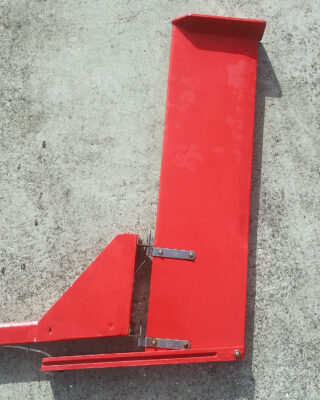
The high aspect ratio fin works a bit like a rudder. Photo by Pete Hill and Linda Crew-Gee
It is a vertical, reasonably high aspect ratio fin (like a rudder) hinged vertically on the end of a 6ft pole (in our case).
The pole has a vertical pin about halfway along its length which fits into a suitable hole on a transom of the dinghy (in our case, the pin is made from 12mm stainless steel round bar).
The fin has a short tiller with a light line going to the pole to limit its travel from side to side. We limit the fin to 25° travel either side, which works well, but may not be optimal.
It works by moving the forward end of the pole backwards and forwards.
As the fin flips from side to side it produces forward motion.
On its own it can be used to propel the dinghy at similar speeds to sculling with an oar over the stern, but with the big advantage of being very much simpler to operate.
In our experience, on its own it does not give the same power as rowing with a pair of oars in the normal way.
However, we can now row with a pair of oars from the forward rowing position and the other person in the dinghy can work the fin sculling pole.
This greatly increases our speed, particularly when rowing against strong headwinds, when it is most needed.
Another advantage is that the fin sculler is facing forward and can steer with that fin. It requires no skill to operate (unlike rowing or sailing).
The main disadvantages of the power fin sculling, if used on its own, are that the dinghy can’t be stopped and is less manoeuvrable when coming alongside than a pair of oars.
Another disadvantage is that the vertical fin significantly increases the draught and so is not suitable in very shallow waters, but it is very easy to lift the fin clear of the water.
But overall it works very well and we are super happy with it.
I’m now the human outboard – sustainable, reliable, beautiful, but high maintenance!
It draws a lot of attention.
Non-mechanical dinghy propulsion compared
Oars
Pros:
- Relatively inexpensive to buy
- Relatively easy to make DIY
- Cheap to make
- Long lasting
- Light
- Not a target for thieves
Cons:
- Not as powerful as an outboard motor
- Easily lost if careless
- Two people can’t row a small dinghy easily
Sailing rig
Pros:
- Quite powerful and good fun
Cons:
- Complicated to build DIY
- Expensive to buy
- Difficult to stow
- Time-consuming to assemble into the dinghy
- Wind dependant
- Usually not on board when needed
- Not so practical when carrying load or people
Power fin sculling
Pros: Same as the oars, plus
- Both people can propel
- Sculler facing forward navigates and steers
- The pole is very easy to lift in and out
Cons:
- Fin significantly increases the draught – but can easily be lifted out of the water
- If used on its own: the dinghy can’t be stopped and is less manoeuvrable when coming alongside
Pete Hill and Linda Crew-Gee have championed the junk rig and small-boat, low budget cruising for decades and have won numerous awards for their seamanship including the Blue Water Medal and the Royal Cruising Club Medal for Seamanship
Pete Hill on sail repair, damaged steering and two lost drogues while battling storms in the Tasman Sea
Pete Hill faced damaged steering and lost two drogues while battling extreme conditions in the Tasman Sea. Graham Cox tells…

Sculling – a useful skill for any dinghy owner using just one oar over the stern
Single oar sculling is the art of propelling a boat with an oar over the stern. It’s a useful way…
Yann Quenet: Why this solo French sailor refitted his micro-yacht to sail the globe again
Yann Quenet stands out as much for the philosophies behind his self-designed and built 13ft Baluchon as for his sailing…
Quick tips to improve your boat’s performance
Expert delivery skipper Ben Lowings offers his top tips to help improve boat performance and handling. Efficient helming Sailing starts…
Want to read more articles about power fin sculling?
A subscription to Practical Boat Owner magazine costs around 40% less than the cover price.
Print and digital editions are available through Magazines Direct – where you can also find the latest deals.
PBO is packed with information to help you get the most from boat ownership – whether sail or power.
-
-
-
- Take your DIY skills to the next level with trusted advice on boat maintenance and repairs
- Impartial, in-depth gear reviews
- Practical cruising tips for making the most of your time afloat
-
-
Follow us on Facebook, Instagram, TikTok and Twitter
PBO web categories