


Pete Hill faced damaged steering and lost two drogues while battling extreme conditions in the Tasman Sea. Graham Cox tells his story
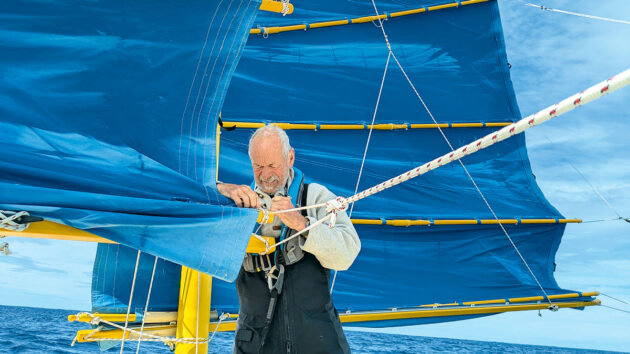
Ocean voyaging is no longer the exclusive domain of legendary sailors whose names are widely known to anyone with an interest in the subject. If you include rallies, there must be thousands of yachts making bluewater passages every year, and their crews remain largely anonymous. But there are a few voyagers who defy this trend, who attain the luminous status of earlier times. Some produce books or YouTube channels, but a small minority become known solely on the strength of their achievements. One of the latter is English sailor, Pete Hill.
After a stint in the Royal Navy, he began building his first boat, Stormalong, a 28ft Wharram catamaran. He took time off from the build in 1972 to make a transatlantic delivery trip, bringing OSTAR boat Aloha VII back to France from Newport. Aged just 22, he sailed the last leg of this passage alone after the designated skipper had to return to England.
After doubling the North Atlantic on Stormalong in the mid-1970s, with his then wife, Annie, they went on to build and voyage widely aboard the junk-rigged schooner, Badger, as detailed in Annie’s classic book, Voyaging on a Small Income, cruising from Greenland to the Antarctic, clocking up around 110,000 miles before selling the boat in Cape Town.
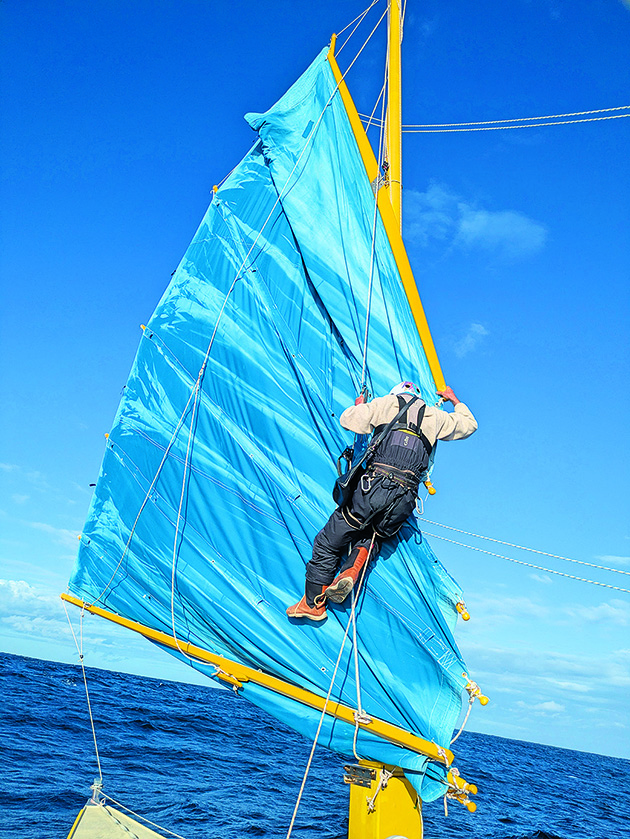
In challenging conditions Pete had to climb the starboard mast to release the upper sheetlet after a fan-up; it took him two hours. Credit: Pete Hill and Linda Crew-Gee
Pete Hill then built a 37ft catamaran in Cape Town to his own design. China Moon carries a biplane junk rig, utilizing an unstayed mast in each hull.
Aboard China Moon, Pete returned to Antarctic waters and zig-zagged around the Atlantic Ocean before delivering the boat to Tasmania with the new owner, sailing nonstop across the Southern Ocean from Brazil to Launceston.
In 2006, aboard the 22ft junk-rigged sloop, Shanti, he came second in the inaugural Jester Challenge, a solo transatlantic race for boats under 30ft. Since Badger, all of his boats have been junk-rigged.
One of his most audacious voyages was aboard the 10m, self-built plywood catamaran, Oryx, which has a biplane aero-junk rig. After a momentous voyage from England to Brazil, South Africa, Mauritius, Tasmania, the east coast of Australia, New Caledonia and New Zealand, Oryx went on to the Austral Islands in French Polynesia, Mangareva, Tahiti, Tonga, and back to New Zealand.
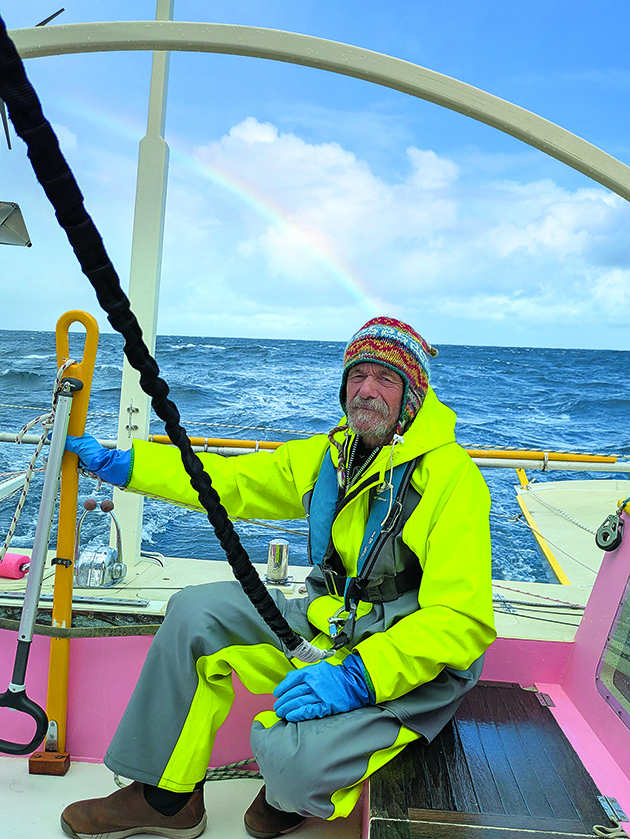
Pete Hill has explored most of the world’s oceans on small, budget boats, often junk-rigged. Credit: Pete Hill and Linda Crew-Gee
On the Pacific circuit, he was accompanied for the first time by Linda Crew-Gee, who has since signed on as permanent mate. Between Brazil and French Polynesia, passing south of Africa and Australia, Oryx sailed east below 30°S for much of the time, an extraordinary latitude to cruise in such a small multihull.
For Pete Hill, however, it was just another voyage. He has won numerous awards for seamanship: the inaugural Jester Medal from the Ocean Cruising Club in 2006, several from the Royal Cruising Club, including the Founder’s Cup and, most recently, the Medal for Seamanship for their 2025 Tasman Sea storm crossing, as well as the Cruising Club of America’s 2025 Blue Water Medal.
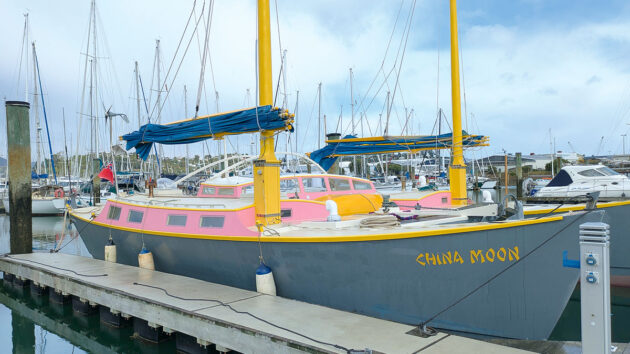
China Moon was designed and built by Pete Hill and has a biplane junk rig. Credit: Pete Hill and Linda Crew-Gee
After further Atlantic adventures on various boats, circumstances recently brought Pete and Linda back to China Moon, which they repurchased in Tasmania for a South Pacific cruise.
They set off across the Tasman Sea for Nelson, on the South Island of New Zealand, in mid-March 2025. The long-range forecast predicted light airs, and Pete estimated that the 1,200-mile passage would take around 12 days.
This Tasman Sea crossing was to prove, however, one of the toughest passages this veteran sailor has ever undertaken. Winds were initially light, with no indication of trouble brewing, but eventually picked up, and the first problem arose when Pete decided to disengage the port windvane and connect up the starboard one.
Unfortunately, the starboard windvane tiller line jammed in its pulley, which broke the self-steering mechanism and threw the boat into a couple of involuntary gybes. First, the port sail gybed, causing a fan-up (sending the sail and battens vertically up the mast – a known hazard with junk rigs), but that cleared when Pete gybed the sail back.
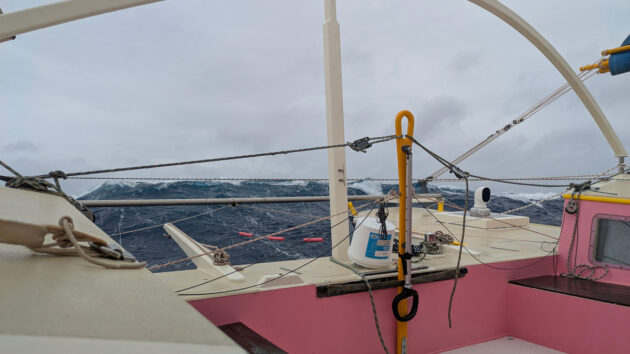
China Moon faced fearsome conditions in the Tasman Sea. Credit: Pete Hill and Linda Crew-Gee
Unfortunately, this course correction made the starboard sail gybe as well, resulting in another fan-up, and this time the upper sheetlet hooked itself round the top of the mast. It was impossible to free it from below. Pete reefed the port sail right down and then released the sheet of the starboard sail so it was feathering over the bow (one benefit of an unstayed mast).
He then climbed the mast by going up the battens, before cutting the offending sheetlet, though the process was challenging, with Pete losing his grip several times, swinging wildly away from the mast before crashing heavily back. The operation was completed within two hours; the only damage was a small tear in the luff of the sail.
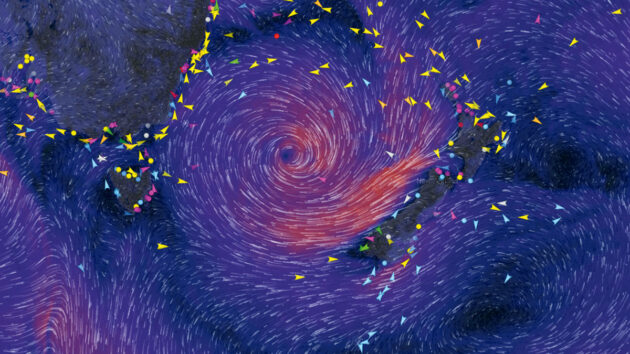
The intensity of the storm that hit China Moon in the Tasman Sea. Credit: Pete Hill and Linda Crew-Gee
Pete Hill lashed the adjacent battens together (a wonderful advantage of junk rigs), taking the damaged panel out of circulation, then resewed the sail later when conditions allowed.
The wind picked up to Force 5 overnight, with China Moon occasionally sailing at 6 knots. They discovered that the tricolour light, which was on the port masthead, was not working – it was damaged during the first gybe – so used the anchor light on the starboard mast for the rest of the passage.
Conditions deteriorated on 31 March, with the wind increasing to Force 7 from the east-north-east. They carried on sailing to windward, deeply reefed, although China Moon’s course-made-good was more or less due north. By first light on 1 April, the seas had grown bigger and were beginning to break, so they decided to run off and deploy their Jordan Series Drogue.
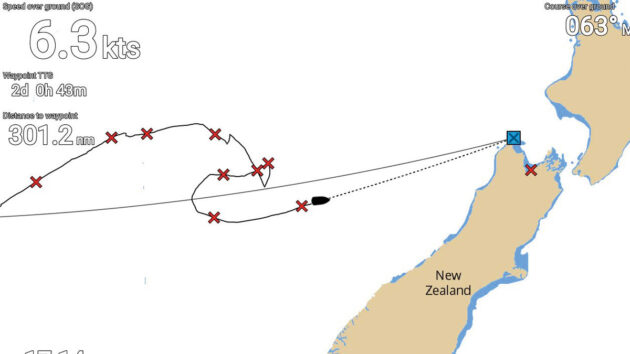
China Moon’s track during the storm. Credit: Pete Hill and Linda Crew-Gee
The wind increased during the day, still from the east-north-east, and Pete estimated the strength as Force 8-9. With China Moon drifting downwind at just over 2 knots, the drogue occasionally snatched at the shackles attaching the bridle to the hull. This had not happened in the past, when they’d used a nylon rode for the drogue on Oryx, rather than the recommended double-braid as rigged on China Moon.
By midnight, the wind had backed to the north-east, still Force 8-9, creating a bit of a cross-sea; occasional crests struck China Moon with a jarring thud, but at 0030 on 2 April, the boat was struck by a breaking wave. The cockpit was flooded, with water surging above the cockpit seats, delaying Pete’s ability to get on deck, but when he did, he discovered China Moon was lying ahull.
It quickly became apparent that the drogue had parted, and the tiller bar had snapped in half. Pete felt China Moon was vulnerable to another breaking crest while lying ahull, and decided that they had to run off or risk capsize. The drogue may have parted under the impact, but it probably saved them from going over.
Linda came on deck and together they manoeuvred China Moon to run off downwind. Linda clung to the whipstaff, which was still connected to the port rudder, trying to turn the boat to port, while Pete grabbed the starboard tiller bar and tried to steer, facing aft.
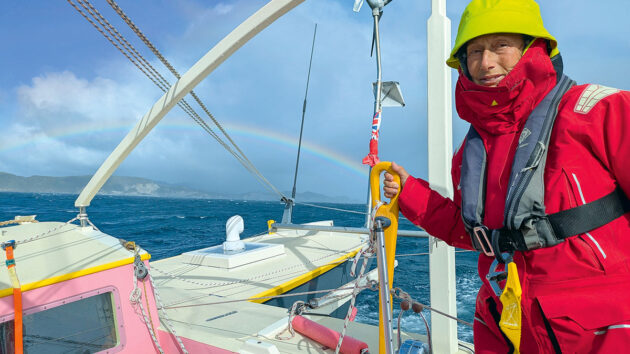
Linda helming China Moon; by now, the wind had dropped off. Credit: Pete Hill and Linda Crew-Gee
In the blinding tumult of that pre-dawn maelstrom, the boat slowly came around and started running downwind. Linda, who was steering by China Moon’s burgee – which was illuminated by the anchor light – called out instructions to Pete. There was no way for him to see the waves coming up astern until they were upon the boat, and keeping before the wind was imperative.
Realising they couldn’t continue like this for long, Pete hurriedly raised the top panel of the starboard sail, with a preventer rigged to hold it out, which gave the boat enough speed so Linda could steer downwind with one rudder.
In fact, China Moon was surfing dangerously fast. He then set about rigging another drogue. They carried a Sea Break drogue as a spare, to which Pete shackled a 50m warp. It took some time to rig and deploy, given the extreme conditions.
Once the Sea Break was set, it made steering easier and reduced their surfing speeds. Pete took over the steering until dawn, and then Linda steered for seven hours while Pete rested.
The following morning the seas had gone down, and they lay ahull briefly to repair the tiller bar, using a spare length of batten and four jubilee clips. But the wind picked up to Force 8-9 from the north-east. The sea rose with it, and they resumed running off the wind.
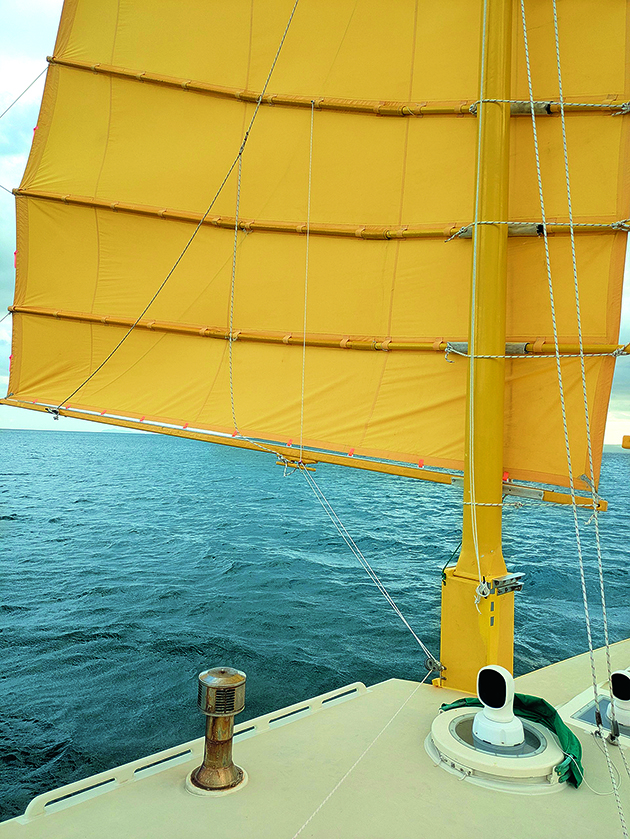
China Moon’s new fan-up preventer. Credit: Pete Hill and Linda Crew Gee
China Moon was regularly surfing up to 12 knots, but the steering was relatively easy. Linda did not feel confident that she could steer well enough in the dark in those conditions, so Pete took over as the sun set, steering without a break throughout the night. He had to concentrate on steering dead downwind, always fearful of broaching as the catamaran surfed down waves, sometimes at 13 knots. He refused Linda’s offer of a hot drink in case he needed to empty his bladder afterwards. He couldn’t risk leaving the tiller.
At 0400 on 3 April, the Sea Break drogue was lost when the eye splice pulled out of the end of the warp. Now, just that 50m warp was slowing the boat, and the average surfing speed increased to 16 knots. There was nothing Pete could do but concentrate on keeping the boat steady and hope for the best. On one occasion, the log briefly registered 20 knots.
By dawn, the wind had backed into the north-west, and it eased off to Force 6-7 as the day wore on. Linda took over steering at 0700, with China Moon still sailing at those crazy speeds, but she had the advantage now of being able to read the compass and see the very large waves as they approached from astern.
By 4 April, the wind had eased to Force 4 from due west, and they were sailing in flat seas under clear skies. Later the wind backed further to south-west, growing lighter all the time. They briefly motorsailed to try and make landfall before the next forecast depression arrived.
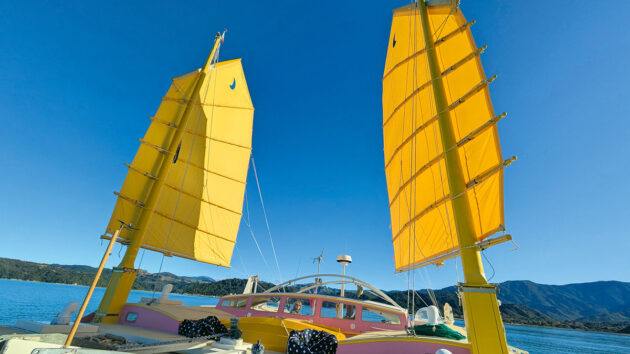
Repaired and with new sails, China Moon is now ready to sail into the Pacific again. Credit: Pete Hill and Linda Crew-Gee
By dawn on 6 April, the wind had veered north-east, blowing Force 5-6, pushing them south of the rhumb line at a 30° tangent. They tacked when they were 40 miles from the west coast of South Island, sailing due north for a few hours, beset by heavy rain and squalls.
The wind then picked up from the west-south-west as the next front approached. During the morning of 7 April, the wind increased to Force 6 from the south-west, with heavy rain squalls. They had a wild downwind ride past Cape Farewell Spit, with a Force 7 wind blowing from the west.
Once again, the waves were rapidly increasing, and China Moon was regularly surfing at or above 12 knots. On rounding the spit, they sailed across Golden Bay with a Force 8 wind on the beam, fortunately blowing off the land, so they were protected from the swell.
Once past Golden Bay, the wind slowly eased off, and they entered Port Nelson under engine in light winds, mooring to the customs dock at 9pm. It had been a memorable passage.
Lessons Learned: Pete Hill reflects on his experience
- The sizing of the Jordan Series Drogue (JSD) cable has to be considered. If using Dyneema, as we did on China Moon, perhaps a higher safety factor is needed because of its lack of stretch. The JSD we inherited on China Moon used 8mm Dyneema. We have replaced it with 11mm Dyneema. On our previous catamaran, Oryx, we used 16mm double-braid nylon rope with great success. The size of nylon double-braid specified for a multihull of China Moon’s size is 19mm.
- We should have tied off the JSD retrieval line to the stern (instead of to the aft beam) so that it would not have broken the tiller bar when the JSD carried away.
- A method to prevent fan-ups when gybing junk sails (intentionally or otherwise) should be considered for ocean-going, junk-rigged yachts. China Moon’s new fan-up preventer is a 6mm line that runs down from the 3rd batten (about halfway along) to a small block on the boom, and from there to another block on deck abaft the mast, at an approximate 45° angle. From there, it runs to a cleat next to the cockpit. This line is always set up tight, and adjusted as needed with reefing. There is also a ‘kicking strap’ from the boom to the deck, also at 45°.
Sailing through a thunderstorm at Portland Bill: How I survived a solo knockdown
David Edgar experiences a knockdown on a fraught solo sail round Portland Bill as a gale gathers strength
Force 10 in the Channel: ‘We took a colossal wave broadside, and the cockpit was suddenly knee-deep in water’
A routine Channel crossing became a nerve-shredding passage when a ferocious storm hit, as Ron Stride recalls
Heavy weather sailing techniques: how to protect your boat in storm conditions
Øyvind Bordal and Magne Klann explain the steps you need to take to protect your rig and sails when the…
What I learned during a boat knockdown while sailing alone
Freya Terry gets an early lesson in the perils of single-handed sailing when she embarks on a round-UK and Ireland…
What to read more seamanship articles like Pete Hill on sail repair, damaged steering and two lost drogues while battling storms in the Tasman Sea?
A subscription to Practical Boat Owner magazine costs around 40% less than the cover price.
Print and digital editions are available through Magazines Direct – where you can also find the latest deals.
PBO is packed with information to help you get the most from boat ownership – whether sail or power.
-
-
-
- Take your DIY skills to the next level with trusted advice on boat maintenance and repairs
- Impartial, in-depth gear reviews
- Practical cruising tips for making the most of your time afloat
-
-
Follow us on Facebook, Instagram, TikTok and X