



Rules are tightening all over the world in an effort to improve local water quality, with holding tanks playing a vital role on board yachts. Jake Kavanagh looks at the options for efficient waste disposal
The changing attitudes to the health of rivers and seas and a greater demand for a ‘home from home’ experience when aboard a boat have led to some remarkable innovations in marine sanitation, including the boat holding tank.
These include electric toilets that use less than 0.5lt of water to flush, pumps that can transfer waste up to 70m horizontally, and even ‘incinerator’ toilets that reduce solid waste to a cup of inert and odourless ash (apparently, it contains elements that are good for your garden). The 2020 pandemic gave a boost to the sanitation sector, with more people using their boats for longer and realising their toilet systems could do with an upgrade.
Many manufacturers PBO has spoken to have experienced a surge in demand during lockdown, encouraging them to develop even quieter and more energy-efficient electric toilets. Meanwhile, improvements have continued with the rest of the sanitation system, too.
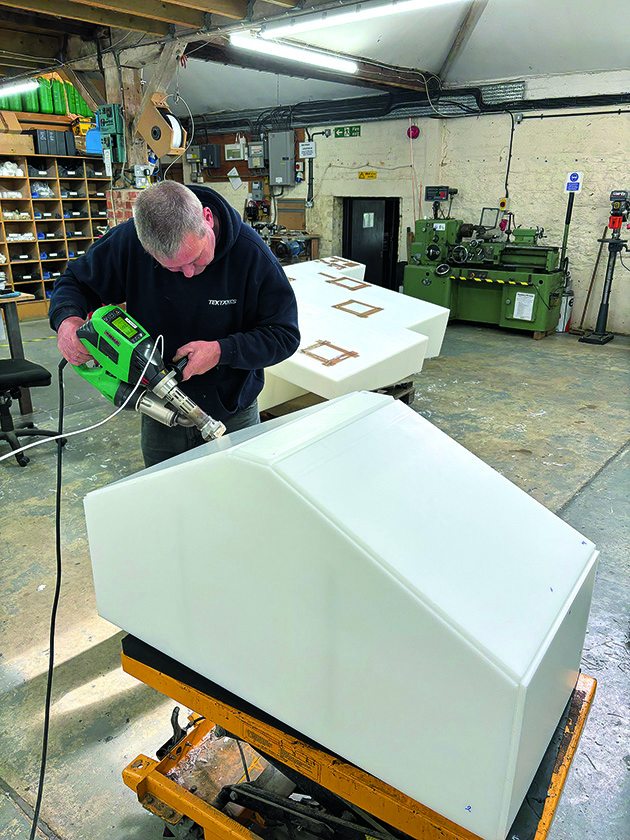
A custom holding tank made from polyethylene takes shape in the workshops of Tek-Tanks. The material is corrosion resistant, easy to modify and impervious to odours. Credit: Martin Rye/Tek- Tanks
The hoses leading from the toilet to the various junctions and valves, for example, are now far more flexible thanks to new types of polymer. This makes retrofitting easier, especially in tight spaces. Modern sanitation hose also has a longer life, now guaranteed for up to 10 years.
Even ‘off-grid’ toilet paper has evolved, mainly for use in cabins, campervans and boats. The glues and plasticisers involved have been reduced, allowing the paper to dissolve into a cloud of white powder in the tank. Paper blockages from the uninitiated should now become far less common.
Boat holding tank design
Once pumped from the bowl, waste is increasingly destined for a boat holding tank rather than into the long-suffering sea. In some countries, heavy fines await anyone who pumps raw sewerage into their pristine, azure-blue waters, and some won’t allow sea discharge anywhere inside specific cruising grounds.
The RYA website has a list of the various regulations in countries that restrict sea discharge of black water (sewerage) although visiting boats will not be required to fit a tank just to visit the coastal waters. Instead, there are limits at which the toilet can be used.
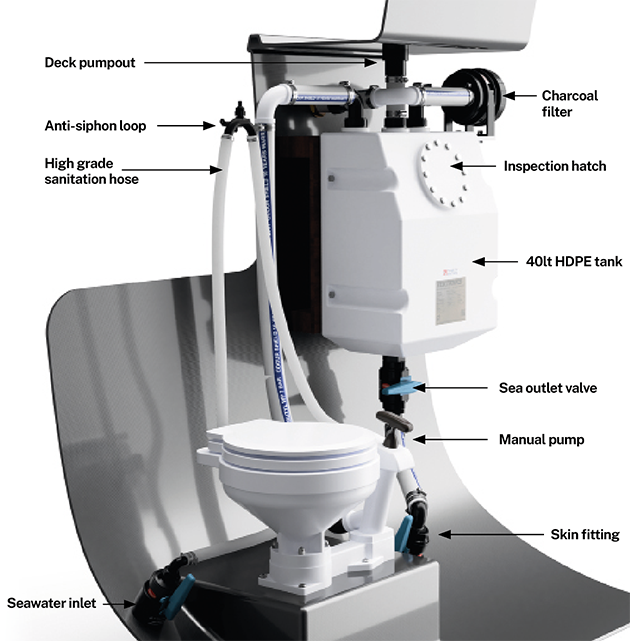
The popular 40lt tank design is attached to the side of the hull and can gravity discharge to the sea when allowed. Credit: Tek-Tanks
These vary, with Denmark specifying two miles offshore, while Finland wants 12 miles. There is not yet an international convention which requires a private yacht under 400 tons to carry a holding tank, but the vessel is required to comply with local regulations. Generally, boats built after 1 January 2000 in Europe must have a holding tank fitted and connected to a deck fitting for a shoreside pump out, but there remains a long list of caveats. Boats travelling along inland waterways, especially in Europe, will find much stricter regulations, with seacocks often closed shut at the port of entry and locked with an official seal. Fortunately, the boat holding tank has improved greatly in recent years.
Traditionally fabricated from stainless steel or glassfibre, they’re now routinely made from materials such as High Density Polyethylene (HDPE). This rigid plastic effectively eliminates odours and the drum-like sounds of flexing.
“Many people don’t realise just how corrosive human waste can be,” said Martin Rye, the managing director of UK-based Tek-Tanks. “Perhaps the worst material to use is aluminium. These tanks often have a very short life, with the welded seams often suffering from corrosion-induced failures.”
HDPE is far more stable, and with the use of modern CNC machinery and 3D design programmes tanks can be custom-made to fit any space within a hull. Some have even been developed into small-scale sewerage treatment plants, efficiently processing the contents between pump-outs.
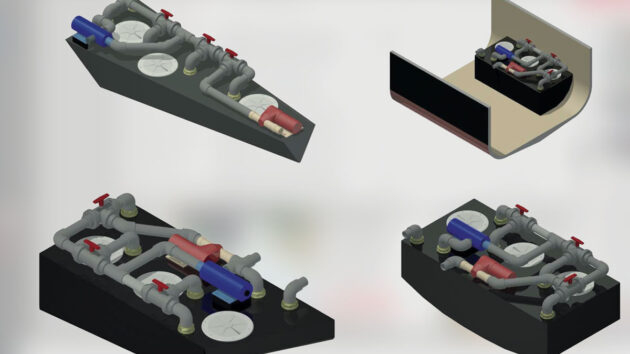
Various pre-made tanks designs for the most common profiles of bilge spaces, for all applications from water and fuel to black waste. Credit: Tek-Tanks
Although urine is sterile, the bacteria in solids can be very harmful, so the sewerage is rendered safe enough for ecological discharge at sea. Production boats usually have provision for a holding tank to be fitted, even if one wasn’t supplied at the point of sale. This means a retrofit is relatively easy, as the space already exists.
Companies like Tek-Tanks already have the dimensions for a boat holding tank for all the popular production boats, and for older vessels or one-offs, can build a custom version from accurate measurements. The safest way is to make a cardboard template within the space itself, allowing room for the various connectors and pipe runs.
The HDPE tanks are corrosion-proof, long-lasting, easy to modify, and available in a range of sizes and shapes. The capacity will depend on how long you plan to cruise between pump outs, how many people are usually aboard, and the regulations in the area you intend to cruise. However, the most popular sizes for yachts in the 9m-12m length range are between 40- to 80lt capacity. Tek-Tanks’ best seller is the 40lt model in a gravity-discharge configuration.
Do you fit a boat holding tank above or below the waterline?
A boat holding tank is often mounted above the waterline, as it makes the plumbing easier. Gravity is used to empty the tank’s contents into the sea when allowed, although a large diameter (50mm/2in) seacock is recommended, with the pump-out connector directly above it. This positioning allows for rodding through from the deck if there is a blockage. A diverter valve sends the waste to the tank when regulations dictate.
Some boatbuilders prefer to place the holding tank in a suitable area of the bilge, bringing the weight further onto the centre line. This requires more thoughtful plumbing but does help with trim. The tank will also need to be secured in a way to support a full capacity of 1kg/lt, transferring the stresses easily to the rest of the hull.
Manual or electric toilet?
Marine toilets have also improved tremendously over the years, most notably the electric versions. Gone are the days when a flush sounded like someone trying to angle-grind their way into the hull. This noise deterred guests from flushing at night, afraid they’d wake everyone up. By morning, there was often a bowl full to overflowing.
Thankfully, the latest motors are compact, powerful, and remarkably quiet. In addition, some of the more popular manual toilets are now available with a retro-fit motor kit. Hand-pumped toilets tend to be simple affairs and remarkably capable. A few strokes of a handle and the contents of the bowl are magically whisked away. They are also very easy to maintain, with pump specialists Xylem saying it is still getting requests for spares for the Brydon Boy model. Manufactured in the 1980s, this suggests large numbers remain in use.
Vacuum toilets are also very popular as they use very little water to flush. However, they rely on the crew closing the seat and creating a pressure drop using a large diaphragm pump. While manual toilets are cheaper and easier to maintain, electric versions usually come with a macerator, driven by the same electric motor that works the pump. This mashes the waste and tissue, so it is easier to move around the system, making blockages less likely.
Seawater or fresh flush?
When using a boat holding tank more often, it’s important not to fill it up any more than necessary, and fresh water has a role to play; not only does it help reduce odours, but it can also be rationed by smart-flush pumps. One of the toilet manufacturers working hard to minimise the use of water is US -based Thetford Marine and its macerator subsidiary Tecma.
“A perfect flush can start at just 0.5 lt,” said marine business manager Gianluca Silvestri. “The inlet spray nozzle in the toilet bowl optimizes the flush and the cleaning of the toilet even with a very low amount of water.”
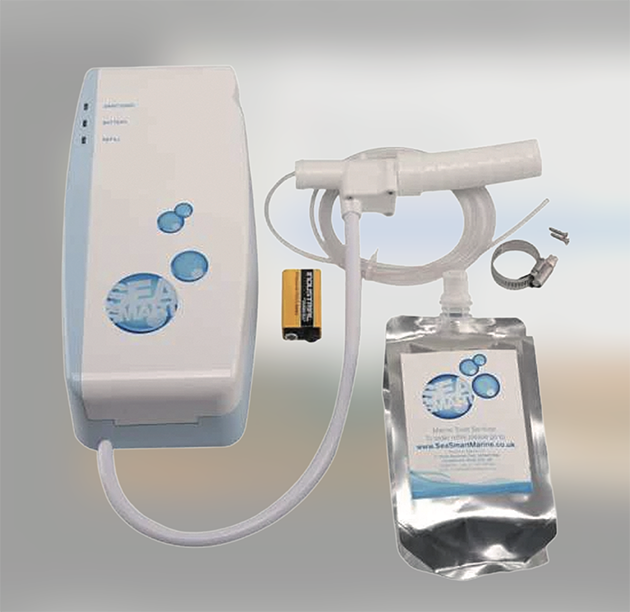
Seawater flushing can trap biologicals in the pipes, which leave a rotten egg stench when they decompose. Fresh water can be fed from a separate tank, or treatment systems like SeaSmart added, to kill off the organics. Credit: SeaSmart
Water reduction has a knock-on effect with tank sizing, often allowing a smaller tank to be used with more options. It also uses less power for the flush, another factor to consider.
Dometic Marine president Eric Fetchko feels that refitters will have to evaluate how much holding tank capacity they will need against the greater efficiency of the toilets fitted. “Marine macerator toilets have become more reliable and quieter over the past several decades,” he said. “They still consume a lot of power when compared to our Dometic VacuFlush systems, requiring more of the onboard current capacity. As vessels continue to add more electrical accessories, this may be a good time to look at less water consumption and less energy-hungry alternatives in the heads space.”
Fresh water flushing has become more common now, especially as the outside water in some areas may be less than pleasant. Also, when small aquatic creatures suspended in seawater get left in a toilet’s plumbing, they die and decompose, resulting in a ‘rotten egg’ stench.
A good solution is to use a freshwater flush, now highly practical due to the small amounts of water needed. US-based Raritan, for example, offers a patented Seafresh system that allows users to switch between fresh water from the tanks or sea/lake water from outside. “This means less worry about using up onboard water supplies with the toilet,” said Raritan’s Kim Carrell. “If raw water has been used during the cruise, the Seafresh system allows for proper flushing of the lines before letting the boat sit for a week or two.”
Fresh water flushing has also been promoted by the increasing number of boats fitting a watermaker which gives plenty of spare capacity. Special check valves ensure that no wastewater can backwash and contaminate the potable supply. If a toilet can be freshwater flushed, it will usually be a more pleasant experience for the owner, especially if the boat isn’t used for some time.
Measuring the depth
Knowing when to pump out relies on accurate gauges, but these can still be a bit hit-or-miss. “You really want to avoid having any sensors inside the tank itself,” Martin Rye explained. “They don’t tend to last long, and no-one really wants the job of replacing them. The best ones work from outside, and measure moisture content. However, a build-up of dried waste on the tank walls can still confuse them.”
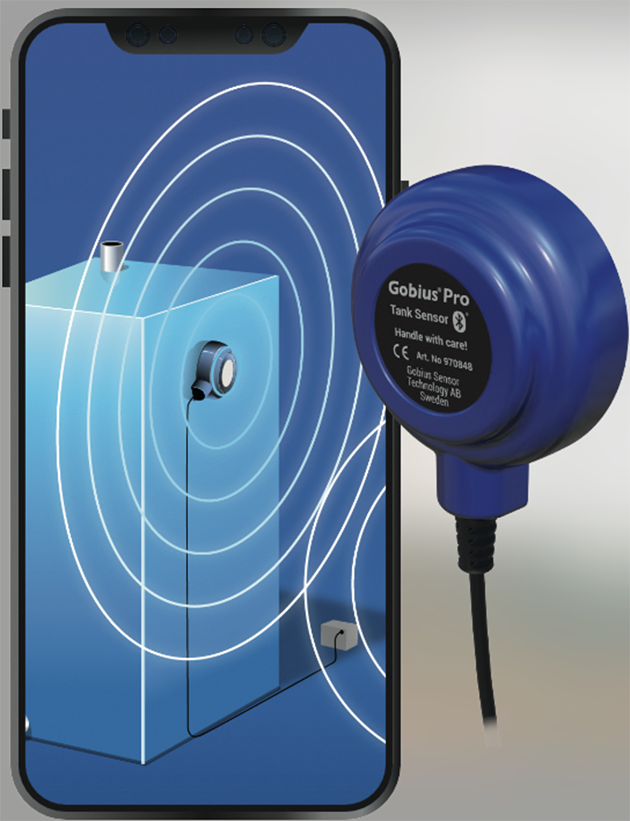
Various devices can sit on the tank exterior for accurate readings,such as Gobius Pro. The reading can be sent wirelessly to any connected device. Credit: Gobius Pro
Instead, Rye recommends using gauges that harness short-range radar to bounce signals off the top of the waste for a highly accurate reading, although these are expensive (£300+). Another solution is the Swedish-designed Gobius Pro from FM Marin. This is a Bluetooth-enabled sensor which also shows the tank levels as a graphic on a smart phone, or any other connected device. A high-level alarm can also be set.
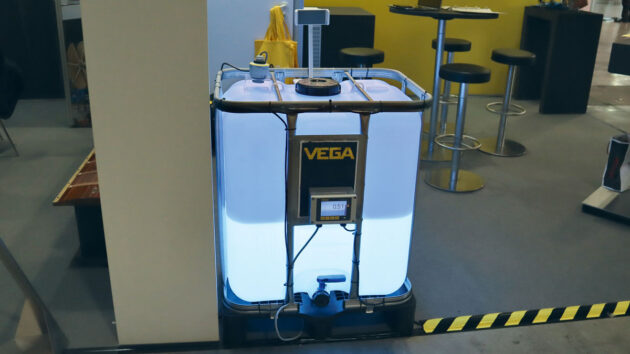
Gobius products measure from the outside of the tank so are very well suited to black waste applications. Up to nine units can be placed on one boat holding tank to increase sensitivity. Probably the most fail-safe solution is to use a translucent tank and shine a light through it from the back. The level is easy to see immediately, and you can even use coloured lights for a more surreal effect.
Better hoses
Many retrofitters have been discouraged from installing a boat holding tank by the impending battle with tough, unwieldy sanitation hose. However, new technology has led to hoses that are not only highly flexible but long-lived and impermeable.
One example of gas-quality butyl rubber is from the Italian-based manufacturer Hoses Technology. While more expensive than alternative PVC, the higher price is offset with a longer working life, an improved degree of flexibility and a higher resistance to leaking odours (permeability of just 0.5%).
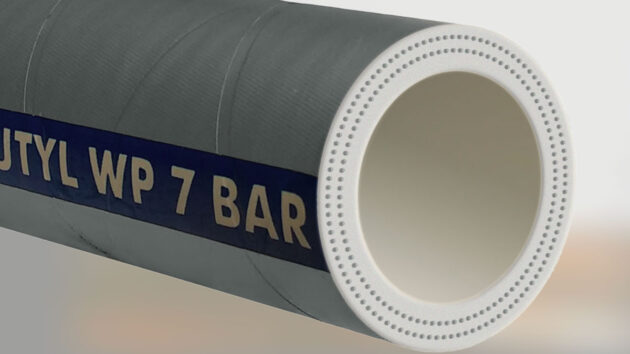
Hoses used to be an issue with breakages and odours. Now they are highly flexible, non-permeable and guaranteed for up to 10 years. This Sanipomp from Hoses Technology of Italy is built to cooking gas standards. Credit: Sanipomp/Hoses Technology
“We have introduced the Sanipomp/extra/Silver version,” said marine business manager Gianluca Silvestri. “Due to its white butyl inside layer we can give a 10 year warranty against smell. A silver external film not only protects the surface but also makes it easier to clean. All these hoses are very flexible, because we use textile yarns and not net.”
Tek-Tanks’ Martin Rye demonstrates this hose flexibility to customers by tying it in figure-of-eights. “This is an excellent sanitation hose,” he told PBO. “Available in two sizes, 1in (25mm) and 1 ½in, (38mm) these hoses come with the warranty actually printed on the skin. The extreme flexibility aids installation and allows for a much tighter bend radius. A nice touch is that this hose is impregnated with vanilla essence which helps to keep an enclosed heads compartment smelling fresh.”
Seacocks – metal or plastic
With human waste so corrosive, the best onboard sanitation systems will avoid metal components as much as possible. When it comes to seacocks, vents and other fittings, suppliers such as Lee Sanitation and Tek-Tanks recommend composite solutions.
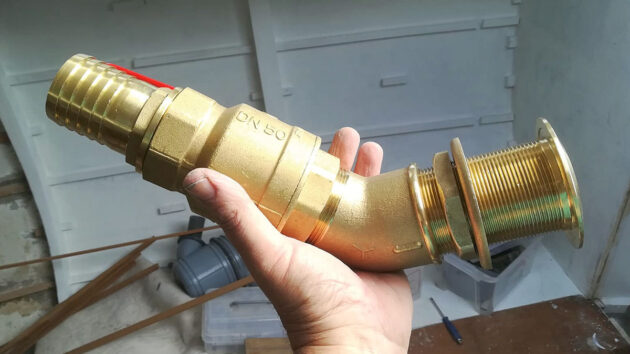
A direct discharge seacock needs to be quite substantial. This is the recommended 50mm (2in) version in bronze
The long-lived materials used are impervious to most corrosive agents. One recommended product comes from New Zealand-based TruDesign, a product used in all RNLI offshore lifeboats. Composite seacocks won’t be affected by a lightning strike too!
Venting
“A question that we get asked a lot is about an anti-siphon vent,” said Martin Rye.“This is less important on a motorboat, but on a yacht that can heel over quite steeply, there is a chance that water could be drawn into the boat via the tank and the toilet. The anti-syphon loop will prevent this.”
Another fitting Rye recommends is an inspection hatch – just in case it’s needed. “It is highly unlikely that anyone will ever need to get into the tank, but if they do, this makes it easy to clear a blockage that simply refuses to be rodded out. Some guests unfamiliar with a marine toilet think it can handle sanitary items of all types, so blockages can occur. The sign that says ‘Except for tissue, nothing should go into this toilet that hasn’t been eaten first,’ always rings true.”
Smells are a common issue with marine toilets, but usually because they aren’t emptied properly between outings. Several treatments can be introduced into the flushing line, but the freshwater flush remains the best remedy for most. For the holding tank which needs to vent outboard, several designs of activated charcoal filter will help avoid the pervasive smell of a sewerage farm.
Conclusions
Fitting a robust sanitation system is a task where it’s worth spending a bit extra on the best quality materials. This will save having to replace everything after a few seasons, a job no-one really enjoys.
The effortless flushing, odour dampening systems, minimal water flushing and quiet motors should make the toilet on board just a comfortable to use as the one at home. The sea will be grateful, too.

Sea toilet restoration: How I refurbished the heads on the PBO Project Boat
With seacocks previously installed in the Maxi 84, it was time to connect the hoses. The first thing to decide…
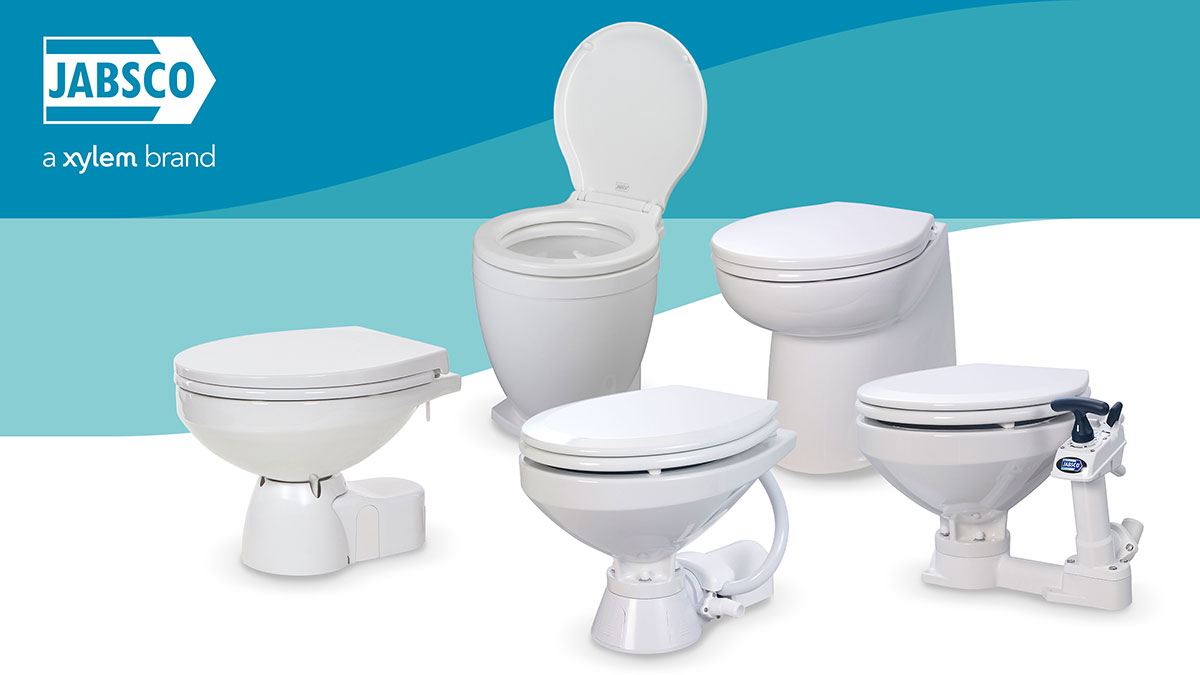
Why now is the time to upgrade your marine toilet
Most boats have manual marine toilets on board. This is why you should consider upgrading to an electric unit

Choosing a marine toilet for the PBO Project Boat
Choosing a marine toilet isn’t as straightforward as you think – and after looking at the options it may be…
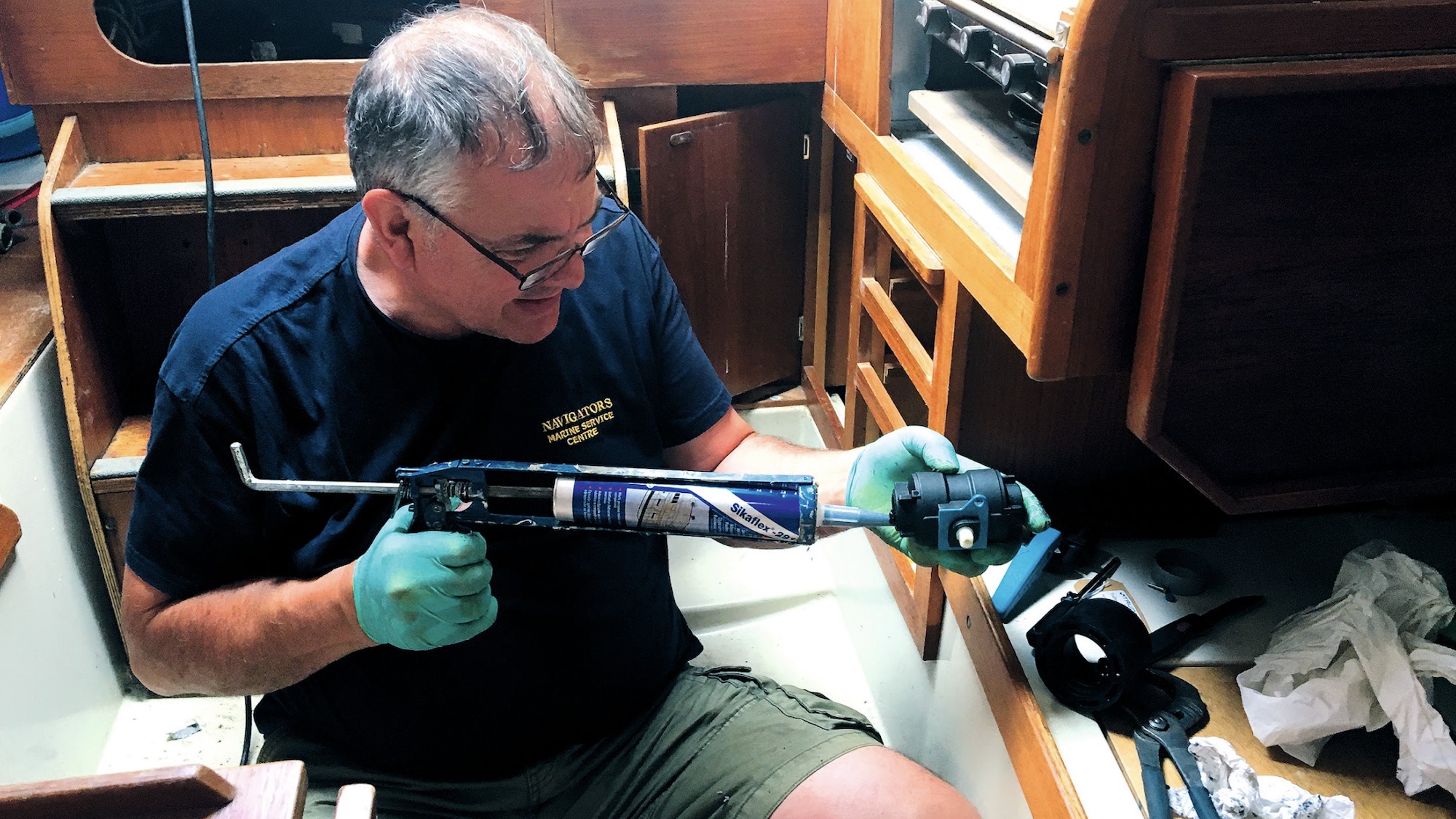
Fitting new seacocks and skin fittings on the PBO Project Boat
Maximus, our PBO Project Boat, had four seacock fittings that need changing – three ball valves in the forepeak (1…
Want to read more articles like Retrofitting a boat holding tank?
A subscription to Practical Boat Owner magazine costs around 40% less than the cover price.
Print and digital editions are available through Magazines Direct – where you can also find the latest deals.
PBO is packed with information to help you get the most from boat ownership – whether sail or power.
-
-
-
- Take your DIY skills to the next level with trusted advice on boat maintenance and repairs
- Impartial, in-depth gear reviews
- Practical cruising tips for making the most of your time afloat
-
-
Follow us on Facebook, Instagram, TikTok and X