


Designed for simple home-building in plywood, the Chat 18 is a versatile and economical daysailer-cum-camper cruising cat. David Harding gets on board
Chat 18: the economical camper cruising cat that can be launched in 15 minutes

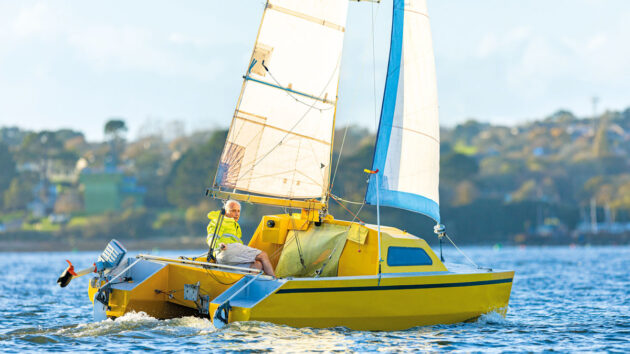
Small new cruising catamarans are hard to find these days so I was pleasantly surprised to come across the Chat 18.
To many, ‘small’ means under 40ft (12m), so you’re not exactly spoiled for choice. To most of us, ‘small’ means more like 25ft (7.6m) and under. The sub-20ft market is almost the exclusive preserve of the dinghy and beach cat. To be fair, small production cats with cabins have always been something of a rare breed.
We have to go back to the early 1960s to find the 20ft Cracksman, built by Newbridge Boats. Then the 22ft Hirondelle was launched a few years later. Since then we have seen hardly anything like these two.
But if you enter the realm of the home-builder prepared to start with a few sheets of plywood, you will discover a whole new world that you might otherwise not have known existed.
Take the designs of Richard Woods and the late James Wharram, for example. These are two of the best-known designers of small catamarans, and names that will be familiar to many. Some of their cats have had production runs in GRP, such as Woods’ Strider (the subject of the video ‘A Day Sail To Russia’, see below).
Most, however, have been sold as plans for construction by their owners or builders commissioned by the owners. Woods’ portfolio currently includes no fewer than 10 catamarans between 18 and 25ft, including the evergreen Strider and one of the more recent additions in the form of the 18ft Chat.
Like all Woods’ designs around this size – and some of the bigger ones too, both catamarans and trimarans – the Chat 18 is designed to be as straightforward and economical as possible to build while still offering good performance.
She has chined, flat-bottomed hulls, and the beam of 8ft (2.4m) allows the main bulkhead to be cut from one sheet of plywood. She has LAR (low aspect-ratio) keels for simplicity of building, sailing and beaching unless you want the performance of daggerboards, and you can use a rig from a 16ft dinghy cat such as the Condor or Shearwater.
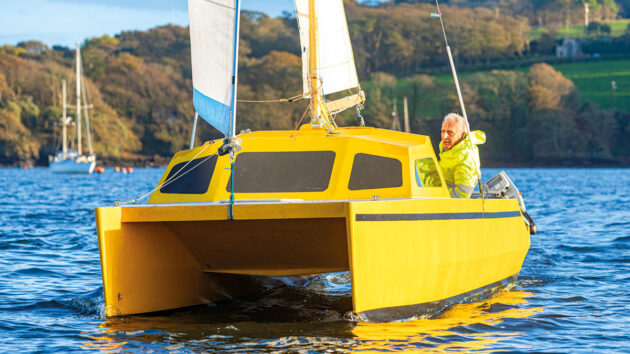
Generous freeboard combined with high bridgedeck clearance should make for a dry boat and minimise slamming in a seaway. Credit: David Harding
If you have the space, the time and relatively basic woodworking skills, you should be able to build a Chat 18. Panels are either flat or single-curvature and all chine joints are glass/epoxy, so no bevelling or even use of a plane should be needed.
Home-builders typically take around 300 hours to reach a ready-to-paint stage, several commenting on how well the plans have worked. You will need 24 sheets of 6mm and 9mm plywood. If you don’t want to tackle the job yourself, you could always commission a boatbuilder for the basic structure and then finish it off from whatever stage you choose.
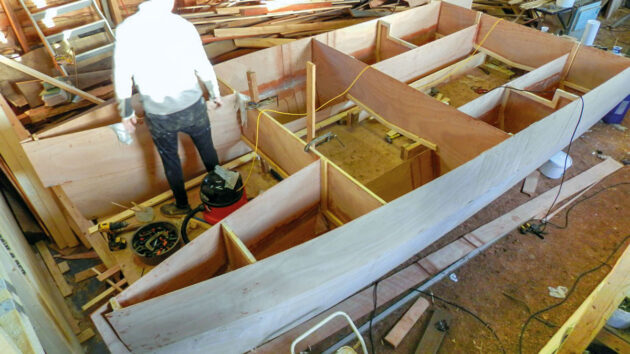
Home construction should be straightforward if you have the space and some basic woodworking skills. Credit: Woods Designs
That’s what Richard Woods did this time. Over the past 40+ years he has built over 20 of his own designs, in plywood, cedar strip and GRP (having built the moulds too), to make sure that his plans work and to refine the designs in a way that’s only possible through building and sailing them himself. On this occasion, having decided that a Chat 18 would be just the boat for sailing locally on the Tamar, he had one built in a barn up the road and then set about finding the necessary fittings and equipment.
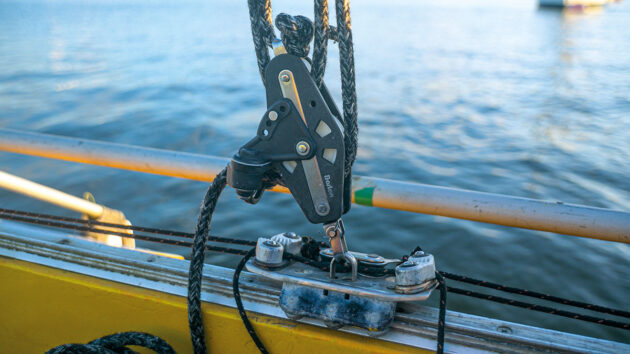
All the hardware, including the mainsheet blocks and traveller system, was acquired second-hand from other boats. Credit: David Harding
He cut down a rig from an old Condor, the sliding gooseneck and gold anodised spars giving a clue as to its vintage. Everything else had had a previous life as well, including a second-hand jib and furling system that were added later. Hardware came from various boats, rudder stocks from a Nacra 18 cat and blades from a Hobie.
That’s exactly the sort of approach that many Chat owners are likely to take.
Chat 18 cat with a cuddy
But what sort of boat do you end up with – and what sort of sailing can you do in an 18ft catamaran? Well, as you would expect with an 18-footer, the Chat 18 is essentially a day-sailer or occasional weekender.
Because she’s a cat, however, she provides a good deal more deck and cockpit space than an equivalent monohull. She also has an open-backed cuddy, inside which you can shelter from the rain, brew a cuppa and use a portable loo. There’s even space for a mattress, though for camper-cruising you would rig up a cockpit tent; then you might choose to sleep in the cockpit and use the cabin for stowage.
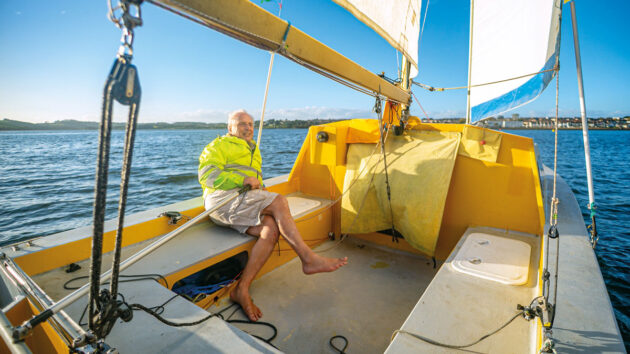
An enormous cockpit for an 18-footer. and generous stowage. Credit: David Harding
All you don’t get is more than the 3ft 6in (1.05m) of headroom between the sole (a continuation of the cockpit sole) and the deckhead. The sole doesn’t drop down into the hulls, because their volume is kept for buoyancy in watertight compartments.
This isn’t a cruising boat, so the idea was to avoid presenting owners with the temptation to make it a fully-fitted cabin or carry too much kit.
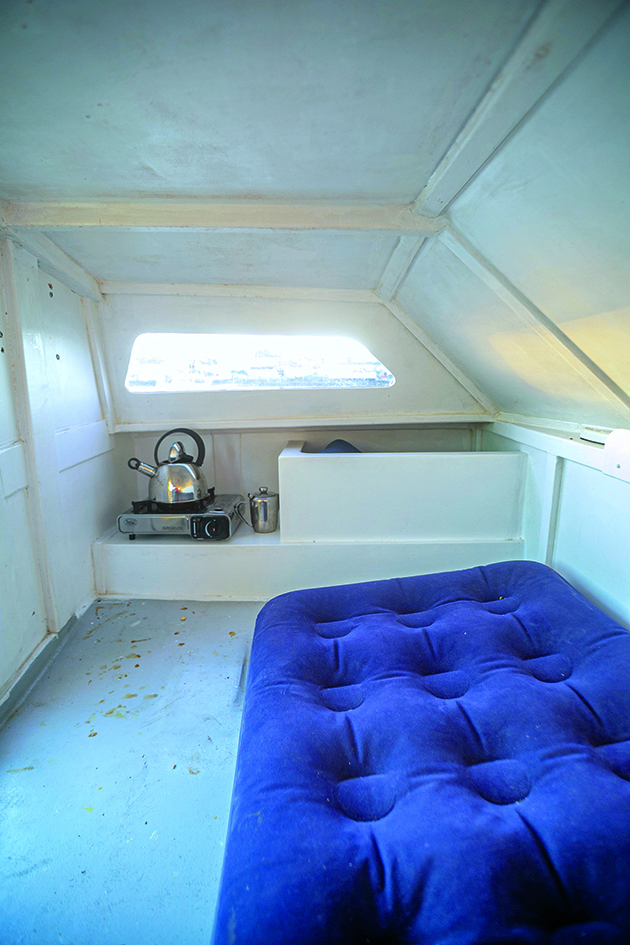
Plenty of beam means space fro a mattress and somewhere to brew a cuppa. Credit: David Harding
Back on deck, where you really notice the difference compared with a monohull is at the ends. Catamarans carry their maximum beam from bow to stern, so the 8ft-long cockpit is over 7ft (2.13m) wide all the way to the transom. You would have to buy a sizeable monohull to find this much cockpit space. Square ends help on the foredeck, too: it’s big enough to work on when you’re mooring or anchoring, and more comfortable when you’re hopping aboard from the beach.
Simple sailing on the Chat 18
The Chat is a wide, stable platform that stays level when someone steps on or off. Rigging and de-rigging is much more straightforward when you have plenty
of space and the boat doesn’t lurch from side to side as you walk around.
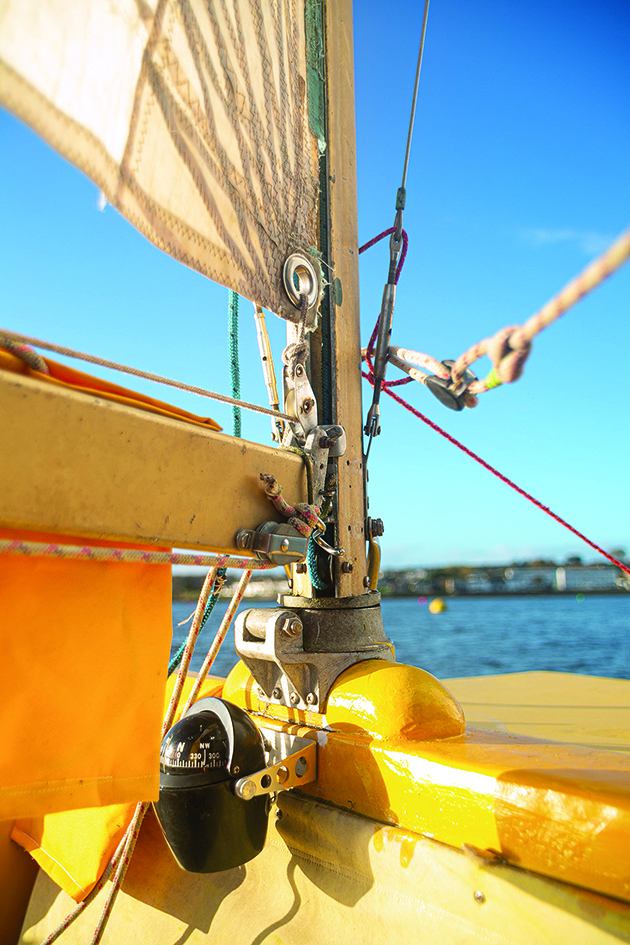
This second-hand rig with its gold anodising is an economical solution. Credit: David Harding
I was reminded of that when I joined Richard for a sail on what eventually turned into a bright autumn afternoon. Once we were rigged and ready, we dropped the mooring during the tail end of a squall and shot off on a reach at over 8 knots. The boat was certainly not breaking sweat, and Richard has clocked over 10 knots
on occasions.
By the time we turned upwind the squall had passed and the wind eased to 8-12 knots. We still made an easy 5-5½ knots as we beat back up the river against the tide. Leeway was by no means excessive despite the LAR keels. I have sailed shallow-draught monohulls that make a lot more.
Tacking in flat water was straightforward. As is normal with a cat, it helped if we backed the jib to make sure the bow came round. Occasionally, if we tacked in a light patch, we helped the rotating mast to rotate as well.
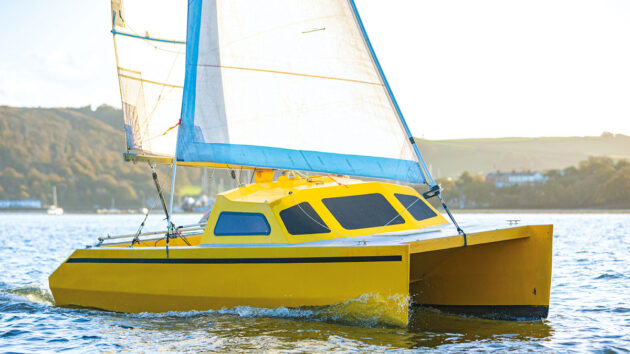
A non-overlapping headsail could be used, sheeted to the coachroof. Credit: David Harding
No winches are needed on the Chat 18 and the hardware is all pretty simple. Life is made easier by the fact that the cockpit extends forward to the mast, so all sail-handling, hoisting and stowing (with white sails at least) can be managed from the cockpit. The jib sheets are on a 2:1 purchase taken to the outside of the coamings just abaft the shrouds. If you had a shorter-footed jib of higher aspect-ratio, you could take the sheets to the aft end of the coachroof, achieving a narrower sheeting angle while still keeping the cockpit clear.
The 4:1 mainsheet from the end of the boom is taken to a full-width traveller immediately forward of the tiller bar. A single tiller extension is all you need provided it’s long enough.
Adjustability
The only intrusion into the cockpit is the kicker – a necessity, of course, but potentially replaceable by a gnav (an adjustable strut from up the mast to the boom, widely seen on modern dinghies) if you were so minded.
With so much clear space and all sail controls outside the cockpit, sailing the Chat 18 is as simple as sailing can be. Weather helm was minimal – just enough to give a positive feel.
Since our test, Richard has cut down the mainsail by 11ft2 (1m2) to make it the size he originally drew. Now he says the tiller can be left in light airs and the boat will sail herself. If finding (and potentially cutting down) a rig from a beach cat isn’t something you want to do, you could always fit the alternative gunter rig.
With a smaller main and an appreciably smaller jib because of the lower hounds, it reduces the total sail area by 32ft2 (3m2). Shorter spars mean easier raising, lowering and trailing, and they would be easier to make or adapt from another boat. As with so many aspects of the Chat, you can tailor the rig according to the sort of sailing you want to do.
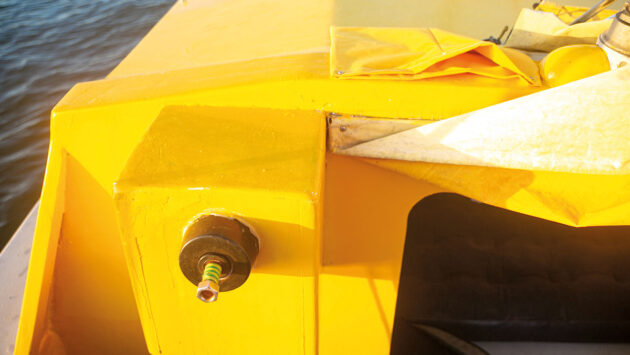
In power mode, the Chat can be fitted with a wheel – here recently removed. Credit: David Harding
If you like the Chat 18 but would prefer not to have a rig at all, you can buy plans for the power version instead: the Skoota 18.
Essentially it’s the same boat without the keels or the mast support and with slightly fuller stern sections to support the weight of a larger outboard. With 20hp on the transom, you should reach a top speed in the low teens and cruise efficiently at 9-10 knots.
Power catamarans make a lot of sense, as I found when I owned a 17ft (5.25m) power cat for several years. They provide a lot of space, they don’t roll, they create minimal wake and they’re extremely power-efficient. They have self-draining cockpits, give a comfortable ride in a seaway and are easy to beach.
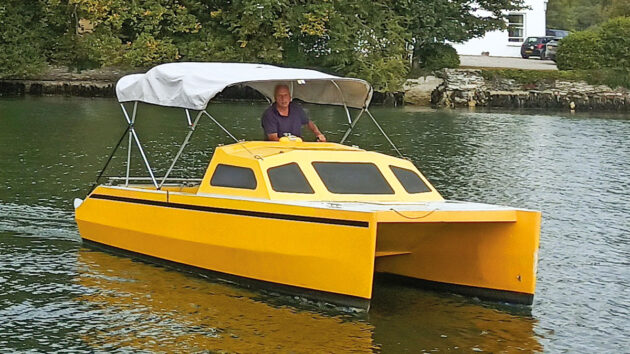
The Chat can be converted for use as a power cat, cruising at around 7 knots with a 6hp outboard. Credit: Woods Designs
If you want a dedicated power boat, one of the Skoota cats (18-36ft/5.5-11m) might be the answer. Alternatively, there’s no reason why you shouldn’t use the Chat 18 as a power cat with a smaller engine and cruise at up to 7 knots or so. Choose the Skoota if you want the extra speed and power and don’t want to sail.
Proving the Chat’s versatility, Richard ran his own boat in power mode with a 6hp outboard for most of last summer – complete with steering wheel on the cuddy bulkhead – before converting it back to sail and switching to a smaller outboard.
Outboard power
In a further switch before our test, he replaced the petrol outboard with an 1,100W Torqeedo Travel 1103 electric motor (roughly equivalent to 3hp). The only problem was that, with the motor mounted on a central bracket, the tiller arm had to be raised to clear the stern, and that rendered it unusable because lifting the tiller arm is how you remove it.
For our test sail we had the Torqeedo mounted on the port hull. Richard later bought a throttle extension cable so he could put the motor back on the central bracket and control it remotely. Whatever sort of outboard you choose, it goes without saying that you have to be able to tilt the leg clear of the water. Dragging a prop would be sacrilege on a boat like this.
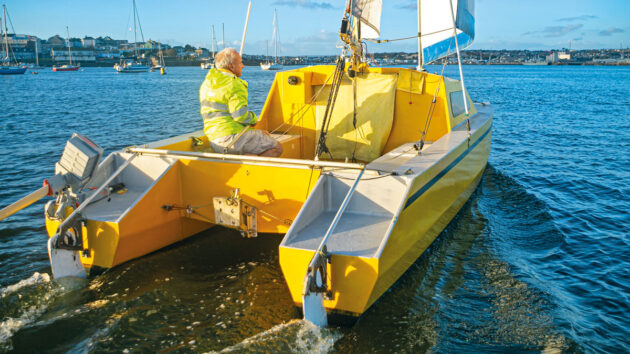
An outboard would normally be on the central bracket, but tilting the Torqeedo clear of the water was problematic. Credit: David Harding
Because the Chat 18 is so easily driven, you’re unlikely to need an outboard unless the wind abandons you or you have to punch the tide. Upwind performance seems pretty good, and it would fly with downwind sails. The problem with a spinnaker on a day-sailer, as Richard points out, is that you have to make your way upwind before you can turn around and use it.
Day-sailing rarely takes you far enough to windward for that, so arguably it makes more sense to have a flatter-cut sail such as a screecher that can be flown with the wind on or forward of the beam. Such a sail can be stowed in one of the lockers with watertight deck hatches in the cockpit seats.
Further aft in the cockpit are open-fronted lockers for bulkier items, and a dedicated anchor locker is in the foredeck. There’s space to carry everything you’re likely to need for day trips around rivers, harbours, bays and estuaries, which is what the Chat 18 was designed for.
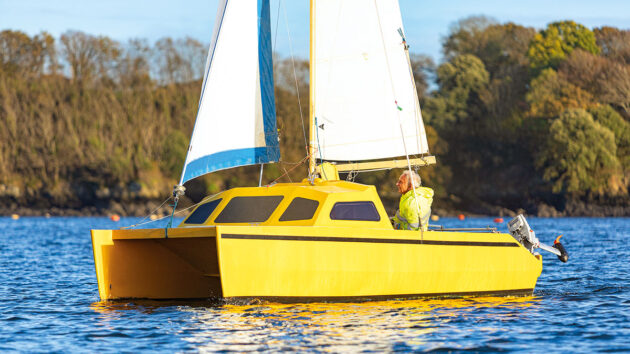
The Chat 18 is designed to trim level with crew weight in the cockpit, whereas many small boats squat at the stern. Credit: David Harding
If you want to take a few people along to enjoy the ride, you have plenty of space as well as the load-carrying capacity to go with it. The Chat’s empty weight is 705lb (320kg), and carrying the same again will take her to the designed waterline. Even when she’s laden, the generous bridgedeck clearance should minimise slapping in a seaway, especially as the underside is a shallow V-shape.
Although she’s not designed for covering the miles in open water – few 18-footers are – the Chat 18 should be quick and simple to launch and recover from a trailer, making trailer-sailing something you can realistically contemplate.
For a start, she can sit on an ordinary flatbed trailer. You will need to immerse it to float her off, but no special rollers or supports are needed. The mast should be straightforward to raise and lower – especially if you have a gunter rig – and there’s no centreboard, lifting rudder or water ballast. If you’re well organised, you could be rigged, afloat and ready to sail within 15 minutes of driving up to the slipway.
Verdict on the Chat 18
The Chat 18 is a small, simple catamaran, and that’s exactly what she was designed to be. Designing small, simple boats that are easy for an owner to build at home but also practical, fast and fun to sail is far from easy, however. That might be one reason why designs like this are so few and far between.
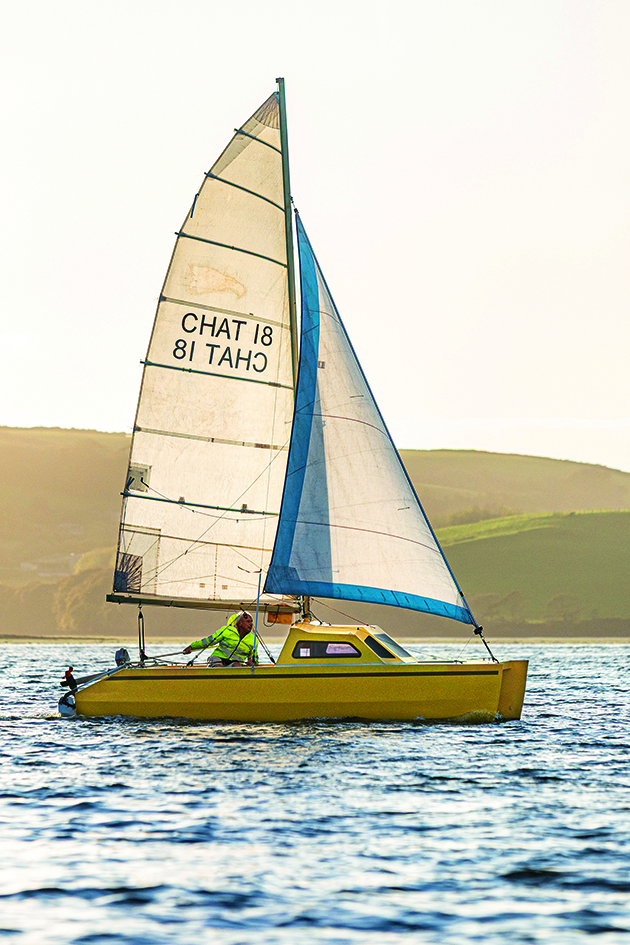
This is a cut-down rig from a beach cat. Credit: David Harding
Richard Woods has been designing, building and sailing catamarans and trimarans for over 50 years, and he has raced and cruised everything from single-handed dinghies to offshore yachts, both monohull and multihull. He has won national championships in dinghies and performance catamarans, competed in long-distance events such as the Cape Town to Rio race, made multiple Atlantic crossings in his own designs and others, and survived a fair few gales and storms along the way.
He was forced to abandon his Eclipse 99 cat in a storm so violent that a 450ft US frigate wouldn’t come anywhere near. (Eclipse was later found, upright and unscathed, but that’s another story.)
A vast amount of experience has been distilled into producing this small and simple cat, whose name can be seen as a play on words or as recognition that she’s a boat on which people can chat sociably as they sail along. Richard keeps his own boat on a half-tide beach mooring close to his house and can pop out for a couple of hours whenever time, tide and weather coincide.
Plans have been sold to builders and prospective builders in Europe, the USA and even a remote island in the Pacific, so you never know where you might find yourself stopping for a Chat.
Details
Price of plans:£140
LOA:5.60m (18ft 4in)
LWL:5.40m (17ft 8in)
Beam:2.50m (8ft 2in)
Draught:0.53m (1ft 9in)
Sail area: Bermudan rig:17.6m2 (189.5ft2)
Sail area: gunter rig:14.6m2 (157ft2)
Empty weight:320kg (705lb)
Displacement (max):700kg (1,543lb)
Motor:Outboard 2-4hp
Designer:Richard Woods
Details and plans:sailingcatamarans.com