


Debbie and Jeremy White downsize from sail to power after making their liveaboard dream in sunnier climates a reality.
My husband, Jeremy, and I have been involved with boats, both motor and sailing, on and off for over 35 years. Like many people, we had a dream to sail off into the sunset, liveaboard, and explore every corner of the Mediterranean.
Our dream developed in stages.
Buy a boat; restore it; explore the UK coast; keep the boat in Jersey and explore the nearby islands and French coast; move the boat to Spain – all this while still working demanding jobs in the UK.
Seven years of flying back and forth to our boat’s base in Costa Blanca allowed us to sail around the Balearics and sort our life plan for retiring with the ultimate aim to liveboard.
The time to put it into action came in January 2007. We quit the rat race, left our jobs, and moved aboard our boat in Alicante, with our sights set on Greece.
Leaving it all behind
Our first extended voyage was a 10-week coastal hop journey from Alicante.
After a summer exploring the Ionian, we bedded down for our first winter in Lefkas Marina on MY Bobble, a Grand Banks 36.
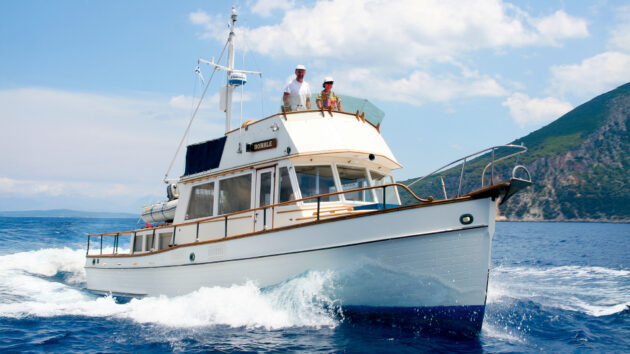
Power: Debbie and Jeremy’s first boat was a Grand Banks 36, Bobble. Photo by Debbie White
After two years, smitten with the area, we bought a Greek holiday home and downsized to a 28ft Beneteau yacht, SY Kapsali.
In 2016, we sold that house and decided to liveaboard. We sold the Beneteau and bought a 36CC Beneteau, SY Nita.
Now, 17 years later, we felt ready for a change from our base of Lefkas Marina.
Our basic wish list
Lots had happened during those 17 years; Brexit, Covid, a huge explosion in the Greek Ionian charter business.
Our decision to move was driven by a number of factors, not least our age! Now in our 60s, we felt that the time was right to push on while we had the energy to do so.
Keen for a new boat base, our first dilemma was where to go. We wanted somewhere quieter on the boating front, but also with lively towns and villages all year round.
Due to Brexit, we were only able to stay long term in Greece as we have a 10- year residency permit – other parts of the Mediterranean were not an option as the 90/180 day Schengen area rule would restrict our movement.
We didn’t want another island, so we looked at mainland Greece.
Choosing our home harbour
After much research we decided on the Nafplio area in the Peloponnese. Nafplio was the first capital of modern Greece, and is the current capital of the Argolis region.
The old town is full of narrow, cobbled streets and Venetian inspired buildings, while the new town offers a plethora of everyday necessities. Archaeological finds abound; Mycenae, Epidavrous, ancient Corinth, ancient Nemea, ancient Assini, to name a few.
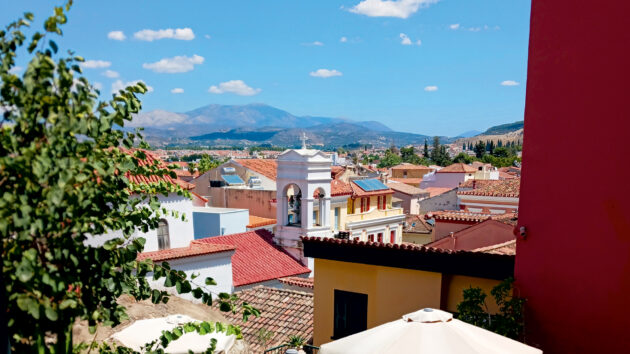
The historic port of Nafplio on the Argolis coast. Photo by Debbie White
It also has a very impressive harbour (with rumours of a new marina…), beaches, the wonderful castle (Palamidi) and the Bourtzi fortress guarding the seaward entrance to the city.
The next challenge was to find somewhere to live on shore, a new boat, and to prepare for relocation.
The original plan was to rent a small lock-up-and-leave apartment. This proved to be nigh on impossible if we wanted to rent all year; like many areas around the world, Airbnb has taken over. We could find plenty of availability from September to May, but nothing for the summer months.
So, we took the bull by the horns and bought a two-bed apartment just outside Nafplio. Not exactly a liveaboard life for us, then…
Switching from sail to power
Our move back to motor was due to many reasons, not least the ability to transport the boat by road to and from our land-based winter storage.
While it’s true that there is nothing quite like sailing in 12 knots of wind on a beam reach, our first love was motor. Our boating adventures began on a Grand Banks motorboat.
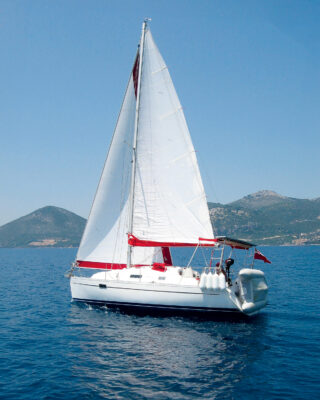
Jeremy and Debbie enjoyed many Ionian Sea adventures aboard their 28ft Beneteau Kapsali. Photo by Debbie White
And we do like a bit of speed – it’s so exhilarating; we can cover a lot of ground quickly to far-flung destinations and get ourselves out of trouble quickly should the weather change.
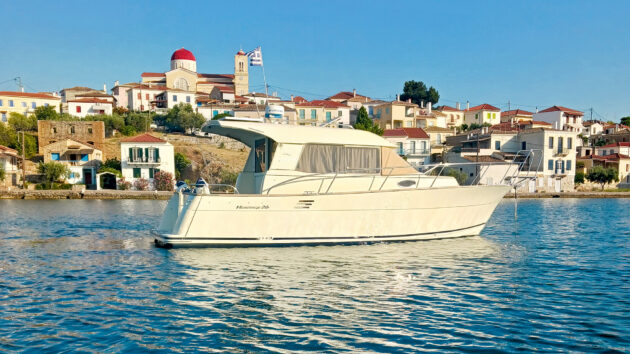
Once we decided that we wanted to return to the dark side, we researched and finally decided on a 2002 26ft ACM Heritage, single-engine, semi-displacement boat and had her delivered by road from Croatia to Lefkas Marina.
We wanted to keep her in a marina when we moved, so we booked a berth in the new marina at Porto Heli, just over an hour’s drive from our apartment, costing €350 per month for three months (July, August and September 2024).
The relocation from Lefkas took some planning as we had to transfer all our worldly goods (a car, a motorbike, a box trailer and personal belongings) 350km by road.
In addition, we planned to take our new boat and us by sea, 255 miles.
As usual, when purchasing a ‘new to us boat’, we needed to make lots of modifications to bring her up to our specification before we set off.
Upgrades and modifications
We replaced the fenders, upgraded the mooring lines, added an aluminium passerelle, changed the cabin mattress, added mosquito nets and sun shades for all hatches and portholes.
We also made more costly changes to power generation and ground tackle.
We added a 100Ah domestic lithium battery, a 1,000W pure sine wave inverter, a DC to DC 30A battery charger and a 200W solar panel. This gave us a power output sufficient for all our requirements.
For the ground tackle, we changed the Brittany anchor for a Rocna Vulcan 9kg anchor; added a Fortress Guardian 2.7kg stern anchor and upgraded the chain from 25m/7mm and 12m of three-strand nylon to 50m/7mm din 766 galvanised chain plus 20m of three-strand nylon.
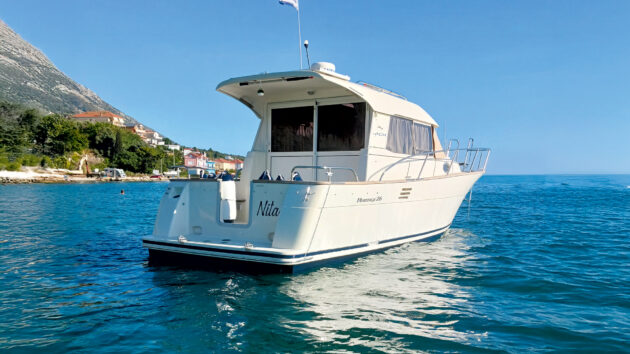
Current vessel, the 2002 26ft ACM Heritage motorboat – also called Nita after Debbie’s mum. Photo by Debbie White
As we like to anchor off whenever possible to avoid town quays and harbours, two issues worried us:
- Holding sufficient water; our tank only holds 75lt.
- Obtaining and carrying sufficient fuel; we hold 200lt. As space is limited, we needed to be resourceful when coming up with a solution.
We solved the first problem by purchasing 3 x 10lt plastic collapsible containers (for easy filling while out and about) and 2 x 22lt plastic water containers which we stored (free standing) in the lazarette, thus increasing our water capacity to 119lt.
Regarding fuel, we bought 4 x 10lt containers. We filled them before we set off and continued to fill them at every opportunity. Again, they proved to be easy to handle and meant we could filter all the fuel we added to our tanks.
Boat relocation
Next, we needed to think about the journey by sea. After moving everything except the boat and ourselves to the new location, we sat aboard in Lefkas marina and watched the weather.
We set off on 15 June in calm conditions, perfect for a small motorboat.
Calm, that is, up until we hit an uncomfortable swell just beyond the island of Kastos. We had a following sea, so the autopilot struggled with the constant corkscrewing.
After an hour of hard steering and 28 miles, we decided to pull into Pandelimon. The only boat there, in flat calm waters, we anchored in 8m and had a lovely first night. Nothing ashore except cattle. We ate aboard and slept like babes.
Up and off early the next day, we headed for Messolonghi Marina, 33.6 miles away.
It was a good stop for us to check everything, refuel, and re-water. One night in the marina cost €23.85. Electricity and water was an extra €10 for the day. There was no fuel dock; instead, a truck delivers to order so this took a little time to arrange.
Our next destination was 36.4 miles east to the island of Trizonia.
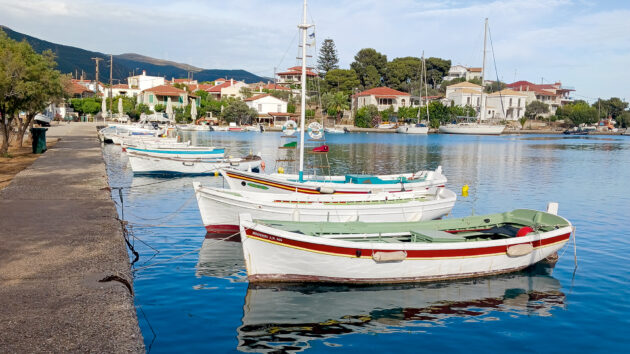
Tucked away in the calm waters of the Corinthian Gulf, Trizonia is a tiny, car-free island. Photo by Debbie White
We passed underneath the amazing Rio – Antirrio ‘Charilaos Trikoupis’ Bridge, which we know as Rion bridge, following the required procedure by calling up on VHF Channel 14, five miles before the bridge to receive instructions.
Trizonia is a beautiful island. We anchored off the harbour in 5m and took the dinghy ashore for dinner.
Next stop was a 20.3-mile journey to the stunning town of Galaxidi. We anchored in 6m in Heirolakkas Bay with around 19 other boats for company.
There is a town quay for those who would rather step ashore. We travelled by tender, stocked up on provisions and even managed to book the diesel van to meet us near our boat to fill our canisters. What a great service!
After a weather check, we decided to power on through the Gulf of Corinth (notorious for winds blowing either from the west or the east) to the Corinth Canal and get through before the wind changed.
Strong winds were coming, so we thought we might just make it if we got going.
Final legs
About two hours before the canal, the sea state became quite rough. Again, we had a following sea and steering was a challenge.
Our boat Nita was handling things well but we faced two more hours of travel time. Plus, the sea state on the other side of the canal was likely to be worse, so we diverted to the northern shores of the gulf to seek shelter.
We tried for a port called Antikyra but the swell was untenable, so we diverted to Isidoros and found a lovely place to hole up, for what turned out to be three days.
We anchored in 3.5m of sand (with water clear enough to check that it was firmly in) and hunkered down for what was forecast to be Force 7 winds.
Again, our little boat handled the conditions well. Our ground tackle did a grand job, even if I did swim over it 10 times, just to check! A couple of bars and tavernas ashore made it a highly recommended stop.
The Corinth Canal
After the weather had passed through, we once again set off to transit the Corinth Canal. This time the conditions were perfect and we spotted a pod of dolphins an hour into our journey; always such a pleasure.
We tried to book our canal transit via the online booking system (to avoid stopping at the eastern end when through) but, for some reason, we couldn’t get beyond the ‘make your payment’ stage. Many of our friends have successfully booked online, so it was obviously just a glitch.
The procedure to transit the canal (regardless of whether you have paid online or not) is to call on Ch11 three miles out and receive instructions.
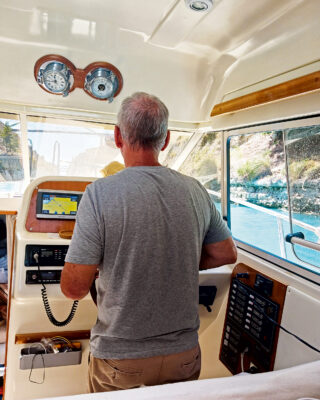
Beware strong current on the Corinth Canal. Photo by Debbie White
The cost for our 26ft motor boat was €111.60. As it turned out, stopping to pay at the other end meant we could take advantage of the fuel truck on the quay along with all the other motor boats.
The current in the canal was quite strong so staying on course required concentrated helming and staying well back from the boat in front.
Once through, and 50.7 miles later, we arrived at Korfos. We tried to anchor in the north-eastern corner, but it was full of mooring buoys so we moved to the south-western part of the bay and anchored in sand in 4m.
We saw at least three large turtles while anchoring – a treat indeed. The village offered plenty of choice for eating, drinking and provisioning.
Dodging traffic
The next leg of the journey was a shocker. After passing so few boats en route, we encountered several massive motor boats, presumably due to the proximity to Athens, 25 miles away. We spent the journey avoiding their wash.
Our destination was 25 miles to the island of Poros, passing Aegina. We anchored in 3.5m in the very busy Navy Bay.
The area was awash with sailing boats, flotillas, motor boats, water taxis, ferries, super ferries. There was even a pink glass-bottomed submarine! Madness, and it was only 24 June!
Having said all that, Poros is a pretty, vibrant place, with shops, tavernas and bars, scenic walks, boat trips and beaches.
After three days on weather watch, the winds died down and we set off on the last leg, 30.2 miles from Poros to the new marina at Porto Heli. Sea conditions were mixed, the heavy seas we found outside Poros calmed after we rounded Spathi island.
Passing Hydra and Spetses, and after just over 255 miles and 10 days, we arrived at our new home.
Cruising the Peloponnese Peninsula: Porto Heli Marina
After all our research and high hopes, our new boat base did not disappoint. It offers the most amazing protection from all winds and is an ideal summer location, especially for an aspiring liveaboard couple.
There is a lot of boat movement inside and outside the marina during the main summer months, which can cause a snatching motion when moored. Springs are therefore recommended to dampen the impact.
The facilities are all new as of July 2024. The toilets and showers are impressive and immaculately clean. Discounts are available for monthly bookings, and electricity and water are charged extra.
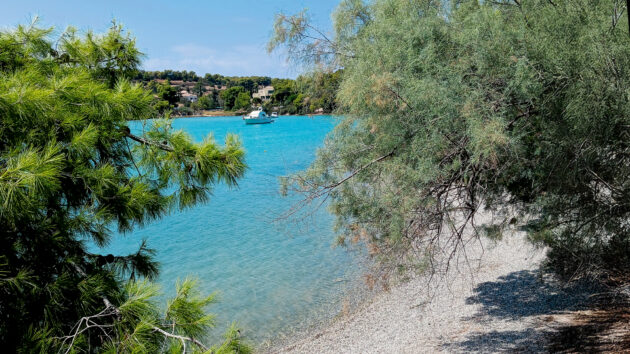
Porto Heli – just swim over the anchor to check holding in the clear sea. Photo by Debbie White
The marina’s proximity to the town (all walkable) is a big bonus. Large, well-stocked supermarkets abound, all within walking or cycling distance, and the town itself has a wide array of shops, bakeries, butchers, pharmacies, tavernas and coffee shops.
The town has one excellent chandlery. If what you want is not in stock, the very helpful man who runs the shop will order it for you, and it usually arrives within a few days.
There is also a laundry in the village which offers a service wash; staff also pick up and drop off at the marina. If you don’t want a berth, the bay offers a large, safe anchorage.
However the area is a ghost town during winter, which would be rather too quiet for us if we did liveaboard year round.
Cruising ground
This is a great area to explore. To the west, there are the islands of Aegina, Poros, Hydra and Spetses. These are all very busy in the summer months with motor yachts of varying sizes.
Erimoni, also to the west, is a delightful village with anchorages on two sides of a peninsula, giving great shelter whatever the winds.
Another attractive harbour is Epidavros. In addition to the ancient amphitheatre, there is a sunken village to explore.
To the south-west is the amazing Monemvasia, with its fortified town built into the cliff.
Venturing north and east of Porto Heli, up towards Nafplio, is like a different world. The boats thin out and the villages and anchorages on both sides of the peninsula are like Greece 20 years ago.
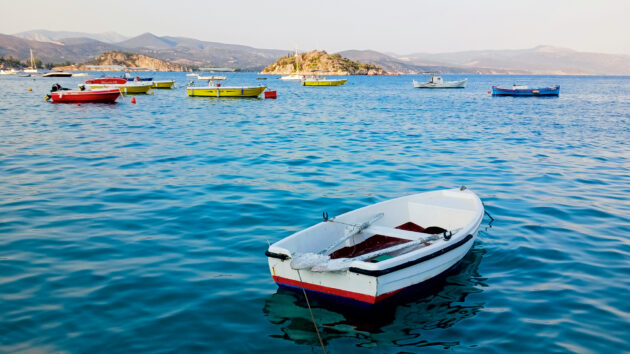
Debbie and Jeremy White were among just four boats anchoring overnight at Tolo – remarkably quiet in the Ionian’s peak season summer months. Photo by Debbie White
Even the tourist area of Tolo is relatively quiet.
In July 2024, our anchorage at Tolo had just four boats overnight – unheard of in the Ionian. Places to visit are Vavari bay, Doroufi bay and Kiláda (with a cave ashore to visit) to name but a few!
Winter storage
After a fantastic season, our summer berth expired on 1 October so we headed north to our winter storage facility in Nafplio, approximately 25 miles from Porto Heli marina.
There are quite a few shore-based yards for boats of our size in the area. We chose Nafplio Marina Boat Parking.
At €50 per month on a hardstanding, this represented fantastic value and was literally 15 minutes away from our apartment.
With water and electricity included, it meant we had everything we needed to complete the usual winter jobs.
Staff were right on time for our 1000 haul out. The experience of getting onto the trailer was interesting. We expected to be hauled on with ropes but instead, we motored straight on which was a tad nerve-racking.
All went well and 20 minutes later we were in the yard.
Debbie & Jeremy White met in the 1980s and share a passion for travel and the sea. Jeremy ran a business discovering water leaks in underground pipe systems, while Debbie had a successful career in banking. In 2007 they retired early to embark on a liveaboard life. Some 18 years and four boats later, they’re still based in Greece.
Want to read more articles about liveaboard lifestyles?

A subscription to Practical Boat Owner magazine costs around 40% less than the cover price.
Print and digital editions are available through Magazines Direct – where you can also find the latest deals.
PBO is packed with information to help you get the most from boat ownership – whether sail or power.
-
-
-
- Take your DIY skills to the next level with trusted advice on boat maintenance and repairs
- Impartial, in-depth gear reviews
- Practical cruising tips for making the most of your time afloat
-
-
Follow us on Facebook, Instagram, TikTok and Twitter