



The Legend 31 was built with quality in mind, is roomy down below and performs surprisingly well in terms of both performance and ease of handling, as David Harding reports
Legend 31: a clever piece of yacht design

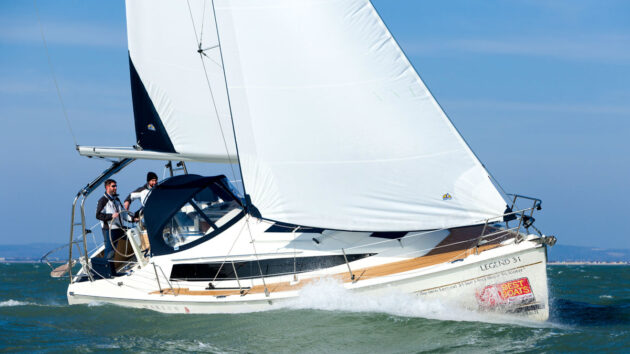
In their earlier incarnation, Legends were widely seen as belonging to the same general category as the mainstream budget offerings from the big European builders.
But after 2012, when David Marlow purchased Hunter Marine Corporation, the emphasis was firmly on quality of construction, with structural materials subject to extensive analysis, testing and research to, im the words of Marlow, ‘provide products far and away above the low cost, government- supported EU imports we observe dumped on the American and European markets without regard for longevity, underlying quality of product and future residual or resale value’.
According to Marlow, the chopper gun was banned from use in structural components, as were standard polyester resins. Also discarded are ‘particle board cabinets anchored by household glues and fasteners’, together with low-grade plywoods and ‘balsa cores saturated in generic resins… intended for general-purpose applications far from the sea’. Die-cast alloys were no longer used either.
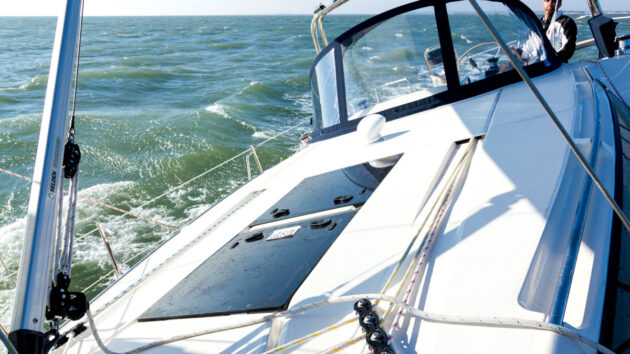
Flush-fitting hatches and recessed handrails on the coachroof. The traveller on the arch is optional. Credit: David Harding
Instead, in came polyester resins, low-porosity gelcoats, biaxial rovings, Kevlar reinforcement, an internal stiffening matrix running from bow to engine, collision bulkheads forward of the mast, and Nida-Core’s ultra-stiff, non-absorbent polypropylene honeycomb in cored laminates that have been tested to destruction. Away from the hull and deck structures, Russian birch was used in the internal furniture, electrical wiring was fully tinned, adhesives and bonding compounds came from known names like Sika and 3M, metals were chosen for their resistance to corrosion, and so it went on.
This decision to concentrate on structural integrity rather than fight it out with the budget buys meant that Legends cost a lot more than they once did. For example, the Legend 31, when new, had a list price of over £140,000. That includes extras such as a larger engine, twin keels, Flexiteek decks, a fridge, a freezer and a canting
wheel, but the base price including VAT was still nearly £116,000.
That is a lot of money for a coastal-cruising weekender that makes no pretence at being anything else (even though she’s in Category A under the RCD). If you’re buying a boat that’s capable of serious or extended cruising you might well place a greater emphasis on structure and the maintenance of essential systems. Such
considerations are likely to be important for offshore racing folk too. But with a boat that’s fundamentally a marina-hopper?
Describing the Legend 31 as a marina-hopper is not to insult her. Marina-hopping is what a lot of people do, and there’s nothing wrong with that. But let’s be clear about what the Legend 31 does and doesn’t offer.
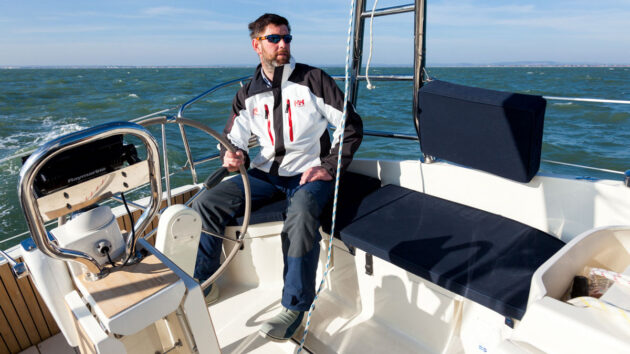
The helmsman is well catered for with the optional canting wheel, a hinge-up foot brace and the mainsheet and traveller tails close at hand. (It is a good idea to wear a lifejacket when on the water). Credit: David Harding
She’s an enormous 31-footer (nearly 32ft/9.75m on deck, for a start) with high freeboard and a cockpit wider than it is long. She has a vast amount of open living
space for a boat of her length. Moving around on board is incredibly easy when she’s in harbour: you could hold a barn dance in the saloon and you can walk – even run – from the forecabin to the cockpit without bumping into or having to hold on to anything.
She’s nicely finished, cleverly designed and she sails surprisingly well in terms of both performance and ease of handling. For many people this will be tick, tick, tick – and understandably so.
So what is she not? That’s simple: a passage-maker (or a racing yacht or, some might say, a vessel possessed of grace and great beauty. Others may beg to differ…). She hasn’t been designed for living aboard out at sea, and that will instantly be clear to anyone who wants a boat that is. She has a linear galley, minimal stowage and nothing that could really be counted as a sea-berth.
All that wall-to-wall open space that’s so lovely in harbour is more of a liability when you’re heeling and bouncing in a seaway, and the general lack of stowage means that living out of kitbags is likely to be the order of the day.
For stepping aboard in a marina, loading on your weekend gear, enjoying a nice day’s sail and then parking up at anchor or in a marina again, she might be hard
to beat. Unlike some boats designed for this sort of use, however, she will still get you to your destination even with 20 knots of headwind. She’s cleverer and more capable than you might expect, this Legend.
Climbing aboard the Legend 31
Your first challenge, if the Legend 31 is alongside in a marina berth with no access from the stern, will be scaling the topsides. Having accomplished that, you’re greeted
by a narrowish side deck across which the headsail sheet cuts on its way from the car to the Lewmar 30 winch.
The winches are mounted on coamings right outboard because the cockpit runs the full width of the stern – all 9ft 7in (2.92m) of it measured between the insides of the coamings. Boarding from the stern, via the drop-down ‘tailgate’, is really the idea: it all ties in with the absence of a backstay and the single, small, central wheel (canting and/or folding as an option) that’s easy to walk past.
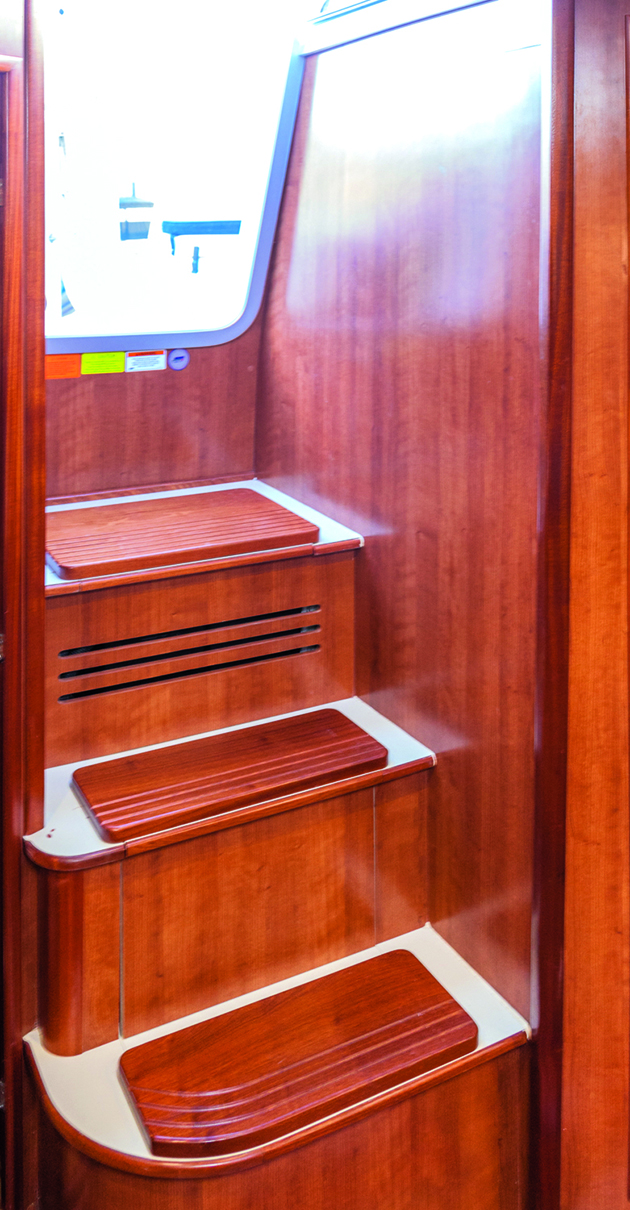
Companionway steps don’t come easier to negotiate than these. Credit: David Harding
Whichever route you take to the cockpit, you’ll find it unlike most others. Cockpits on monohulls have traditionally been longer than they are wide, not twice as wide
as they are long. This one is just 5ft (1.5m) fore and aft, so the proportions are more akin to those seen on a catamaran.
Legend’s patented mainsheet arch is overhead and a table folds out from the pedestal. From here you can take an easy stroll down the companionway steps into the
cabin, of which more later.
In the meantime, how does she go once you slip the mooring lines? Well, thankfully, she’s nicely responsive under power – just as well on a breezy day in a tightly packed marina. A 21hp Yanmar saildrive came as standard, but owners could upgrade to the 29hp alternative.
Steering is precise and throttle response pretty positive, even if the fixed two-bladed propeller won’t bring her to an abrupt halt and you need to allow for a modest kick to port in astern.
In open water we reached 6.3 knots at 2,500rpm, an extra 500 revs taking us to 7 knots.
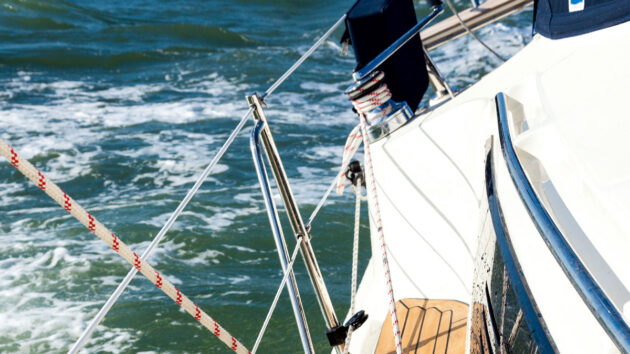
Primary winches are mounted right outboard on the coamings. Credit: David Harding
And so to the sailing. Seeing the boat ashore at Southampton, noting her full-sectioned hull and twin keels that are not far off vertical rather than splayed, I couldn’t help but wonder how she would perform. I had memories of the earlier models of the same length not being the most obedient or responsive of boats.
Thankfully, we chose a perfect day to test the new Legend 31. It was blowing 15-20 knots from the north-east, with gusts up to 25 knots at times. I wanted to see how she responded to being over-pressed, so we started with everything flying, bar a couple of rolls in the mainsail, before rolling both main and jib down to a more sensible area. An in-mast mainsail comes as standard on the Seldén rig, because that’s what the vast majority of buyers asked for. A heavily roached, conventional main on a shorter mast is an option.
At first we were indeed pushing the limits. Nonetheless, the boat was still manageable. On the wind she could be feathered and depowered to keep the heel to around 25° while retaining enough drive to make respectable headway into the Bracklesham Bay chop. In this case, ‘respectable’ meant around 4.5 knots on average. Significantly, the helm didn’t load up excessively even if she was deliberately heeled further, and the rudder only lost grip when the gunwale was a few inches from the water. On a boat with this much freeboard, that’s a lot of heel.
Tolerant behaviour
There’s no doubt that the Legend 31 is remarkably tolerant when pushed far harder than most owners will ever push her. Sailing like this is the boat-testing
equivalent of taking a mild-mannered family estate around a racetrack and leaving most of the rubber on the tarmac. It’s a good opportunity to see where the limits really lie.
One thing I would criticise (gently) is the balance of the rudder: a little more balance would make life more comfortable. Even when the boat is upright, you’re aware that there’s a sizeable blade under the transom. It’s good to have plenty of blade for grip, as she has, and even better to have it balanced so the helm is finger-light.
With several rolls in both sails she was easier to manage and, not surprisingly, faster too: after a little more tweaking we made up to 5 knots on port tack and 5.5 on starboard, tacking through a little over 80°. The speed difference might have been because the waves were at a kinder angle on starboard tack – no other reason was obvious.
Downwind she slipped along at an easy 7 knots-plus, surfing readily, peaking at 8.3 and, unlike some of her predecessors, showing no propensity to round up. If you want to get the best out of the boat, you will need to ensure the rigging is fully up to tension. We had a lot of forestay sag and of course there’s no backstay with the B&R rig. I was far from impressed with the cut of the mainsail and, what’s more, we were dragging a fixed prop around with us.
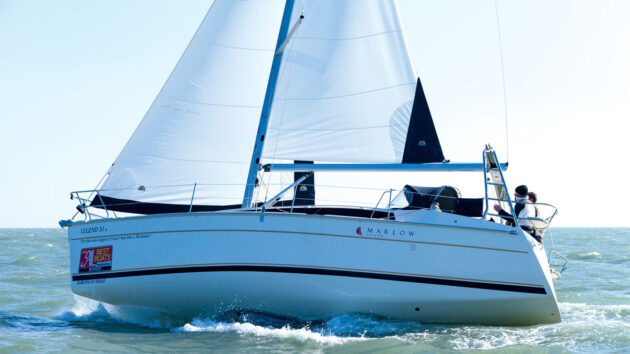
The root of the windward keel is just breaking the water, but there was none of the thumping that’s characteristic of twin keels. Note the chine towards the stern – below rather than above the static waterline. Credit: David Harding
Given those handicaps, she acquitted herself well. Such a voluminous hull is inevitably going to bounce around more and be stopped by the waves to a greater extent than one that’s slimmer, other factors being equal. All the same, the relatively fine entry and rounded forward sections (complete with Legend’s favoured bow hollow) ensured that the Legend 31 rarely slammed. She was also notably dry, no water making its way to the cockpit and not even a splash landing on the weather deck.
Perhaps the most notable feature was the absence of thumping from the twin keels, because the roots are further inboard than on many boats and the keels are almost vertical. The idea is that the weather keel generates lateral lift rather than inducing heel through vertical lift as it would if more parallel to the waterline when the boat heels.
Other factors come into play, and the result is that they really do seem to work. You would have no idea you were weren’t on a fin-keeler unless you went below and lifted the sole boards.
More boats have twin wheels than twin keels these days, but the Legend 31 sticks to one. Ideally, you want a boat with the canting pedestal, because without it you really would struggle to sail the boat properly. It allows you to sit comfortably on the weather side, right outboard and with a good view forward. A footrest hinges up from the cockpit sole to help keep you in position.
You need to leave the helm to tend the headsail winches if single-handing. The Lewmar 30s are just big enough, though the guardwires need to be raised so they don’t foul the top of the handles. Being double-ended, the mainsheet can be handled from the arch or the coachroof, where there are three clutches each side and room for a fourth – a bare minimum, I would suggest.
The arch is useful to hold on to when you’re moving forward from or returning to the cockpit. On deck, the hatches are flush and the grabrails recessed into the corner of the coachroof, so there’s not a lot to brace your feet against should you venture on to the coachroof. On the other hand, the optional Flexiteek seems to bestow upon your feet a limpet-like grip even when it’s wet.
A moulded upstand forms a toerail and is part of the hull-to-deck flange joint. It’s good to see a chunky, steel-capped moulded rubbing strake too.
Accommodation on the Legend 31
You learn a lot from going down below when a boat is beating into 20 knots of wind and a short chop. I won’t criticise the Legend 31 for not having a seagoing layout,
because she’s not that sort of boat. One thing I wanted to know was how much creaking and groaning was going on. The answer was none, indicating a rigid structure.
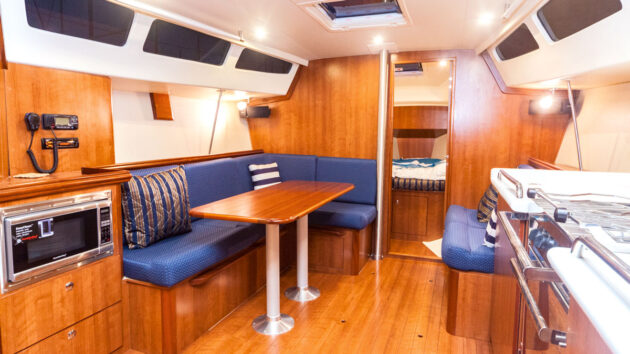
The emphasis down below is on wide-open spaces. There’s no dedicated chart table. Credit: David Harding
If you’re a potential buyer youwill make up your own mind about the layout, so I will skim over that here. What I did establish among other things, after several hours of poking around and crawling into dark recesses after our sail, is that the structural elements looked reassuring and the sort of messy, unfinished, out-of-the-way corners you might expect were notable by their absence.
Space around the engine is tight, although there are access panels. It’s mounted back-to-front, gearbox-forward. The finish below decks is generally neat and thorough – all-wood drawers, for example – even if cherry wouldn’t be my first choice of timber because it tends to dent easily. What you get in abundance is living space – lots of it. The principal shortage is stowage, for things both large and small.
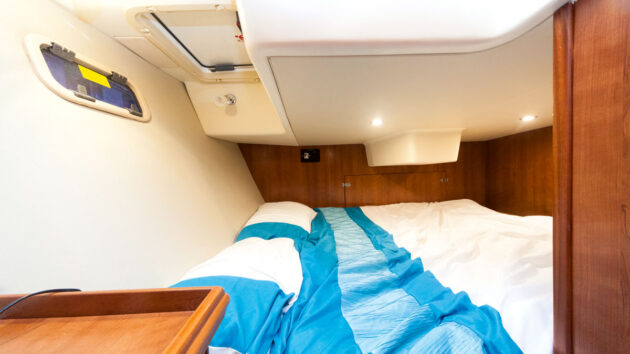
An athwartships double bunk runs across the stern beneath the athwartships cockpit. The escape hatch is a welcome feature. Credit: David Harding
One reason she’s so roomy is the short cockpit. Rotating the berth in the aft cabin to run athwartships is nothing new. Turning the cockpit around too is more of a novelty.
The Legend 31 is one of those boats about which you could write a book, not just a four-page feature. While traditionalists might dismiss her, she’s undoubtedly very good at what she’s designed to do. Here’s a 31-footer that feels like a much bigger boat below decks. She’s engineered and built with care, neatly finished and much more capable under sail than her looks would suggest.
Love her or hate her, this is one seriously clever piece of yacht design.
Details
Length on deck:31ft 11in (9.73m)
LWL:29ft 8in (9.04m)
Beam:11ft 10in (3.61m)
Draught (deep fin):5ft 5in (1.65m)
Draught (shallow fin):4ft 5in (1.35m)
Draught (twin keels):4ft 5in (1.35m)
Displacement (twin keels):12,250lb (5,556kg)
Ballast (twin keels):3,774lb (1,712kg)
Sail Area:524sq ft (48.68sq m)
Displacement/Length Ratio:206
Sail Area/Displacement Ratio:16.5
RCD Category:A
Engine:Yanmar 21hp diesel saildrive
Designer:Glenn Henderson
Builder:Marlow-Legend, Florida