



Ashore or afloat, winter cold and damp can have a detrimental effect. Jake Kavanagh looks at the options for keeping condensation and moisture at bay
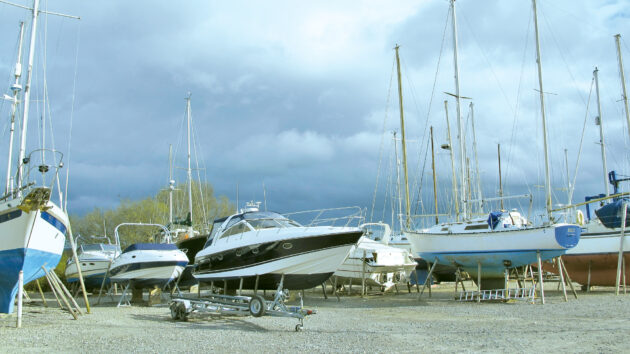
With advances in heating, clothing and insulation, winter sailing is now more popular than ever, but most boat owners still prefer to haul the boat out for the winter months, despite the risk of damp.
Some also winterise afloat, sometimes out of necessity, or because they still hope to grab an occasional day of bright, midwinter sailing. A Boxing Day trip, for example, remains on many boaters’ wish lists.
For anyone owning a boat, the key factor in winterisation is to keep it dry inside, especially as moisture can do more damage than just assist the growth of mould.
For boats that have a lot of external natural wood, keeping the exterior dry too, especially during a spate of biting frosts, will help extend the life of the finish.
As soon as autumn arrives, there will be four main considerations for winterisation.
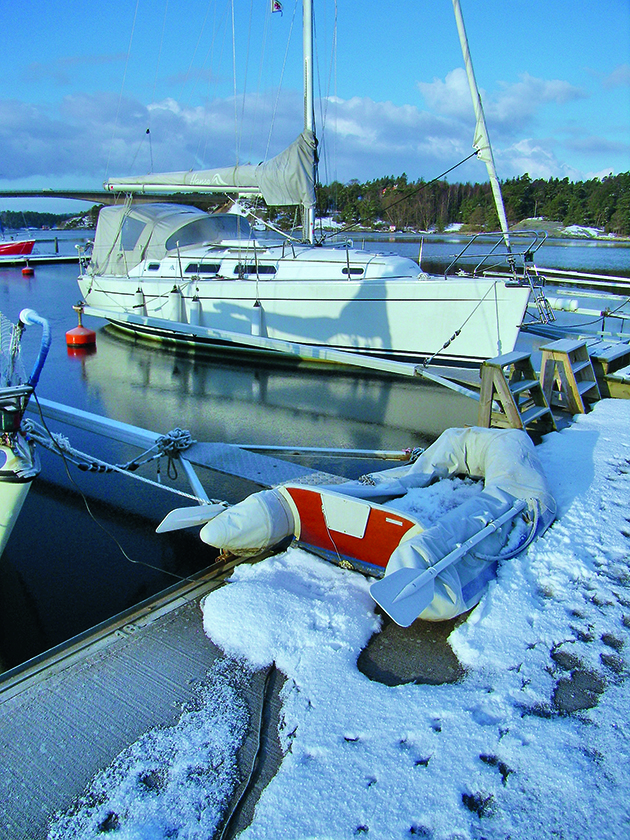
Many boats winter afloat, benefitting from the stabilising effect of the seawater around them, provided it doesn’t freeze. Photo: Jake Kavanagh.
Will the boat be brought ashore, or kept afloat, and do you have access to mains power, or are you off-grid? Each will have an impact on your damp-busting strategy.
The two key weapons in keeping the internals dry are ventilation and a lack of condensation.
As black mould loves standing water or a permanent film of moisture, air movement – however gentle – will make a huge difference.
While ventilation can be achieved with natural air flow, or battery/solar-powered fans, dehumidifiers still require access to mains power for reliable operation. Some can also be quite heavy to manhandle, a consideration if your boat is ashore and accessible only by ladder.
Here are some winter boat maintenance ideas, gleaned from boat owners around the world who often face extremes of cold and damp during the winter, or high humidity if wintering in the tropics.
How to banish damp ashore
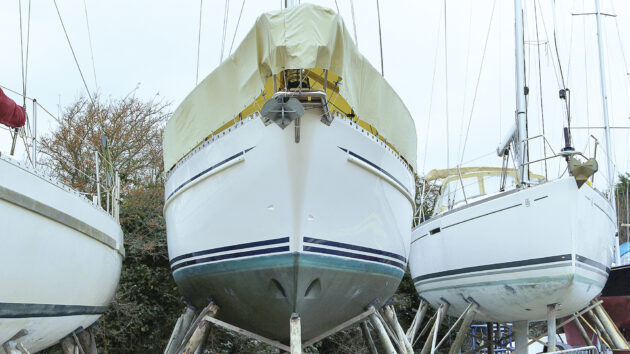
A custom-made cover can prove a good investment when designed to allow a good flow of air over the deck to banish damp. Photo: Jake Kavanagh.
Lifting the boat out and wintering ashore can either be on a hard standing of some kind, or – more rarely – inside a shed. Scandinavian countries have under-cover winter storage as a major industry, keeping thousands of boats gently heated and ventilated through the harshest weather.
Wherever the boat is stored, a key asset will be access to mains power which will allow the owner to run fans, dehumidifiers, or heaters during the coldest or dampest days.
Some choose to run them all through the winter, but the rising cost of mains energy –sometimes at a marina premium – can make this quite expensive.
Cover it well – but not too well to keep damp at bay
Many owners choose to leave their boats uncovered for their winter boat maintenance, but will usually place a small tarpaulin over the cockpit to keep wind-blown leaves and litter from collecting there.
The drains are usually left open to deal with any rainwater, and the cover should stop them from becoming blocked.
Other boat owners prefer to cover the entire boat, especially when they have teak decks, wooden grab rails and acrylic hatches.
Keeping frost and UV off the boat when not in use helps to prolong the life of exposed coatings, plastics, and fittings.
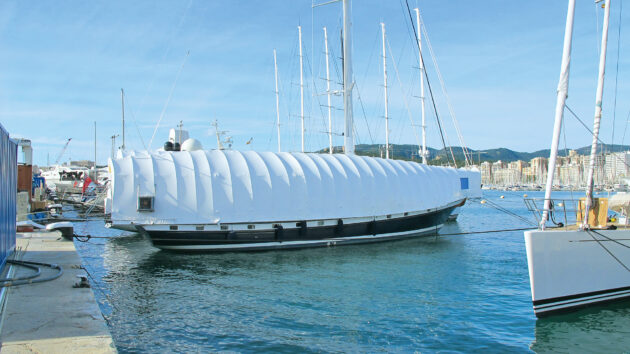
Refit projects done during the winter can benefit from a shrink-wrapped cover, as seen here in Mallorca. Note the extractor fan for better temperature control and to prevent damp. Photo: Jake Kavanagh.
Covers can take three main forms – a tarpaulin, a shrink wrap enclosure or a timber ‘shed’.
Tarpaulins are the easiest and cheapest to fit, but unless custom-made from robust canvas-type material, they rarely last more than a season.
Shrink wrap is very effective, but it is usually more expensive and is used for long-term refits or boat transport.
The plywood ‘shed’ is often the resort of boat owners who regularly lay up in the same spot, or who intend to keep the same boat indefinitely. They make a frame to fit, which can be temporarily bolted into place.
Although relatively expensive to build and time-consuming to assemble each winter on site, a modular shed can last for many years. This often makes it more cost-effective in the long run than continually replacing a tarpaulin.
While a cover will keep the worst of the weather out, it still needs to allow a good flow of air to both enter and leave the boat hull. This is usually achieved by keeping the ends at the bow and stern partly open, although larger boats will have vents set into the tarpaulin amidships too.
Professionally made custom-fit covers have these sewn in at regular intervals, with a design that makes them watertight. In securing the cover, allowances must be made for the worst of the weather.
The whole planet seems to be experiencing stronger and more frequent storms, so choosing an extra-strong material for the tarpaulin, adding more eyes for attachment points, and protecting the boat hull against line chafe are all simple precautions to take.
To prevent damp: chain out, stops in
Even with the cover on, it’s important to ensure no rainwater can enter the boat.
Sometimes the mast is taken down, a good precaution in exposed locations, as it reduces windage.
This can, however, leave plugs and other openings exposed, so these need a temporary cover to prevent the weather or pests.
Bilges should be left as dry as possible, and entry points such as the hawse pipe for the anchor chain, should be sealed up. The anchor and chain are usually pulled out and laid out on a palette.
This is because the weight is no longer supported by the surrounding water, so placing the tackle on the ground takes the strain off the bow.
The right humidity to deter damp

Ideally, relative humidity should be somewhere between 30-50%. Above 60% can accelerate corrosion, and below 25% can dry out skin and cause health issues. Photo: Jake Kavanagh.
The term ‘relative humidity’ refers to the amount of water vapour present in air, expressed as a percentage of the amount needed for saturation at the same temperature.
The higher the temperature, the more water vapour the air can contain, so as the temperature decreases, this water is released, condensing out on cooler surfaces.
When a boat is laid up, a cabin that routinely heats up and cools down again will cause the moisture in the incoming air to be deposited on every exposed surface.
This encourages mould to settle, and bacteria to thrive, which adds to the ‘musty’ smell of a damp cabin. Dust mites also like moderate temperatures and high humidity, as they absorb their water requirements directly from the atmosphere.
We need a degree of water vapour in the air for good health. Comfortable and healthy humidity is anywhere between 30% and 60%.
However, for a winterised boat, untreated iron will rust at anything over 50%, and mould will grow at 68%. At levels of 80% or higher, steel will corrode, and marine electronics may no longer be covered by warranty.
The best weapon against damp
Good ventilation is probably the best natural weapon against damp, and in eliminating the accompanying black mould. However, ventilation is not such a good idea if you’ll be depending on a dehumidifier.
There’s little point running a dehumidifier if all it is doing is stripping moisture from a large volume of incoming air.
To ventilate naturally, open the vents on deck, ensuring they won’t be susceptible to wind-blown rain. Allowing an air flow across the deck will help pull the interior air out and replace it with a drier version.
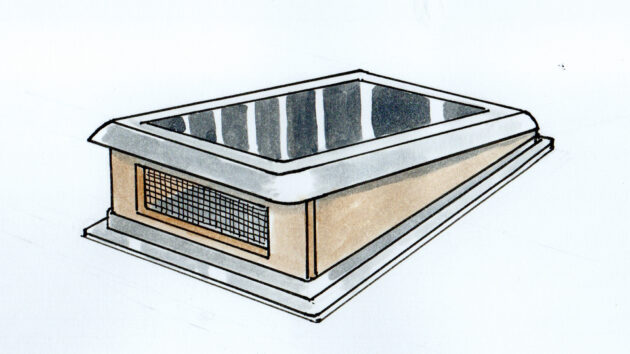
This graphic shows how a hatch can be fitted with a DIY vent grill. Photo: Jake Kavanagh.
Fans are a useful tool here, too, but the usual self-powered solutions such as solar power vents will be compromised by the cover, or – where still exposed – by short hours of daylight.
Instead, some owners have fitted low-power mains or battery fans that draw very little current and keep the air moving, passing it right through the boat.
To aid the movement of air and reduce the effects of mould, many owners strip the boat of its cushions and leave as many locker doors open as possible.
Cracking the hatches
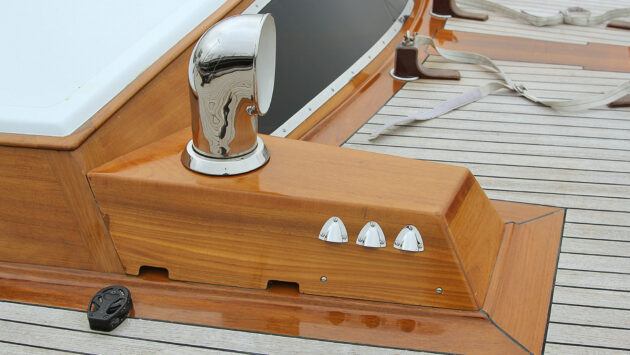
Dorade vents are best left closed if using a dehumidifier below. Photo: Jake Kavanagh.
The hatches on a laid-up boat can be adapted to provide ventilation without compromising security.
The forward hatch, for example, can be wedged open under the protection of the cover, but locked in such a way as to prevent intrusion.
Portholes can also be fitted with a temporary dorade vent. Some can be made from old plastic flower pots.
A thin mesh across open hatches and portlights can also prevent rain from entering, while assisting with airflow.
Use a dehumidifier to prevent damp
There are two basic types: compressor and desiccator. Each has its pros and cons, and you can read a very good review at pbo.co.uk/dehumidifier.
The compressor types work in much the same way as a refrigerator. A gas (the refrigerant) is compressed by a pump and cooled to a liquid state. It is then passed over a condenser, where it becomes a gas again.
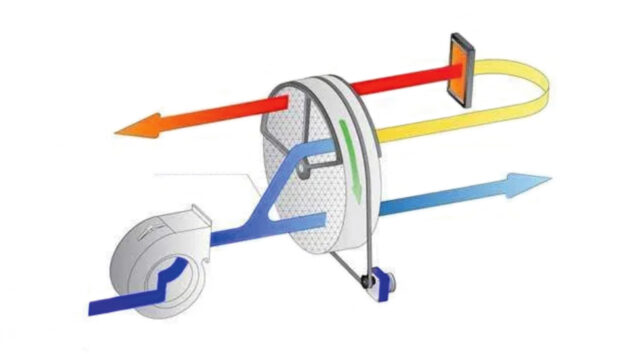
Dessicator dehumidifiers remove moisture and warm the expelled air. Photo: DT Group .
During this process, the condenser becomes very cold, and this causes air being drawn into the dehumidifier to shed its water content. The water runs down the plates of the condenser and is collected in a tank.
Some models have a pipe fitting so the water can be drained continuously into a sink or other outlet, ideal for when boat owners intend to run the machine for long periods.
The desiccant type works differently by drawing air in over a wheel coated with zeolite, a material that readily absorbs water. The wheel slowly rotates, drawing water into one half before moving it to a drying area.
In this part of the rotation, a fan and heater dry the zeolite, and the moist, hot air released is cooled on a condenser. The water collected drops into a tank, and the drying air is expelled from the machine.
This air is usually about 10°c warmer than the cabin air being drawn in, which helps to keep the chill out of the interior.
Which dehumidifying solution for winter boat maintenance?
In terms of which type is best boat dehumidifier, many prefer the desiccator. The main advantage is the expelled warmer air, which helps prevent domestic water pipes from freezing.
The desiccant models tend to be lighter, an advantage if moving them around inside the boat, but they also use a lot more power.
Dessicator dehumidifiers remove moisture and warm the expelled air. Photo: DT Group .
The zeolite is also very susceptible to damage from solvents, so it would be unhappy in a boat being refitted where paints, varnishes, and thinners are being used.
Compressor types use less electricity, but in very cold weather the condenser plates can freeze up and the machine will shut down. However, they work very well in hot weather, so they would be ideal for a Caribbean lay-up.
The larger motors and pumps inside also make them relatively heavy, although the evolution of more compact and efficient motors has made a big difference to both weight and performance.
Using a dehumidifier has other advantages in that it pulls moisture out of the boat’s structure as well, which can absorb a lot of water over time.
Pulling this moisture back out again means doors will open more easily, the foam or balsa core will dry out, and electrics, engine and other metal-based components will remain in better condition for longer.
Also aiding the operation of modern dehumidifiers is more advanced monitoring and control, where the machine can be set with a timer or when humidity levels become too high.
‘Smart’ dehumidifiers can even be checked and operated remotely via an app, as part of a general boat monitoring system.
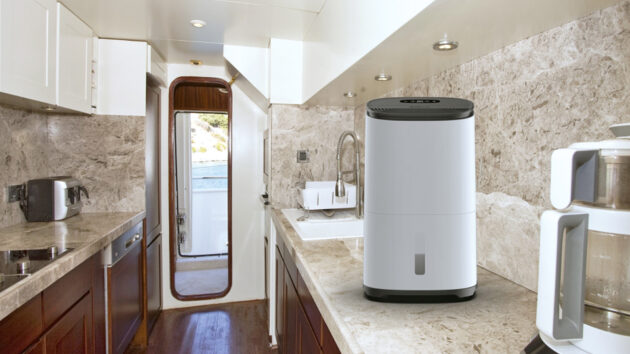
A new generation of ‘smart’ dehumidifiers can be set to automatic operation or be part of a remotely accessed system. Photo: Maeco.
Mythbusting: Do dehumidifiers ever catch fire?
While marine models are generally robust and safe, there have been some incidents of cheaper domestic varieties catching fire when left unattended on board, and operating for too long. Some marinas have banned the use of dehumidifiers for this reason.
It’s also worth checking with your insurance company if you intend to leave a dehumidifier running for extended periods, as some models are approved, but some are not.
However, an approved marine-grade unit used sensibly is a major weapon in the war against damp, and a good investment by reducing the maintenance and repairs arising from moisture damage.
Keeping an even temperature during winter boat maintenance
As temperature is the main factor in how much water vapour the air can carry, maintaining a relatively even level of warmth inside the cabin is key to reducing condensation. This can be achieved in several ways:
1. A thermostatically-controlled heater.
This will require a grid connection, but these can be set to turn on via a pre-programmed thermostat.
Intended for unheated buildings such as garages and greenhouses, they use relatively low amounts of power (commonly between 60w-100w) and can be placed in vulnerable areas such as near engines, water pipes or batteries.
The general idea is not to heat the boat up, just to prevent frost from forming in the cabin.
The most popular choice for boats is the oil-filled bar type, as they are generally sealed units that are easy to place and unlikely to move.
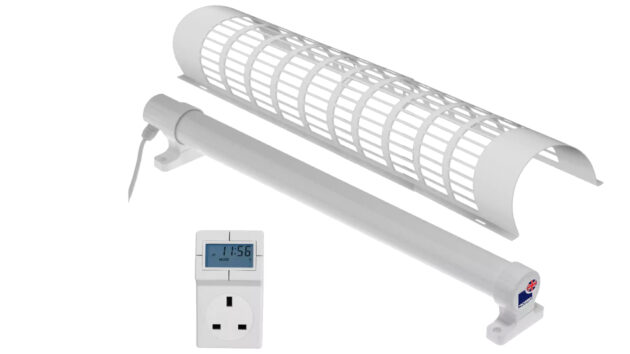
Oil-filled bar heaters have been designed mainly for greenhouses, and are easy to slide beneath engines or under lockers. They can be linked to a simple thermostatic control or programmable timer. Photo: Morris Direct UK
2. Improve the insulation.
Having better insulation inside the boat will help to reduce big swings in temperature. This can be added relatively inexpensively and will also make summer cruising more comfortable.
Some types, such as 3m’s Thinsulate, are also described as ‘hydrophobic’ so they won’t absorb any moisture.
Foam types should be of the closed-cell variety, or they will simply act as a giant sponge.
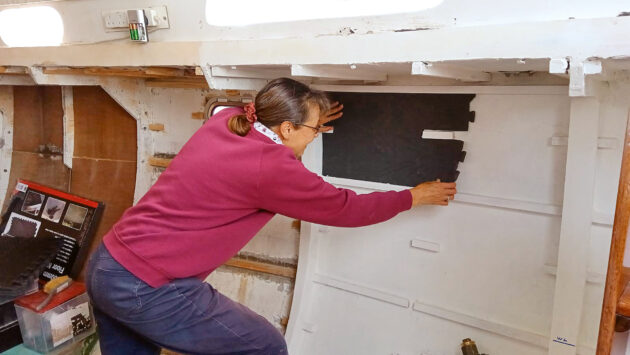
Closed cell foam insulation can make a big difference by reducing peaks and troughs in temperature.
3. Temporarily double-glaze.
Adding an extra layer of glazing to the main windows will help reduce condensation. This could be a layer of clear polythene attached with double-sided tape, or even bubble wrap stuck across the aperture.
Paul Fay (see below) used clear ‘builders’ plastic sheeting over the windows of ti-gitu, fixing it with double-sided tape and then heating it so it shrank and pulled taut.
He later switched to clear vinyl used in sprayhoods, with velcro attachment points instead.
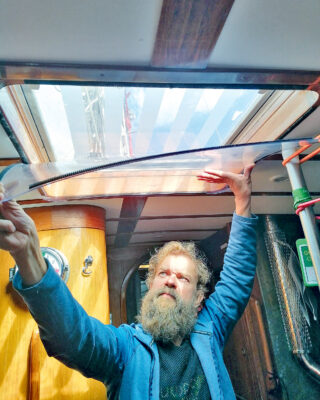
Adding an extra layer of temporary glazing will help reduce condensation and trap it in situ. Photo: Katy Stickland.
4. Draw the curtains… or even make a special pair for the winter, with a silvered outer surface.
Low-level sun streaming into the boat can heat the air inside, which then condenses out as the temperature falls.
Drawing the curtains and covering hatches keeps the interior at a lower but more even temperature.
It also prevents sun bleaching of exposed woodwork.
5. Self-timed blown air heater.
Set the diesel heater to come on for a few hours.
Some of the more modern models of diesel heaters, such as Webasto or Eberspächer, have a function where they will fire up and run for a set time to a set temperature, warming the interior and preventing condensation.
These smart functions can all be operated and managed remotely, provided you have a good wifi link.

Some diesel heaters can be operated remotely. Photo: Katy Stickland.
Preventing damp afloat
If the boat remains afloat at a marina berth, then access to mains power should mean that ventilation, heat or dehumidification can be used as usual.
Things get a bit trickier, however, when on a remote mooring or where no shore power is available.
In this situation, keeping the boat dry will require stopping all leaks, maintaining an empty bilge, ventilating well and using passive desiccation units.
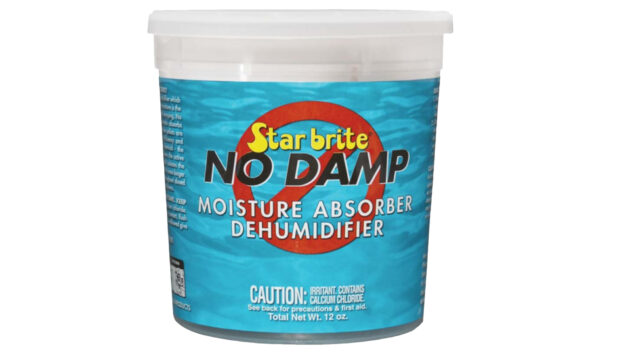
Passive dessicators such as this Starbrite unit will help to keep lockers dry. They usually need regular replacement, but can absorb a lot of moisture to prevent damp. Photo: Force 4 Chandlery
These consist of plastic pots filled with a moisture-absorbing material. They work as intended but need regular replacement, especially in moisture-laden air.
However, located strategically inside lockers and other hard-to-access areas, such as around the engine, they should help to absorb a lot of otherwise potentially damaging moisture.
Positive Input Ventilation
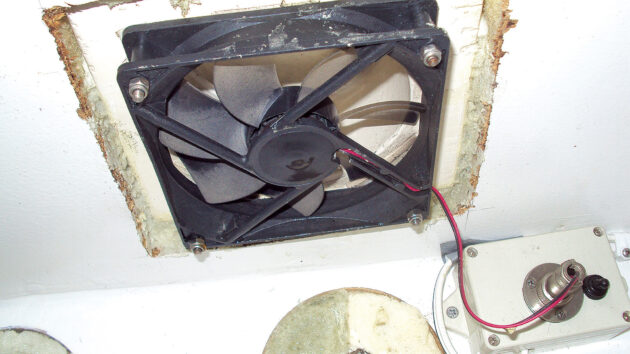
Paul Fay uses slow revving, low draw DC fans to push air continuously through his 40ft steel boat. Photo: Paul Fay.
A good example of a well-ventilated all-season boat is described by Paul Fay.
He has adapted the concept of positive input ventilation (PIV) for his steel 40ft schooner ti-gitu.
PIV is usually used for buildings, and the idea is to have a slightly higher air pressure inside by running a large, slow-revving fan in the attic.
This creates slightly higher pressure within the rooms and forces all the moist air out through the various vents and gaps in the structure.
Professional yacht painters use the same technique in the paint tents they erect over a refit project.
The PIV system keeps dust, pollen, and other particulates away from the paint surface and stops dust from being blown in when the access flap is opened.
Paul fitted three slow-revving 12v computer-type fans into his boat, an 80mm fan at the bow, another at the stern, and a 120mm fan amidships, all for a total of 1a power consumption, which is less than a dehumidifier.
Paul feels that this system, which has proved hugely effective, could easily be set up to run from a battery topped up with solar power or from a wind turbine.
Read his detailed account about condensation.
Coming soon: ‘black mast’ aircon from Foundation Zero
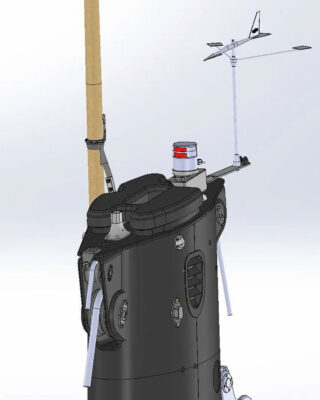
The top of the Project Zero mast is fitted with rainproof vents which are connected to the internal ducting. Photo:
Here’s an idea from Foundation Zero that will keep a boat well-ventilated in both winter and summer: paint the mast black and insert a ventilation duct inside which has an input in the cabin, and an outlet at the masthead.
As the mast heats up in the sun, it causes the air inside to rise. Colder air is drawn into the boat to replace the air being pulled up the mast.

As the black mast heats up in the sun, the air inside rises, pulling fresh air in through the boat’s ventilators.
The idea has been developed by Foundation Zero, a not-for-profit organisation seeking to produce a sailing superyacht that uses minimum energy without compromising creature comfort.
The two tall masts have been built by composite specialists carbo-link and feature an internal duct system with no fans or moving parts.
The designers reckon that the 70m tall mainmast could generate between 5kw-10kw of air movement, depending on the weather.
Considering the average domestic fan requires 1kw-1.5kw of energy, the cooling effect of the black mast is equivalent to as many as 10 household fans. www.foundationzero.org.

Boat condensation: one sailor’s solution to keep your boat dry
Many boats suffer from water droplets forming on cold windows as a result of hot air or steam becoming cool…

Boat maintenance: jobs to tackle over the winter
Now’s the time to tick-off those jobs you’ve been putting off all season and get a head-start on the spring…
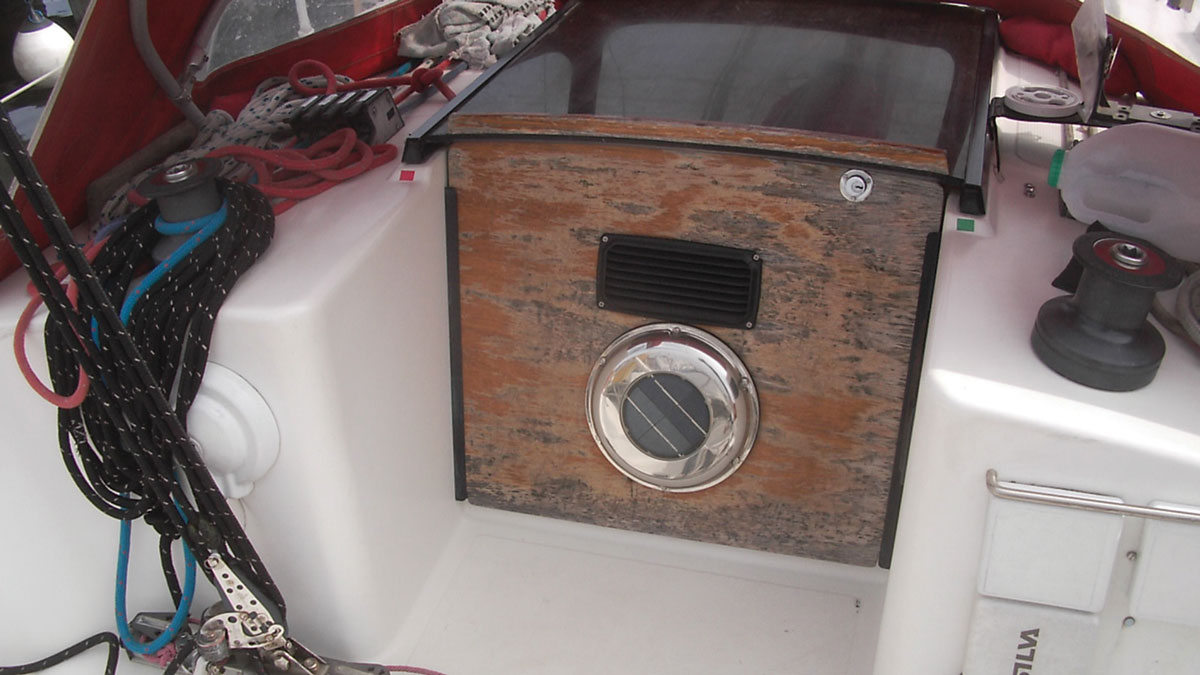
Banish winter damp: install a solar-powered vent
Ten years ago, Colin Haines installed a solar-powered vent on his boat. He shares the results and if it still…
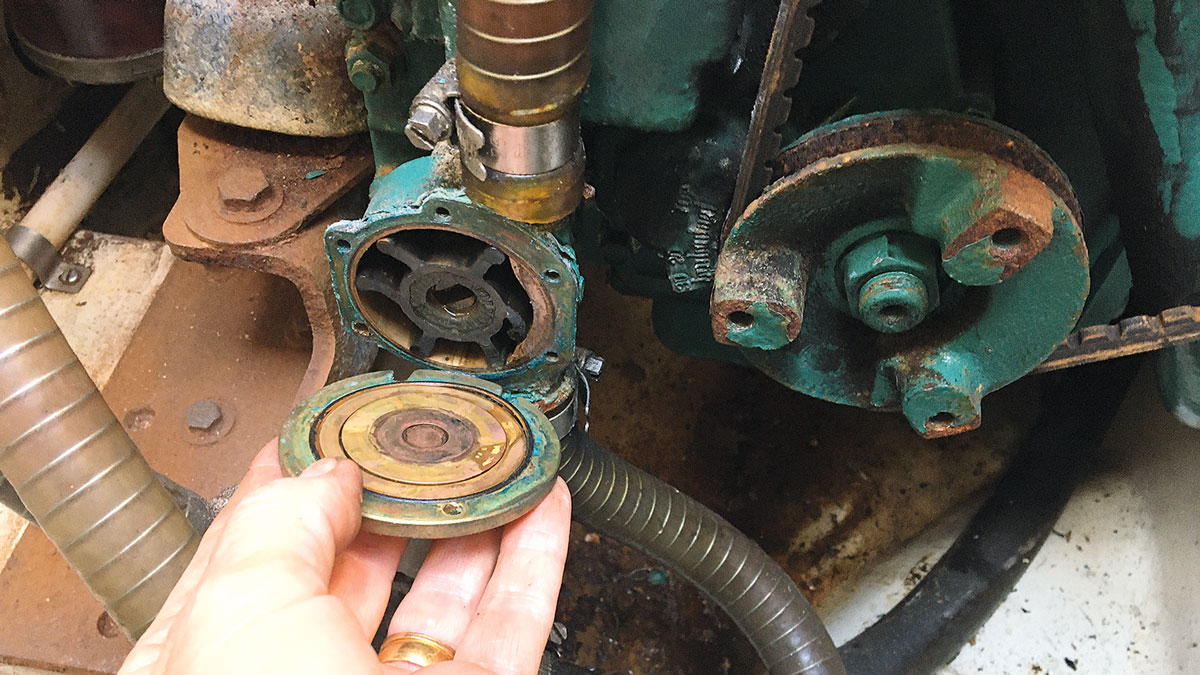
How to winterise a boat engine
Engineer Stu Davies explains the steps you should take to make sure your boat’s engine is protected over the winter…
Want to read more articles like Banish damp from your boat this winter?

A subscription to Practical Boat Owner magazine costs around 40% less than the cover price.
Print and digital editions are available through Magazines Direct – where you can also find the latest deals.
PBO is packed with information to help you get the most from boat ownership – whether sail or power.
-
-
-
- Take your DIY skills to the next level with trusted advice on boat maintenance and repairs
- Impartial, in-depth gear reviews
- Practical cruising tips for making the most of your time afloat
-
-
Follow us on Facebook, Instagram, TikTok and Twitter