

Against all odds, Pip Hare’s broken mast during the last Vendée Globe became a masterclass in resilience. She talks about her life in sailing and how she coped with her Vendée disappointment
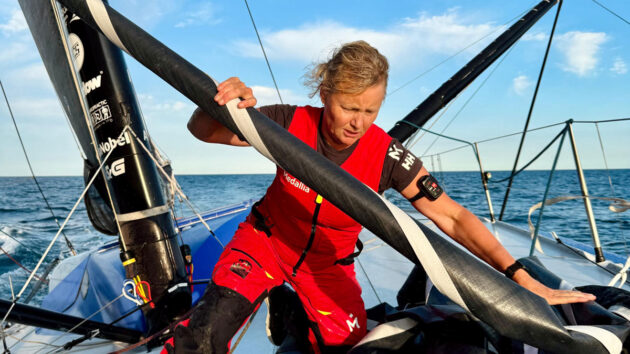
Pip Hare embarked on her remarkable career by attending sail training schemes, something which opened her eyes to a whole new world of opportunities.
From these beginnings, she has led an extraordinary life of adventure, resilience, and two Vendée Globe races – and why she believes sail training can change young lives.
There is a particular kind of freedom that comes from standing at the helm of a sailing boat with the wind on your face and an open horizon ahead. For Pip Hare, that feeling ignited a passion when she was just 16 years old, and has shaped every decision she has made since.
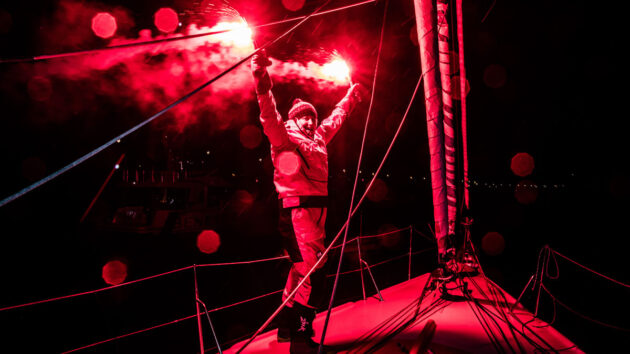
Pip Hare came 19th in the 2020 Vendée Globe
Today, she is one of Britain’s most respected solo ocean racers, a two-time Vendée Globe competitor, and an outspoken advocate for the power of sail training to transform young lives.
But Pip’s story does not begin in a harbour town or a sailing family. It begins in Huntingdon, Cambridgeshire, about as landlocked as England gets.
Growing up in a county with no coastline and no connection to the sailing world, Pip Hare had little reason to expect that she would spend her adult life racing solo across the world’s oceans. What changed everything was a single experience: a sail training scheme.
“It was a sail training scheme, the Young Skipper Scheme, that gave me my passion for believing that I could have a career in sailing, or that I wanted to make sailing a big part of my life. That was when I was 16.”
It was not just the sailing itself that made an impression. It was the agency, the sense of responsibility and possibility that came with it.
“I just recognised immediately that it was a sport that would allow me to push myself as an individual, but also I was really inspired by the possible adventure, you know, of an open horizon and going to other countries and all of that.”
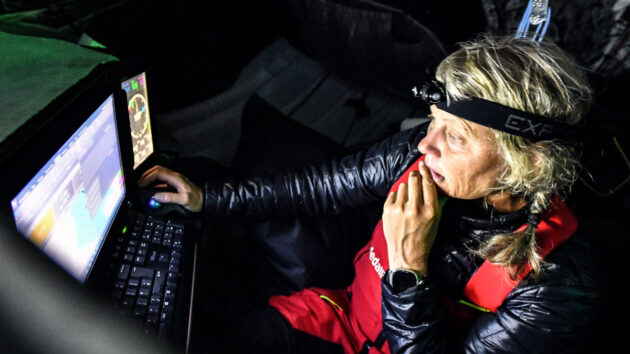
Pip Hare spent time volunteering to build her sailing miles and her experience. Credit: James Tomlinson
Without a network of sailors around her, Pip Hare built her knowledge the only way available to her: through volunteering. She spent a year bouncing between sail training organisations, accumulating miles and experience with a determination that would come to define her career.
“I sailed on square riggers. I sailed with disabled sailors, youth programmes, programmes for disadvantaged young people. I just said yes to everything, really. And it was that that gave me the bedrock of knowledge that then allowed me to go on and pass my Yachtmaster exam pretty quickly.”
A community without barriers
For young people who do not come from sailing backgrounds, the traditional sailing world can feel unwelcoming, a world of membership fees, inherited connections, and unspoken codes. Pip Hare experienced this tension firsthand. But in sail training, she found something different.
“The sail training community offered me a community where I was just accepted for who I was, whereas the more mainstream sailing community seemed harder to access. And that has been pretty much a struggle my whole life. I’ve always felt like an outsider in the sailing world, and yet the sail training community is always welcoming with open arms.”
The inclusivity she encountered was not just social, it was structural. Working early on with organisations like the Jubilee Sailing Trust and the RYA Seamanship Foundation, Pip found herself in an environment where a role existed for everyone, regardless of physical ability.
“The first time you watch somebody who is visually impaired steering a boat using the wind on their face or listening to an audio compass… For a young person to be immersed in a world where there really genuinely is that kind of equality is quite an incredible thing.”
She is quick to add that this inclusivity is not performative…it is simply how things are done.
“It’s just a normal thing. It’s not a big deal. It’s just; this is how we go sailing.”
Pip Hare: Breaking into a male-dominated world
If the sailing world was slow to welcome those from outside its traditional demographics, it was even slower to accept women, particularly at the top levels of offshore racing. When Pip Hare began her offshore sailing career, fewer than one percent of participants were women. The challenges she faced were direct and, at times, bruising.
“People constantly doubted my ability, my validity. When I was teaching, I remember somebody walked off one of my courses, somebody turned up for a five-day course, realised they had a young female instructor, and just left.”
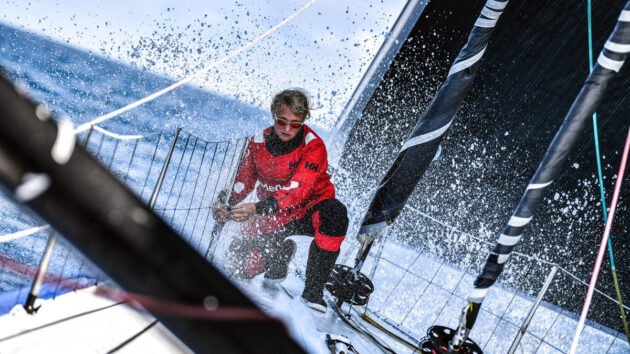
Pip Hare taking part in the Fastnet. Credit: James Tomlinson
Rather than being deterred, Pip channelled the resistance into resolve.
“I just rolled with it, because that was just the way it was. And I guess it just made me very determined to prove, to myself and to everyone else, that I was more than capable.”
Three decades on, things are changing. Pip estimates female participation in sailing is now closer to 20% — still far from parity, but a significant shift from where she started. And she is clear about what she hopes her story represents for others who might see themselves as outsiders.
“I just love sailing, so I’m just not going to let anybody take that away from me.”
Pip Hare: Sailing Against the World
The Vendée Globe is one of sport’s most extraordinary tests: a solo, non-stop, unassisted race around the world. Pip Hare has competed in it twice — an achievement that places her among an exceptionally small group of sailors globally. Her first campaign – in 2020 – was built on audacity as much as ability.
“I started my Vendée Globe campaign as a complete outsider, with a £25,000 loan and no team, and I went up against really well-established teams. Some of them had 40 paid team members and millions of pounds of funding. And I went up against them alone with nothing.”
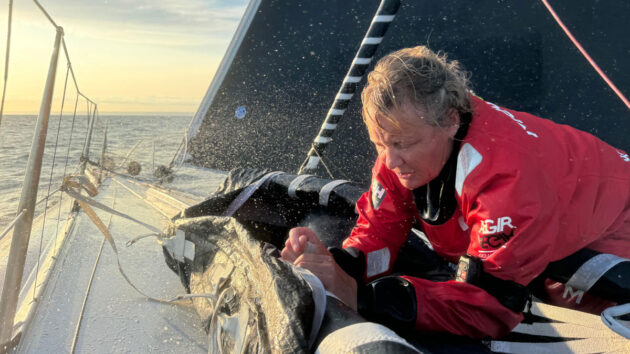
Pip Hare has taken part in two Vendée Globe Races – 2020 and 2024
“I was left 800 miles south of Australia with no mast and my race was over.”
What followed was a masterclass in practical problem-solving under extreme duress. Pip cut away the mast to prevent damage to the hull, constructed a jury rig from the wreckage, and sailed herself back to Australia over the course of two weeks – totally alone.
But it was the emotional and psychological recovery that proved the greater challenge.
“You know, lots of people can imagine it like an Olympic sprinter breaking their leg a week before the Olympics. It’s not just the last four years of preparation — it’s a lifetime. And then it’s not just me; it’s my team, my sponsors, my followers. You hold everybody’s hopes, and then… this is the most important sporting event in my life, and I failed. It is beyond devastating.”
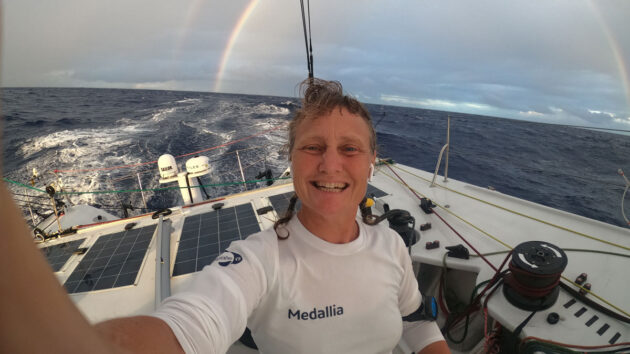
Pip Hare regularly posted on social media during her Vendée Races, helping her to win legions of fans
Facing grief, isolation, and the wreckage of years of preparation, Pip made a deliberate choice. She decided to treat each day as an opportunity to take something back.
“Something was taken away from me with no choice, and it’s within my power to take something back every day. So, every day I improved the boat. I sewed new sails, I adapted my rig, I moved weight around, I changed the autopilot settings. I managed the boat like it was still a race boat and I managed myself like I was still racing.”
The discipline of that daily effort, practical, purposeful, incremental, became the mechanism for emotional recovery. And in retrospect, Pip regards those two isolated weeks at sea as something more than just survival.
“In a strange way, those two weeks are something I actually really value, they allowed me to repair myself in a way I don’t think I would have if someone had come and taken me off the boat and straight to shore.”
This strategy of breaking difficulty into stages, acting within your control, and moving forward one day at a time, is central to the book Pip wrote after her first Vendée Globe. She describes In My Element not as a book about sailing, but a book about life.
“I wrote it to answer the most common questions that I’m asked. And those are questions that relate to everybody’s lives: how do you manage loneliness? How do you stay motivated? How do you pace yourself when you’ve got a big task ahead?” A second edition incorporating her account of the disaster and its aftermath is now in progress.
Human potential and resilience
Looking back across a career built on opportunity, resilience, and a willingness to say yes, Pip Hare is consistent in identifying the foundation: sail training. Not just as a route into the sport, but as a formative experience that gave her, and gives countless young people, something much harder to quantify.
She describes arriving at a Poole marina to find it full of young people returning from an ASTO (Association of Sail Training Organisations) Small Ships Race: no phones in sight, energy crackling between the boats, crews buzzing with the particular aliveness that comes from a week of shared challenge.
“The air was just electric. Everyone was buzzing. All of these young people had clearly had the most incredible week.”
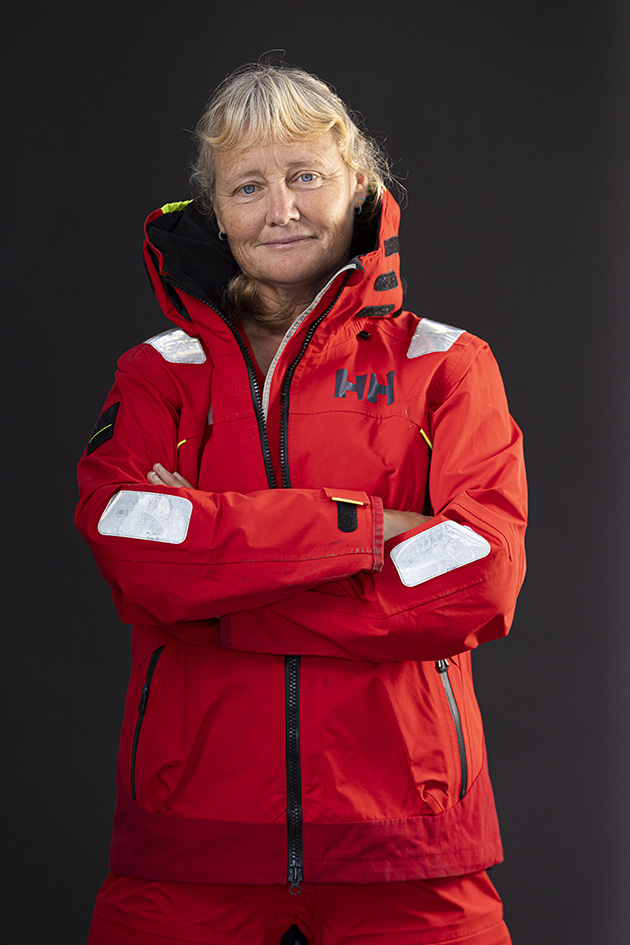
Pip Hare finished the 2020 Vendée Globe in 95d 11h 37m 30s. Credit: Mark Lloyd/Lloyd Images
It is a scene she recognises from her own young self, the teenager from Huntingdon who found a world where she belonged, was given responsibility, and discovered she was capable of more than she had imagined.
“In a sail training situation, there is no confirmation of circumstance or anything like that. It naturally gives opportunities to people who don’t normally have them, which means you have a real melting pot of people. And I just found that a very easy environment to learn in, because I didn’t feel stupid, ever.”
For Pip Hare, that is ultimately what sail training offers: not just skills, not just qualifications, but the foundational belief, formed through experience rather than instruction, that the open horizon is available to anyone willing to take the helm.
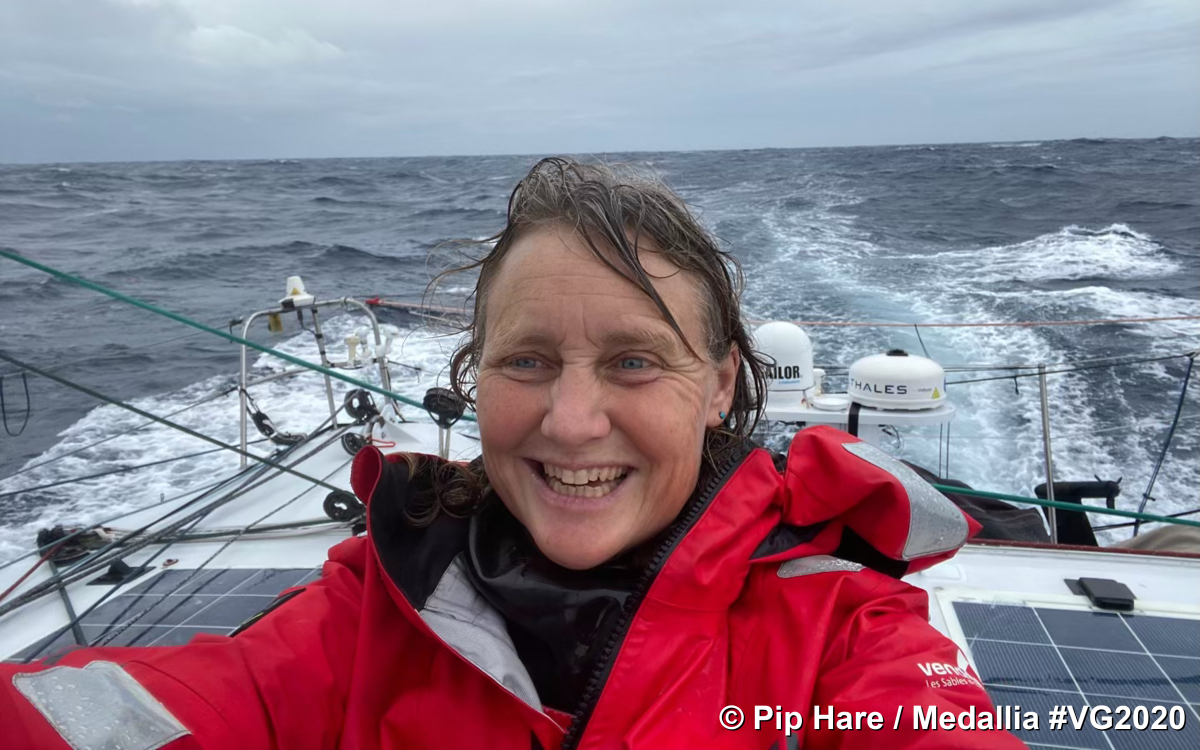
Pip Hare: I’ve not just sailed 97% of the way around the world to be broken now
It is relentless out here. Squall after squall. Multiple wind shifts. Waves coming from every direction. Just this second one…

Pip Hare: “I am looking for a top 10 finish in the 2024 Vendée Globe”
British skipper Pip Hare says she plans to "maximise every opportunity" to achieve a top 10 finish in the 2024…

British sailor Pip Hare’s Vendee Globe ‘full throttle’ challenge is in jeopardy
Vendee Globe 2024 challenger Pip Hare may have to "throttle-back on performance" and jeopardise a world sailing record bid unless…

Pip Hare: ‘I now have a fighting chance for Vendée Globe 2024 success’
The six month refit aims to give Pip Hare's Imoca 60 Medallia "a fighting chance" against the 13 new-build boats,…

Véndee Globe: Pip Hare first British sailor to cross the line
Pip Hare is the first British sailor to cross the finish line of the Vendée Globe, finishing the solo round-the-world…
Want to read more articles like Pip Hare: a masterclass in resiliance?
A subscription to Practical Boat Owner magazine costs around 40% less than the cover price.
Print and digital editions are available through Magazines Direct – where you can also find the latest deals.
PBO is packed with information to help you get the most from boat ownership – whether sail or power.
-
-
-
- Take your DIY skills to the next level with trusted advice on boat maintenance and repairs
- Impartial, in-depth gear reviews
- Practical cruising tips for making the most of your time afloat
-
-
Follow us on Facebook, Instagram, TikTok and Twitter