



The Polish-built Storm 22 is a sporty weekender that is small enough to be easily handled and large enough for overnighting
Storm 22: the spirited performer that will satisfy racers and cruisers

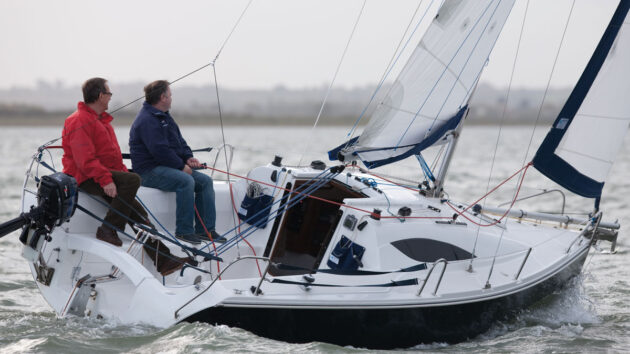
Time was when a sporty 22-footer was a popular rung on the ladder for sailors moving up from racing dinghies. These days, however, someone looking for a small, fast, trailable weekender is as likely to be moving down from a bigger boat as on the way up from something smaller.
Many of those looking at this size of boat are of retirement or near-retirement age and have spent plenty of time either owning larger boats or sailing on other people’s. They have chosen a 22-footer because that’s the size they want: small enough to be easily handled afloat and ashore yet large enough for overnighting or the occasional weekend.
The Storm 22 was conceived principally as a lake-racer with many of them being bought by sailors in mainland Europe, where many racing fleets were established.
This leads to several questions, among the most important being one that relates to many trailable sailers from Poland: how well does a light, sporty design aimed primarily at lake sailing take to the coastal waters of the UK?
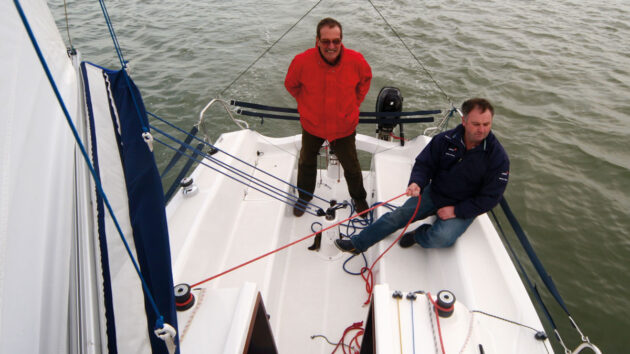
A roomy cockpit that works for short-handed sailing and should also allow a racing crew to operate efficiently. The Sport version comes with a traveller. (Ed’s note: it is a good idea to wear a lifejacket when on the water). Credit: David Harding
Conditions on the Bodensee or Lake Geneva can hardly be compared with those around the British coast.
Some lake-sailers I’ve tested have needed careful handling when the breeze picks up: they’re not boats I would recommend to anyone looking for an easy ride. Competent dinghy racers might manage to keep them on their feet, but others would struggle.
The reason in most cases is principally lack of ballast, the builder’s objective being to keep the boat light for easy trailing and the keel light for easy lifting.
You can still have a light keel if you put enough ballast in the bilge and draw a hull with ample form stability, as with the Hawk 20 or the Hunter 20, for example. Both these are powerful performers in a blow, designed in and for the UK.
If, on the other hand, a boat has minimal internal ballast, a light keel and a hull without a firm turn to the bilge, it’s likely to struggle when the breeze picks up unless you have plenty of crew sitting on the high side or flat enough water to make upwind when reefed right down. More often than not, the British owner of a boat like this will be sailing short-handed in water that’s likely to get choppy.
Adaptability of the Storm 22
Given the number of Polish lake-sailers that have found homes in British coastal waters and the challenges that have faced some of them, it’s reassuring to see that the Storm 22 comes in what’s dubbed the Salt Water version. In fact she comes in three versions: Cruiser, Sport and Salt Water.
The exact specifications of each vary according to which piece of the builder’s literature you read, but essentially there are two rigs (standard and tall) and two keel configurations (swinging steel centreplate and vertically-lifting daggerboard).
The proportion of the ballast that’s contained in the keel and inside the hull also varies.
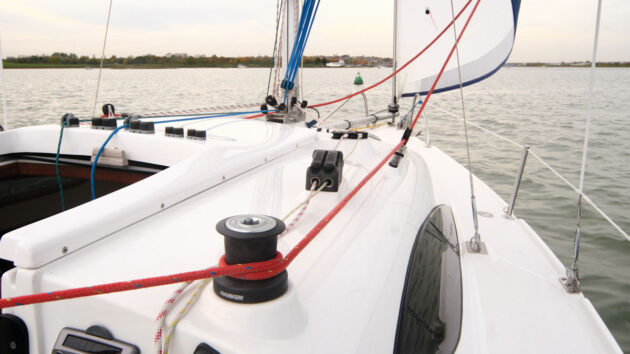
The deck layout is simple and functional. Extra hardware can be added for spinnaker gear and racing kit. Credit: David Harding
For racing, or simply to maximise performance, the daggerboard is the way to go: it’s a fully-profiled stainless-steel section containing lead ballast that’s concentrated at the bottom to give the lowest centre of gravity. Extra lead bonded inside the hull adds to the ballast and allows the board to be kept light enough for easy lifting.
As well as an efficient foil section, the boat benefits from minimal drag because there’s no long slot in the hull as with a centreplate. Drag from the slot is part of the package with a centreplate, as is the reduction in hydrodynamic efficiency because it’s simply a flat steel plate with bevelled edges.
The centreplate is the first choice for cruising sailors, however, because it will swing up if you hit something and you don’t have to live with a wet (and quite possibly smelly) lump of metal in the middle of the cabin when it’s raised.
Lift and go
When you sail from the top of a tidal estuary like the Blackwater in Essex, as does Martin Appleton, a centreplate makes a lot of sense. Whatever boat Martin owns has to have minimal draught anyway, because at low tide it settles on the mud in its berth immediately outside his house.
Martin bought his Storm 22 in 2010 having previously owned a Hawk 20 (the open dayboat) and then a Hawk Cruiser version. For his next boat he wanted something slightly bigger to provide more accommodation for weekending and overnighting, so he looked at all the alternatives he could think of, test-sailed many of them, and settled on the Storm 22.
‘I wanted more space but without sacrificing the performance,’ he told me. ‘When I tested the Storm 22, I was impressed by the way it sailed and it had everything I needed.’
Having since covered more than 700 miles in and around the Blackwater, Martin had got to know the boat pretty well by the time I sailed with him. He admits to finding it a little flighty after becoming accustomed to the stiffness and sail-carrying ability of the Hawk, though with a reef in the main and a few rolls in the headsail he has been able to cope with some fairly boisterous conditions.
When we went out there was no need to reef: we had 12-15 knots of wind for a while before it dropped away, whereupon we entertained ourselves by performing a few of the less conventional manoeuvres like sailing backwards (which the Storm 22 does very well).
While the wind held we slithered along on a broad reach at up to 7 knots and maintained 5.3 to 5.5 knots upwind. That’s more than respectable for a 22-footer, even if it was hard to gauge tacking angles and leeway without any other boats of similar size and type around to act as a yardstick.
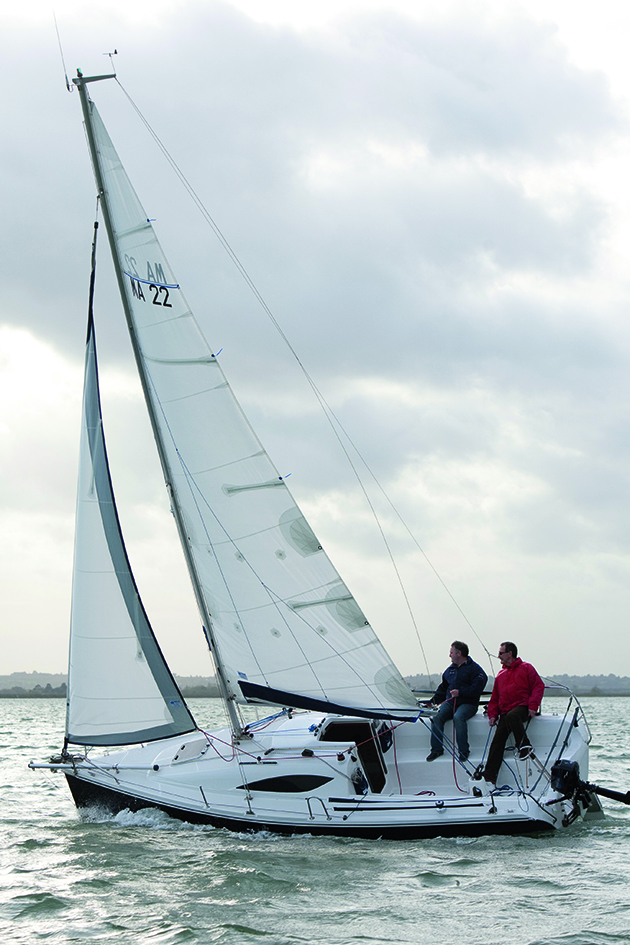
A taller rig is offered on the Sport version. Credit: David Harding
Since the standard boat doesn’t come with a traveller, the mainsail has to be bladed out with a tight kicker instead. With three of us on the windward side we had as much power as we needed and flattened the main right down. On his own, Martin would have needed a reef.
The main flattened nicely but we struggled with the headsail. As standard, the Storm 22 comes with a halyard built into the furling system and it’s impossible to achieve sufficient luff tension. The alternative – a separate halyard taken to a dinghy-style muscle-box on the mast – would be well worth having.
We needed more rig tension, too, to remove some of the forestay sag. We had already taken several turns on the bottlescrews before heading out, but the over-length cap shrouds meant we couldn’t wind them down as much as we needed to. Given the slender section of the rig and the relatively low hounds minimising the backstay’s effect on the headstay, properly-tensioned caps are essential.
Although the Storm 22 is stiffer than some of her compatriots, she’s undoubtedly a spirited performer and needs a flat rig to perform at her best. The builders need to supply her in a form that allows owners to de-power her readily.
A more efficient backstay would help. It’s split low down so the two sides of the initial purchase, taken to the pushpit rails, are at a very poor angle. On top of that there’s a mere 2:1 purchase that’s so short it soon ends up block-to-block (or whipping-to-block, to be precise).
Full marks for obedience
Like many fast and lively boats, the Storm 22 is well behaved and comfortable to sail. The big cockpit makes for easy movement and there’s a comfortable perch on the flat, angled coamings. The guardwires are far enough outboard to let both helmsman and cockpit crew lean back against them when the boat heels.
An under-length tiller extension was my only real gripe: I would want to be able to sit further forward.
For cruising, the standard 4:1 mainsheet that’s taken to a moulded turret on the cockpit sole is adequate. As well as a traveller, which is fitted to the Sport version, competitive sailors would probably want a 2:1 fine tune.
An extra on Martin’s boat is the pair of self-tailing Lewmar 14 winches on the coamings to handle the sheets for his asymmetric spinnaker (it flies from the end of a retractable
bowsprit, though a conventional symmetrical spinnaker with a pole can also be used).
On the coachroof is a pair of Harken 6s for the halyards, genoa sheets and other lines led aft. All deck fittings (mainly from Harken and Ronstan) are secured by machine screws tapped into aluminium plates – not my favourite method of attachment.
One noteworthy feature is the precise engineering of the rudder and tiller assembly; there’s no play whatsoever, leading to a direct and positive feel. Martin’s only comment is that he would ideally like a rudder blade that allows him to steer when it’s partially raised in shallow water.
That would mean having a blade that lifts vertically rather than pivoting, and then it wouldn’t kick up if it hit the bottom.
Weather helm is minimal, to the extent that the boat could be kept on course upwind with the tiller let go, the mainsheet played in the gusts and crew weight moved when necessary. The balance on the rudder blade is about right, too.
Some weather helm could probably be induced through adjustment of the mast’s rake and position: there are several fore-and-aft slots for the heel as well as for the cap shrouds and forestay.
As she was set up, Martin’s boat only rounded up if pushed to around 35° of heel on the wind. It was the mildest of rebukes and she was easily brought back on course. This bodes well for her ability to be kept on track downwind under spinnaker in a breeze, not that we had the opportunity to try it.
Even under plain sail in cruising mode, however, Storm 22’s have been clocked surfing down waves at over 10 knots. A Sport version with a crew of four hefty chaps could be seriously quick. I would like to try her in more challenging conditions. I have few doubts that she’ll fly downwind.
Upwind any light, flat-sectioned boat of this size will present a challenge but it would be interesting to see how she copes with a chop and more breeze.
In light conditions, as on any boat, keeping the transom clear of the water will be important. That’s largely a function of having the crew weight in the right place, though unusually the Storm 22 is ballasted in the factory according to the weight of the crew with the objective of avoiding excessive stern-drag.
Lateral as well as fore-and-aft sensitivity to weight is inevitable with a boat like this. Step-on stability is not high; you just have to get used to it.
A fair finish on the Storm 22
In terms of mouldings and stainless work, the Storm 22 reflects the high standards found in many Polish boats. The split pulpit is a particularly neat piece of design. It’s made in one piece, the middle section wrapping around the stem at gunwale level and contributing to the structure’s impressive stiffness.
A standard bolt-on or quick-release anchor roller can be fitted, the anchor itself living either in the roller or in the shallow anchor locker.
The main stowage lockers are each side in the cockpit, the port one on Martin’s boat containing a charging unit for the 5hp Tohatsu that sits on the transom and will fit inside the locker if necessary.
Other features that stand out on the Storm 22 include the lead ballast. It keeps the weight lower than would be the case with cast iron, making the boat stiffer and maximising headroom below decks where every half-inch counts.
The only evidence of ferrous metals misbehaving was a few rust streaks from fastenings on deck.
Accommodation on the Storm 22
One of several surprises on the Storm 22 is how welcoming and nicely appointed she is below decks. There’s plenty of trim in neatly finished American cherry, a stretched-vinyl headliner and little evidence of the full interior hull moulding until you start lifting the upholstery. Even the window bezels are in wood.
In a boat of this size there’s seldom scope for creativity in the layout but some of the proportions are worth noting – particularly those of the saloon seats-cum-quarter berths at over 2.00m (6ft 7in) long and 0.61m (2ft) wide. Headroom is 1.46m (4ft 10in) at the highest point and there’s a more-than-adequate 1.16m (3ft 10in) above the bunks.
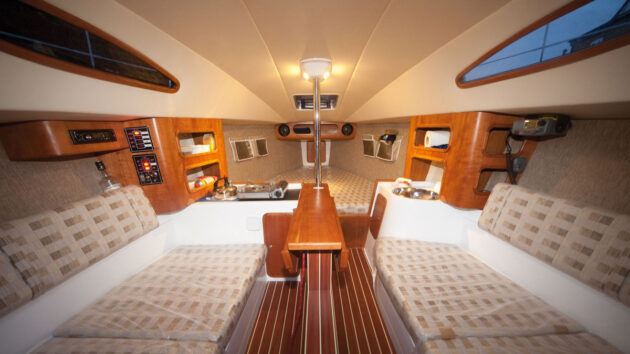
Plenty of nicely finished American cherry lends a warm feel to the interior. Berths in the saloon are over 2m (6ft 7in) long. Credit: David Harding
The interior moulding is a complete structure that incorporates the under-bunk stowage bins as well: it’s not cut away beneath the locker lids. This reduces the total stowage volume and restricts access to the outer hull, though some of the bins can be unscrewed and lifted out.
On the plus side are the smooth, wipe-clean gel surface, the flat bottoms to the stowage spaces and fewer dark recesses to lose things in.
Foam buoyancy totalling 1.23 cubic metres is incorporated within the inner moulding where lockers would be harder to reach.
The centreplate case makes a convenient seat for the simple galley, which is split either side. Log and echo-sounder transducers are inside the galley unit to port, immediately forward of the battery.
One factor that might have a bearing on the keel option you choose is the fact that the centreplate precludes the stowage of a chemical toilet. With a daggerboard, there’s space
beneath the forward end of the cockpit whereas the centreplate case splits this in two.
Simplicity is the key when it comes to lifting the centreplate: the lifting line is led to a sideways-mounted cam cleat on the aft end of the case and can easily be flicked in and out from the helm.
PBO’s verdict on the Storm 22
The Storm 22 is an attractive boat that’s enjoyable to sail. She undoubtedly has competitive potential but, if sailed at half throttle, is also capable of satisfying those who prefer cruising. She’s a spirited performer and one that demands quicker reactions and a higher degree of tuning than some of the heavier, more sedate and less responsive alternatives.
She appears soundly constructed and is, on the whole, equipped with good-quality equipment. Combined with the pleasing interior and the flexibility offered by the builders, these are all qualities that should stand her in good stead.
Details
Data relates to Salt Water/UK hybrid specification:
LOA:6.58m (21ft 7in)
LWL:6.26m (20ft 6in)
Beam:2.49m (8ft 2in)
Draught (centreplate up):0.26m (0ft 10in)
Draught (centreplate down):1.46m (4ft 9in)
Displacement:1,000kg (2,240lb)
Ballast (internal and centreplate):330kg (727lb)
Sail Area (main and foretriangle):21.5sq m (231 sq ft)
Sail area/displacement ratio:21.56
Displacement/length ratio:99.5
Engine:3-5hp outboard
Headroom:1.46m (4ft 10in)
Designer:Wojciech Spisak
RCD Category:C
Builder:Storm Yachts SA, Poland
Price when first launched (2011):From £26,666